


Salary sacrifice car schemes are often seen as a perk for large companies. In reality, there is no minimum team size in law, and a business with a handful of staff can run one.
This guide reflects HMRC guidance as reviewed on 2 November 2026.
An electric car salary sacrifice scheme is an arrangement where an employee gives up part of their gross salary before tax in exchange for an electric car leased by their employer. Because the payment is taken before Income Tax and National Insurance, the employee pays less tax, and the employer usually pays less National Insurance too. The employee still pays a small Benefit-in-Kind tax on the car — 4% of its P11D value in 2026/27 for a pure electric car.
This guide is for owners and directors of small limited companies, roughly 1 to 50 staff, and covers the 2026/27 tax rules, a worked example, and set-up steps.
What is an electric car salary sacrifice scheme?
An electric car salary sacrifice scheme lets an employee swap part of their gross salary for a car leased through their employer. The monthly amount comes off pay before tax and National Insurance, so both sides can save money, while the employee drives a new car with most running costs included. HMRC defines a salary sacrifice in its Employment Income Manual (EIM42750): the employee gives up the right to part of the cash remuneration due under their contract of employment, and the sacrifice is achieved by varying that contract.
You may also see the term salary exchange — it means the same thing.
The employee agrees in writing to a lower cash salary. The employer uses that amount to lease an electric car from a provider, for work and private use. Because the salary is lower, the employee pays less Income Tax and employee National Insurance, and the employer pays less employer National Insurance too.
The employee does pay tax on the car itself, called Benefit-in-Kind, or BiK. For pure electric cars it is currently very low, which is why the scheme works so well.
It only really works for electric cars and some very low-emission hybrids, because of the Optional Remuneration Arrangements, or OpRA (ITEPA 2003, ss.69A–69B). Cars at 75g/km or less are exempt — HMRC’s guidance on cars under OpRA (EIM44070) only brings cars with CO2 emissions of more than 75g/km into the rules. Pure electric cars emit 0g/km, so they keep their low BiK charge. Most petrol and diesel cars are not exempt, so HMRC taxes whichever is higher — the BiK value or the salary given up — wiping out the saving.
How does it work? Step by step
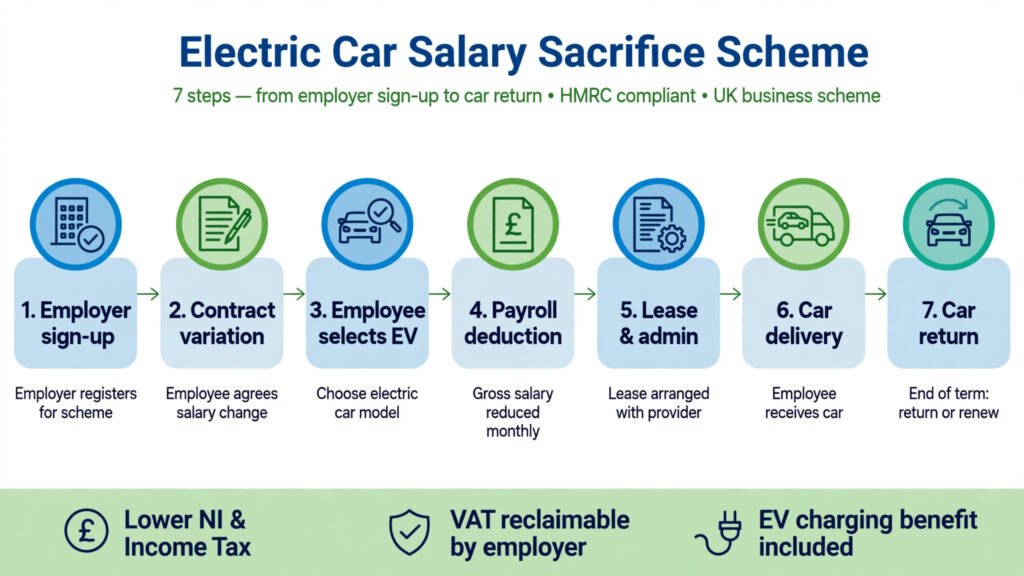
The scheme runs in seven steps, from sign-up to the car being handed back at the end of the lease. Most admin sits with the provider and payroll, but you stay responsible for the contract and tax reporting.
- The employer signs up with a provider and sets basic rules, such as who is eligible and whether to limit the scheme to electric cars only.
- The employee chooses a car, term and mileage from the provider’s new or used electric cars, usually on a two- to four-year term.
- The employee signs a written variation to their contract. This must happen before the benefit starts.
- Payroll deducts the amount from gross salary each month, before Income Tax and National Insurance. It shows on the payslip as a pre-tax deduction.
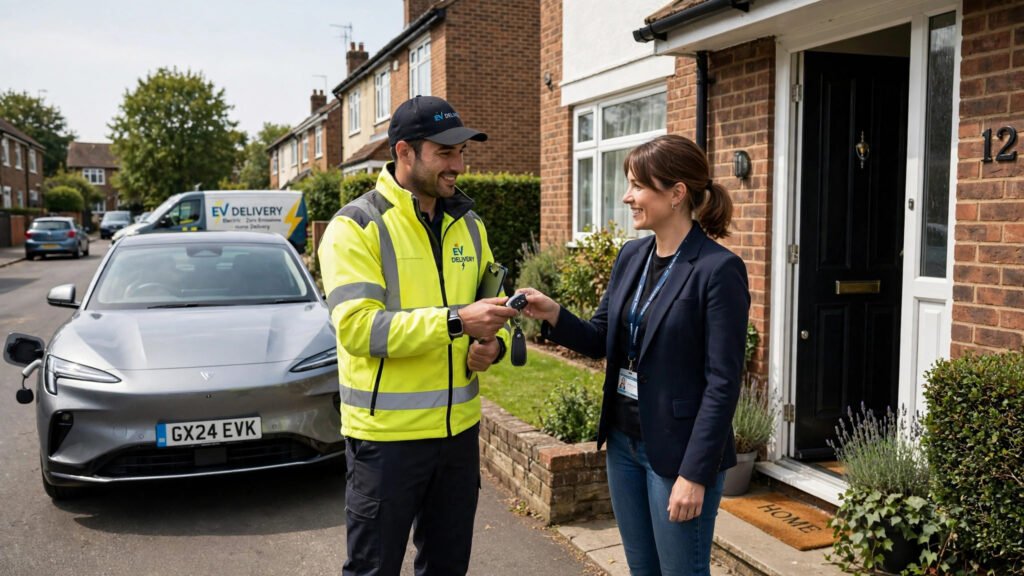
- The provider supplies the car, usually delivered to the employee’s home or workplace, with insurance, servicing, MOT and breakdown cover included.
- Tax is reported and paid. The employee pays Benefit-in-Kind tax, usually through their tax code. The employer reports the benefit to HMRC and pays Class 1A.
- The car is returned at the end of the term. There is no option to buy and no balloon payment.
Providers often quote set-up in as little as a week, but timescales vary. Allow time for payroll and contract checks before anyone signs.
What’s included in the monthly payment?
Most schemes bundle the car and main running costs into one fixed monthly amount, making budgeting simple. The package varies by provider, so check the small print first.
Usually included:
- The car itself, new or used
- Fully comprehensive insurance
- Servicing and routine maintenance
- MOT, once the car needs one
- Replacement tyres for fair wear and tear
- Breakdown and recovery cover
- Road tax for the term of the lease
Not usually included:
- Electricity for charging, at home or in public
- Parking fines, congestion charges and penalties
- Excess mileage charges if the agreed limit is exceeded
- Personal subscriptions, such as premium apps
- End-of-lease damage charges beyond fair wear and tear
Some providers offer a home charger or charging credit. That is a provider offer, not a tax rule.
Can a small business offer salary sacrifice?
Yes. There is no legal minimum number of employees, so a business with two, five or ten staff can offer salary sacrifice in principle. In practice, each provider sets its own acceptance rules, and those rules — not the law — may stop a very small or very new business.
Providers commonly check trading history and profitability. Some expect two years of trading and a profitable record; others are more flexible. If one turns you down, ask another.
The scheme only works inside an employment relationship. It suits limited companies with employees, including director-employees. Sole traders and partners cannot sacrifice salary to themselves, as they are not employees of a separate business.
You do not need an HR department. The provider handles sourcing, ordering and delivery. Your jobs are narrower: agree the policy, ensure payroll can run the deduction, vary contracts in writing, and report the benefit correctly.

Can directors use it for their own car?
Yes, a director who is an employee of their own limited company can usually take a car through salary sacrifice on the same terms as any other employee. For many owner-directors, it is one of the most tax-efficient ways to run a new electric car.
The director gives up part of their salary, the company leases the car, and the director pays the low BiK charge — often cheaper than buying personally out of taxed income, or funding a personal lease with extra salary or dividends.
Take care with pay levels. If the director has a contract of employment, the sacrifice must not take cash pay below the National Minimum Wage. Many directors take a small salary, which limits how much they can sacrifice. The route also avoids borrowing from the company, so there is no overdrawn director’s loan account and no Section 455 charge to worry about.
The tax rules: Benefit-in-Kind, HMRC and OpRA explained
The employee pays Benefit-in-Kind tax on the car, not on the salary given up, because pure electric cars are exempt from the OpRA rules. The charge is the car’s P11D value multiplied by a set percentage, taxed at the employee’s Income Tax rate. The employer pays Class 1A National Insurance on the same value.
Three terms matter. Benefit-in-Kind (BiK) is a non-cash benefit taxed as if it were income. P11D value is the car’s list price when new, including VAT, delivery and most options — not the lease cost. The car benefit charge sits in ITEPA 2003 (s.114 onwards): the cash equivalent is the price of the car multiplied by the “appropriate percentage” (s.121, with the percentage set under ss.133 to 142), and HMRC’s Employment Income Manual works through the calculation from EIM24000. Class 1A is the employer’s National Insurance charge on most benefits, at 15% for 2026/27. Class 1A is charged under s.10 of the Social Security Contributions and Benefits Act 1992, and HMRC’s National Insurance Manual (NIM13140) confirms company cars are among the benefits that attract it.
The formula is simple:
P11D value × BiK percentage = annual benefit value
Annual benefit value × your Income Tax rate = tax you pay
For a pure electric car the BiK percentage is very low, but rising. A lease signed in 2026 spans several tax years, so check the whole table.
| Tax year | Pure electric (0g/km) BiK rate | Tax on a £40,000 car — 20% taxpayer | Tax on a £40,000 car — 40% taxpayer |
|---|---|---|---|
| 2025/26 | 3% | £240/year | £480/year |
| 2026/27 | 4% | £320/year | £640/year |
| 2027/28 | 5% | £400/year | £800/year |
| 2028/29 | 7% | £560/year | £1,120/year |
| 2029/30 | 9% | £720/year | £1,440/year |
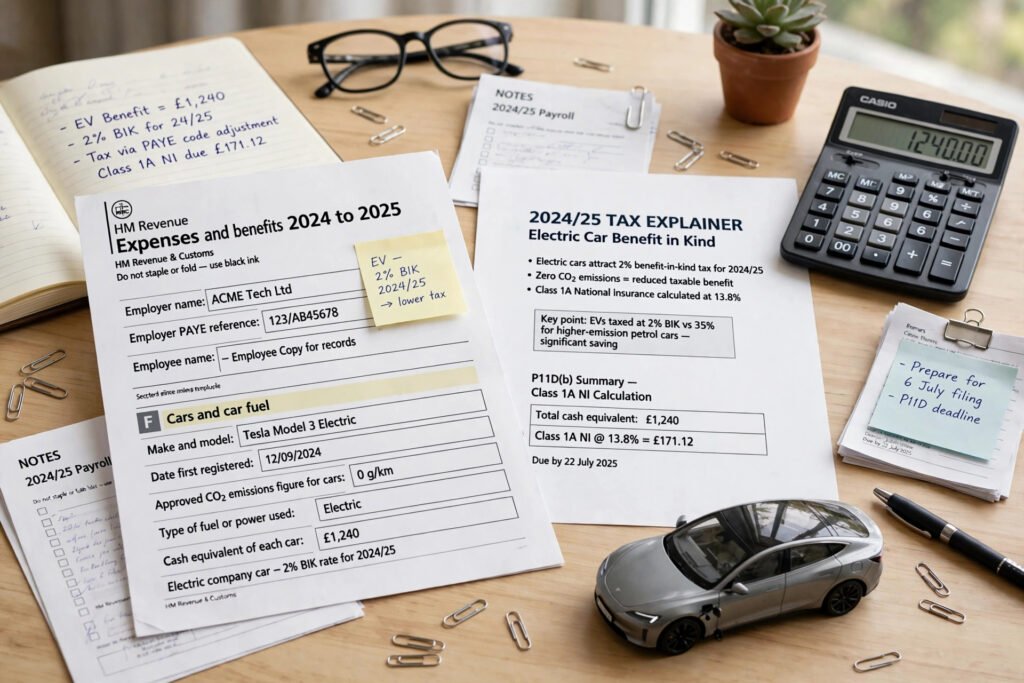
Many petrol and diesel cars are taxed at up to 37% of P11D value. Our guide to benefits in kind tax for small businesses in the UK covers BiK reporting across all staff benefits, not just cars.
Why the special treatment? Since April 2017, most salary sacrifice benefits are taxed on the higher of the benefit value or the salary given up. Cars at 75g/km or below are carved out of that OpRA rule, so a pure electric car keeps its low BiK charge; a petrol car does not.
Scottish taxpayers pay Income Tax at Scottish rates and bands, so their cost and saving differ slightly; the BiK percentage is UK-wide. Wider rate changes, such as those in the Autumn Budget 2025 small business changes, also affect savings.
Worked example: what it costs and saves (2026/27)
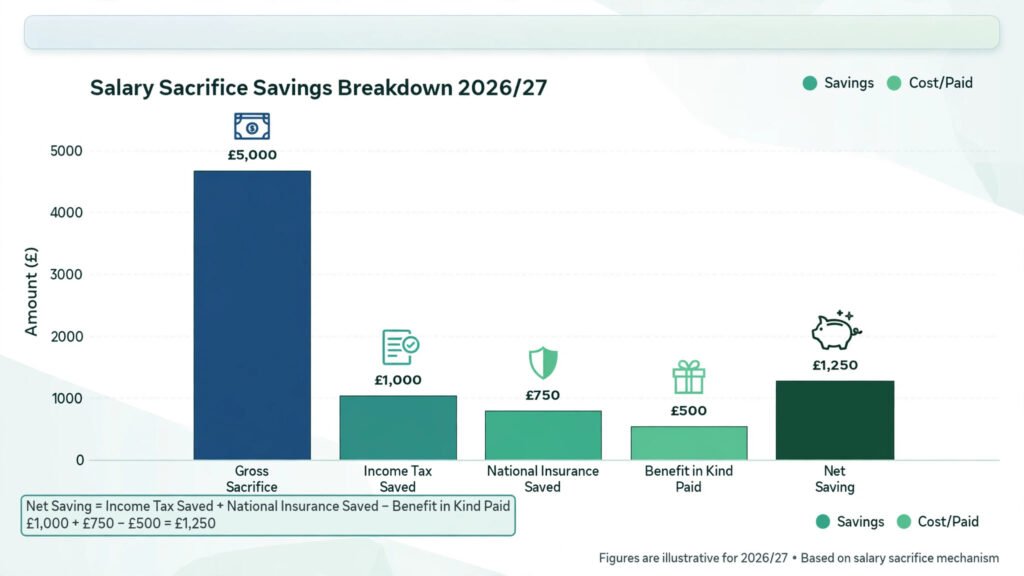
A worked example makes the trade-off clear: the employee saves tax and National Insurance on the salary sacrificed, then pays a much smaller BiK charge. On the figures below for 2026/27, a basic-rate employee keeps £1,360 a year, and the employer saves £660 after Class 1A.
Stated assumptions — change any of them, and the result changes:
- Employee salary: £40,000, basic-rate (20%) taxpayer in England, Wales or Northern Ireland
- Car: pure electric, P11D value £40,000
- Gross sacrifice: £500 a month, £6,000 a year
- Tax year: 2026/27 — BiK 4%, employee NI 8%, employer NI 15%
The employee
- Income Tax saved: 20% of £6,000 = £1,200 a year
- Employee National Insurance saved: 8% of £6,000 = £480 a year
- Total saved on the sacrifice: £1,680 a year
- BiK charge: £40,000 × 4% = £1,600 benefit value; tax at 20% = £320 a year, about £26.67 a month
- Net tax saving: £1,680 − £320 = £1,360 a year
That saving comes on top of funding the car from gross pay, not take-home pay.
The employer
- Employer National Insurance saved: 15% of £6,000 = £900 a year
- Class 1A to pay: £1,600 benefit value × 15% = £240 a year
- Net employer saving: £900 − £240 = £660 a year, per car
For a 40% taxpayer the picture is stronger: the same employee saves £2,400 in tax and £120 in National Insurance at the 2% rate above the upper earnings limit, pays £640 in BiK tax, and keeps about £1,880 a year. Run the numbers for each employee’s tax band. Figures are an illustration for 2026/27 only; quotes vary by provider, car, term and mileage.
Benefits for employers
The main benefit for employers is a valued staff perk that can cost very little — and often saves National Insurance overall. In a tight labour market, a brand-new car on an all-inclusive deal is a high-value benefit small firms can offer on the same terms as larger rivals.
Retention and recruitment come first. Staff have a reason to stay, candidates see a modern benefits package, and the cost sits within the employee’s salary, not as a new overhead.
Next is the National Insurance position — the 15% employer rate covered in our guide to employer National Insurance contributions. The saving on the sacrificed salary is usually far larger than the 15% Class 1A charge, because an electric car’s BiK value is so small. On a £6,000 sacrifice, the net saving was £660 a year per car.
A scheme also supports your green credentials, which can help in tenders, and reduces grey fleet risk — the risk from staff using their own, possibly older and poorly insured cars for work trips. Providers handle ordering, delivery, maintenance and end-of-lease return, and good providers offer early-termination protection.

Benefits for employees
For employees, salary sacrifice is usually cheaper than leasing the same car personally, because the cost comes out of gross pay and there is no deposit to find. One fixed amount also covers insurance, servicing and breakdown, making the true cost predictable.
Access matters. Many staff cannot easily fund a large deposit. A workplace scheme removes it and uses corporate lease rates. Used electric cars lower the monthly amount further.
Convenience counts too. There is no separate hunt for insurance quotes, service plans and tyre cover — a real help for drivers switching to electric for the first time.
Keep the balance in view. Savings are largest for 40% taxpayers and higher-priced cars; basic-rate taxpayers benefit by less. Show each employee their own figures before they commit — just as you would explain how perks sit alongside things like working from home tax relief in the UK.
Salary sacrifice vs personal leasing vs company car vs car allowance
Salary sacrifice suits most small businesses best when staff want a new electric car and value simplicity, but it is not the only route.
| Option | Who arranges the car | What tax is paid | What’s included | Main risk or drawback |
|---|---|---|---|---|
| Salary sacrifice EV | Employer leases via provider | Low BiK (4% in 2026/27); employee saves tax and NI on sacrifice | Car, insurance, servicing, MOT, tyres, breakdown | Employer holds the lease if employee leaves |
| Personal leasing | Employee leases directly | No BiK; cost paid from net pay | Car only; insurance and maintenance extra | Deposit due; full net cost |
| Traditional company car | Employer owns or leases car | BiK at full rate; employer pays Class 1A | Set by employer; often car plus maintenance | High BiK on petrol/diesel; more admin |
| Cash allowance | Employee buys or leases themselves | Allowance taxed as salary; full tax and NI | Nothing — employee arranges everything | No tax saving; grey fleet risks |
A short verdict. Choose salary sacrifice for a low-cost benefit with the best tax result for electric cars. Choose personal leasing only if you want no employer involvement. Consider a traditional company car where the role needs a specific vehicle under your control — and check the buying reliefs first, in our capital allowances guide for small businesses and our guide to the annual investment allowance in the UK for 2025/26, if you plan to buy rather than lease. A cash allowance is easy, but least tax-efficient.
The rules and risks you must get right
The scheme is straightforward when set up correctly, but pay must never fall below the National Minimum Wage, contracts must be varied in writing first, and staff must be warned about pension and statutory pay effects.
Never breach the minimum wage. A sacrifice must not take cash pay below the National Minimum Wage or National Living Wage — £12.71 an hour for workers aged 21 and over from 1 April 2026. Check every employee, and recheck when hours or pay change. Without enough headroom, the employee cannot join at that level. This is the check small employers most often skip, and it is the one that can unwind the whole arrangement.
Vary the contract in writing. The reduced salary must be the new contractual salary before the car is provided. Keep signed copies, and use the new figure in payroll and salary-based calculations where required.
Explain the knock-on effects. A lower salary can reduce:
- Pension contributions, where they are a percentage of salary — check whether they can be based on pre-sacrifice salary
- Statutory pay, including maternity, paternity, adoption and sick pay, worked out from earnings in a reference period
- Student loan repayments, which usually fall slightly
- Salary evidence for mortgages and loans, where lenders may use the reduced contractual pay — flag this early
Explain these effects in writing before an employee signs, and keep a record.
Plan for leavers. If an employee resigns, is made redundant, or takes long-term leave mid-lease, the lease does not vanish. Without protection, you may pay for a car nobody uses. Many providers sell early-termination protection for a fee in the monthly price. For a small business, it is often worth it.

Report the benefit correctly. Report each car to HMRC on form P11D by 6 July after the tax year, with form P11D(b) for Class 1A, or payroll the benefit monthly. Payrolling benefits becomes mandatory from 6 April 2027. — GOV.UK’s policy paper on mandatory reporting of benefits in kind in Real Time Information confirms company cars are in the first phase from that date, with most other benefits following from April 2028.
Look ahead on costs. BiK rises to 9% by 2029/30 — still low, but a four-year lease signed in 2026 ends in a higher-rate year. A pay-per-mile charge for electric cars, eVED, is due from April 2028 and is not in most quotes. Warn staff that running costs may change.
How to set up a scheme in your small business
You can set up a scheme in six steps: check payroll, choose a provider, set your policy, vary contracts, launch to staff with real figures, and run reporting monthly. Do not let staff order cars before the contract and minimum wage checks are complete.
- Check payroll can handle it. Confirm payroll can deduct the sacrifice before tax, show it on payslips, and either payroll the benefit or produce P11D data.
- Choose a provider. Ask about minimum employee numbers, trading checks, fees, used cars, charger offers, and what happens when someone leaves. Get early-termination terms in writing.
- Set your scheme policy. Decide who is eligible (for example, staff past probation), set a headroom rule above the minimum wage, and consider limiting the scheme to pure electric cars.
- Vary contracts in writing. Issue a variation stating the new salary, sacrifice amount, car benefit, and pension and statutory pay effects. Staff sign before any order.
- Launch to staff with real figures. Share figures in each employee’s own tax band, not a headline percentage. Give staff time to check mortgage implications.
- Run payroll and report to HMRC. Process the deduction monthly, keep records of cars, P11D values and drivers, and meet reporting deadlines.
Providers then handle ordering, delivery and in-life support.
Frequently asked questions
Can a small business with fewer than 10 employees offer an electric car salary sacrifice scheme?
Yes. There is no legal minimum number of employees, so a business with fewer than 10 staff can offer a scheme if a provider accepts it. Providers set their own rules and often check trading history and profitability, so a new business may be declined by one and accepted by another.
Can a company director take a car on salary sacrifice?
Yes, if the director is an employee of their own limited company. The director sacrifices part of their salary, the company leases the car, and the director pays the low BiK charge. The sacrifice must not take pay below the National Minimum Wage where an employment contract applies, and a small salary may limit the amount.
How much Benefit-in-Kind tax will I pay on an electric car in 2026/27?
In 2026/27 the rate for a pure electric car is 4% of P11D value. On a £40,000 car the benefit value is £1,600. A 20% taxpayer pays £320 a year, about £26.67 a month; a 40% taxpayer pays £640. The rate rises to 5% in 2027/28, 7% in 2028/29 and 9% in 2029/30.
Does salary sacrifice affect my pension or maternity pay?
It can. If pension contributions are based on your reduced salary, yours and your employer’s may fall. Statutory maternity, paternity and sick pay are worked out from earnings in a reference period, so a lower salary can reduce them. Employers must explain this first; some schemes allow contributions on pre-sacrifice salary.
What happens if an employee leaves during the lease?
The car is leased by the employer, so the lease stays with the business unless the scheme has early-termination protection. Many providers offer protection covering resignation, redundancy and some leave, built into the monthly price. Without it, the employer may keep paying, redeploy the car, or pay an exit fee.
Can salary sacrifice reduce pay below the National Minimum Wage?
No. A sacrifice must never take cash pay below the National Minimum Wage or National Living Wage. The rate for workers aged 21 and over is £12.71 an hour from 1 April 2026. Employers must check headroom before an employee joins and whenever pay or hours change.
Do employees own the car at the end?
No. The car is leased by the employer and returned at the end of the term. There is no purchase option and no balloon payment within the scheme. The employee hands the car back and can choose a new car under a fresh agreement.
Is salary sacrifice worth it for a basic-rate taxpayer?
Yes, in most cases, but the saving is smaller than for a higher-rate taxpayer. A basic-rate employee still saves 20% Income Tax and 8% National Insurance on the salary sacrificed, against a small BiK charge. On a £6,000 sacrifice for a £40,000 car in 2026/27, the net saving is £1,360 a year.
Conclusion
For most small employers, electric car salary sacrifice is worth offering. It gives staff a high-value benefit, usually saves the business National Insurance even after Class 1A, and — with no legal minimum team size — is open to firms that assumed it was only for large companies.
The condition is simple: do the checks first. Confirm minimum wage headroom, vary contracts in writing, explain pension and statutory pay effects, price in leaver protection, and set up P11D or payrolling correctly. None of it needs an HR department — it needs one careful afternoon before the first car is ordered. Do that, and the scheme runs quietly in the background.
This article is general information for UK employers for 2026/27, not regulated financial or tax advice. Confirm figures with your accountant or payroll provider before launching a scheme.