
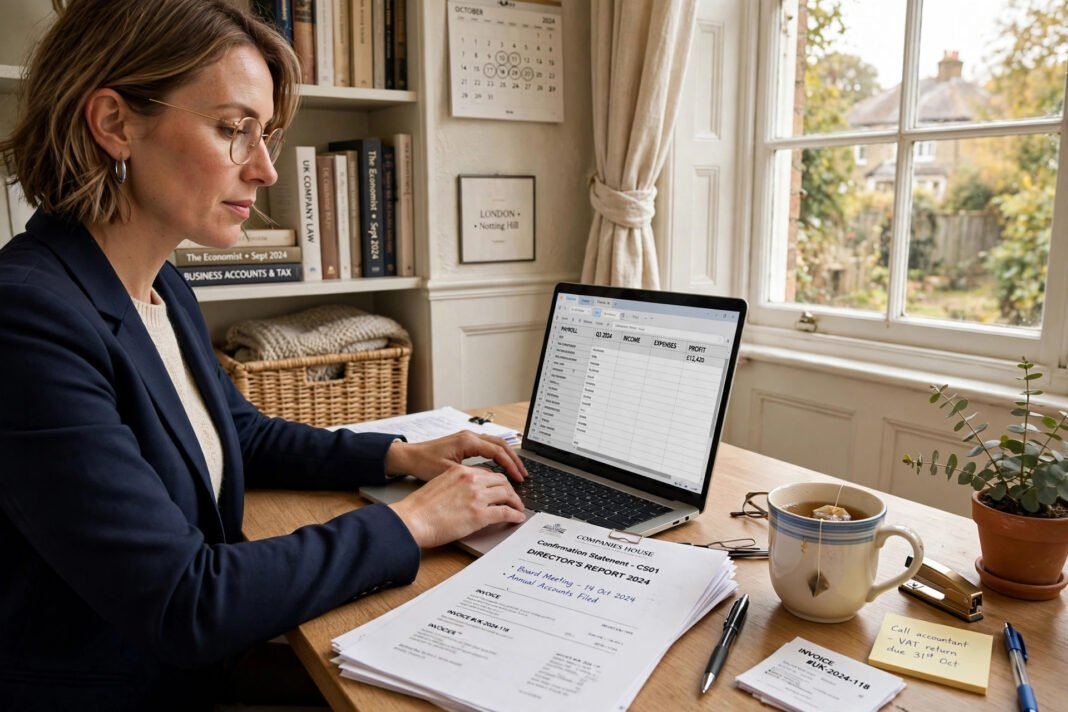

Yes — if you are a limited company director who works from home, your company can pay you a working from home allowance, and it can be tax-free. The simplest route pays £6 a week, £312 a year, with no receipts to keep. Two other routes — your actual extra costs, or renting a room to your company under a licence — can pay more, but both take more paperwork. And one thing has changed: since 6 April 2026, the company payment is the only route left. This guide is for directors of small limited companies, including one-person companies, and covers all three routes for 2026/27.
This guide reflects HMRC guidance as reviewed on 2 November 2026.
Quick answer: A limited company director cannot claim working from home relief personally in 2026/27. From 6 April 2026, a new rule (s.360B, ITEPA 2003) closed the personal claim for unreimbursed household expenses. Your company must pay you instead. Under the exemption in s.316A, ITEPA 2003, the company can pay up to £6 a week (£26 a month, £312 a year) towards your extra household costs — tax-free, with no receipts — where you work from home under a homeworking arrangement. The company can instead reimburse your actual additional costs, or rent a room from you under a licence at market rent. The licence pays the most, but the rent is taxable income for you personally.
Can a limited company director claim a working from home allowance?
Yes — but it is the company that pays, not you who claims. As a director, you are an employee of your own limited company, so the employment expenses rules apply to you, not the self-employed rules. The company pays you or reimburses you, and the payment is exempt from tax and National Insurance when it meets the conditions.
The key condition is genuine homeworking. There should be a homeworking arrangement between you and the company — an agreement that you work from home, or work from home for part of the week. For a one-person company this feels formal, but a short written arrangement is what separates a tax-free allowance from a payment HMRC could treat as salary.
One warning before anything else: the sole trader flat rates do not apply to you. Self-employed people can use simplified expenses of £10, £18 or £26 a month, based on hours worked at home. Those rates are for the self-employed only. Some older guides quote them as the directors’ “flat rate” — that is wrong. A director’s no-receipts amount is £6 a week, paid by the company.
The April 2026 change: why your company now has to pay you
From 6 April 2026, your company has to pay you — there is no personal claim to fall back on. Before that date, a director who had to work from home had two possible reliefs. The first was payment or reimbursement by the employer. The second was a personal deduction under s.336, ITEPA 2003, claimed on the Self Assessment return or through the tax code, where the director was required to work from home and the company had not reimbursed the cost.
The second route has closed. A new section, s.360B, ITEPA 2003, applies from 6 April 2026 and disallows the personal deduction for unreimbursed additional household expenses. It makes no difference that your contract requires you to work from home, and it makes no difference that you kept every bill. If the company did not pay it, you cannot claim it.
What survives is the employer-payment exemption. The exemption in s.316A, ITEPA 2003, for employer payments towards additional household costs was left in place, so a company payment — the flat £6 a week or evidenced actual costs — is still tax-free in 2026/27. GOV.UK’s guidance for employees now says it directly: for the tax year 6 April 2026 to 5 April 2027, “you will not be able to claim tax relief for working from home.” Our guide to working from home tax relief in the UK covers the employee position in full.
One door is still open for earlier years. Claims for the four previous tax years remain possible, so if you were required to work from home in 2022/23 to 2025/26 and were never reimbursed, those years can still be claimed — the deadline for 2022/23 is 5 April 2027. For 2026/27 onwards, though, the practical position is simple: set the company payment up, because there is no fallback.
The three ways to claim — at a glance
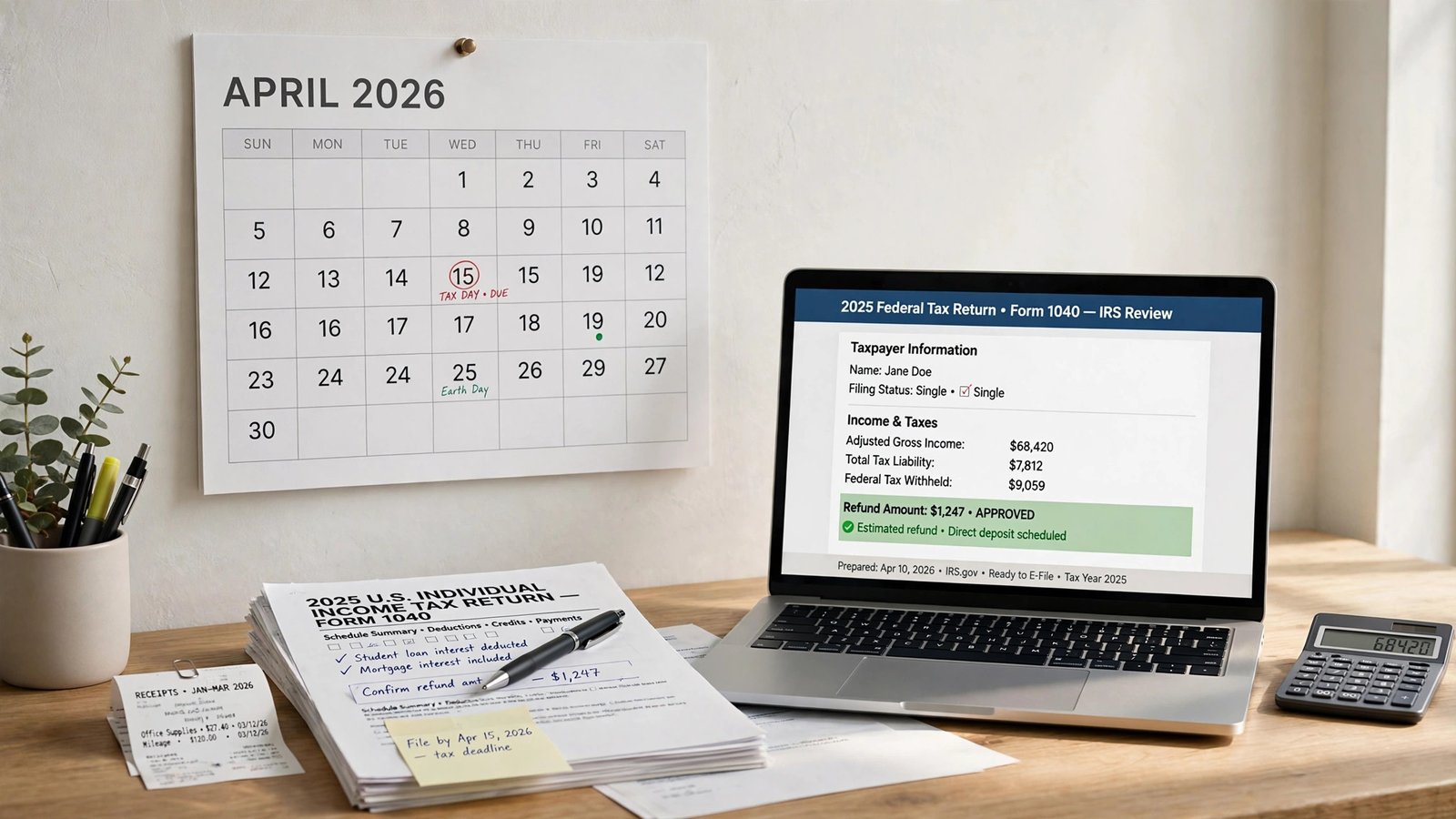
There are three ways to get homeworking money out of your company: the £6 a week flat rate, reimbursement of your actual additional costs, or a licence under which the company rents a room from you. The right one depends on the size of your bills and how much admin you will accept.
| Route | How it works | What you get | Paperwork | Tax position |
|---|---|---|---|---|
| 1. Flat rate | Company pays you £6 a week (£26 a month) under a homeworking arrangement | £312 a year, fixed | Written arrangement; no receipts | Tax-free and NI-free for you; the company gets corporation tax relief |
| 2. Actual costs | Company reimburses the extra household costs caused by working from home | Whatever your calculation shows — often less than £312 | Bills plus a written rooms-and-time calculation | Tax-free up to the evidenced amount; the company gets corporation tax relief |
| 3. Licence | Company rents a room from you under a licence agreement at market rent | Market rent — can be several thousand pounds a year | Licence agreement, market-rent evidence, Self Assessment return | The rent is taxable income for you; the company gets corporation tax relief on the rent |
In short: the flat rate is the simplest and is capped at £312. Actual costs are evidence-heavy and often pay less than the flat rate. The licence pays the largest amounts, but brings the most paperwork and a personal tax bill.
Route 1: the £6 a week flat rate
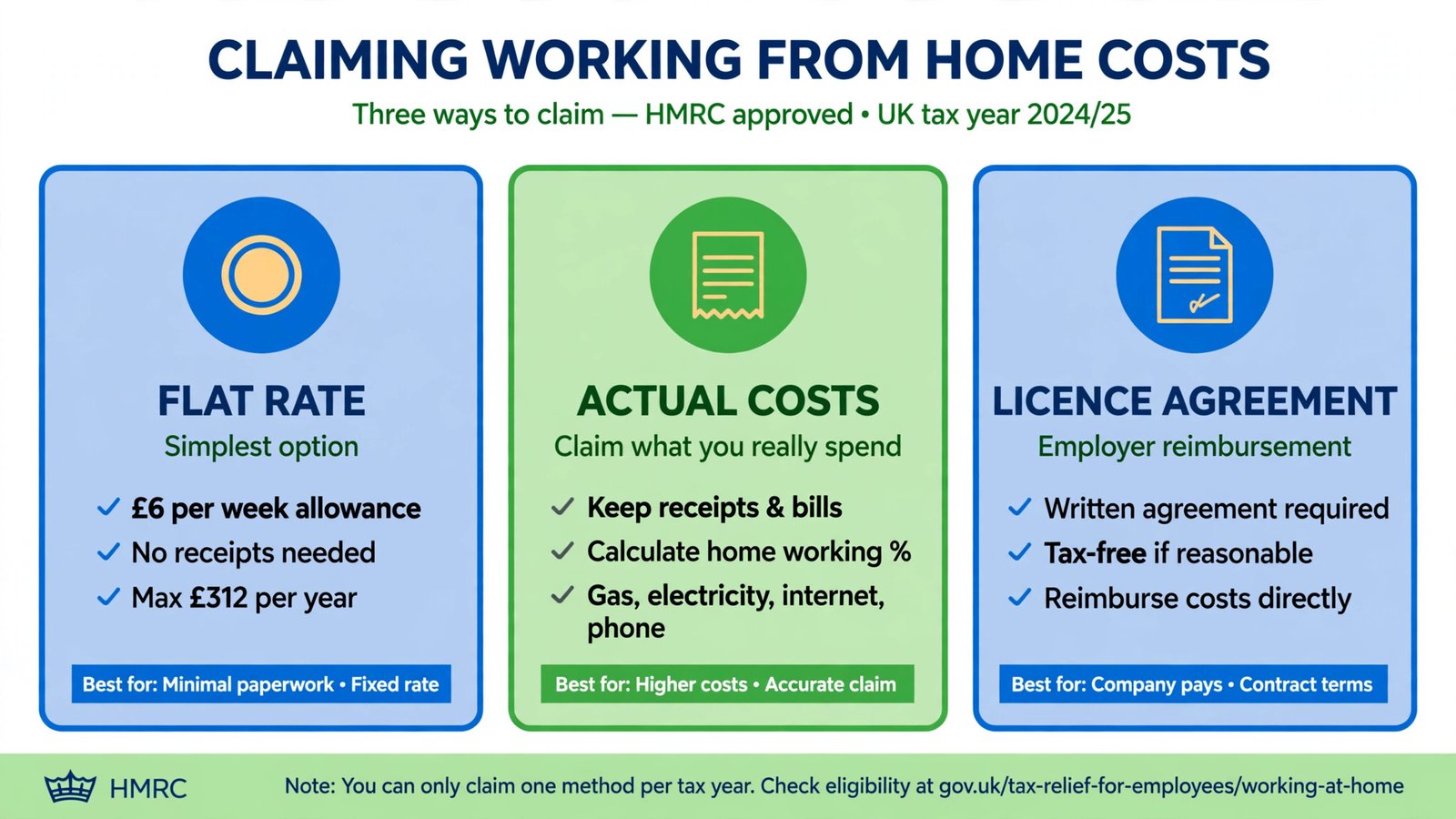
The flat rate is exactly what it sounds like: your company pays you £6 a week, or £26 a month if you run it through monthly payroll, and nobody has to justify the amount. HMRC’s Employment Income Manual (EIM01476) explains why no evidence is needed — “We would expect that £6 per week would be sufficient for most cases” of additional household cost. The rate has been £6 a week since April 2020; before that it was £4 a week (£18 a month).
The payment is tax-free and free of National Insurance for you, under the exemption in s.316A, ITEPA 2003, as long as it is paid under a homeworking arrangement. Within that exemption there is nothing to report — no P11D entry and nothing on your Self Assessment return. The company claims the £312 as an expense, which saves about £59 a year in corporation tax at the 19% small profits rate.
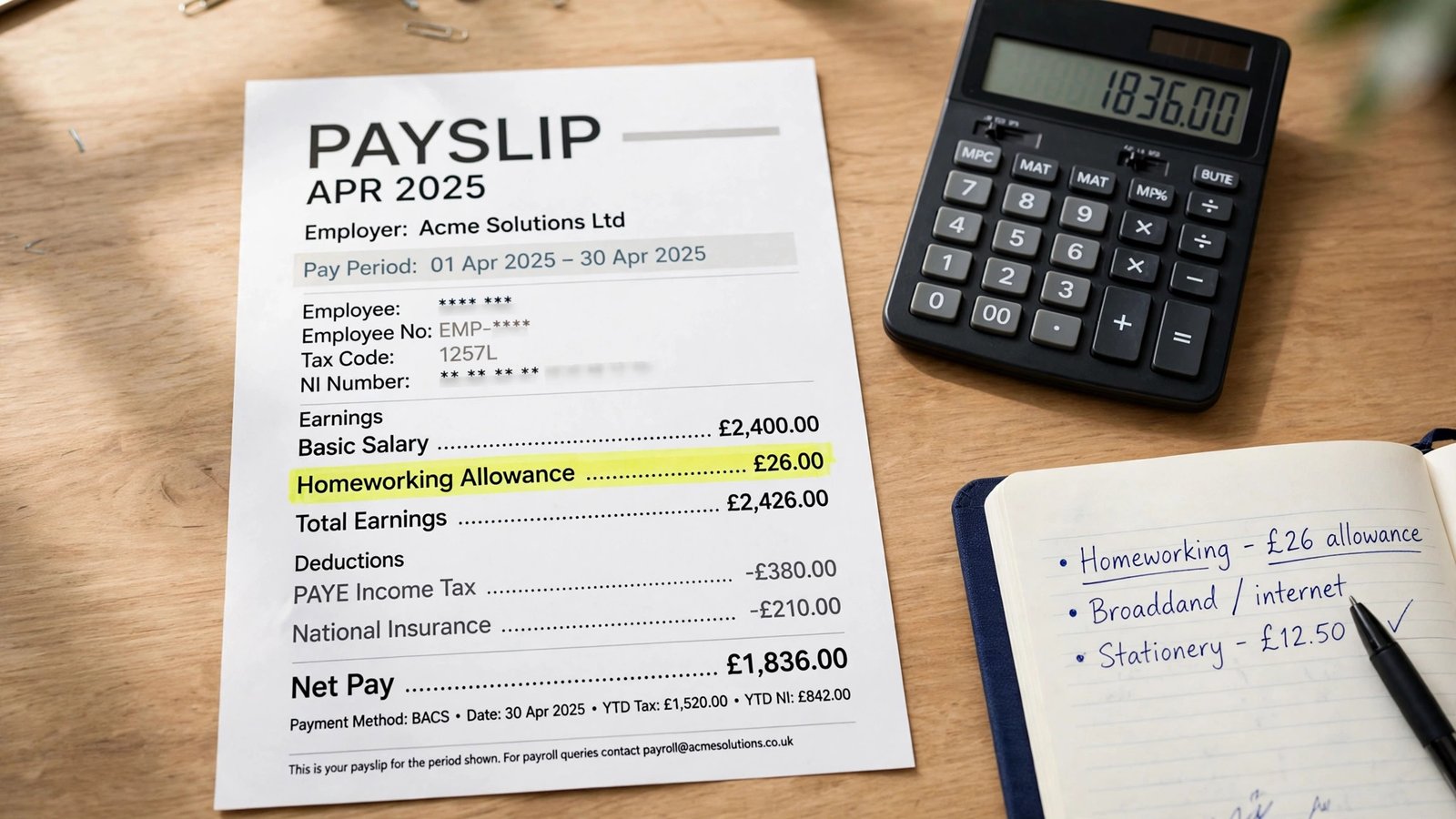
You do not have to work from home every day to use it. The arrangement can cover a regular homeworking pattern, and most one-person companies simply agree the arrangement once and pay £26 a month. For most directors this route is the right answer: it takes one board minute and one payroll or expenses entry, and then it runs itself.
Route 2: claim your actual additional costs
Your company can reimburse your actual additional household costs instead, tax-free — but only the extra costs that working from home causes. That word “additional” does all the work. The company can cover the extra heating, electricity and metered water you use because you are at home, plus business phone calls. It cannot cover costs you would pay anyway.
Under this route you can never claim:
- Rent or mortgage payments, including mortgage interest
- Council tax
- Water rates (metered water actually used is different — that can count)
- Dual-purpose costs such as home broadband, unless the contract is in the company’s name or the business use is separately itemised
The accepted way to work out the amount is rooms multiplied by time. Count the usable rooms in your home, excluding bathrooms, hallways and the kitchen. Take the share of the room you work in, then multiply by the share of the week the room is used for work. Multiplying is the point — one published guide tells readers to divide at this step, which inflates the answer and would not survive an HMRC enquiry.
Keep the bills and a copy of the written calculation with the company records. And go in with your eyes open: on typical household bills, the honest answer comes out below the £312 flat rate, as the example below shows.
Equipment is a separate matter. A desk, chair, monitor or laptop that the company buys and owns is a company asset, not a household cost — different rules apply, including the reliefs in our capital allowances guide for small businesses.
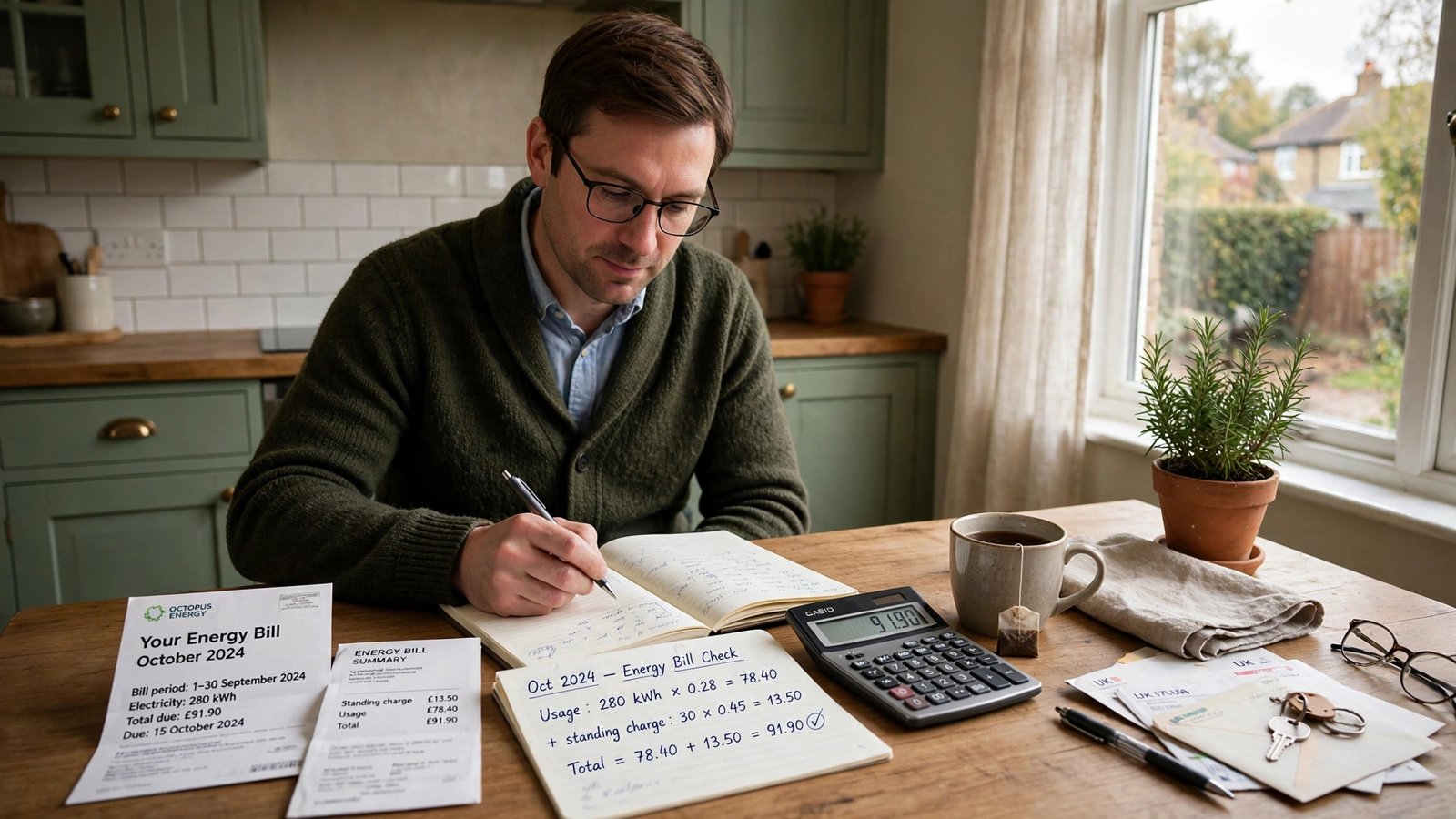
Worked example: the same director, three routes
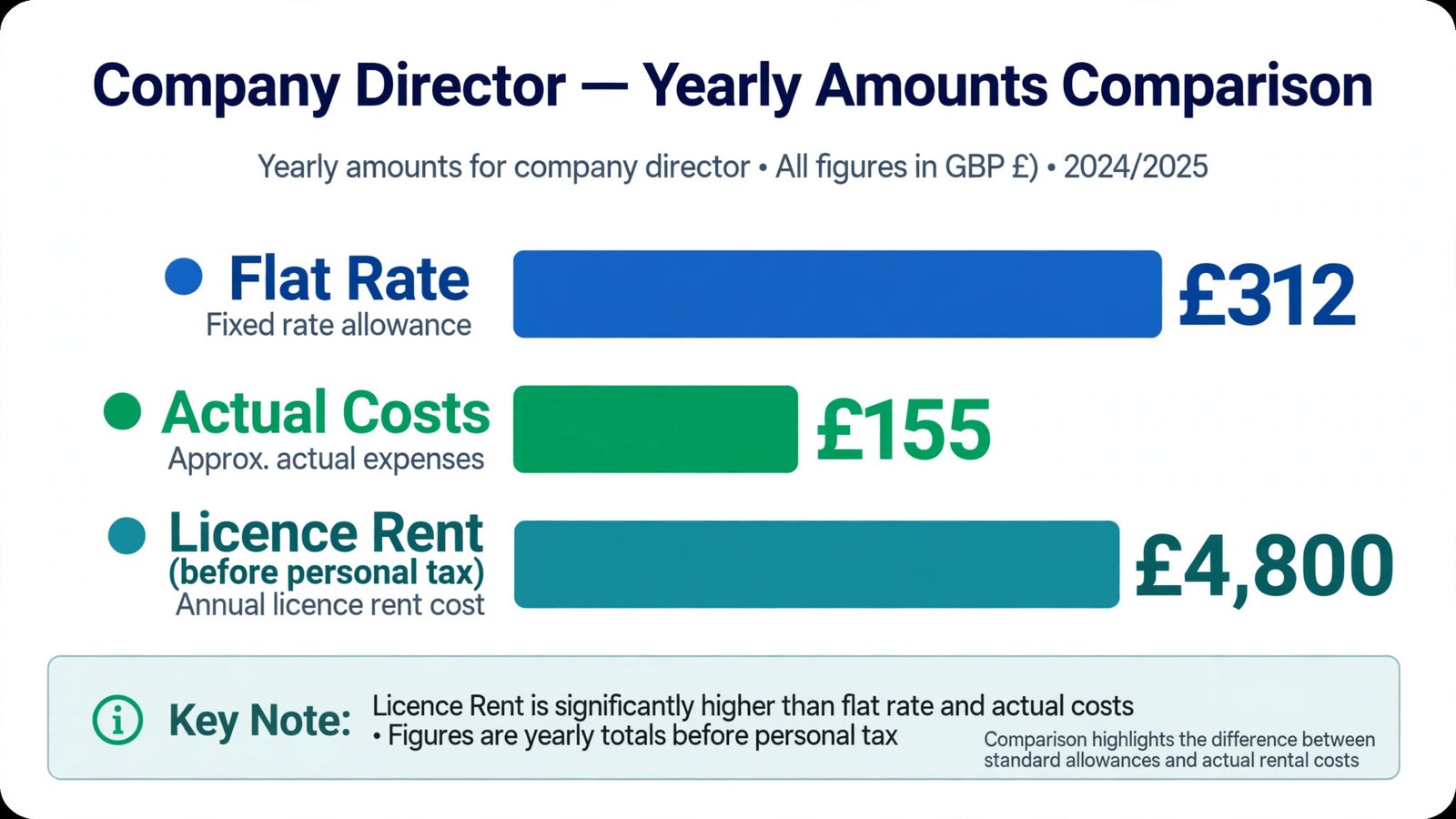
Take one director, working from home full-time in one room of a five-room house, and run all three routes on the same facts. The assumptions: combined gas, electricity and metered water bills of £3,250 a year; the room is used for work 40 hours a week; and a similar room locally would rent for £400 a month (£4,800 a year) — an illustration from local listings, not a recommended figure.
Route 1 — flat rate. £6 × 52 weeks = £312 a year, tax-free. The company saves about £59 in corporation tax at 19%.
Route 2 — actual costs. Room share: 1 of 5 usable rooms = 20%. Time share: 40 hours out of 168 in a week = 23.8%. Multiply: 20% × 23.8% = 4.76%. Applied to the bills: £3,250 × 4.76% = about £155 a year. On these bills, actual costs pay less than half the flat rate.
Route 3 — licence. Rent of £4,800 a year. Against it, the director can deduct the apportioned share of household costs — including fixed costs such as mortgage interest, council tax and insurance — say about £1,150 on these facts. Taxable rental profit: £4,800 − £1,150 = about £3,650, taxed at the director’s marginal rate (£730 at 20%, £1,460 at 40%). The company gets corporation tax relief on the full £4,800 — about £912 at 19%.
The verdict: the licence pays the most on paper, but it costs personal tax, a Self Assessment entry and real paperwork. For most one-person companies, the flat rate still wins.
Route 3: rent a room to your company under a licence
The licence route pays the largest amounts: your company pays you a genuine market rent for the use of a room, and it does so under a formal licence agreement — a licence, not a lease. The agreement should be for non-exclusive use of the room. You keep using the room for personal purposes too, and that one drafting point protects your capital gains tax position, as explained below.
The rent must not exceed a genuine market rent for the room. Support it with evidence gathered before you set the figure — an estate agent’s valuation or comparable local listings. Anything above market value is exposed: HMRC can treat the excess as earnings rather than rent.
The company deducts the rent as a business expense for corporation tax. You declare the rent on your Self Assessment return as property income, and against it you deduct the apportioned share of your household costs. This is the one route where fixed costs enter the calculation — a share of mortgage interest, council tax, insurance, and the rent you pay yourself if you rent your home. If you own the property jointly, the rent is split between the owners in line with your shares, and each of you declares your share.

The amounts can be far larger than £312 — in the worked example, £4,800 a year. The price is admin and tax: a written agreement, a Self Assessment entry every year, and income tax on the profit.
What the licence agreement must cover
A short agreement is fine, but it must cover the points HMRC and your mortgage lender would look for:
- The parties: you personally, and the company
- The room or rooms covered, identified clearly
- Non-exclusive use — the company gets use of the room, not exclusive possession
- The term of the arrangement and a review date
- The rent, and how the market rent was evidenced (valuation or listings kept on file)
- The hours or pattern of business access
- How either side can end the arrangement
- Signatures: yours, the company’s, and any co-owners of the property
Keep the signed agreement with the company records, and take advice before signing — this is the highest-value route and the one most likely to be tested.
The cautions: CGT, business rates and permissions
Three property risks sit behind the licence route and, to a lesser extent, the others. None of them is a reason to avoid claiming — all three are managed by how you set things up.
Capital Gains Tax and Private Residence Relief. Your main home is normally exempt from capital gains tax under Private Residence Relief when you sell. If part of the home is used exclusively for business, that part can lose relief for the period of exclusive use. The protection is simple: keep some personal use of the room. A desk in a room the family also uses does not create the problem; a room given over wholly to the business can. This is why the licence is written for non-exclusive use.
Business rates. Most homeworking never attracts business rates. The risk rises where a part of the home is adapted or set aside purely for business and staff or clients regularly visit — at that point the Valuation Office Agency can treat that part as rateable. A desk in a spare room in a house where only you work is normally fine.
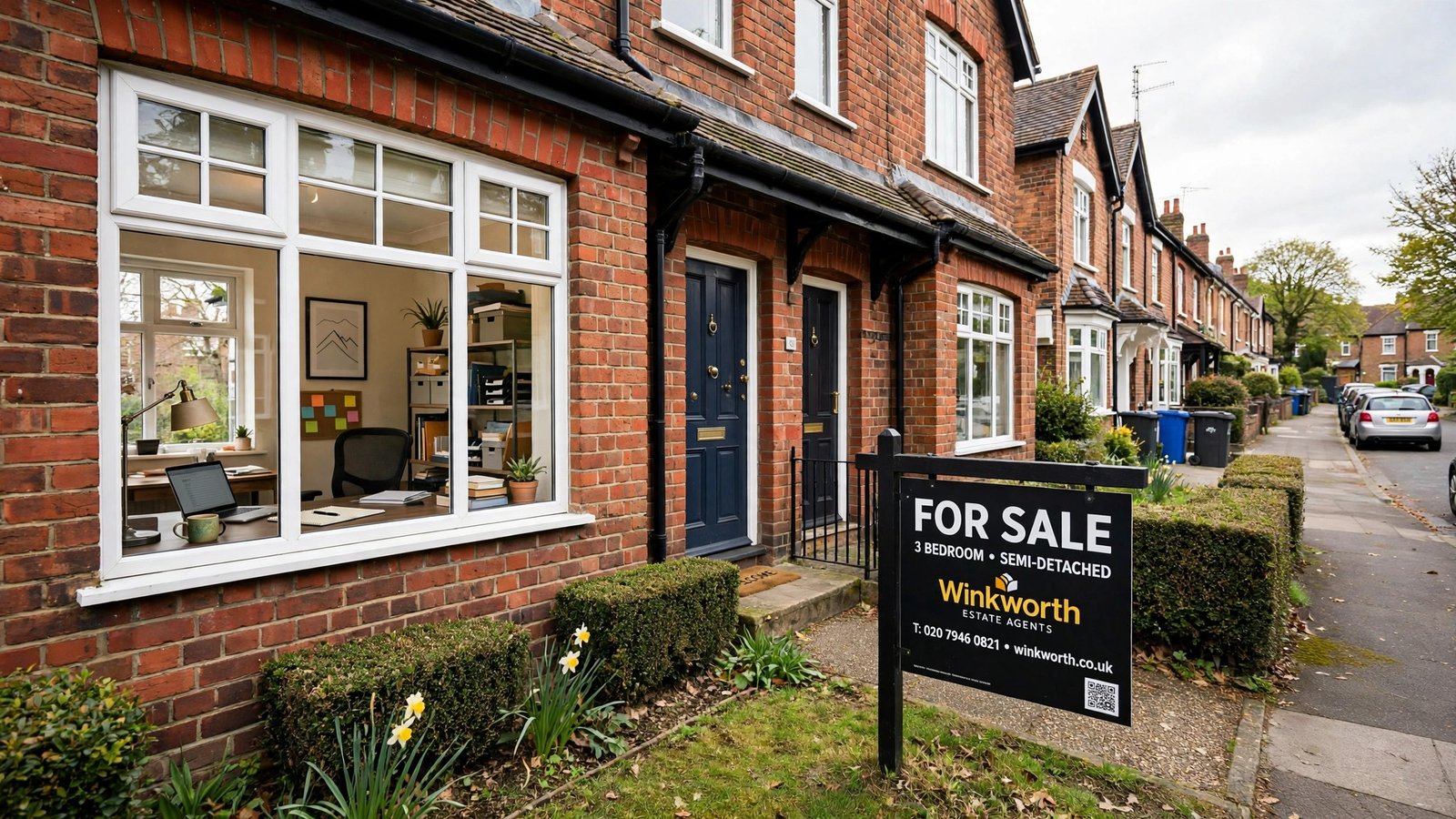
Permissions and insurance. Before signing a licence, check your mortgage terms or tenancy agreement — some require the lender’s or landlord’s consent to any business use — and check your home insurance, which may need the homeworking declared. And note that rent-a-room relief does not help here: it covers furnished residential letting, such as taking in a lodger, not licensing a room to your company for office use.
How to pay yourself — and the records to keep
The payment itself is simple once the paperwork exists. Start with the written homeworking arrangement: who it covers, from when, the pattern of homeworking, and the amount or method the company will pay. Record it in a board minute. For a one-person company you are both sides of the agreement, but the document is still what makes the payment defensible.
There are three ways to move the money:
- Payroll: set the allowance up as a separate payroll element, outside tax and National Insurance, reflecting the exemption — the treatment covered in our guide to employer National Insurance contributions
- Expenses: claim it through the company’s expenses process, monthly or annually, with a journal for the use-of-home charge
- Director’s loan account: credit the amount to your director’s loan account and draw it down later — keep the running balance on the right side of the Section 455 rules explained in that guide
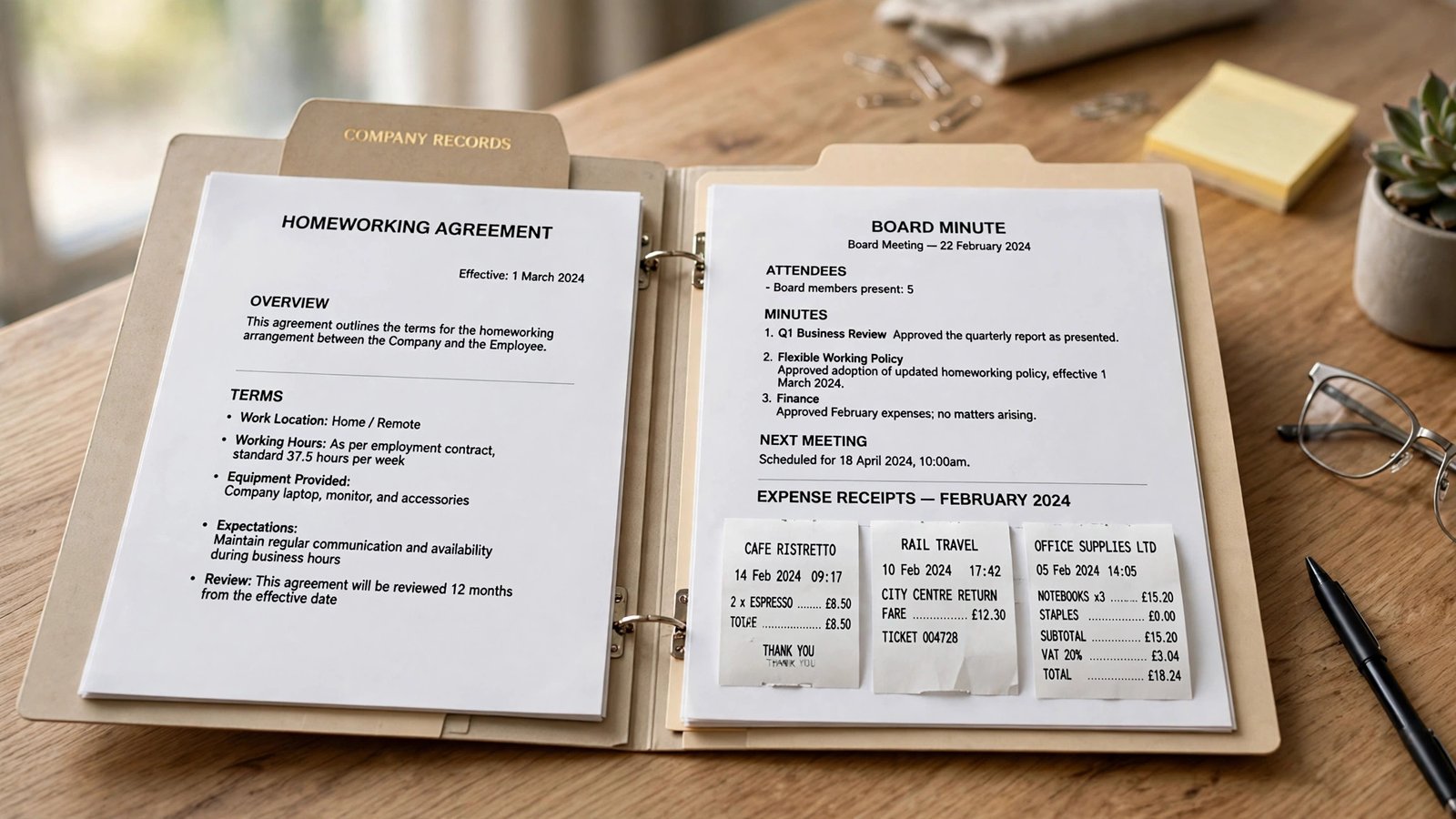
Payments within the s.316A exemption do not go on a P11D. For Route 2, keep the bills and your written calculation. For Route 3, keep the licence, the market-rent evidence and the cost apportionment. Keep it all with the company records — companies must keep records for six years from the end of the accounting period they relate to.
Common mistakes and HMRC risks
Most problems with directors’ homeworking claims are regime mix-ups and paperwork gaps, not fraud. The ones to avoid:
- Using the sole trader flat rates. The £10/£18/£26 monthly rates are for the self-employed. A director’s flat rate is £6 a week.
- Claiming fixed costs under Route 2. Rent, mortgage costs and council tax are never “additional” costs. They only enter the picture as deductions against licence rent.
- Paying more than £6 a week without evidence. Above the exemption, an unevidenced payment is taxable — treated as pay or as a benefit in kind, with the reporting that follows in our guide to benefits in kind tax for small businesses.
- No written homeworking arrangement. Without it, the exemption’s conditions are hard to prove.
- Claiming 2026/27 personally. The s.360B closure means a Self Assessment claim for this year will fail — earlier years are a different matter and remain open.
- Setting the licence rent above market value, or drafting the licence as exclusive use and quietly creating a capital gains problem.
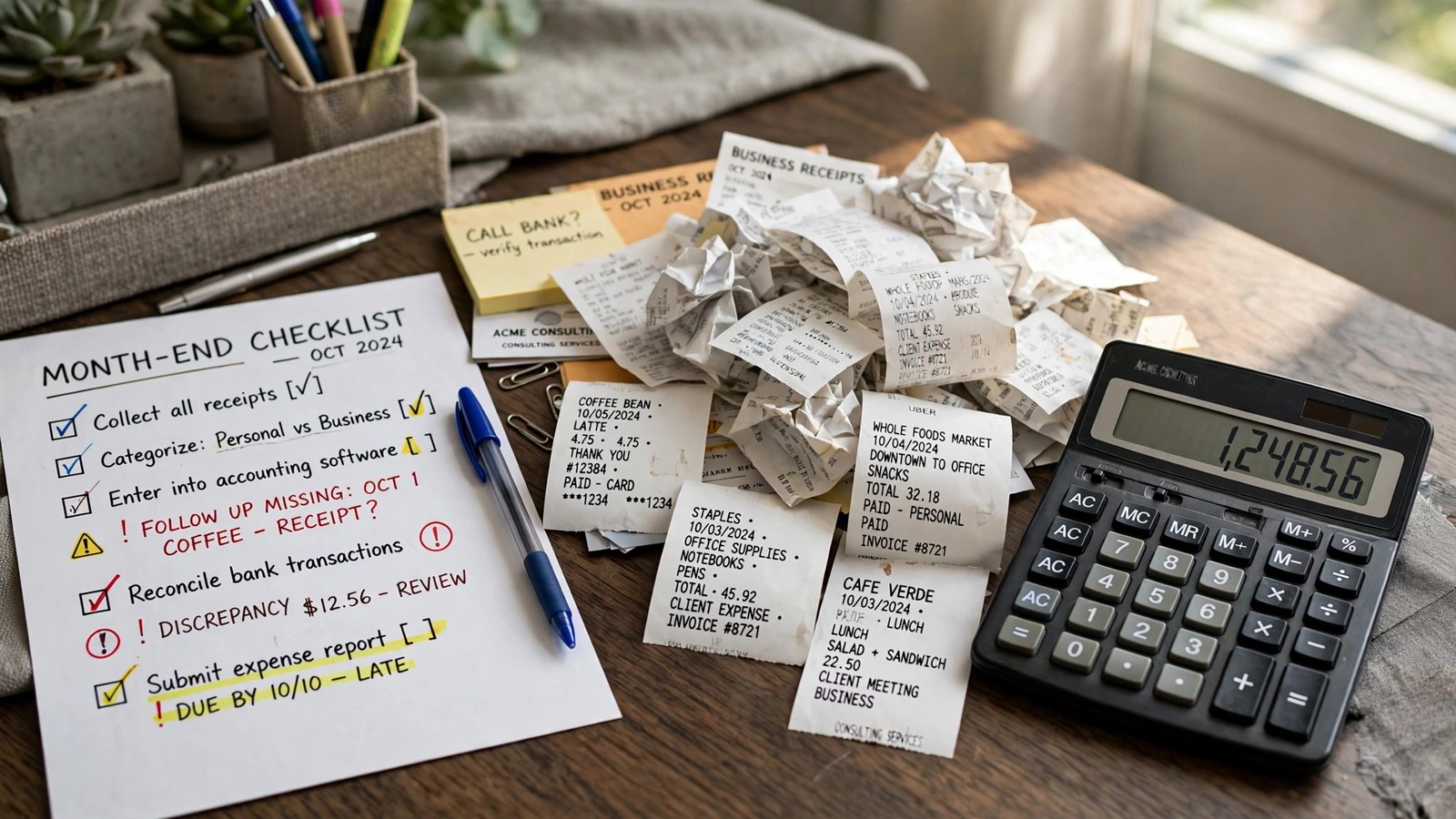
Remember that homeworking claims are self-assessed. If HMRC opens an enquiry, errors can be pursued back through earlier years with interest and penalties on top. The records described above are not bureaucracy — they are the defence.
Frequently asked questions
Can I still claim working from home relief on my Self Assessment in 2026/27?
No. From 6 April 2026, s.360B, ITEPA 2003 disallows the personal deduction for unreimbursed additional household expenses — even if you are required to work from home and kept your bills. Your company must pay you instead. Claims for the four previous tax years are still open, starting with 2022/23, which has a deadline of 5 April 2027.
How much can my company pay me for working from home?
Three options. A flat £6 a week (£26 a month, £312 a year) with no receipts, under a homeworking arrangement. Or your actual additional costs, evidenced with bills and a calculation. Or market rent for a room under a licence agreement — the largest amount, but the rent is taxable income for you.
Do I need receipts for the £6 a week?
No receipts and no calculation — HMRC’s manual (EIM01476) accepts that £6 a week is enough for most cases. What you do need is a homeworking arrangement with the company, ideally written down and supported by a board minute. Receipts and bills only become necessary if the company pays more than £6 a week under the actual costs route.
Can I claim part of my mortgage, rent or council tax?
Not under the flat rate or actual costs routes — those cover only the extra running costs of being at home, and mortgage payments, rent and council tax are fixed costs you would pay anyway. They become relevant only under the licence route, where a share of them can be deducted against the rental income you declare.
Is the £6 a week the same as the £10, £18 and £26 sole trader rates?
No — and this mix-up is everywhere. The £10, £18 and £26 monthly amounts are simplified expenses for self-employed people, based on hours worked at home. Directors are employees of their company, so a different rule applies: an exempt company payment of up to £6 a week under s.316A, ITEPA 2003.
Will renting a room to my company affect capital gains tax when I sell my home?
Only if the room is used exclusively for business. Exclusive business use can restrict Private Residence Relief on that part of the property for that period. A licence written for non-exclusive use — where the room still has personal use — avoids the problem. Keep some genuine personal use of any room the company pays for.
Does the allowance go on a P11D or my tax return?
The flat rate and evidenced actual costs, paid within the s.316A exemption, go on neither — no P11D entry and nothing on your personal return. Licence rent is different: it is property income, declared on your Self Assessment return each year, with the apportioned household costs deducted against it.
Conclusion
If your company is not paying you the £6 a week yet, set it up now — since April 2026 it is the only route left, and it takes one arrangement, one board minute and one recurring payment. Look at actual costs only if your evidenced bills clearly beat £312. Consider a licence only where the rent is genuinely at market level and you have taken advice first.
This article is general information for UK limited company directors for 2026/27, not regulated financial or tax advice. Confirm figures and arrangements with your accountant before acting, particularly before setting up a licence agreement.