


Your lender has asked you to sign a personal guarantee — or your company is struggling and a guarantee you signed years ago is suddenly very real. Either way, the question directors actually ask is: if I have to pay, what does it cost me after tax, and can I claim anything back?
This guide is for directors of small limited companies: what a guarantee is, when lenders require one, the tax position if you pay, and how to limit your exposure.
This guide reflects HMRC guidance as reviewed on 2 November 2026.
A personal guarantee makes a director personally liable for a company loan if the company cannot pay. Signing one has no tax effect by itself, and if the guarantee is called and you pay, the payment is not tax-deductible against your income — but you may be able to claim it as a capital loss under loans to traders relief (section 253, Taxation of Chargeable Gains Act 1992), reducing capital gains tax on current or future gains.
What is a personal guarantee?
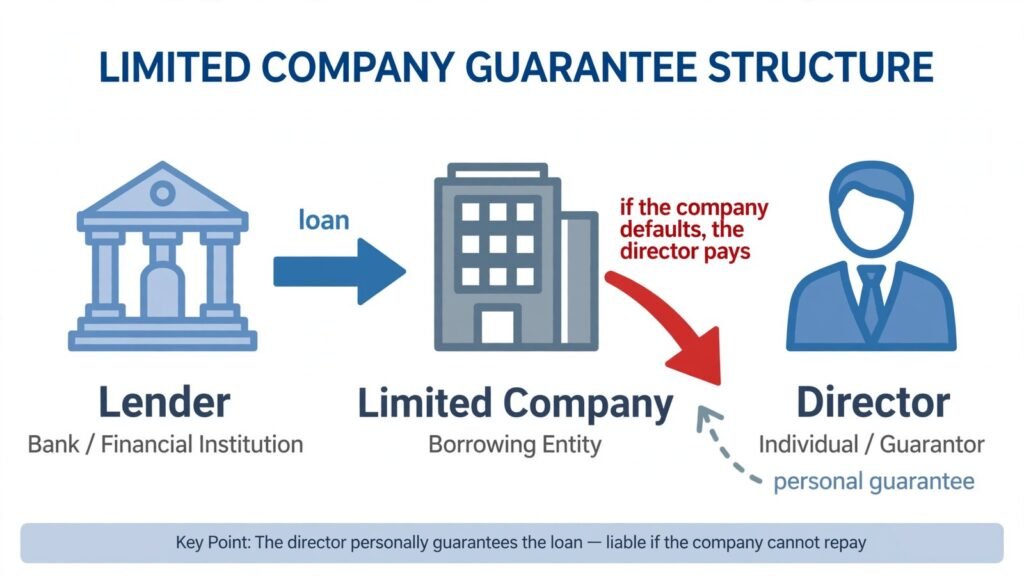
A personal guarantee on a business loan is a legally binding promise by a director or owner to repay the loan personally if their limited company defaults. It pierces the protection of limited liability for that debt: the lender can pursue the guarantor’s personal assets, including savings and, unless excluded, their home.
The company is still the borrower; the guarantee gives the lender a second person to claim from: you. It is not a director’s loan: you are not lending the company money, you are standing behind its borrowing. It only costs you anything if the company cannot pay and the lender calls the guarantee in.
Guarantors are usually directors or major shareholders. Lenders sometimes ask a spouse or family member to guarantee as well — treat that with great care, and take independent legal advice first; lenders often require evidence of it, because guarantees signed under pressure at home have been challenged in court.
A guarantee is not quite the same as an indemnity: a guarantee is a secondary obligation (the lender must first establish the company’s default), while an indemnity is a primary obligation the lender can claim on directly. Many bank documents combine both — check which you are signing.
The main types: capped, unlimited, joint and several, all monies
Guarantees are not all equal. The wording decides how much you can lose.
| Type | What it means for you |
|---|---|
| Capped (limited) | Your liability stops at a fixed amount or percentage of the loan |
| Unlimited | You are liable for the whole debt, plus interest and costs |
| Joint and several | The lender can pursue any one guarantor for the full amount |
| All monies | Covers other and future borrowing from the same lender, not just this loan |
| Secured | A specific asset, often your home, is charged to support the guarantee |
| Unsecured | No asset is charged, but the debt can still be enforced through the courts |
Read unlimited, joint and several, all monies most carefully: it is the widest promise a lender can take — a standard starting draft, not a legal necessity, and much of it is negotiable.
When do lenders require a personal guarantee?
Lenders require personal guarantees when the company on its own is not a strong enough borrower: young companies with a short trading history, businesses with few assets to secure against, and unsecured facilities of any size.
You are most likely to meet one on:
- Term loans and overdrafts from banks and alternative lenders
- Asset finance for vehicles, machinery and equipment
- Invoice finance, where guarantees are often capped at around 25% of the facility
- Business credit cards and trade credit from suppliers
- Commercial property leases (landlords take guarantees too)
Guarantees commonly cover 20% to 100% of the facility, plus interest and enforcement costs. If you are borrowing to buy plant or machinery, the relief on the asset itself is a separate question, sitting in the annual investment allowance rules.
Personal guarantees on government-backed loans
No — a government-backed loan does not remove your personal liability. The government guarantee protects the lender, not you: the borrower remains liable for 100% of the debt. Under the Growth Guarantee Scheme (GGS), run by the British Business Bank, the government guarantees 70% of the facility to the lender.
What the schemes do control is whether the lender can ask you for a guarantee, and whether your home can be taken as security:
| Scheme | Can the lender take a personal guarantee? | Your main home |
|---|---|---|
| Bounce Back Loan Scheme (closed) | No — personal guarantees were prohibited | Not applicable |
| CBILS (closed) | No up to £250,000; above that, recovery under the guarantee capped at 20% of the balance after business assets | Could not be taken as security |
| Growth Guarantee Scheme (current) | Yes, at the lender’s discretion, as in its normal lending | Principal private residence cannot be taken as security under the scheme |
Directors with legacy Bounce Back Loans have no guarantee exposure at all; a GGS borrower may well be asked to sign.

What are the tax implications of a personal guarantee?
The tax position has three parts. Signing a guarantee has no tax effect at all — nothing to report, nothing to claim. Paying under a guarantee gives you no income tax relief, but may give you a capital loss to set against capital gains. And being repaid afterwards reverses the tax treatment to match the money.
If the guarantee is called and you pay: capital loss relief (s.253 TCGA 1992)
The one relief available is capital: under loans to traders relief, section 253 of the Taxation of Chargeable Gains Act 1992, the amount you pay can be treated as an allowable capital loss — there is no deduction against salary, dividends or any other income. HMRC explains the guarantor rules in helpsheet HS296 (Capital Gains Tax and Debts) and the Capital Gains Manual at CG65991 onwards.

The conditions:
- You have actually paid. Merely being liable is not enough. As HMRC puts it in the Capital Gains Manual (CG65910), a guarantor has no asset until he or she makes a payment under the guarantee — which is also why a negligible value claim cannot help on a guarantee that has not been called: there is no asset to write down.
- The underlying loan qualifies. It must be a loan of money, used wholly for the purposes of the borrower’s trade — or to set up a trade that was then actually carried on. Trade includes a profession or vocation, but not money lending.
- The borrower was resident in the UK when the loan was made.
- The debt was irrecoverable. Some of the loan or interest was outstanding and beyond recovery from the borrower when you paid.
- The spouse bar does not apply. No claim if you and the borrower were spouses or civil partners when you gave the guarantee, or became so afterwards (HS296, section 7.1). Guaranteeing your own company’s loan is fine — being a director or shareholder does not block relief.
Relief covers both principal and any interest you pay. If there are co-guarantors, your claim is reduced by the contributions they are liable to make — you claim your share, though you can claim for extra you are forced to pay if a co-guarantor cannot pay theirs.
How and when to claim. The payment is treated as an allowable capital loss of the tax year in which you make it. Claim on the Capital Gains pages of your tax return (HS296 gives the entries) or by writing to HMRC — and note the deadline: under HS296, the claim has to be made within 4 years of the end of the tax year in which you made the payment. Miss it and the relief is gone. Once claimed, the loss is set against gains of the same year first; any unused balance carries forward indefinitely, with no carry-back. Losses reduce gains before your £3,000 annual exempt amount applies, so a loss is worth most when gains comfortably exceed £3,000.
Two honest limits: the relief is only worth anything if you have capital gains — now or in future — to set it against, and it never converts into relief against income.
Worked example: a £60,000 guarantee payment
Assumptions: you are the sole director and sole guarantor; the company borrowed for its trade, has failed, and will pay the lender nothing; the bank calls your guarantee and you pay £60,000 in 2026/27, with the section 253 conditions all met; in the same year you sell an investment — shares or a buy-to-let — making a capital gain of £60,000; and you are a higher-rate taxpayer, so the gain would be taxed at 24% (the higher CGT rate on GOV.UK’s Capital Gains Tax rates page; the basic-rate figure is 18%).
The result
| Step | Amount |
|---|---|
| You pay under the guarantee | £60,000 |
| Allowable capital loss under s.253 | £60,000 |
| Gain in the same year, fully offset by the loss | £60,000 |
| CGT saved (at 24%) | up to £14,400 |
| Income tax relief on the same £60,000 | £0 |
Up to because your £3,000 annual exempt amount might have sheltered part of the gain anyway. With no gain in the year of payment, the £60,000 loss simply carries forward — but the claim still has to be made by the deadline: for a payment in 2026/27, that is 5 April 2031. CGT rates have stood at 18% and 24% since the October 2024 Budget — see our Autumn Budget 2025 small business changes roundup.

If the company repays you, indemnifies you, or you claim against it (subrogation)
Paying the lender does not leave you with nothing: in law you step into the lender’s shoes, a right called subrogation. You can claim the amount you paid from the company, and a contribution from any co-guarantors. In practice the claim against a failed company is usually worth little — but it matters for tax.
The tax follows the money, under sections 253(5) and 253(6) TCGA 1992 and HMRC’s guidance at CG66041:
- Recoveries after a claim are taxed. If you claim the capital loss and later recover any part of what you paid — from the company, a liquidator, or by selling your recovery rights — the amount recovered is treated as a chargeable gain in the year you receive it, to the extent it corresponds to the loss claimed. You cannot keep the full relief and the repayment.
- An advance indemnity changes everything. If the company indemnifies you in advance and pays the lender itself, you have made no payment — no loss, nothing to claim. If it reimburses you after you have paid, that is a recovery, taxed as above.
Where the company ends up owing you money, the balance is normally recorded through your overdrawn director’s loan account position, which has its own tax rules. Take advice here: the order of payments, claims and reimbursements can change the tax outcome.
Personal guarantee insurance: the paid-for alternative
Personal guarantee insurance (PGI) is an annual policy that pays a percentage of the guarantee amount if your company becomes insolvent and the lender calls the guarantee. It does not reduce what you owe — it funds part of the bill. Cover runs to up to 80% (British Business Bank), and in the UK the specialist provider is Purbeck Insurance:
- Secured loans: cover of up to 80% of the guarantee from the outset
- Unsecured loans: cover steps up over the policy years — 60% in year one, 70% in year two, up to 80% from year three
Premiums are priced on your circumstances — guarantee size, sector and trading history — the policy must be renewed annually, and fraud or dishonesty voids cover. Hold on to two things: at least 20% of the guarantee always remains your problem, and insurance complements negotiation rather than replacing it.

The risks you need to see clearly before you sign
The risk is simple to state: a personal guarantee converts a company debt into your personal debt, and it can reach assets the company itself could never touch.

- Your home. If the guarantee is secured, your home is directly charged. Even if it is not, an unpaid guarantee debt can be enforced through the courts, including by a charging order over property you own. Scheme rules against taking your main home as security (GGS, CBILS above £250,000) do not make a judgment debt disappear.
- Joint and several means 100%. Own 10% of the company and guarantee jointly and severally, and the lender can pursue you alone for the whole amount, leaving you to chase your co-guarantors.
- All-monies creep. An all-monies guarantee quietly extends to future borrowing you may not have focused on when you signed.
- It survives you leaving. Resigning, selling your shares, or even the company’s liquidation does not end a guarantee. It ends only when its terms say so or the lender releases you — and if you die, a claim can be made against your estate.
- Enforcement is quick once it starts. Expect a demand, then possibly a statutory demand: 21 days to pay or reach agreement, and only 18 days to apply to court to set it aside. After that, for a debt of £5,000 or more, the lender can petition for your bankruptcy — and while bankrupt you cannot act as a director.
- The preference trap. If the company is struggling, do not use company money to pay down your guaranteed facility ahead of other creditors. Under section 239 of the Insolvency Act 1986 a liquidator can challenge such a preference, and for people connected with the company the look-back period under section 240 is two years.
- Your credit file. Signing alone should not affect your credit score. Default and non-payment will, for years.
How to negotiate a personal guarantee (or reduce one you have)
Almost every term of a guarantee is negotiable before you sign, and almost none of it afterwards. Work through this ask list:
- Cap the amount — a fixed £ figure or a percentage of the facility, not the whole balance
- Limit it to this facility — strike out all monies wording so future borrowing is not covered
- Add a time limit or burn-off — the cap falls as the loan is repaid, or the guarantee expires on a set date
- Ask for several, not joint and several, liability — each guarantor liable only for their share
- Exclude the family home expressly — in writing, in the deed
- Get a release trigger — the guarantee ends when the facility is repaid or refinanced, or when you leave the company
- Offer a corporate guarantee instead — another group company guarantees instead of you
- Take independent legal advice — lenders often require it anyway; use it to check the deed, not just witness the signature
For an existing guarantee, the lever is track record: on-time payments and up-to-date accounts argue for a lower cap or a release at renewal or refinance. For a continuing guarantee, you may also be able to give notice to stop liability for future advances — existing debt stays covered, but exposure stops growing.

Alternatives if you will not sign
If the terms on offer are wider than you accept, borrow differently, borrow less, or bring in money that is not debt. Secured lending against business assets and revenue-based finance can sometimes proceed without one — though invoice financiers often still ask for a capped guarantee. Equity from angels or crowdfunding avoids personal debt altogether, at the cost of a share of the company. And if the borrowing buys equipment or premises, weigh the tax relief on the purchase too: our capital allowances guide for small businesses explains what the company can claim.

Frequently asked questions
Do I get tax relief if I pay under a personal guarantee?
Not against your income — there is no income tax deduction for a guarantee payment. What you may get is a capital loss under section 253 TCGA 1992: the amount you paid becomes an allowable loss to set against capital gains, provided the loan was used wholly for the borrower’s UK trade, the debt was irrecoverable, and you claim in time.
Is a guarantee payment tax deductible against my salary or dividends?
No. A guarantee payment cannot be set against your salary, dividends or any other income — the most common wrong assumption. The only relief route is the capital loss under section 253, against capital gains only, at 18% or 24%, not your income tax rates.
How do I claim the capital loss, and what is the deadline?
The loss arises in the tax year you make the payment. Claim it on the Capital Gains pages of your Self Assessment return (HMRC helpsheet HS296 sets out the entries) or by writing to HMRC, within 4 years of the end of the tax year in which you paid. Once claimed, the loss is used against gains of that year first, then carried forward indefinitely.
Can I claim relief if I guaranteed a loan to a company connected to me, or to my spouse’s business?
Your own company is fine: guaranteeing its loan is the normal case, and being a director or shareholder does not block relief. A spouse’s or civil partner’s business is different: no relief if you and the borrower were spouses or civil partners when you gave the guarantee, or became so afterwards. Other family cases are fact-sensitive, so take advice before relying on a claim.
What happens for tax if the company later repays me?
The repayment is a recovery. If you have already claimed the capital loss, the amount you get back is treated as a chargeable gain in the year you receive it, to the extent it matches the loss claimed (sections 253(5) and 253(6) TCGA 1992). If you have not yet claimed, it reduces the loss first. Either way, you cannot have the full relief and the full repayment.
Are personal guarantees required on government-backed loans?
It depends on the scheme. Under the current Growth Guarantee Scheme, guarantees are at the lender’s discretion, but your main home cannot be taken as security. Bounce Back Loans prohibited personal guarantees entirely. Under CBILS, guarantees were barred up to £250,000, and on larger facilities recovery was capped at 20% of the balance after business assets. In every scheme, the government guarantee protects the lender — you remain liable.
Does a personal guarantee end if I resign as a director?
No. A guarantee is a personal contract with the lender, separate from your role at the company. It survives your resignation, a sale of your shares, and even the company’s liquidation. It ends only when the facility is repaid, its terms expire, or the lender agrees in writing to release you — which is why a release-on-exit clause is worth negotiating before you sign.
Is my home at risk from a personal guarantee?
It can be. If the guarantee is secured on your home, the lender has a direct charge over it. If it is unsecured, the lender can still enforce an unpaid guarantee debt through the courts, including seeking a charging order over property you own. The GGS and larger CBILS scheme rules stop lenders taking your main home as security at the outset, but they do not cancel the underlying debt.
Conclusion
A personal guarantee is often simply the price of the loan. The mistakes are signing the widest version without negotiating, assuming the government stands behind you on a scheme loan, and — if the worst happens — assuming a payment will be tax-deductible against income. It will not be. What the tax system offers instead is a capital loss under section 253: worth up to 24% of what you paid, but only against gains, and only if you claim within four years.
Sign with your eyes open: cap it, limit it, exclude your home if you can — and if a guarantee is ever called, diarise the claim deadline on the day you pay.
This article is general information for UK company directors, not legal or tax advice. A personal guarantee is a legally binding commitment that can reach your home and your savings. Take independent legal advice before signing one, and tax advice before making or claiming any payment under one.