


For most sole directors, the most tax-efficient way to take profit out of a limited company in 2026/27 is still a small salary topped up with dividends — but the numbers changed on 6 April 2026. Dividend tax rose by two percentage points, employer National Insurance is now 15% from a low threshold, and for profit you do not need today, a company pension contribution beats both routes. This guide sets out the 2026/27 rates, settles the salary question with arithmetic, and works the same £60,000 of profit four ways.
This guide reflects HMRC guidance as reviewed on 2 November 2026.
The short answer for 2026/27: pay yourself a salary of £12,570, take dividends up to the £50,270 higher-rate threshold at the new 10.75% basic rate, and put surplus profit into a company pension contribution — which is deductible for corporation tax and free of income tax and National Insurance — before you take a single extra dividend.
Profit extraction in 2026/27: what changed
Two changes drive every calculation in this guide. First, dividend tax went up on 6 April 2026: GOV.UK’s “Tax on dividends” page confirms the 2026/27 rates are 10.75% in the basic rate band, 35.75% at the higher rate and 39.35% at the additional rate, with the dividend allowance held at £500. Second, employer National Insurance — raised to 15% in April 2025, with the secondary threshold cut to £5,000 — now applies to almost every pound of a director’s salary above that low line. Both changes were set out in the Autumn Budget 2025 small business changes.
Behind those headlines, frozen thresholds do quiet damage: the personal allowance stays at £12,570 and the higher-rate threshold at £50,270, and the House of Commons Library records that the November 2025 Budget extended the threshold freeze to April 2031. The rates below are for England, Wales and Northern Ireland; Scotland sets its own income tax bands.
| 2026/27 rate or threshold | Figure |
|---|---|
| Personal allowance | £12,570 |
| Income tax | 20% to £50,270 · 40% to £125,140 · 45% above |
| Employee National Insurance | 8% from £12,570 to £50,270 · 2% above |
| Employer National Insurance | 15% above the £5,000 secondary threshold |
| Lower Earnings Limit (state pension) | £6,708 |
| Employment Allowance | £10,500 (not claimable by a sole-director company) |
| Dividend allowance | £500 |
| Dividend tax rates | 10.75% · 35.75% · 39.35% (2025/26: 8.75% · 33.75% · 39.35%) |
| Corporation tax | 19% up to £50,000 · 25% over £250,000 · 26.5% marginal rate between |
| Pension annual allowance | £60,000 |
| Trivial benefits | £50 per benefit (£300 a year cap for directors of close companies) |
The building blocks: how each route is taxed
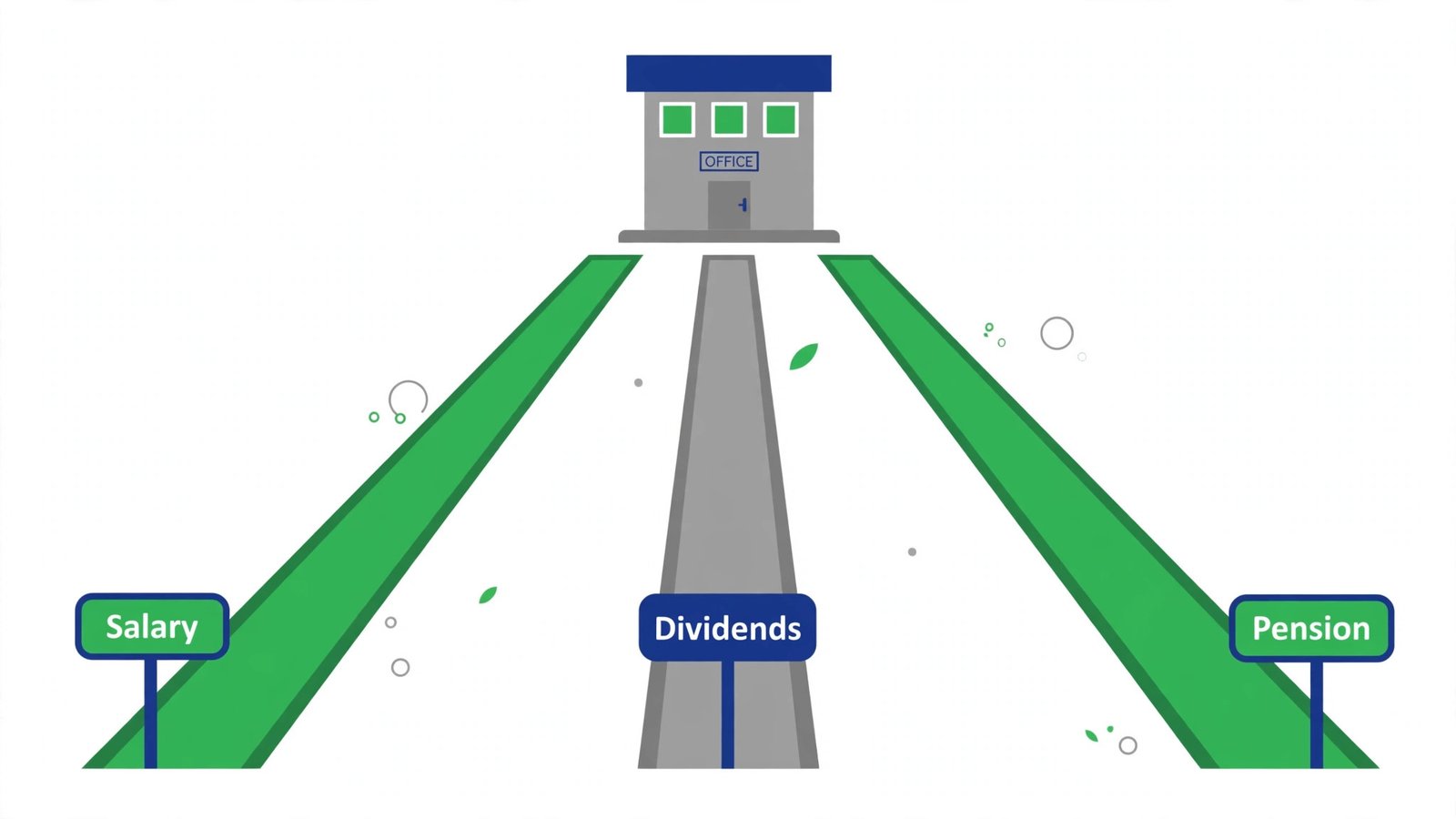
Each route is taxed at a different point, so the comparison only works if you count both ends: company money is not your money until it crosses. Salary is taxed on you but relieves tax in the company; dividends come out of already-taxed profit; a pension contribution is taxed at neither end.
Salary: deductible, but National Insurance on both sides
Salary is an allowable cost, so it reduces the company’s corporation tax bill. Against that, it runs through payroll: income tax under PAYE, employee National Insurance at 8% above the £12,570 primary threshold (2% above £50,270), and employer National Insurance at 15% above the £5,000 secondary threshold — GOV.UK’s “Rates and thresholds for employers 2026 to 2027” page confirms all three figures. The employer charge is the part directors forget; it is a real cost of the route, though itself deductible.
Dividends: no National Insurance, but paid from taxed profit
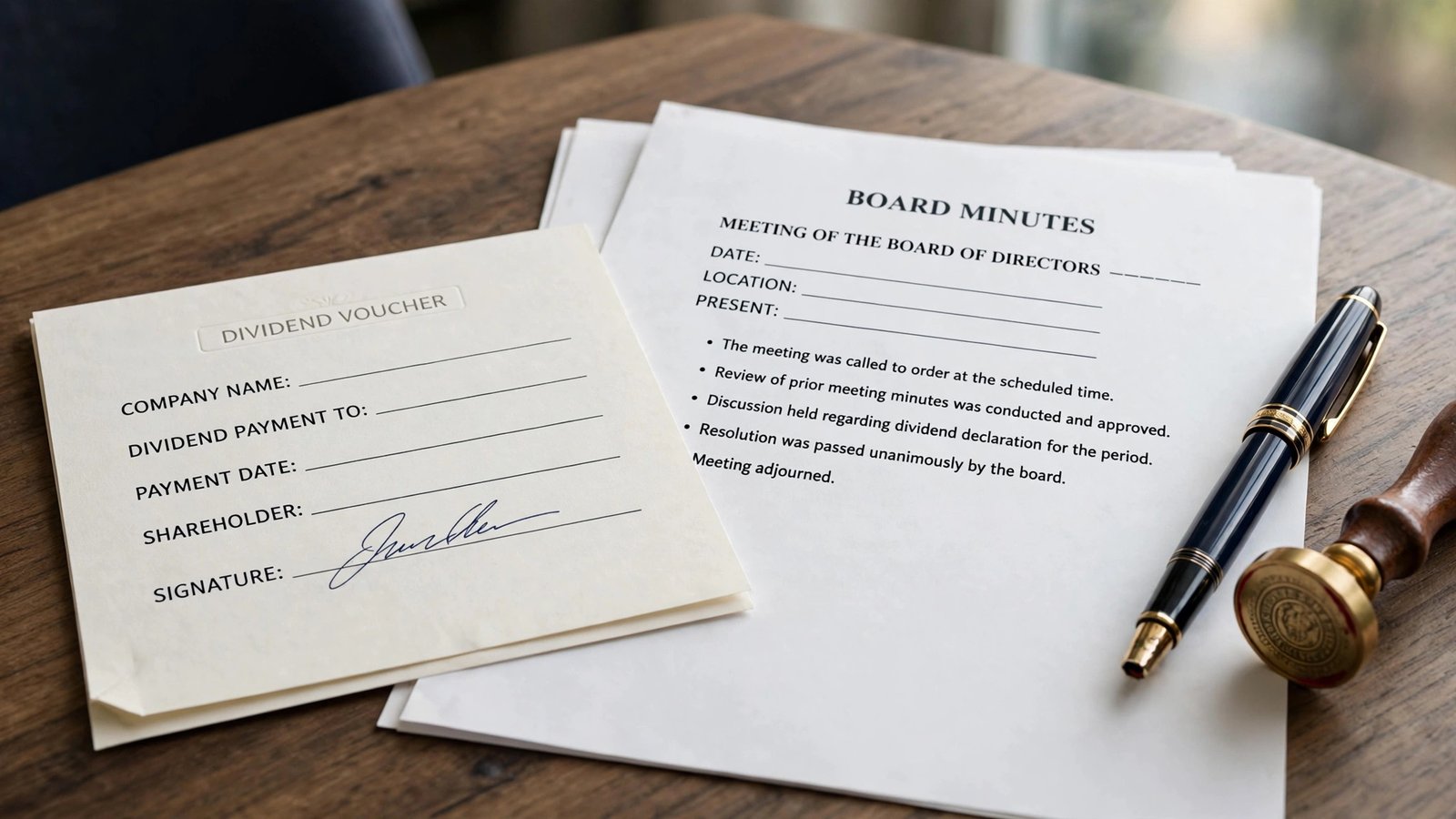
Dividends carry no National Insurance at all — but they are not deductible, so the company pays corporation tax first and you take what is left. GOV.UK’s guide to taking money out of a limited company is strict about the mechanics: the company must not pay out more than its available profits from current and previous years, a directors’ meeting declares the dividend with minutes kept even if you are the only director, and every payment needs a dividend voucher. Dividends normally go to all shareholders in proportion to their shares.
Pension contributions: no tax at either end
A contribution paid by your company into your pension is deductible for corporation tax, attracts no employer or employee National Insurance, and is not taxed on you as income when it goes in. No other route does that. The catch is access: the money is locked away until pension age, and counts against your £60,000 annual allowance — the pension section below covers the limits.
The smaller levers: rent, interest, benefits and trivial benefits
Three smaller routes can sit alongside the main ones. Your company can pay you rent for business use of your home — under a licence agreement, at a defensible rate — deductible for the company, free of National Insurance, and taxed on you as property income. If you have lent the company money, GOV.UK confirms interest you charge is a business expense for the company and personal income for you, paid under deduction of 20% basic rate tax. And trivial benefits in kind are a small win: a benefit costing £50 or less, not cash or a cash voucher and not a reward for work, is exempt — capped at £300 a year for directors of close companies.
Setting your salary: £5,000, £6,708 or £12,570?
For most sole directors, £12,570 is the right salary in 2026/27 — the worked example proves it against the £5,000 alternative. Three candidate levels come up in every discussion:
- £5,000 is the secondary threshold: pay exactly this and employer National Insurance is nil — which is why the figure is so often recommended in isolation.
- £6,708 is the 2026/27 Lower Earnings Limit from GOV.UK’s employer rates page: earn at least this and the year counts as a qualifying year for your state pension, with no National Insurance payable by either side.
- £12,570 uses your full personal allowance and sits exactly at the primary threshold, so no income tax and no employee National Insurance. The cost is employer National Insurance of £1,136 (15% of the £7,570 above the secondary threshold).
| Salary | Employer NIC | Income tax & employee NIC | State pension year? | Best for |
|---|---|---|---|---|
| £5,000 | £0 | £0 | No — below the Lower Earnings Limit | Very small profits, or where your personal allowance is used elsewhere |
| £6,708 | £256 | £0 | Yes | Protecting your state pension record at the lowest NIC cost |
| £12,570 | £1,136 | £0 | Yes | Most sole directors — it wins the worked example below |
The swing factor is the Employment Allowance, worth up to £10,500 against employer National Insurance. GOV.UK’s Employment Allowance guidance is explicit that a company cannot claim if it has just one director and that director is the only employee liable for secondary Class 1 National Insurance. Add a second genuine employee — a spouse doing real work, for example — and the £12,570 salary becomes National-Insurance-free, strengthening its case further. Directors’ National Insurance is worked out on an annual earnings period, and salary only saves corporation tax if paid through payroll — see our guide to employer National Insurance contributions.

Dividends in 2026/27: the new rates
Dividends are still the workhorse of profit extraction — no National Insurance, and flexible timing — but they are two points dearer now. From 6 April 2026 you pay 10.75% in the basic rate band, 35.75% at the higher rate and 39.35% at the additional rate, after your £500 dividend allowance and any personal allowance not used by salary. Most directors plan around the £50,270 line: salary plus dividends up to that threshold keeps every dividend in the 10.75% band.
Above £100,000 of total income, plan with care. GOV.UK’s income tax page confirms your personal allowance is withdrawn at £1 for every £2 of income over £100,000, disappearing at £125,140. Inside that taper zone each extra £1 of dividend also claws back 50p of allowance, so the effective rate there can exceed 60% once the lost allowance is counted. The standard defences are to cap extractions at £100,000, or to push through the zone with pension contributions rather than suffer it slowly.
Timing is the last lever. A dividend is taxed in the year it is declared, so declaring before or after 5 April moves both the tax year and the payment date — a cash-flow benefit most years, and a rate benefit at the 2026 changeover. What timing can never fix is a lack of distributable profits: a dividend declared without them is unlawful.
Worked example: £60,000 of profit, four ways
The same profit behaves very differently depending on the route — here is the full arithmetic. Assumptions: a sole director-shareholder; £60,000 of company profit before director’s pay, pension contributions and corporation tax; no other personal income; full personal allowance available; no Employment Allowance, because the director is the only employee; no associated companies; 2026/27 rates throughout. Route C locks £20,000 into a pension, so compare its total value, not just its cash.
| A: All salary | B: £12,570 salary + dividends | B2: £5,000 salary + dividends | C: B + £20,000 pension | |
|---|---|---|---|---|
| Employer NIC | £7,174 | £1,136 | £0 | £1,136 |
| Corporation tax | £0 | £8,796 | £10,825 | £4,996 |
| Income tax | £8,562 | £0 | £0 | £0 |
| Employee NIC | £3,067 | £0 | £0 | £0 |
| Dividend tax | £0 | £3,977 | £3,881 | £2,236 |
| Total tax | £18,803 | £13,909 | £14,706 | £8,368 |
| Cash in your pocket | £41,197 | £46,091 | £45,294 | £31,633 |
| Pension value | £0 | £0 | £0 | £20,000 |
Route A pays everything as salary: to spend the whole £60,000, the salary is £52,826 and employer National Insurance £7,174. There is no corporation tax — the pay bill wipes out the profit — but income tax of £8,562 and employee National Insurance of £3,067 make it easily the most expensive route.
Route B is the standard strategy and the cheapest way to maximise cash: corporation tax of £8,796 on the £46,294 left after salary and employer NIC, leaving £37,499 of dividends taxed at £3,977 after the £500 allowance. It beats Route A by £4,894.
Route B2 is the challenger — and it loses by £797. Skipping the £1,136 of employer National Insurance feels efficient, but the smaller salary leaves £55,000 of taxable profit, inside the corporation tax marginal relief band where, as GOV.UK’s Marginal Relief guidance sets out, each extra pound is effectively taxed at 26.5%. The extra corporation tax is £2,029; the dividend tax saving is only £96. The pattern holds at lower profits — at £40,000, Route B still wins by roughly £460 — so the £5,000 salary only competes where profits cannot fund £12,570, or your personal allowance is used by other income.
Route C pays the least tax of all — £5,541 less than Route B — because the £20,000 pension contribution is deductible and untaxed at both ends. The price is patience: it is locked away until pension age.
Pension contributions: the most efficient route of all
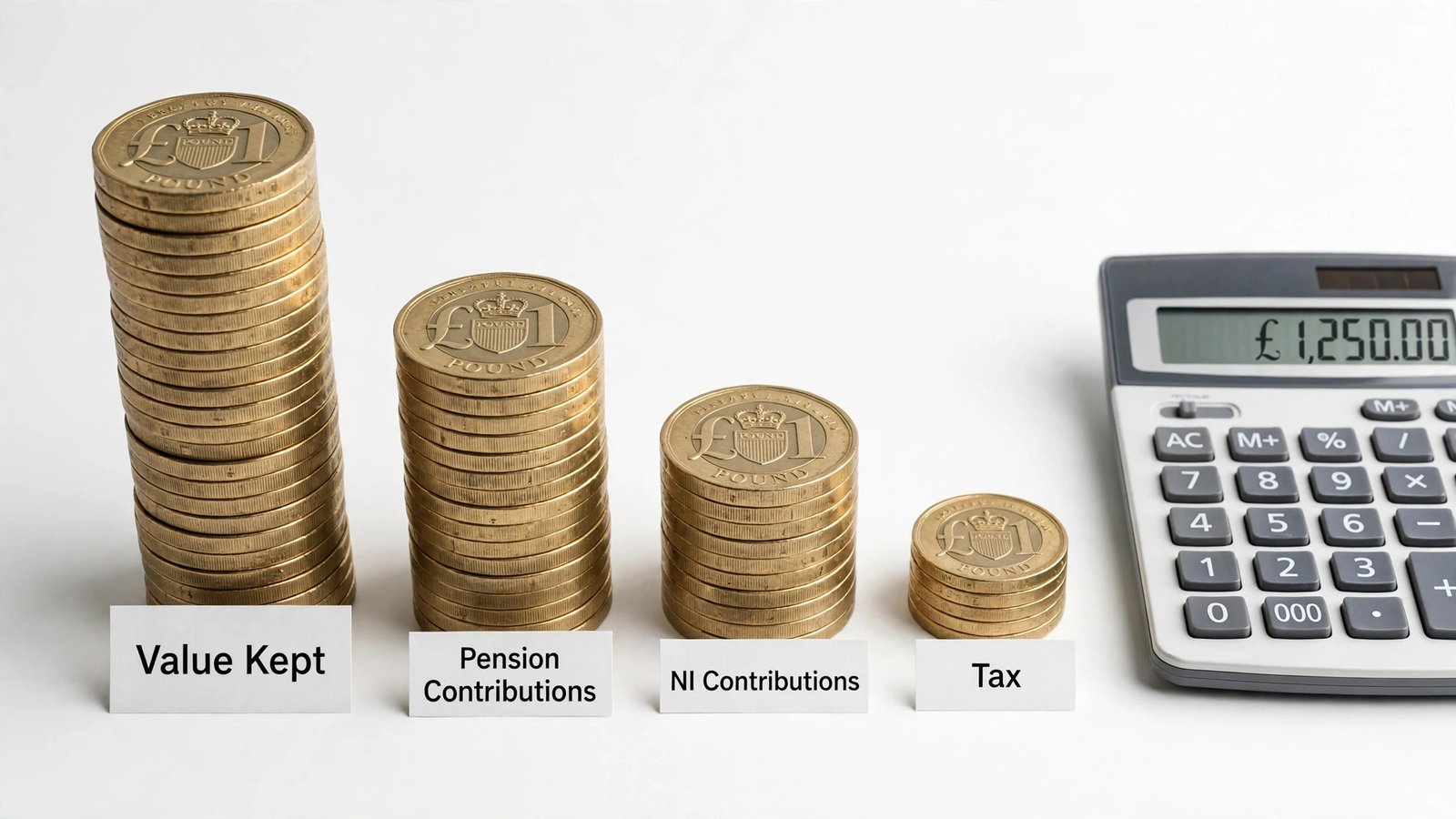
A company pension contribution is the most efficient extraction route there is, because it is the only one taxed at neither end: deductible for corporation tax, free of employer and employee National Insurance, and free of income tax on you when it goes in. One pound of company profit reaches your pension whole — salary and dividends both lose a slice on the way.
The limits matter. GOV.UK’s annual allowance guidance sets the standard allowance at £60,000 a year, with unused allowance from the previous three tax years carried forward. Very high earners face a taper: HMRC’s Pensions Tax Manual (PTM057100) confirms the allowance falls by £1 for every £2 of adjusted income above £260,000, once threshold income also exceeds £200,000, down to a minimum of £10,000. Exceed your allowance and the excess is taxed back through an annual allowance charge.
Two cautions. First, HMRC’s Business Income Manual (BIM46000 onwards) treats employer contributions as deductible only where incurred wholly and exclusively for the trade — for a director, the contribution must sit comfortably within a reasonable overall remuneration package for the work done. Second, the money is genuinely locked away: HMRC’s Pensions Tax Manual (PTM062100) confirms the normal minimum pension age is 55 now, rising to 57 from 6 April 2028.
Two announced future changes are worth knowing. From April 2027, most unused pension funds are announced to fall within inheritance tax. And GOV.UK’s published guidance confirms that from April 2029 the National Insurance exemption for pension contributions made through salary sacrifice will be capped at £2,000 a year. That cap bites on salary sacrifice, not on straightforward employer contributions, which remain free of National Insurance.
Using your household: spouse salaries and dividends
For a family company, a spouse or civil partner who genuinely works in the business is the biggest lever after pensions: a second personal allowance, basic rate band and dividend allowance all come into play. A salary must be for real work at a defensible rate — set it too high for the duties and HMRC can deny the company its corporation tax deduction for the excess.
Dividends to a spouse require shares with real rights, and rest on a famous case. The settlements legislation in Part 5, Chapter 5 of the Income Tax (Trading and Other Income) Act 2005 can tax one spouse on income diverted to the other — but in Jones v Garnett [2007] UKHL 35, the Arctic Systems case, the House of Lords held that an outright gift of ordinary shares between spouses falls within the exemption in section 626 of that Act, because ordinary shares carry rights to capital and votes, not merely a right to income. The protection has edges: it does not extend to arrangements for minor children, and income-only share classes are where it runs out.
One related trap: dividend waivers, where one shareholder gives up a dividend so a lower-taxed shareholder can take more. Waivers made after profits are known can themselves amount to a settlement — set shareholdings up properly at the start instead.

Leaving profit in the company — and taking it out at the end
You do not have to extract anything: profit left in the company has only suffered corporation tax, at 19% below £50,000. Retention is a legitimate strategy — to fund growth, build a buffer, or spend on equipment, where capital allowances for small businesses and the annual investment allowance can shelter the purchase. But it is not tax-free money in waiting; it is taxed again whenever it eventually reaches you.
Watch what retention does to the company itself: if the balance grows until the company looks like an investment vehicle rather than a trade, reliefs you may want later are endangered. The natural endgame is a capital exit — selling the shares, or winding up and taking the balance as capital. GOV.UK’s Business Asset Disposal Relief page confirms gains on qualifying disposals from 6 April 2026 are taxed at 18%, subject to the £1 million lifetime limit and two-year qualifying conditions. Hold one line alongside that: on a winding-up, only the first £25,000 of distributions can be treated as capital under section 1030A of the Corporation Tax Act 2010 — above that, a members’ voluntary liquidation is usually the route.
Risks and common mistakes
The expensive errors in profit extraction are rarely exotic:
- The overdrawn director’s loan. Money taken that is neither salary nor a declared dividend is a loan from the company. GOV.UK’s director’s loans guidance sets the clock: if the loan is still outstanding nine months and one day after the end of the accounting period, the company pays a section 455 Corporation Tax Act 2010 charge — and because that charge tracks the dividend upper rate, it is 35.75% on loans made on or after 6 April 2026, against 33.75% for earlier loans. The charge is repaid once the loan is cleared, but the cash-flow pain is real. A loan over £10,000 at any point in the year is also a benefit in kind, taxed on you at the official rate of interest. Our guide to the overdrawn director’s loan account covers the deadlines in full.
- Dividends without distributable profits. A dividend paid beyond available profits is unlawful: repayable on demand and, in HMRC’s hands, liable to be recharacterised as a loan or as salary.
- Extraction without the paperwork. Salary that never went through payroll and RTI, and dividends with no minutes and no vouchers, invite HMRC to reclassify the payment on its terms, not yours.
- Drifting into the traps. Dividends drawn into the £100,000–£125,140 taper zone, or company profits sliding into the 26.5% marginal corporation tax band, both quietly cost more than the headline rates suggest. Watch the associated companies rule too: GOV.UK confirms the £50,000 and £250,000 thresholds are shared between companies under common control.
- Pension contributions that overshoot. A contribution beyond your annual allowance (including carry-forward) triggers a tax charge; one made in a year when the company has no profits gets no corporation tax relief.
Frequently asked questions
What is the most tax-efficient way to take money out of a limited company in 2026/27?
For most sole directors: a salary of £12,570, dividends up to the £50,270 higher-rate threshold, and a company pension contribution for profit beyond that. The April 2026 dividend rise narrowed the gaps but did not change the order.
How much salary should a director take in 2026/27 — £5,000 or £12,570?
£12,570, in most cases. In the worked example above it beats the £5,000 salary by £797, because the smaller salary pushes company profit into the 26.5% marginal corporation tax band. The £5,000 level only competes where profits cannot fund it, or your allowance is used by other income.
What are the dividend tax rates for 2026/27?
10.75% in the basic rate band, 35.75% at the higher rate and 39.35% at the additional rate, with a £500 dividend allowance. The basic and higher rates rose by two percentage points on 6 April 2026; GOV.UK’s “Tax on dividends” page shows the full table.
Can my company pay into my pension instead of paying me?
Yes — and it is the most efficient route of all. Company contributions are deductible for corporation tax and free of income tax and National Insurance, up to your £60,000 annual allowance plus carried-forward unused allowance. The money is locked away until age 55, rising to 57 from April 2028.
Is it worth employing my spouse?
It can be, where the work is real. A genuine salary brings a second personal allowance into the plan, and dividends on a spouse’s shares are protected by the outright-gift exemption confirmed in the Arctic Systems case, Jones v Garnett [2007] UKHL 35. Pay must be defensible for the duties done.
What happens if I just take money out without declaring salary or dividends?
You have a director’s loan. Left outstanding nine months and one day after the accounting period ends, it triggers a section 455 charge for the company — 35.75% on loans made from 6 April 2026 — and a loan over £10,000 is also taxed on you as a benefit in kind. See our overdrawn director’s loan account guide.
Should I take a dividend before or after 5 April?
A dividend is taxed in the year it is declared, so timing moves the bill between tax years and changes when you pay it. It mattered most at the April 2026 rate rise. The company still needs distributable profits at the declaration date.
Can I leave profits in the company and take them when I sell or wind up?
Yes. Retained profits bear only corporation tax until extraction, and a later sale or winding-up can produce capital treatment — including Business Asset Disposal Relief at 18% from 6 April 2026 if you qualify. The risk to manage is the company drifting into investment activity while the balance builds.
Conclusion
Profit extraction in 2026/27 is an order-of-operations problem. Set the salary first — £12,570 for most sole directors. Use a company pension contribution for profit you can lock away, because nothing else arrives untaxed at both ends. Take dividends for the rest, watching the £50,270 threshold, the £100,000 taper and the company’s marginal corporation tax band. Then repeat the exercise every year: the rates moved this April, thresholds are frozen until 2031, and last year’s answer is not automatically this year’s.
This article is general information about profit extraction for UK company directors, based on 2026/27 rates and allowances. It is not personal tax advice. Your optimal mix depends on your company’s profits, your other income and your household’s position, so take advice from a qualified accountant or tax adviser before acting on it.