
If you’ve searched for a “British Business Bank loan,” you’ve probably already hit the first source of confusion: there’s no button on the British Business Bank website that says “apply here.” That’s not a design flaw. It’s because the Bank doesn’t lend money directly to most businesses. It works through a network of partners instead, and understanding that structure is the key to getting funded.
What Is the British Business Bank (and How Does It Actually Work?)
The British Business Bank is a state-owned development bank, wholly owned by the UK government through the Department for Business and Trade. It exists to make sure smaller UK businesses can get debt and equity finance, particularly when high-street banks won’t lend to them.
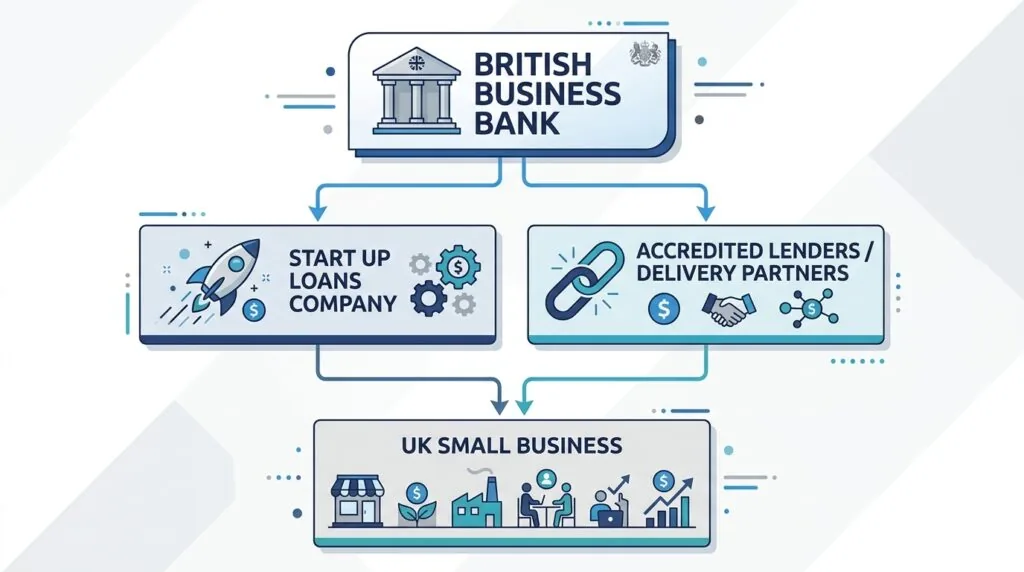
Crucially, the Bank rarely hands money to a business directly. Instead, it acts more like a wholesale funder: it works through accredited lenders and delivery partners — banks, building societies, and specialist finance providers — who assess applications and disburse the actual loans. The government backs the risk; the partner does the lending.
The Core Difference: Direct vs Indirect Funding
There are two structures at play, and mixing them up is the single biggest source of applicant confusion:
- Start Up Loans are delivered through the Start Up Loans Company, a British Business Bank subsidiary, and its network of delivery partners. You apply once, and the Start Up Loans Company matches you with a partner and a dedicated business adviser.
- The Growth Guarantee Scheme works differently. You apply directly to an accredited commercial lender — your own bank, for example — and that lender decides whether to offer you finance under the scheme. The British Business Bank never touches your application; it simply guarantees part of the lender’s risk.
In both cases, it’s not a grant. Every penny is a loan that must be repaid, with interest, on commercial or near-commercial terms.
Option 1: The Government-Backed Start Up Loan Scheme
A Start Up Loan is a government-backed personal loan for people starting or growing a business in the UK. It’s aimed at very early-stage businesses that struggle to get commercial credit because they have no trading history.
Key Features of the Start Up Loan
- Loan amount: £500 to £25,000 per applicant.
- Interest rate: A fixed 7.5% per year, charged on the reducing balance. This rose from the long-standing 6% rate on 6 April 2026 — loans agreed before that date keep their original 6% rate.
- Repayment term: 1 to 5 years, with no early repayment charges.
- Multiple founders: Up to four co-founders in the same business can each apply for their own £500–£25,000 loan, taking the total available to the business to £100,000.
- Security: Unsecured — you don’t need to put up business or personal assets as collateral.
- Fees: No application fees.
Because the loan is legally a personal loan rather than a business facility, the lender runs a personal credit check on you, not a business credit assessment. That means a default shows up on your personal credit file, not a company one — worth remembering if you’re used to thinking of business debt as ring-fenced.
Start Up Loan Eligibility Criteria
To qualify, you generally need to:
- Be aged 18 or over.
- Live in the UK and have the right to work here.
- Be starting a new business, or run one that has been trading for up to 60 months (five years) for a first Start Up Loan — this limit was extended from 36 months in April 2026.
- Have a viable business plan and cash flow forecast.
- Not already have an outstanding Start Up Loan on the same business (beyond the co-founder allowance above).
Sole traders, partnerships, and limited company directors can all apply — the scheme doesn’t require you to have incorporated a limited company first, which sets it apart from most commercial alternative lenders that have tightened their own criteria to limited companies and LLPs only in 2026. If you haven’t decided on a structure yet, it’s worth reading up on the difference between operating as a sole trader and forming a limited company before you apply, since it affects how you’ll eventually manage tax and liability either way.
The Hidden Benefit: 12 Months of Free Business Mentoring
Every successful applicant is offered up to 12 months of free mentoring, typically four to fifteen hours of structured one-to-one support, plus access to discounts and business offers from partner organisations. For a first-time founder with no professional network, this can end up mattering more than the cash itself. If you want to compare it against other routes to support, our guide on finding a free small business mentor in the UK covers alternatives worth stacking alongside it.
Before you apply, it helps to have your numbers in order. A realistic cash flow forecast and a clear business plan are what delivery partners actually assess your application against — not just your credit score.
Option 2: The Growth Guarantee Scheme (GGS)
What Is the Growth Guarantee Scheme?
The Growth Guarantee Scheme is aimed at established smaller businesses that need debt finance to invest or grow, rather than brand-new startups. It replaced the Recovery Loan Scheme in July 2024 and has since been extended to run until 31 March 2030.
Unlike Start Up Loans, GGS isn’t a single product. It’s a government guarantee that sits behind several types of commercial finance — term loans, overdrafts, asset finance, invoice finance, and asset-based lending — offered by accredited lenders.
Key Terms: Limits, Guarantee Levels, and Repayments
- Maximum facility size: Up to £2 million for most UK businesses; up to £1 million for businesses in scope of the Northern Ireland Protocol, with lower caps in sectors like agriculture and fisheries.
- Government guarantee: 70% of the outstanding balance is guaranteed to the lender if the business defaults, after the lender has completed its normal recovery process.
- Borrower liability: You remain 100% liable for the full debt at all times. The guarantee protects the lender, not you.
- Turnover limit: Businesses must have annual group turnover of no more than £45 million.
- Repayment terms: Term loans and asset finance typically run from 3 months up to 6 years; overdrafts, invoice finance, and asset finance facilities usually run from 3 months up to 3 years.
- Decision-making: Fully delegated to the lender. The British Business Bank does not assess or approve individual applications.
This point trips up a lot of applicants: the 70% guarantee is a comfort blanket for the lender’s balance sheet, not a discount on your bill. You’ll still be credit-checked, and you’ll still owe every penny back.
Who Are the GGS Accredited Lenders?
GGS is delivered through a panel of accredited lenders that includes major high-street banks and a number of specialist and challenger lenders offering different products — some focus on term loans, others on asset or invoice finance. The panel changes periodically as lenders join or leave the scheme, so the most reliable way to check who’s currently accredited, and which products each one offers, is the British Business Bank’s own lender list rather than a static article. Because approval sits entirely with the lender, it’s worth approaching more than one if your first choice doesn’t have appetite for your sector.

Eligibility Matrix: Which Scheme Fits Your UK Business?
| Start Up Loans | Growth Guarantee Scheme | |
|---|---|---|
| Best for | New founders, pre-trading or trading up to 5 years | Established businesses needing to invest or grow |
| Loan amount | £500–£25,000 per person (up to £100,000 per business) | Up to £2 million (£1 million in Northern Ireland) |
| Interest rate | Fixed 7.5% p.a. | Set by the lender; varies by risk and product |
| Security required | None | May be required, depending on the lender and product |
| Who assesses you | Start Up Loans Company delivery partner | The lender directly |
| Government’s role | Funds the loan via the Start Up Loans Company | Guarantees 70% of the loan to the lender only |
| Turnover limit | No formal minimum; typically pre-revenue or early-stage | Group turnover under £45 million |
| Application route | Apply once via the Start Up Loans Company | Apply directly to an accredited lender |
Step-by-Step Guide: How to Apply for a British Business Bank-Backed Loan
Step 1: Prepare Your Business Plan and Cash Flow Forecast
Both schemes ultimately come down to one question for the assessor: can this business realistically repay what it borrows? Before you touch an application form, put together a business plan that covers your market, your offer, and your numbers, plus a 12-month cash flow forecast. Delivery partners and lenders read dozens of these a week — vague projections and copy-pasted templates are usually the first thing that gets an application flagged for extra scrutiny.
Step 2: Choose the Correct Delivery Partner or Accredited Lender
For Start Up Loans, you don’t choose a partner yourself — you apply once through the Start Up Loans Company, and it matches you with a delivery partner and adviser based on your location and business type. For GGS, the opposite is true: you approach an accredited lender directly, usually starting with your existing business bank or a specialist lender suited to your sector. If your bank rejects you, that’s not necessarily the end of the road — GGS decisions are made lender by lender, so a different accredited lender may take a different view of the same application.
Step 3: Complete the Viability and Credit Assessment
Expect a personal credit check for Start Up Loans, or a business credit and affordability assessment for GGS-backed products. You’ll typically need:
- Proof of identity and right to work in the UK (Start Up Loans).
- Business plan and cash flow forecast.
- Bank statements and, where applicable, filed accounts.
- Details of any existing business debt.
If you’re approved, funds are usually released within a few weeks of a complete application — faster if your paperwork is in order from the start.
Common Pitfalls: Why British Business Bank Applications Get Rejected (and How to Avoid Them)
Applying to the wrong scheme. A pre-revenue founder applying for GGS, or an established five-year-old company with strong turnover applying for a Start Up Loan, both waste time. Match your business stage to the scheme before you apply.
Weak or generic business plans. Assessors can tell within a page whether a forecast reflects real research or a downloaded template. Be specific about your market, your costs, and how the loan will actually be spent.
Ignoring existing credit problems. You don’t need a spotless credit history for a Start Up Loan, and minor historical issues — a missed payment from years ago, for instance — are often looked at in context rather than treated as an automatic block. What tends to cause a decline is something active and serious: current bankruptcy or insolvency proceedings, an active Debt Relief Order, or a pattern of recent defaults. Be upfront about your credit history rather than hoping it won’t come up.
Underestimating the personal guarantee liability. For Start Up Loans, the debt sits with you personally by design. For GGS, the 70% guarantee protects the lender, not you — you remain fully liable for the whole facility. Don’t borrow more than your business can service on a bad month, not just an average one.
Missing the subsidy control rules on GGS. Government-backed lending is treated as a subsidy, and there’s a cap on how much subsidy a business and its wider group can receive over a rolling three-year period. If you’ve already had support through other government schemes, check this before assuming you’ll get the full £2 million.
Applying too early or too late. Businesses trading for more than five years generally won’t qualify for a first Start Up Loan, and very early-stage businesses with no trading history will struggle to satisfy a commercial lender’s GGS affordability checks. If you’re stuck in that gap, it’s worth exploring alternatives such as small business grants, angel investment, or the SEIS scheme for equity-based funding instead.
Frequently Asked Questions
Does the British Business Bank lend directly to businesses?
No. It funds Start Up Loans through the Start Up Loans Company and its delivery partners, and it guarantees 70% of loans made by accredited lenders under the Growth Guarantee Scheme. In both cases, an intermediary — not the Bank itself — decides your application and pays out the money.
What is the interest rate on a government-backed Start Up Loan?
A fixed 7.5% per year on the reducing balance, as of April 2026. This applies to every successful applicant equally, regardless of credit score, though your credit history and business plan still affect whether you’re approved at all.
Can I get a British Business Bank loan with bad credit?
Possibly, for a Start Up Loan — delivery partners look at the full picture rather than declining on a single blemish, and there’s no minimum credit score published. Active bankruptcy, current insolvency proceedings, or a pattern of recent defaults are far more likely to result in a decline than an old, resolved issue. For GGS, it depends entirely on the individual lender’s credit policy, since they assess and approve applications themselves.
How many co-founders in a business can apply for a Start Up Loan?
Up to four co-founders of the same business can each apply for their own £500–£25,000 loan, bringing the maximum funding available to that business to £100,000 in total.
Is a British Business Bank loan a grant?
No. Every scheme delivered through the British Business Bank is a loan that must be repaid with interest. Grants are a separate category of funding, usually administered through different government or local authority schemes.
What happens if my business fails and I can’t repay a GGS-backed loan?
The lender pursues its normal recovery process first. Only after that is the government’s 70% guarantee paid to the lender to cover its loss — it does not clear or reduce your personal liability for the debt.