
An angel investor is a wealthy individual who puts their own money into an early-stage business, usually in return for equity. In the UK, most angels invest between £10,000 and £100,000 of their own cash, though syndicates of angels investing together can write cheques of £250,000 or more. They’re not banks, and they’re not venture capital funds spending someone else’s money. That distinction matters, because it shapes how you find them and how you pitch to them.
What Is an Angel Investor, and How Do They Work in the UK?
An angel investor in the UK is typically a high-net-worth individual who provides capital to an early-stage business, usually in exchange for equity or convertible debt. Unlike a bank, an angel takes on the same risk as a shareholder. If the business fails, they usually lose their money. If it succeeds, they share in the upside.
Solo Investors vs. Angel Syndicates
Angels operate in two main ways in the UK:
- Solo angels invest their own money, on their own timeline, often in sectors they know from their own careers. They tend to write smaller cheques and get more personally involved as mentors or non-executive directors.
- Angel syndicates are groups of angels who pool capital and due diligence, usually led by a “lead investor” who negotiates terms on behalf of the group. Syndicates can deploy far more capital per deal and are more common for rounds above £150,000.
Average Angel Investment Sizes in the UK
| Investor type | Typical cheque size | Involvement level |
|---|---|---|
| Solo angel | £10,000 – £100,000 | Often hands-on, may take an advisory role |
| Angel syndicate | £100,000 – £500,000+ | Lead investor manages terms; group follows |
| Angel network (co-investment) | £250,000 – £1,000,000+ | Multiple syndicates co-invest in one round |
According to the UK Business Angels Association (UKBAA), the national trade body for the sector, UK angels collectively invest an estimated £1.5 billion a year, making them the country’s largest source of early-stage capital outside the founder’s own pocket.

Step 1: Secure Your SEIS/EIS Advance Assurance First
Most competing guides mention tax relief as a footnote. That’s a mistake. For a UK angel, whether your company qualifies for SEIS or EIS is often the first thing they check, before they even look at your numbers. If you don’t have Advance Assurance, or a clear plan to get it, some angels won’t take the meeting.
Advance Assurance is HMRC’s confirmation, given before you raise money, that your company is likely to qualify for SEIS or EIS relief once shares are issued. It’s not a legal guarantee, but it’s the strongest signal you can give an investor that their tax relief is safe.
Seed Enterprise Investment Scheme (SEIS) Explained
SEIS is aimed at the earliest-stage companies. To qualify, your business generally needs to be trading for less than three years, have fewer than 25 full-time equivalent employees, and gross assets of no more than £350,000 before the investment.
For the investor, SEIS offers:
- 50% income tax relief on investments up to £200,000 per tax year
- Capital Gains Tax exemption on any profit, provided the shares are held for at least three years
- Loss relief if the company fails, which can offset most of the downside
A company can raise up to £500,000 in total under SEIS (this limit rose from £250,000 in April 2025), after which further rounds move to EIS.
Enterprise Investment Scheme (EIS) Explained
EIS is the follow-on scheme for companies that have outgrown SEIS limits or don’t meet its early-stage criteria. It offers investors 30% income tax relief on investments up to £1 million per tax year (rising to £2 million if the extra £1 million goes into a knowledge-intensive company), plus the same three-year CGT exemption and loss relief protections as SEIS.
Both schemes let an investor “carry back” their claim to the previous tax year, which is a detail many founders never mention in a pitch but that experienced angels will ask about directly.
| SEIS | EIS | |
|---|---|---|
| Income tax relief | 50% | 30% |
| Annual investor limit | £200,000 | £1,000,000 (£2m for knowledge-intensive) |
| Company lifetime raise limit | £500,000 | £20,000,000 (£30m for knowledge-intensive) |
| CGT exemption after 3 years | Yes | Yes |
| Typical company stage | Pre-revenue to early trading | Scaling, post-SEIS |
Getting your Advance Assurance sorted before you approach investors, alongside a solid UK business plan that lays out how the funds will be used, puts you ahead of most founders angels meet.
Step 2: Where to Find Angel Investors in the UK
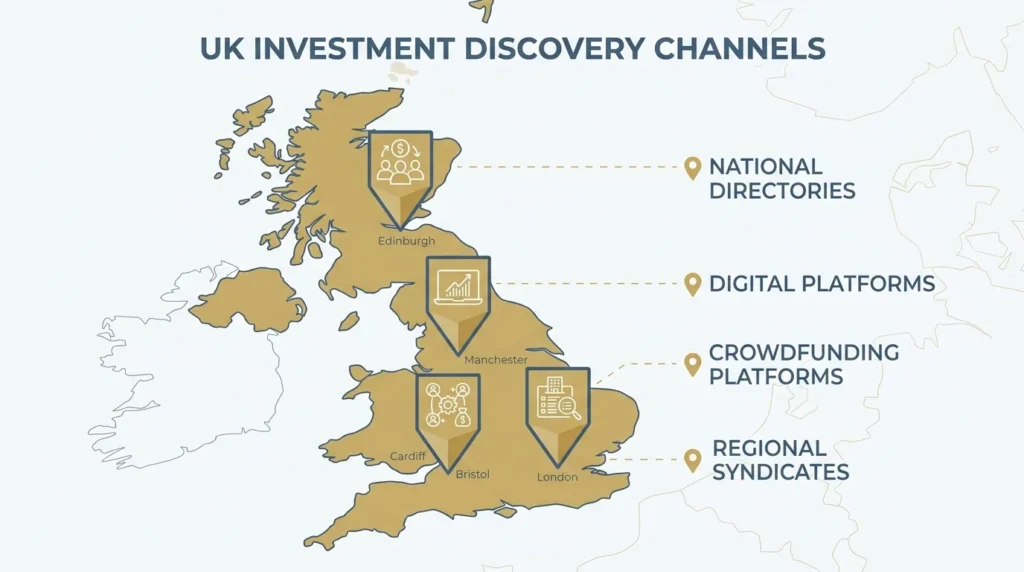
Once your tax position is sorted, the next question is where these people actually are. Four channels cover most of the UK angel market.
1. Official UK Angel Networks and Directories
The UK Business Angels Association (UKBAA) is the sector’s national trade body, representing more than 170 member organisations and around 18,000 investors. Its member directory lists angel syndicates, individual investors, early-stage VCs and accelerators by sector and region, and it’s the closest thing the UK has to an official register of who’s actively deploying capital.
2. Digital Angel Investment Platforms
Platforms like the Angel Investment Network (AIN) and Angels Den let founders create a profile and pitch directly to a database of registered investors, rather than relying on personal introductions. These platforms won’t replace a warm intro, but they’re a legitimate way to get visibility if your network doesn’t stretch to investors yet.
3. Equity Crowdfunding Platforms as a Discovery Tool
Seedrs and Crowdcube are built for public equity crowdfunding campaigns, but many founders use them differently: as a way to identify active angels. Investors who back deals on these platforms publicly are, by definition, people who invest in early-stage UK companies. A well-run crowdfunding campaign can also double as a lead-generation exercise for your next private round.
4. Regional and Sector-Specific Syndicates
London dominates headline numbers, but regional syndicates in Scotland, the North West, and the Midlands often move faster and face less competition for founder attention, because fewer companies pitch to them. Sector-specific syndicates (health tech, climate, consumer) are also worth seeking out, since angels who’ve made money in your sector before are usually faster to say yes and more useful once they’re in.
Step 3: Outreach Strategies That Actually Work
Directories get you a list of names. They don’t get you a meeting. Most founders fail at this stage because they either wait passively for inbound interest or send the same generic pitch to fifty people at once, which reads as spam and can create compliance problems (more on that in Step 4).
How to Find Active Angels on LinkedIn
Search LinkedIn for people whose profile mentions being a “business angel,” “angel investor,” or “non-executive director” alongside your sector. LinkedIn Sales Navigator makes this far easier, since you can filter by past investment activity and current company relationships. Look for angels who’ve recently commented on or shared posts about funding rounds in your space; recent activity is a much better signal than a static profile.
A short, specific first message performs better than a polished pitch. Something like:
> “I noticed you’ve backed a couple of [sector] startups recently. I’m building [one-line description] and have SEIS Advance Assurance in place. Would you be open to a 15-minute call before I go further with the round?”
This works because it’s short, shows you’ve done your homework, and leads with the SEIS detail angels actually care about.
Leveraging Warm Introductions
Cold outreach converts at a much lower rate than a warm introduction from someone the investor already trusts. Before messaging angels directly, ask your accountant, solicitor, or any founders you know who’ve raised before for introductions. A useful trick practitioners on founder forums recommend: ask for advice, not money, in your first message to anyone in your extended network. People who’d never commit to writing a cheque in a first message will often happily make an introduction or offer feedback, and that conversation is how most warm intros actually start. This is also where consistent LinkedIn networking for your business pays off well before you need it.
Step 4: FCA Compliance and Preparing Your Pitch
Contacting UK investors about an unlisted company is legally restricted under the Financial Conduct Authority’s financial promotion rules, and getting this wrong can be a criminal offence, not just a compliance slip. This is the part almost every competing guide skips, and it’s the one area where getting it wrong has real legal consequences.
The FCA Rules Have Changed Twice Since 2024, and Most Guides Cite the Wrong Figures
In January 2024, the FCA raised the income and asset thresholds required for someone to self-certify as a High Net Worth Individual (HNWI) or Self-Certified Sophisticated Investor, the two main exemptions that let unauthorised founders legally promote investment opportunities to individuals. Under those January 2024 rules, HNWI status required income of at least £170,000 or net assets of at least £430,000.
That change lasted less than two months. Following pushback from the tech and angel investing sector, the government reversed it. Since 27 March 2024, the thresholds have been back down to the original levels, and any investor statement using the higher figures stopped being valid after 30 January 2025.
| Jan–Mar 2024 (reversed) | Current rules (in force since 27 March 2024) | |
|---|---|---|
| HNWI income threshold | £170,000 | £100,000 |
| HNWI net assets threshold | £430,000 | £250,000 (excluding primary home and pensions) |
| Sophisticated investor test | One unlisted investment in 2 years | Two or more unlisted investments in 2 years |
If you’ve read a guide, template, or accountant’s briefing citing £170,000 or £430,000 as the current HNWI threshold, it’s describing rules that stopped applying in March 2024. Practically, this means you can legally approach a slightly wider pool of self-certified investors than the brief 2024 rules would have allowed, but you still need every investor to sign a compliant HNWI or sophisticated investor statement before you send them detailed investment materials. Mass, unsolicited pitches to people who haven’t self-certified are the single most common compliance mistake early-stage founders make, and it’s worth getting advice from a solicitor before your first outreach round if you’re messaging beyond your existing network.
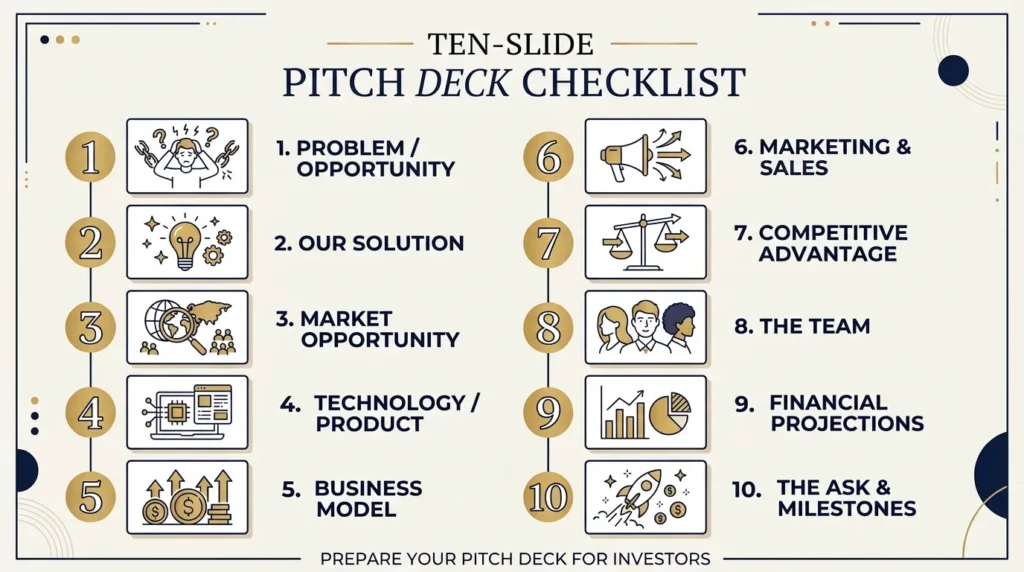
What Must Be in Your Pitch Deck
UK angels expect a consistent structure. A deck that’s missing any of these will raise questions before you’ve said a word:
- The problem you’re solving
- Your solution and how it works
- Market size, ideally with a UK-specific figure
- Product or service demonstration
- Business model and how you make money
- Traction to date, even if it’s early
- Team and relevant experience
- Competitive landscape
- Financials and the specific ask
- SEIS/EIS status and Advance Assurance confirmation
Slide ten is the one most non-UK templates leave out entirely, and it’s often the first thing a UK angel looks for.
Finding Angels Without a Product or Technical Team
Most funding guides quietly assume you already have an MVP and a co-founder who can code. If you’re a non-technical founder with a validated idea and no product yet, you’re not locked out, but you do need to adjust your approach.
- Lead with the problem, not the product. Angels who invest at pre-product stage are backing the founder’s understanding of the problem and their ability to execute, not a finished build. Be explicit that you’re pre-product and explain what the funding will build.
- Target angels who invest specifically at pre-seed or idea stage. Not every angel or syndicate does this; check UKBAA member profiles and platform filters for “pre-seed” or “idea stage” before pitching, rather than approaching angels whose portfolio is entirely post-revenue companies.
- Use a working prototype, even a rough one, over a written concept. A clickable Figma prototype or no-code demo signals far more than a slide describing what the product will eventually do.
- Protect the idea before you share it widely. If you’re at the concept stage, it’s worth understanding how to protect your business idea before sending decks to a long list of unfamiliar contacts.
Non-technical founders often raise smaller first cheques, £10,000–£30,000 from one or two solo angels, specifically to fund a technical co-founder search or an initial build, rather than trying to raise a full round with nothing built.
Common Mistakes That Cost Founders Angel Meetings
- Pitching before SEIS/EIS Advance Assurance is confirmed. Angels notice, and it signals the founder hasn’t done basic homework.
- Mass-messaging unqualified contacts. Beyond the compliance risk, it damages your reputation before you’ve had a real conversation.
- Giving away too much equity in the first round. Early over-dilution makes it harder to raise credibly later, since new investors will ask why so much has already gone.
- Treating angels like a bank. Many want some involvement, whether that’s advice, introductions, or a board seat; founders who resist any input often struggle to close.
- Ignoring company formation basics. Investors will check your company structure early, so make sure setting up your limited company and your company registration are properly in order before you start pitching.
FAQs About UK Angel Investment
How do I find angel investors in the UK as a non-tech founder?
Target angels and syndicates who explicitly invest at pre-seed or idea stage, listed in the UKBAA directory and on platforms like Angel Investment Network. Lead with a working prototype where possible, and be upfront that funding will go toward building the product, not scaling an existing one.
Do angel investors take control of your company?
Not usually outright. Angels typically take a minority equity stake and, in many deals, a board or advisory seat, but a properly negotiated term sheet should keep founders in operational control. Giving up too much equity or too many board seats in an early round is a common and avoidable mistake.
How much equity do UK angels typically take?
There’s no fixed rule, but early angel rounds commonly involve 10–25% equity in total, depending on valuation, the amount raised, and how many investors are in the round.
Can I approach angel investors before I have Advance Assurance?
You can, but most experienced UK angels will ask about your SEIS or EIS status early in the conversation, and not having at least applied for Advance Assurance can stall a promising conversation before it starts.
What happens if the FCA rules change again?
The FCA has publicly said the UK’s HNWI thresholds are low compared with other countries and has signalled further review is possible. Founders relying on the self-certification exemptions should check the current thresholds before each new outreach round rather than assuming last year’s figures still apply.