

Raising your first outside money is hard, because seed-stage companies are risky and most investors know it. The Seed Enterprise Investment Scheme (SEIS) exists to close that gap: it gives your investors generous tax reliefs, so backing your company costs them far less if things go wrong — and nothing extra if things go right.
This guide reflects HMRC guidance as reviewed on 2 November 2026.
In short: SEIS lets a very young UK company raise up to £250,000 in total by offering investors 50% income tax relief on the shares they buy. Investors can also get capital gains tax breaks, loss relief if the company fails, and possible inheritance tax relief. Your company must have gross assets of no more than £350,000, fewer than 25 full-time-equivalent staff, and a new qualifying trade carried on for less than 3 years — and you must run HMRC’s process properly (advance assurance, form SEIS1, then SEIS3 certificates) so your investors can actually claim.
This guide is written for founders raising money: what your investors get, what your company must prove to HMRC, and the mistakes that get relief withdrawn after the money is spent.
What is the Seed Enterprise Investment Scheme?
SEIS is a government venture capital scheme that helps very early-stage companies raise equity by giving individual investors tax relief on new shares they buy. Your company issues new ordinary shares, investors subscribe cash for them, and HMRC rewards the investors — not the company — with a package of reliefs set out in GOV.UK’s guidance on applying to use the scheme.
The scheme sits in Part 5A of the Income Tax Act 2007 (ITA 2007) and is aimed at the smallest, youngest end of the market: a £250,000 lifetime cap on what you can raise, a £350,000 gross assets ceiling and a trade less than 3 years old. Bigger or older than that, and you are probably looking at the Enterprise Investment Scheme (EIS) instead — the two are compared below.
Two points founders often miss. First, SEIS money is equity, not a loan: investors own shares and there is nothing to repay. Second, the reliefs belong to your investors, yet your company controls whether they get them. Almost every condition — the trade, the shares, how the money is spent, the paperwork — is yours to get right or wrong.
The SEIS tax reliefs your investors get
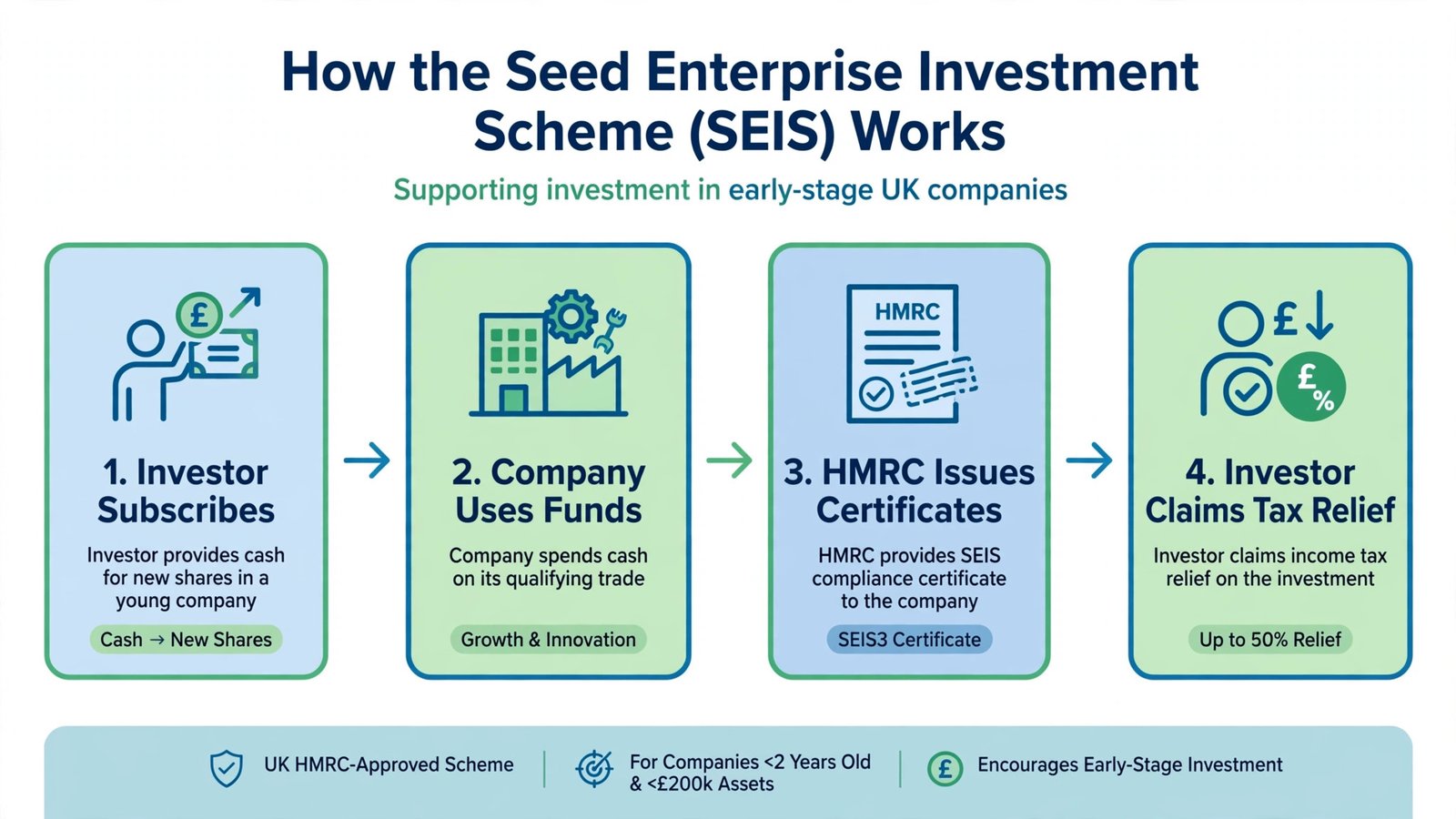
Your investors get up to five reliefs — the reason SEIS money is easier to raise than ordinary seed money. The headline is 50% income tax relief: an investor who puts in £50,000 can cut their tax bill by £25,000, provided they have enough tax liability to absorb it and follow the claim rules in HMRC’s helpsheet HS393.
| Relief | What the investor gets | Key conditions |
|---|---|---|
| Income tax relief | 50% of the amount invested, on up to £200,000 invested per tax year | Shares held at least 3 years; relief capped at the investor’s tax liability |
| Carry-back | Some or all of the shares can be treated as issued in the previous tax year | Subject to the previous year’s £200,000 limit and tax liability |
| CGT disposal relief | No capital gains tax on a gain when the SEIS shares are sold | Shares held at least 3 years, and full income tax relief given and not withdrawn |
| CGT reinvestment relief | 50% of a separate capital gain is exempt when the gain is reinvested in SEIS shares | Maximum £100,000 of gains exempt; investor must also claim SEIS income tax relief |
| Loss relief | If the company fails, the loss (after deducting income tax relief received) can be set against income or capital gains | Loss worked out after reducing the cost of the shares by income tax relief given and not withdrawn |
| Inheritance tax relief | SEIS shares can qualify for Business Relief, reducing or removing inheritance tax on them | Shares generally held at least 2 years; from 6 April 2026 the 100% rate is capped (see below) |
Three of these deserve a closer look, because investors ask about them.
Carry-back. An investor does not have to use all their relief in the year the shares are issued. Under the carry-back rules in helpsheet HS393, they can treat some or all of the shares as issued in the previous tax year and claim against that year’s tax instead — effectively letting a keen investor use two years of £200,000 allowances around a single round.
Capital gains reliefs. There are two. Disposal relief means a gain on the SEIS shares themselves is tax-free if the shares are held for at least 3 years and the income tax relief was given in full and never withdrawn. Reinvestment relief works the other way round: an investor who has made a gain elsewhere — selling a property or another business, say — can shelter 50% of it by reinvesting in SEIS shares, up to £100,000 of exempt gains.
Inheritance tax. Because SEIS shares are unquoted shares in a trading company, they can qualify for inheritance tax Business Relief once held for 2 years. One recent change matters: HMRC’s policy paper on the reforms to agricultural and business property relief confirms that from 6 April 2026, the 100% rate applies only to the first £2.5 million of combined business and agricultural property per person, with 50% relief above that. For most SEIS holdings that cap will never bite, but it is part of the picture after the Autumn Budget 2025 small business changes.
Worked example: a £50,000 SEIS investment
A worked example shows why investors like the scheme. Take an investor who subscribes £50,000 for new shares in your company, has enough income tax liability to use the full relief, and holds the shares as required.
If the company succeeds. The investor claims income tax relief of £25,000 (50% of £50,000), so the net cost of the investment is £25,000. If they sell after 3 years for £100,000, the £50,000 gain is exempt from capital gains tax under disposal relief — a £25,000 net outlay turned into £100,000, with no tax on the profit.
If the company fails completely. The shares are worthless, so the allowable loss is the £50,000 paid minus the £25,000 income tax relief already received: £25,000. Under share loss relief (ITA 2007, Part 4, Chapter 6; HMRC helpsheet HS286 explains the claim), that loss can be set against income of the year of the loss or the previous year. At 45%, it saves a further £11,250 of tax; at 20%, £5,000. A 45% taxpayer therefore recovers £36,250 of a £50,000 investment even in a total failure — a real loss of £13,750, not £50,000.
That downside protection is your pitch. But it only exists if your company qualifies and stays qualifying, which is why the next two sections matter more than the marketing.

Can your company qualify for SEIS?
Your company must meet every condition in GOV.UK’s SEIS guidance for companies, when the shares are issued and, for most conditions, for at least 3 years afterwards. There is no “close enough” — fail one and your investors get nothing.
- Lifetime raise limit: no more than £250,000 in total through SEIS. That figure includes other de minimis state aid received in the previous 3 years, and SEIS money counts towards the limits if you later raise through EIS or a venture capital trust.
- Gross assets: your company and any subsidiaries must not have gross assets of more than £350,000 when the shares are issued. Keep this separate from the £250,000 raise limit — the two figures are often confused, including by advisers.
- Employees: fewer than 25 full-time-equivalent employees in total when the shares are issued.
- Age of the trade: the company must carry out a new qualifying trade, and that trade must not have been carried on for more than 3 years — by you or by anyone who transferred it to you. A company that has already carried on a different trade before starting the new one will not qualify.
- UK base and listing: the company must be established in the UK, must not be trading on a recognised stock exchange when the shares are issued, and must have no arrangements to become a quoted company or a subsidiary of one.
- Independence: the company must not control another company (other than a qualifying subsidiary) and must not have been controlled by another company since incorporation.
- No earlier venture capital money: a company that has already received investment through EIS or from a venture capital trust cannot then use SEIS. Sequence matters — SEIS comes first.
- Risk to capital: the investment must genuinely be at risk and intended to help the company grow over the long term. Arrangements that protect investors — guaranteed returns, priority over others, an agreed exit — fail this condition outright.
- The shares: new, full-risk ordinary shares, paid up in full in cash when issued, not redeemable and carrying no special rights to the company’s assets.
- The trade: a genuine commercial trade carried on with a view to profit, which must not consist mostly of excluded activities — HMRC’s excluded list covers areas such as dealing in land, financial activities and leasing.
The money itself must be spent within 3 years of the share issue, and only on the qualifying trade, on preparing to carry it out, or on research and development expected to lead to it. Money spent on plant and equipment for the trade can also attract tax relief for the company itself through capital allowances for small businesses and the annual investment allowance, so plan the spending rather than letting it drift.
The rules your investors must meet
Investor conditions are your investors’ problem in law, but yours in practice — relief refused to an investor is a fundraising relationship damaged. The main ones: the investor must be an individual UK taxpayer; they must not, alone or with associates, control the company or hold more than 30% of its share capital, voting power or rights to assets on a winding-up (the “substantial interest” test in helpsheet HS393); and they must not be an employee of the company. Paid directors can generally invest in their own company under SEIS within the 30% limit — but anyone putting money in should confirm their own position first, not least because it interacts with separate issues such as an overdrawn director’s loan account if they have been funding the company informally.

SEIS or EIS: which scheme, and in which order?
EIS is SEIS’s bigger sibling: less generous per pound, but available to larger, older companies and able to raise far more. If your company qualifies for SEIS, use SEIS first — you cannot go back after taking EIS money, whereas SEIS money simply counts towards your later EIS limits.
| Feature | SEIS | EIS |
|---|---|---|
| Income tax relief for investors | 50% | 30% |
| Investor limit per tax year | £200,000 | £1 million (£2 million if the extra is invested in knowledge-intensive companies) |
| Maximum the company can raise | £250,000 in total | £5 million a year; £12 million lifetime (£20 million for knowledge-intensive companies) |
| Gross assets limit | £350,000 when shares are issued | £15 million before the share issue |
| Employee limit | Fewer than 25 full-time equivalents | Fewer than 250 (500 for knowledge-intensive companies) |
| Age of trade | New trade carried on for less than 3 years | Generally within 7 years of the first commercial sale (longer for knowledge-intensive companies) |
| CGT reinvestment relief | Yes — 50% of a gain exempt | No equivalent exemption (deferral only) |
Note that SEIS has no separate knowledge-intensive limits: the £200,000 investor allowance and the company limits are the same for every SEIS company. The knowledge-intensive variations in the table belong to EIS only.
How to raise under SEIS: advance assurance to SEIS3
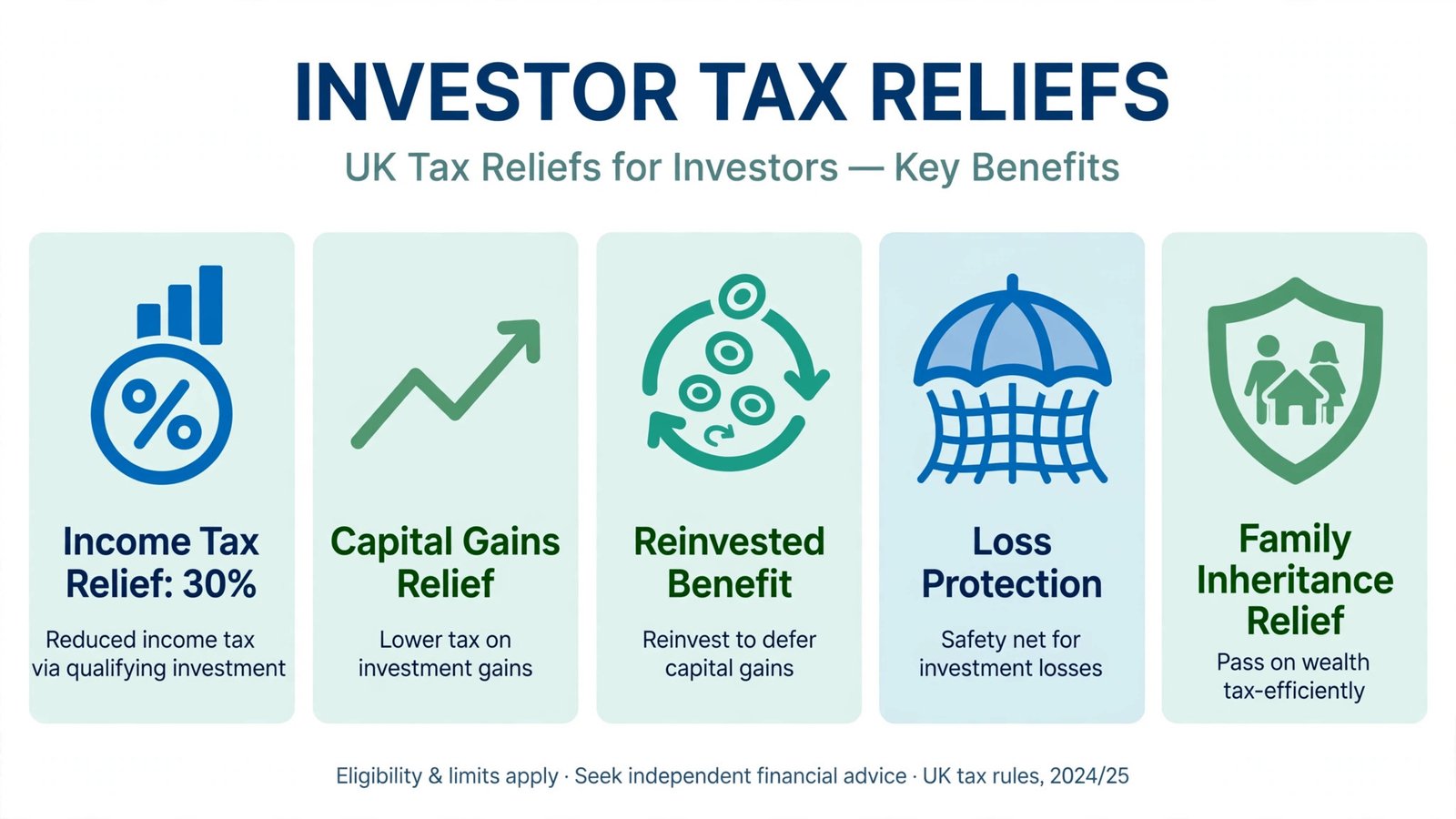
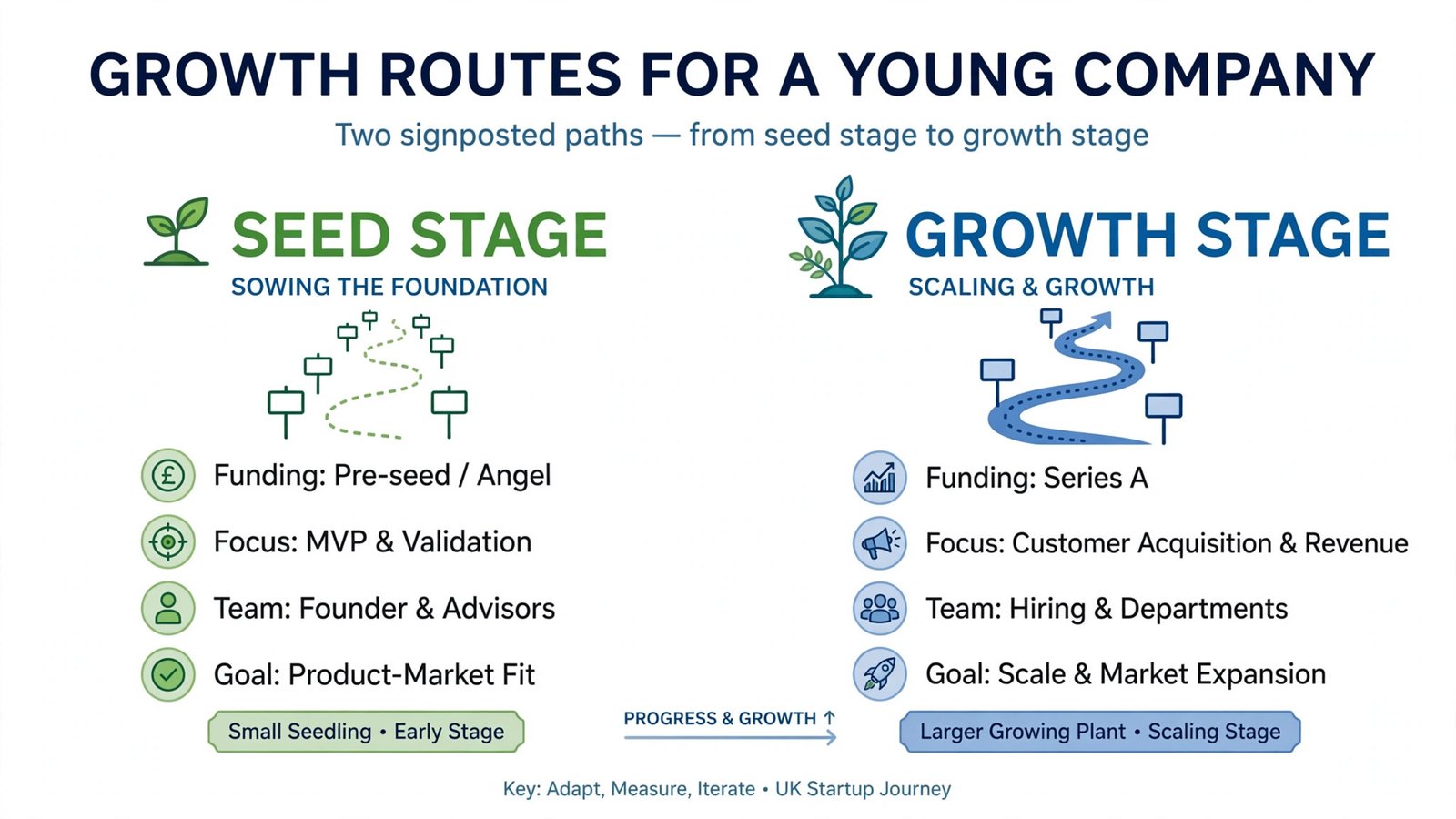
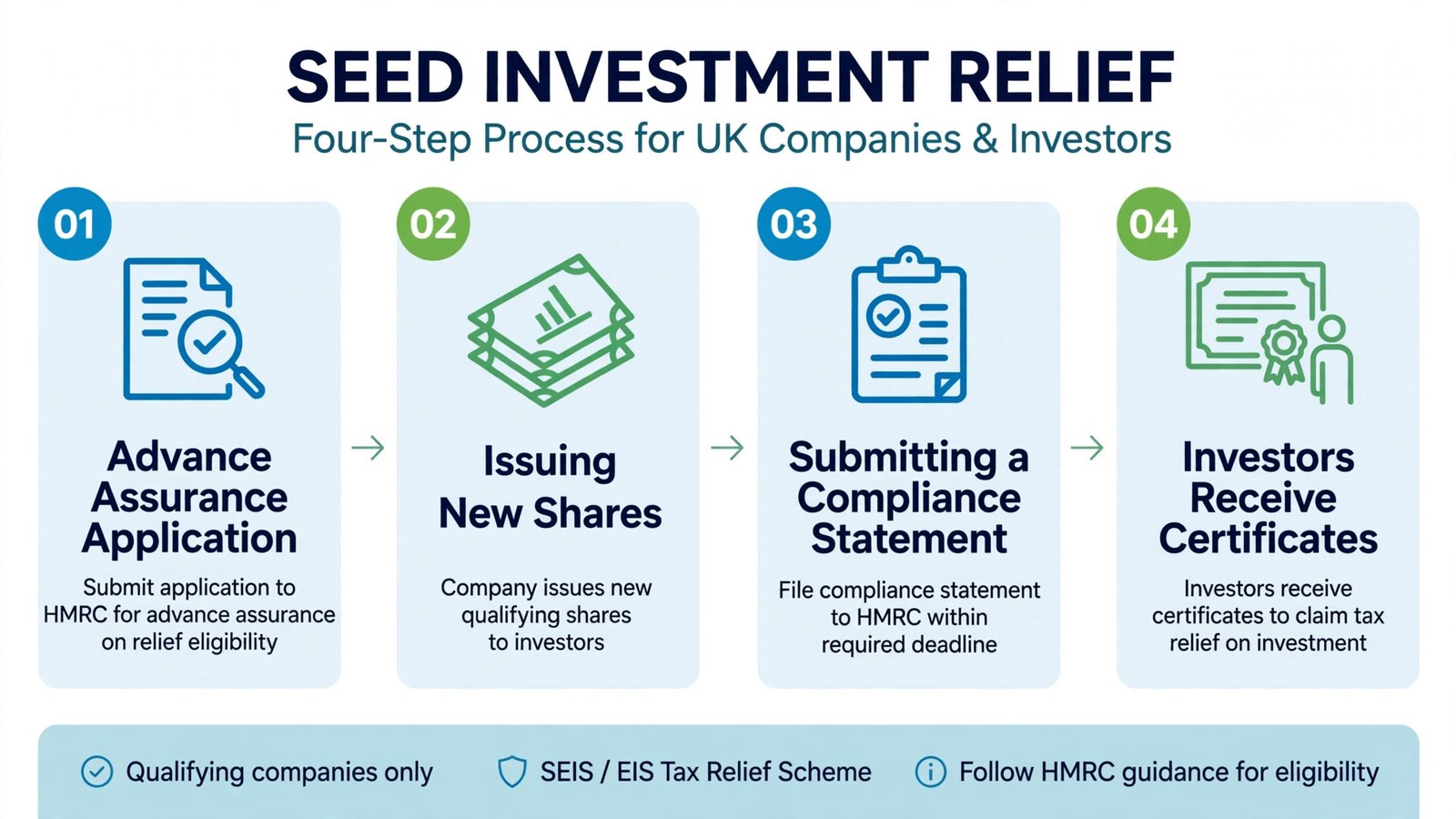
The process has three stages — get HMRC’s view before you raise, issue the shares, then complete the compliance paperwork that unlocks your investors’ claims. Investors cannot claim a penny until the final stage, so treat the admin as part of the raise, not an afterthought.
- Apply for advance assurance (optional, but do it). Advance assurance is HMRC’s statement that a proposed investment is likely to qualify, based on the information you supply. Most serious investors will not commit without it. GOV.UK’s advance assurance guidance sets out what HMRC needs: your business plan and forecasts, latest accounts if you have them, details of the trade and how the money will be spent, your articles of association, your investor documents, and an explanation of how you meet the risk to capital condition. Raising directly from individuals for the first time? Expect to name your prospective investors. GOV.UK publishes no guaranteed response time — HMRC contacts you when a decision is made — so build several weeks into your timetable rather than promising investors a date.
- Issue the shares. Investors subscribe cash for new ordinary shares, paid in full on issue. There must be no arrangement to guarantee the investment, protect the investor from risk or sell the shares back during the investment period.
- Submit form SEIS1 after the shares are issued. This compliance statement is the company’s formal claim that the conditions are met. You can only submit it once the company has either carried on the new qualifying trade for at least 4 months, or spent at least 70% of the money raised — one statement per share issue. HMRC’s Venture Capital Schemes Manual (VCM35020) stresses the details must be exactly right, because your investors’ certificates are generated from it.
- Receive form SEIS2 and the Unique Investment Reference. If HMRC accepts the statement, it sends an authorisation letter (form SEIS2) with a Unique Investment Reference (UIR) and blank compliance certificates.
- Issue form SEIS3 to each investor. You complete a certificate for each investor, including the UIR, and send it to them. Only then can investors claim — through their Self Assessment return, or using the claim form in the SEIS3 for carry-back — and they may be asked to show the certificate, so tell them to keep it safe.
- Stay qualifying for 3 years. The conditions must continue to be met for at least 3 years after the investment. Diarise the spending deadline — all money spent on the trade within 3 years of the issue — and think before any restructuring or change of trade in that window.
What can go wrong: clawback and the risks for founders
Relief under SEIS is granted first and policed afterwards. If the conditions stop being met within 3 years of the share issue, HMRC withdraws relief from your investors — and they will know exactly whose paperwork caused it. The company guidance is blunt: reliefs will be withheld, or withdrawn, if you break the rules within 3 years of the investment.
The common triggers are these. The company stops qualifying: it is taken over, starts a non-qualifying or excluded trade, or fails to spend the money on the trade within 3 years. The investor side breaks: an investor sells shares within 3 years (a transfer to a spouse or civil partner is the main exception), receives value back from the company — a loan, a benefit, a repayment that is not an ordinary dividend — or becomes an employee. And the quiet killer: arrangements in place from the start, such as a side agreement guaranteeing an exit, which can mean relief was never due at all.
Two practical protections. First, keep evidence as you go: bank records showing when the money was spent and on what, board minutes, and copies of everything sent to HMRC. Second, take advice before any corporate change in the 3-year window — a new funding round or bringing an investor onto the payroll can have SEIS consequences that are cheap to check in advance and expensive to unwind.
Be honest with investors about the underlying risk, too. SEIS shares are illiquid, cannot be sold on a market, and seed-stage companies fail often. The tax reliefs reduce the cost of failure; they do not reduce its likelihood.

Frequently asked questions
How much can my company raise under SEIS?
A maximum of £250,000 in total, over the company’s whole life — not per year and not per round. The total includes de minimis state aid received in the previous 3 years, and SEIS investment counts towards the limits for any later EIS or venture capital trust fundraising.
How much tax relief do SEIS investors get?
Income tax relief at 50% of what they invest, on up to £200,000 per tax year — a maximum of £100,000 off their tax bill in a year — plus carry-back, capital gains reliefs, loss relief if the company fails, and possible inheritance tax Business Relief after 2 years. They must have enough tax liability to absorb the relief; it cannot take their bill below zero.
Does my company qualify for SEIS?
Only if it meets every test at the share issue and stays qualifying: gross assets of no more than £350,000, fewer than 25 full-time-equivalent employees, a new qualifying trade carried on for less than 3 years, established in the UK and unquoted, independent, and no previous EIS or venture capital trust investment. If you are unsure, advance assurance exists precisely for this question.
Do I need advance assurance before raising SEIS money?
No — it is optional, and you can issue shares without it. In practice most founders should apply anyway: investors treat it as basic due diligence, and HMRC will be bound by the assurance if the facts you gave were accurate and the compliance statement matches them. Apply early: GOV.UK gives no guaranteed turnaround time.
When can my investors actually claim their relief?
Only after you have submitted form SEIS1, HMRC has authorised the issue with form SEIS2, and you have given each investor their form SEIS3 certificate. You cannot submit the SEIS1 until the company has traded for at least 4 months or spent at least 70% of the money — so build your investors’ expectations around months, not days.
Can I use SEIS and EIS together?
Yes, and many companies do — SEIS for the first round, EIS for later, larger rounds. The order is fixed: take SEIS first, because a company that has received EIS or venture capital trust investment can never use SEIS afterwards. The SEIS money counts towards your EIS lifetime limits.
What happens if the company fails?
Investors can claim loss relief. Their allowable loss is what they paid minus any income tax relief received and not withdrawn, set against income at their marginal rate (45%, 40% or 20%) or against capital gains. On a £50,000 investment that fails completely, a 45% taxpayer’s total tax recovery reaches £36,250, as the worked example above shows.
Conclusion
For the right company, SEIS is the cheapest equity you will ever raise: investors effectively pay half price for their shares, so a round that would fail on cold commercial terms can succeed. But the generosity is conditional. The limits — £250,000 raised, £350,000 of gross assets, fewer than 25 staff, a trade under 3 years old — the share rules, the spending rules and the SEIS1-to-SEIS3 paperwork all bind you for 3 years after the money arrives.
Do the eligibility check before you pitch, get advance assurance, and treat the compliance statement as a closing task of the raise. Get those right, and SEIS does the selling for you. And if the raise funds your first hires, budget for the full cost of employing them, including employer National Insurance contributions, before you fix the amount to raise.

This article is general information about the Seed Enterprise Investment Scheme for UK founders, not financial, tax or investment advice. SEIS investment is high-risk: shares are illiquid, most very early-stage companies fail, and tax relief depends on individual circumstances and on rules that can change. Take regulated advice before raising or investing under the scheme.