

If your business stores customer emails in Gmail, keeps a spreadsheet of client phone numbers, or sends out a newsletter through Mailchimp, there’s a good chance you’re legally required to register with the Information Commissioner’s Office and pay an annual fee. Miss it, and you risk a fine of up to £4,350 — even if you never intended to break the law.
This guide cuts through the legal jargon and tells you exactly where you stand: whether you need to register, how much it costs, who’s exempt, and how to get it done properly.
—
What Is ICO Registration (and Why Does Your Small Business Need It)?
Direct answer: ICO registration is the legal process of paying an annual data protection fee to the UK’s data protection regulator, required of most organisations and sole traders that process personal information electronically.
What Is the Information Commissioner’s Office?
The Information Commissioner’s Office (ICO) is the UK’s independent regulator for data protection and information rights. It enforces the UK GDPR and the Data Protection Act 2018, investigates complaints, and issues fines to organisations that mishandle personal data or fail to register when required.
The Legal Basis: UK GDPR and the Data Protection Act 2018
Registration isn’t optional guidance — it’s a statutory requirement. Under the Data Protection Act 2018, every organisation or sole trader that processes personal information using automated systems must pay a data protection fee to the ICO, unless they are exempt. The fee itself is set by regulations made under DSIT (the Department for Science, Innovation and Technology), not by the ICO directly, which is why the amount changes periodically through parliamentary regulation rather than ICO policy.
—
Do All UK Small Businesses Need to Register with the ICO?
Direct answer: No. Registration depends on how you handle personal data, not on your business size. A one-person sole trader can be required to register, while a larger business that never touches personal data digitally might not be.
The Core Rule: Processing Personal Information Digitally
The test isn’t your turnover or headcount — it’s whether you process personal data electronically. This is the gap most guides leave open, so let’s close it with real examples. If any of the following applies to you, you are almost certainly processing personal data:
- Saving client names and phone numbers in an Excel spreadsheet
- Using Mailchimp, Klaviyo, or a similar tool to send newsletters
- Storing customer emails in Gmail or Outlook to manage enquiries
- Keeping a CRM (even a free one) with contact details
- Taking online bookings or orders that capture names and addresses
- Running payroll software that holds employee records
None of these require anything sophisticated. A shared spreadsheet on Google Drive counts just as much as an enterprise database.
What Counts as “Personal Data” for a Small Business?
Personal data is any information that can identify a living individual, either on its own or combined with other information you hold. Names, email addresses, phone numbers, IP addresses, and even a customer’s purchase history all qualify. It doesn’t need to be sensitive — an ordinary mailing list is personal data.
—
ICO Exemptions: Who Doesn’t Have to Pay?
Who is exempt from the ICO fee?
- You only process personal data for staff administration (payroll, HR records for your own employees)
- You only process data for advertising, marketing and PR for your own business using existing customer or supplier contacts
- You only keep accounts and records for your own business purposes (invoicing, bookkeeping)
- You process data entirely on paper, with no computer or automated system involved anywhere in the process
- You’re a not-for-profit processing data only for establishing or maintaining membership or support
- You process data only to maintain a public register, such as one required by law
The “Core Business Purposes” Exemption (Staff, Accounts & Marketing)
This is the exemption most small businesses hope applies to them, and sometimes it genuinely does. If the only personal data you hold is for running payroll, managing your own accounts, or basic marketing to existing customers, you may be exempt. The moment you add anything beyond that — a customer database for service delivery, an app that logs user activity, or a CCTV system — the exemption stops covering you.
Are Sole Traders and Freelancers Exempt?
Not automatically. Being a sole trader has nothing to do with exemption status. If you’re a freelance designer, consultant, or tradesperson who keeps a spreadsheet of client contact details or uses invoicing software that stores customer data, you’re processing personal data electronically and you likely need to register, regardless of how small your operation is.
The CCTV Catch: Why Security Cameras Make Registration Mandatory
This is the single most overlooked trap in ICO compliance, and it catches out cafes, shops, salons, and offices constantly. Running any of the following instantly removes your exemption, no matter how minimal your other data processing is:
- A shop or office security camera
- A smart doorbell (such as a Ring or Nest device) at a business premises
- A dashcam fitted in a business vehicle
- Any CCTV used for crime prevention, even if footage is rarely reviewed
Many business owners believe their “core business purposes” exemption covers them because they only use CCTV for security. It doesn’t. If the camera can capture identifiable images of people — customers, staff, or passers-by — you are processing personal data and must register, full stop.
—
How Much Does ICO Registration Cost? (The Tier System Explained)
Direct answer: Most small businesses pay either £52 or £78 a year, depending on turnover and staff numbers. These are the current rates, which increased from the older £40/£60/£2,900 figures on 17 February 2025 and have not changed again since.
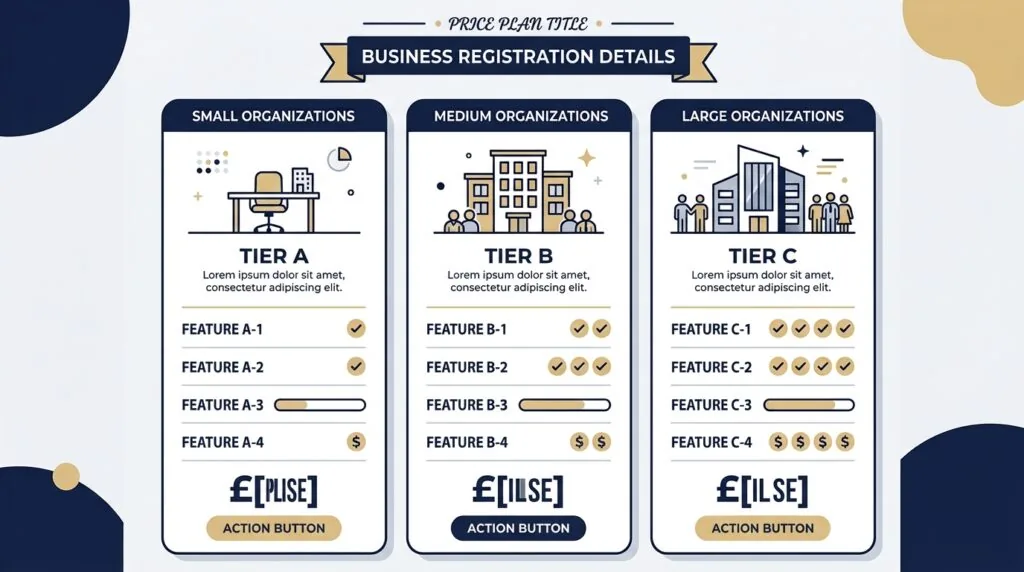
| Tier | Who It Applies To | Annual Fee | Fee by Direct Debit |
|---|---|---|---|
| Tier 1 | Micro-organisations: turnover under £632,000 or no more than 10 staff | £52 | £47 |
| Tier 2 | Small and medium organisations: turnover under £36 million or no more than 250 staff | £78 | £73 |
| Tier 3 | Large organisations exceeding Tier 1 and Tier 2 thresholds | £3,763 | £3,758 |
Tier 1: Micro-businesses and Small Orgs
Most sole traders, freelancers, and small limited companies fall into Tier 1. You qualify if your turnover is under £632,000 for the financial year or you have 10 or fewer staff — you only need to meet one of these conditions, not both.
Tier 2: Medium-Sized Businesses
If you’ve outgrown Tier 1 thresholds but stay under £36 million turnover or 250 staff, you’re in Tier 2. Growing businesses should recheck their tier annually, since crossing these thresholds mid-year won’t automatically update your fee until renewal.
Tier 3: Large Corporations
Anything above the Tier 2 limits defaults to Tier 3. Importantly, the ICO treats every controller as Tier 3 by default until you actively confirm otherwise through registration — so failing to register doesn’t put you in a lower tier by accident, it puts you at risk of being assessed at the highest one.
The Direct Debit Discount
Paying by direct debit saves you £5 a year on any tier. It’s a small saving, but it also means your renewal happens automatically each year, which helps avoid accidentally lapsing and facing a penalty for late renewal.
Step-by-Step Guide: How to Register with the ICO
Direct answer: Registration takes about 15 minutes online and is done directly through the ICO’s website — there’s no need to use a third-party agent, though some accountants offer it as an add-on service.
- Run the official ICO self-assessment. Before applying, use the ICO’s free online tool to confirm whether you need to register and which tier applies to you. This prevents you from overpaying or registering unnecessarily.
- Gather your business information. Have your company name (or trading name if you’re a sole trader), address, Companies House number (if applicable), nature of business, and a contact email ready.
- Complete the online registration form. The ICO’s registration portal walks you through confirming your tier, entering your business details, and reviewing your data processing activities.
- Pay your annual data protection fee. You can pay by card, direct debit, or cheque. Direct debit is generally the most convenient, since it renews automatically each year.
Once registered, your details are added to the public register of data controllers, and you’ll receive a registration number and certificate. Renewal is required annually — the ICO will email you before your renewal date, but the legal obligation to renew on time sits with you, not with them.
—
Penalties & Fines: What Happens If You Don’t Register?
Direct answer: Failing to register when required is a criminal offence under the Data Protection Act 2018, and the ICO can issue a fine of up to £4,350 for non-compliance.
The ICO doesn’t rely on businesses self-reporting their own failure to register. It regularly cross-references its public register of data controllers against Companies House records. If a company appears on Companies House but not on the ICO’s register, and there’s evidence it processes personal data, it becomes a target for a compliance check. This is how many small businesses receive an unexpected letter years after incorporating — the mismatch gets flagged automatically, not through an investigation of their specific activities.
Beyond the fine itself, unregistered businesses lose credibility with clients and partners who may ask for your ICO registration number as part of their own supplier due diligence, particularly in B2B contracts and tenders.
—
How to Check if Your Business (or a Competitor) Is Already Registered
The ICO maintains a free, public Register of Data Controllers that anyone can search by company name, individual name, or registration number. This is useful for three reasons:
- Confirming your own registration is active and hasn’t lapsed
- Checking a supplier’s compliance status before signing a contract
- Verifying a competitor’s registration details for benchmarking purposes
Search results show the registered tier, registration date, and renewal status, all of which are public information by design.
—
Frequently Asked Questions About UK ICO Registration
Do I need to register with the ICO if I’m a sole trader?
Yes, if you process personal data electronically — such as keeping a client list in a spreadsheet or using invoicing software — you need to register regardless of being a sole trader. Being self-employed doesn’t create an automatic exemption.
How much is the ICO fee for a small business?
Most small businesses pay £52 a year (Tier 1) or £78 a year (Tier 2), reduced by £5 if paid by direct debit. The fee depends on turnover and staff numbers, not business type.
Is ICO registration compulsory for sole traders?
It’s compulsory for any sole trader processing personal data electronically and not covered by an exemption such as core business purposes only. It is not compulsory if you genuinely only process data on paper or fall entirely within an exempt category.
What is the penalty for not registering with the ICO?
The ICO can issue a fine of up to £4,350 for failing to register when required, and non-registration is treated as a criminal offence under the Data Protection Act 2018.
Who is exempt from the data protection fee?
Businesses that only process data for staff administration, accounts and records, or marketing to their own existing customers may be exempt — provided they don’t also use CCTV, run customer databases, or process data for any purpose outside these core categories.