

If a member of the public is injured or their property is damaged because of your business, they can sue you for compensation. Public liability insurance (PLI) pays your legal fees and any compensation awarded, up to the limit you choose. It isn’t a legal requirement for most UK businesses, but most clients, landlords and local councils will refuse to work with you without it.
This guide explains exactly what public liability insurance covers, how much cover you actually need, what it costs, and how to buy the right policy without overpaying.
What is Public Liability Insurance (PLI)?
Public liability insurance covers the cost of compensation claims made by members of the public for injury or property damage caused by your business. This includes legal defence costs, medical expenses, and any compensation a court orders you to pay.
Legal Definition & Core Purpose
PLI exists to protect your business from the financial fallout of an accident. If a customer trips over stock left in your shop aisle, or a client slips on a wet floor at your premises, PLI covers the claim. Without it, you’d be paying compensation and legal fees out of your own pocket — and claims regularly run into tens of thousands of pounds.
The policy responds to negligence: situations where a court decides your business failed to take reasonable care, and that failure caused harm to someone outside your business.
What is a “Third Party” in UK Law?
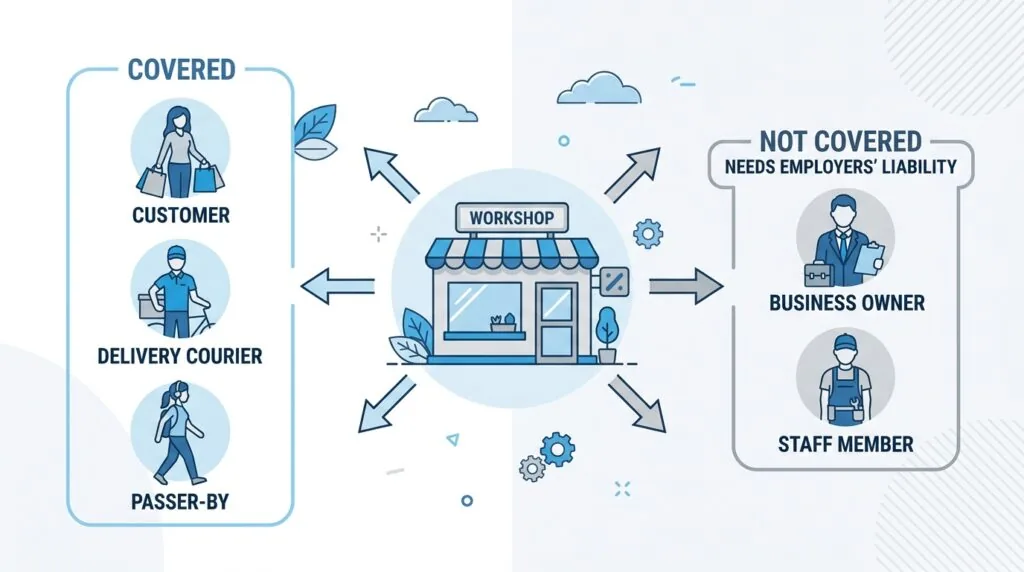
A “third party” is anyone who isn’t you or your employee — a customer, a passer-by, a client, a delivery driver, or a member of the public visiting your premises. Public liability insurance only covers claims from these third parties. It does not cover your own employees (that’s a separate policy — see below) and it doesn’t cover you or your business partners.
Is Public Liability Insurance a Legal Requirement in the UK?
Public liability insurance is not a legal requirement in the UK. No law forces you to hold it, regardless of your business type. However, it’s often required by clients, landlords, trade bodies and local authorities before they’ll let you work with them — which makes it a practical necessity for most small businesses.
Public Liability vs Employers’ Liability Insurance (The Legal Distinction)
This is the point of most confusion, so here’s the direct answer: the main difference between public liability and employers’ liability is who is covered. Public liability protects you against claims from the public. Employers’ liability protects you against claims from your own staff if they’re injured or become ill because of their work.
Employers’ liability insurance is a legal requirement under the Employers’ Liability (Compulsory Insurance) Act 1969 if you employ anyone — including part-time staff, casual workers, and most subcontractors you direct day-to-day. Sole traders with no employees don’t need it. The Health and Safety Executive (HSE) can fine you up to £2,500 for every day you operate without it when required.
| Public Liability Insurance | Employers’ Liability Insurance | |
|---|---|---|
| Legally required? | No | Yes, if you have employees |
| Who it protects you against | Members of the public, clients, customers | Your own employees |
| Typical minimum cover | £1m–£10m | £5m (statutory minimum) |
| Governing legislation | None (voluntary) | Employers’ Liability (Compulsory Insurance) Act 1969 |
If you’re about to take on staff for the first time, it’s worth understanding your obligations before you do — see our guide on hiring your first employee.
When Public Liability Becomes Practically Mandatory
Even though the law doesn’t require it, PLI becomes mandatory in practice when:
- A client contract specifies a minimum level of cover before work can start
- You’re bidding for a local council or public sector contract
- You’re joining a trade association (many require proof of cover as a condition of membership)
- You’re renting commercial premises or a market stall, and the landlord requires it
- You’re working as a subcontractor for a main contractor who insists on it
If you don’t have proof of cover when asked, you’ll typically lose the contract on the spot. This is the real-world reason most UK sole traders and small businesses buy PLI, regardless of legal obligation.
What Does Public Liability Insurance Cover?
Public liability insurance covers compensation claims, legal fees and associated costs when your business activities cause accidental bodily injury or property damage to a third party. Here’s what that means in practice.
Accidental Bodily Injury to the Public
This covers injuries to customers, clients or passers-by that happen because of your business. Examples include a customer slipping on an unmarked wet floor, a client tripping over a trailing cable at your stand, or a passer-by being hit by equipment falling from scaffolding.
Accidental Damage to Third-Party Property
If your work damages a client’s property, PLI covers the repair or replacement cost. A plumber who causes a flood, an electrician who starts a fire, or a decorator who spills paint on a client’s carpet would all typically be covered here.
Legal Defence Fees and Compensation Costs
Even if a claim against you is unfounded, defending it costs money — often several thousand pounds in solicitor and court fees alone. PLI covers your legal fees, whether or not the claim succeeds, plus any compensation a court orders.
Product Liability Cover (The Essential Add-on)
If you manufacture, sell or supply physical products, product liability cover protects you if a product you’ve sold causes injury or damage after it leaves your hands — a faulty candle that causes a house fire, or food that causes illness, for example. Most public liability policies include product liability as standard, but always check the policy wording; some insurers sell it as an optional extra.
What is NOT Covered? (Common Policy Exclusions)
Public liability insurance has clear limits. Knowing what it excludes stops you from assuming you’re protected when you’re not.
Employee Injuries and Internal Business Assets
PLI does not cover injuries to your own staff (that’s employers’ liability), and it does not cover damage to your own equipment, stock, tools or premises (that needs business contents or equipment cover — see our general guide to UK business insurance for the full picture of what else you might need).
Professional Mistakes (Why You Need Professional Indemnity)
PLI covers physical injury and property damage — it does not cover financial loss caused by bad advice, a design error, or a missed deadline. If you’re a consultant, designer, accountant or anyone giving advice or delivering professional services, you need professional indemnity insurance as well. A consultant who spills coffee on a client’s laptop needs public liability; a consultant whose bad financial advice costs a client money needs professional indemnity. They are not interchangeable.
How Much Public Liability Cover Does Your UK Small Business Need?
There’s no single legal figure to aim for, but most UK small businesses land on £1 million, £2 million, £5 million or £10 million of cover, depending on their risk and who they work with.
The Indemnity Limits Explained: £1 Million vs £5 Million vs £10 Million
| Indemnity Limit | Typically Suits | Why |
|---|---|---|
| £1 million | Very low-risk, home-based or clerical businesses (e.g. bookkeepers, virtual assistants) | Minimal public contact and low claim severity |
| £2 million | Freelancers and small trades with occasional client site visits | Balances cost against moderate public-facing risk |
| £5 million | Most tradespeople, retailers and businesses with regular public contact | The most commonly requested minimum in client and landlord contracts |
| £10 million | Businesses tendering for local council or public sector work, high-risk trades, larger sites | Public sector procurement frameworks routinely set this as a condition of tender |
Most UK clients and local authorities will expect small businesses to hold a minimum of £5 million in public liability cover before they’ll sign a contract. This isn’t arbitrary — it reflects the fact that a serious injury claim (a fall from height, a life-changing injury) can easily result in a six or seven-figure settlement once loss of earnings, ongoing care costs and legal fees are factored in.
The jump from £1m to £5m or £10m rarely costs as much as people expect — insurers price indemnity limits on a sliding scale, and the difference is often just a few pounds a month, because the probability of a claim reaching the very top of the limit is low. If you’re planning to bid for council contracts, it’s worth checking the procurement portal’s insurance requirements before you quote, so you’re not caught out mid-tender.
Factors That Dictate Your Level of Cover
- Who you work with — public sector and larger corporate clients almost always specify £5m or £10m in their contracts
- How much public contact you have — a shop or a busy trade van has more exposure than a home-based consultant
- The severity of harm your work could cause — a scaffolder or electrician carries higher risk than a graphic designer
- Trade body or membership requirements — many trade associations set a minimum indemnity level for members
- Subcontractor status — if you use subcontractors, or work as one, your required limit may be set by whoever holds the head contract
How Much Does Public Liability Insurance Cost?
Public liability insurance for a UK small business typically costs between £50 and £150 a year for low-risk trades, and £150–£500+ a year for higher-risk trades, though the exact premium depends on your industry, turnover, claims history and chosen indemnity limit.
Key Cost Drivers: Business Risk Profile, Industry Sector, and Location
Insurers price your premium based on:
- Industry sector — a roofer or scaffolder pays more than a bookkeeper because the potential severity of a claim is higher
- Turnover — higher turnover generally means more public contact and a higher premium
- Claims history — a clean claims record earns a no-claims discount over time
- Indemnity limit chosen — £10m costs more than £1m, but not proportionally more
- Policy excess — choosing a higher excess (the amount you pay towards a claim before the insurer contributes) usually lowers your premium
- Location — businesses operating in higher-footfall urban areas can see slightly higher premiums than rural, low-traffic operations
Average Premiums for UK Sole Traders and Small Businesses
| Business Type | Typical Annual Premium (£1m–£5m cover) |
|---|---|
| Virtual assistant / bookkeeper (home-based) | £40–£80 |
| Freelance consultant or designer | £60–£120 |
| Hairdresser / beautician (mobile or salon) | £70–£150 |
| Cleaner (domestic or commercial) | £80–£160 |
| Tradesperson (electrician, plumber, joiner) | £120–£300 |
| Builder / roofer / scaffolder | £250–£600+ |
These are indicative ranges — always get quotes from more than one insurer or broker. For a wider view of what else your business might need to budget for, see our roundup of affordable business insurance options in the UK.
Real-World Claims Examples for UK Small Businesses
Abstract explanations don’t tell you much. Here’s what actual claims look like.
Case Study 1: The Retail/Office Slip-and-Trip Claim
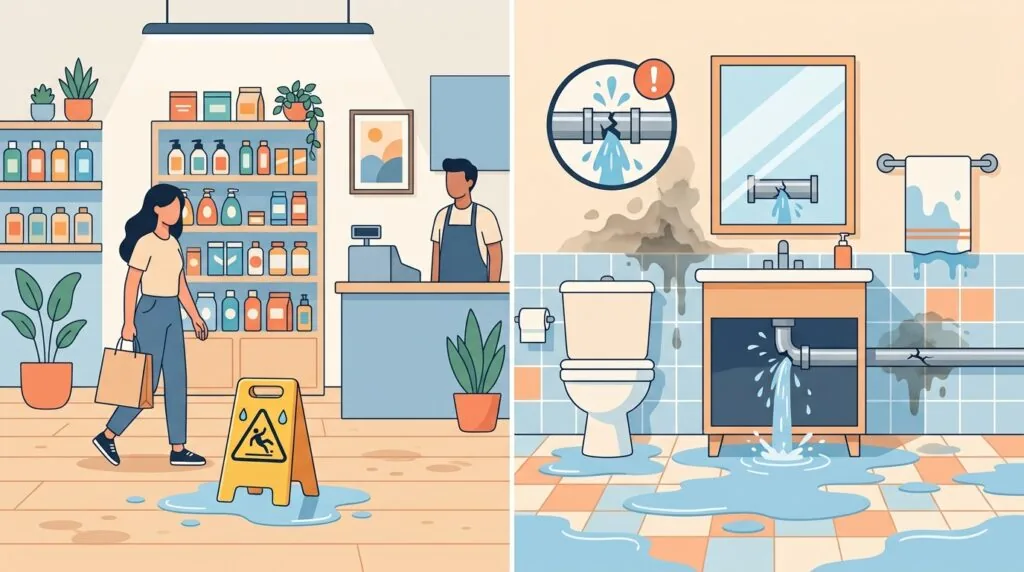
A customer visiting a small independent shop slips on a freshly mopped floor that had no warning sign displayed. She fractures her wrist and is unable to work for six weeks. Her claim covers medical costs, loss of earnings and general damages for pain and suffering. The total settlement, including the shop’s legal defence costs, comes to around £18,000. Without public liability insurance, this would have come directly out of the business’s cash flow — enough to seriously damage, or close, a small independent retailer.
Case Study 2: The Tradesperson Property Damage Claim
A self-employed plumber fitting a new bathroom accidentally punctures a pipe behind a wall, causing a leak that floods the client’s kitchen below and damages flooring, cabinetry and a client’s electrical appliances. Repair costs, including drying out the property and replacing damaged items, come to £14,500. Because the damage was accidental and directly caused by the plumber’s work, it’s a textbook public liability claim — and one of the most common types of claim tradespeople face.
How to Choose the Right Public Liability Policy
- Work out your minimum required limit first. Check any client contracts, tender documents or trade body rules before comparing quotes — this determines your minimum indemnity level, not the other way round.
- Check what’s included as standard. Product liability, legal expenses cover and subcontractor cover vary between insurers — don’t assume they’re all bundled in.
- Clarify your subcontractor position. If you use bona-fide subcontractors (self-employed, working under their own control) they usually need their own PLI. Labour-only subcontractors, who work under your direct supervision, are often covered under your policy — but this varies by insurer, so confirm it in writing rather than assuming.
- Don’t assume home-based means exempt. If you meet clients at home, store stock at home, or have deliveries and visitors to your property, you can still be liable for an accident — home-based businesses face the same third-party risks as any other, and standard home insurance won’t cover business-related claims. If you run your business from home, it’s worth reading our guide on running a business from home in the UK alongside your insurance decision.
- Compare the excess, not just the premium. A cheaper policy with a high excess can cost you more overall if you ever need to claim.
- Buy from an FCA-regulated broker or insurer. The Financial Conduct Authority (FCA) regulates UK insurance providers, and policies are backed by the Financial Services Compensation Scheme (FSCS) if the insurer fails. Always check FCA authorisation before buying.
- Review your cover annually. As your turnover, client base or contract requirements change, your indemnity limit should keep pace.
Frequently Asked Questions
Is public liability insurance compulsory for sole traders in the UK?
No. There’s no legal requirement for sole traders to hold public liability insurance. In practice, though, most clients, landlords and trade bodies will require proof of cover before they’ll work with you.
What is the difference between public liability and employers’ liability?
Public liability covers claims from members of the public and clients. Employers’ liability covers claims from your own staff and is a legal requirement if you employ anyone.
Do I need public liability insurance if I work from home?
Yes, if your business involves any contact with clients, customers or deliveries at your property, or if your work could cause injury or damage elsewhere. Standard home insurance does not cover business liability.
How much public liability insurance do I need for a local council contract?
Most local authority and public sector contracts require a minimum of £5 million, and some specify £10 million. Always check the specific tender or contract documentation, as requirements vary by council and project size.
Does public liability insurance cover subcontractors?
It depends on the type of subcontractor and the insurer. Bona-fide, self-employed subcontractors working under their own control usually need their own policy. Labour-only subcontractors working under your direct supervision may be covered under your policy — confirm this with your insurer before relying on it.
Can I get public liability insurance for a single event or short-term contract?
Yes. Many insurers offer short-term or single-event public liability policies, which suit market traders, event organisers and businesses that only need cover for a specific job or occasion.