
Simplified expenses let sole traders claim three common costs at HMRC flat rates instead of working out what they actually spent: running a vehicle, working from home, and living at your business premises. No bills to split, no room-by-room maths. But simpler is not the same as bigger. For some traders the flat rate beats the real cost; for others it quietly caps a claim worth hundreds of pounds more. This guide gives you the 2026/27 rates, the rules that catch people out, and two worked examples showing when simplified wins — and when it loses.
This guide reflects HMRC guidance as reviewed on 2 November 2026.
Simplified expenses in short: sole traders — and partnerships where every partner is an individual — can claim vehicle costs at 55p a mile for the first 10,000 business miles in 2026/27 (25p after that), working from home at £10 to £26 a month by hours, and a flat £350 to £650 a month private-use deduction if you live at your business premises. You choose category by category, claim on your Self Assessment return, and claim everything else at actual cost.
What are simplified expenses?
Simplified expenses are an optional set of flat rates, set out in Chapter 5A of the Income Tax (Trading and Other Income) Act 2005 (ITTOIA 2005), that replace your actual costs for three things only: vehicles, working from home, and living at your business premises. Every other expense is still claimed at what it actually cost you.
They have been around since April 2013 (Schedule 5, Finance Act 2013), and there is no limit on how much your business can earn and still use them (BIM75001). You can also use them whether or not you use the cash basis — the two schemes are separate, as explained below.
HMRC publishes a simplified expenses checker on GOV.UK that compares the flat rate with your actual costs. Use it — but it only gives you a number for this year. It does not warn you about the vehicle lock-in, or that next year’s costs may look different.
Vehicles: the mileage flat rate
For cars and vans, the flat rate is 55p a mile for the first 10,000 business miles in 2026/27, then 25p a mile. That 55p rate is new: it rose from 45p on 6 April 2026, and GOV.UK’s simplified expenses page shows both years side by side. If a guide, calculator or your software still says 45p for this year, it is out of date. Miles you drove in 2025/26 — the year most people are filing returns for now — still use 45p.
| Vehicle | 2026/27 | 2025/26 and earlier |
|---|---|---|
| Cars and goods vehicles (vans), first 10,000 business miles | 55p per mile | 45p per mile |
| Cars and goods vehicles, after 10,000 miles | 25p per mile | 25p per mile |
| Motorcycles | 24p per mile | 24p per mile |
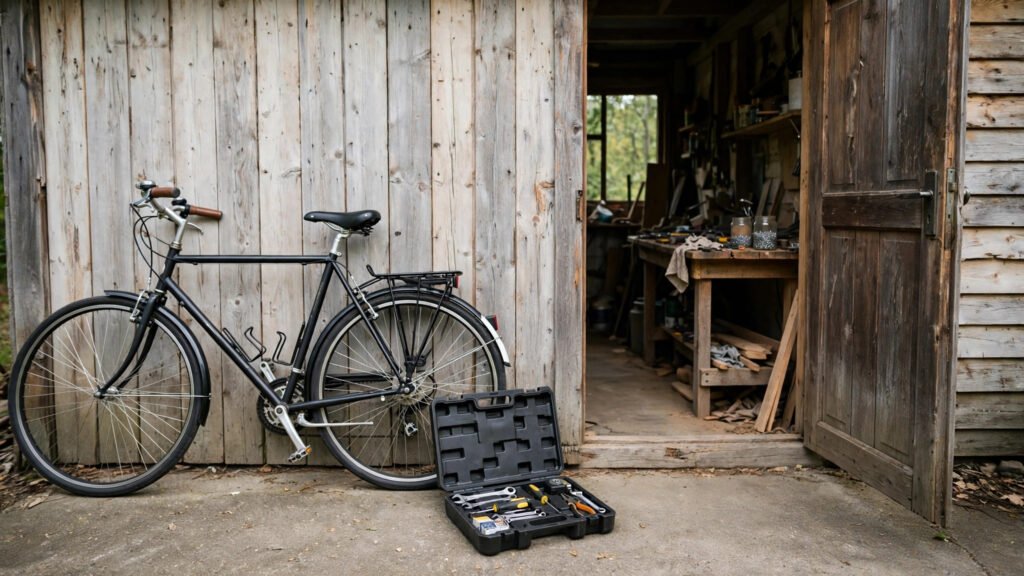
| Bicycles | No rate — not covered | No rate — not covered |
The rate covers everything to do with owning and running the vehicle: fuel, insurance, servicing, repairs, road tax, MOT and depreciation (BIM75005). Electric cars and vans get the same rates — there is no separate electric rate — and how many passengers you carry makes no difference.
One myth needs clearing up: there is no bicycle rate in simplified expenses. The 20p-a-mile figure people quote is the rate an employer can reimburse an
The rules that bite
Four rules matter more than the rates themselves:
- No capital allowances on the same vehicle — ever. If you have ever claimed capital allowances on a vehicle, you can never use the mileage rate for it (s.94E ITTOIA 2005, backed by s.38ZA of the Capital Allowances Act 2001). Choosing mileage also means giving up capital allowances on that vehicle for good — see our guide to capital allowances for small businesses for what that claim can be worth.
- Cash basis purchases can block it too. Under the cash basis, the cost of a goods vehicle or motorcycle can be deducted as an expense when you buy it. If you have done that, the mileage rate is closed for that vehicle.
- Some vehicles are excluded. Cars designed for commercial use — black cabs, hackney carriages and dual-control driving instructors’ cars — cannot use the flat rate at all (GOV.UK).
- Journey costs still claim on top. The mileage rate excludes incidental journey costs, so parking, tolls, congestion charges and other travel such as train fares are claimed separately at actual cost (s.94D ITTOIA 2005).
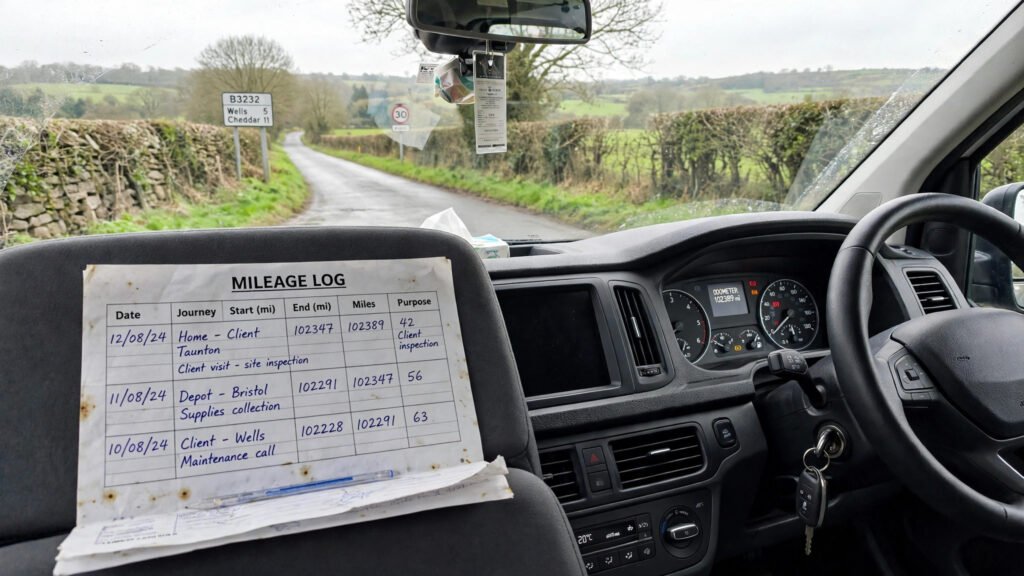
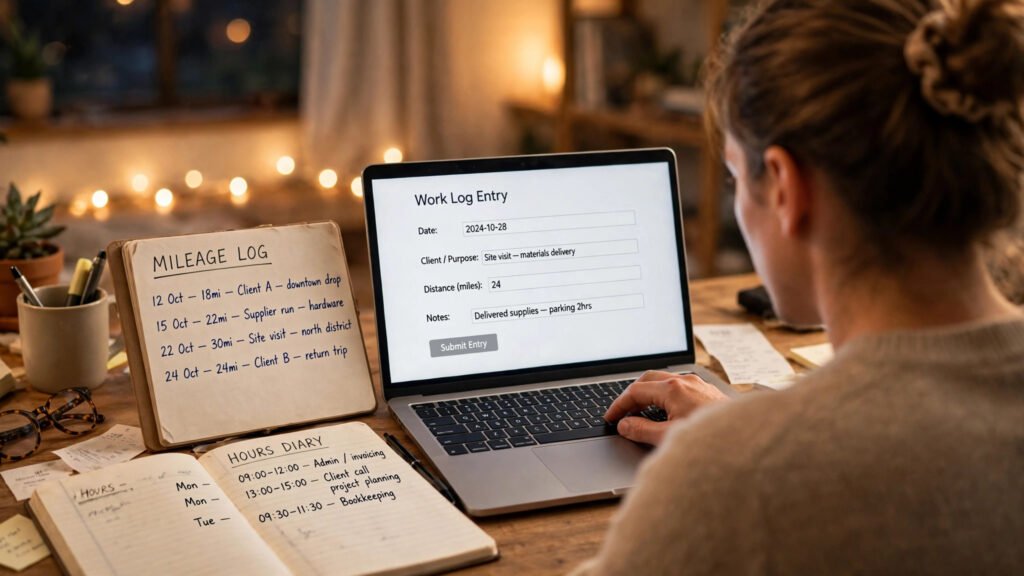
And “simplified” does not mean “no records”. HMRC expects a mileage log kept as you go — dates, journeys, business miles (BIM75005). No log, no claim.
The lock-in rule
Once you use the mileage rate for a vehicle, you must keep using it for that vehicle for as long as you use it in your business — that is written into s.94D(4) of ITTOIA 2005, and HMRC’s manual (BIM75005) puts it plainly: you can only switch to or from actual costs when a vehicle is replaced.
This is the decision inside the decision. Mileage looks generous in a cheap year. But if the same van needs a £2,400 gearbox in year three, the mileage claimant gets nothing extra — while a trader on actual costs claims the business share of the bill. The worked example below puts numbers on both sides.
Working from home: £10, £18 or £26 a month
If you work at home for at least 25 hours a month, you can claim a flat rate based on the hours you work there instead of apportioning your household bills (s.94H ITTOIA 2005). Months can sit in different bands — a quiet month and a busy month are worked out separately.
| Hours of business work at home per month | Flat rate per month | Flat rate per year |
|---|---|---|
| Fewer than 25 | Cannot use simplified expenses | — |
| 25 to 50 | £10 | £120 |
| 51 to 100 | £18 | £216 |
| 101 or more | £26 | £312 |
The hours counted are hours spent wholly and exclusively on work for the business. If an employee works in your home, their hours count too — but two people working at the same time only count the hour once.

What the flat rate does not cover
The flat rate replaces the business share of your household running costs — heating, lighting, power and the like. It does not include telephone or broadband. GOV.UK is explicit: you claim the business proportion of your phone and internet bills separately, at actual cost, on top of the flat rate. Too many traders miss that second claim.
The actual-cost alternative
The other route is to add up the costs of running your home — gas, electricity, council tax, water, buildings insurance — then take the share for the room you work in, and the share of time you use it for business. It takes one calculation a year and a folder of bills.
Compare the ceiling honestly: the flat rate can never pay more than £312 a year, however long your hours. If your apportioned bills come to more than that — and for a full-time home worker they often come to considerably more — actual costs win every year. Worked example B below shows a typical case: £216 at the flat rate against £540 at actual cost.
Living at your business premises
If you run a guesthouse, bed and breakfast or small care home and live there too, you can take your total premises costs and subtract a fixed monthly amount for private use, instead of splitting every bill (s.94I ITTOIA 2005). The premises must be used mainly for the trade.
| People living at the premises | Deduct per month | Deduct per year |
|---|---|---|
| 1 | £350 | £4,200 |
| 2 | £500 | £6,000 |
| 3 or more | £650 | £7,800 |
The band follows the months, not the year. If your son or daughter is home from university for three months of the summer, those months use the three-person rate. So a couple whose premises cost £16,800 a year, with a student child home for three months, deduct (9 × £500) + (3 × £650) = £6,450, and claim £10,350.

Who can use simplified expenses — and who cannot
Sole traders can use simplified expenses, and so can business partnerships — but only where every partner is an individual. Section 94C of ITTOIA 2005 switches the scheme off for a firm if any partner is not an individual, so a partnership with a company partner is out.
Limited companies cannot use simplified expenses (BIM75001). Neither can limited liability partnerships: an LLP is a body corporate, and HMRC’s manual introduces the scheme as simplified rules for unincorporated businesses (BIM75000).
You choose category by category, not all-or-nothing: flat-rate mileage with actual homeworking costs, or the reverse. The one exception is vehicles, where the choice sticks to each vehicle under the lock-in rule. For the other two categories, the choice is made fresh in each year’s return.
If you are a company director instead
Directors are employees of their company, and different rules apply. A company can pay a director or employee who works from home up to £6 a week (£26 a month for monthly-paid staff) towards extra household costs, tax-free, under the homeworking expenses exemption — GOV.UK confirms that limit has applied since 2020/21. Directors also live in the world of benefits in kind and the overdrawn director’s loan account rules. None of the rates on this page apply to you.
Simplified expenses, the cash basis and the trading allowance: three different choices
These three schemes are constantly confused with each other. They answer different questions:
| Scheme | What it decides | Who can use it | Combines with |
|---|---|---|---|
| Simplified expenses | How much you claim for vehicles, homeworking and living at your premises | Sole traders; partnerships with no company partner | Cash basis or traditional accounting — but not the trading allowance |
| Cash basis | When income and costs count — when money is received and paid | Sole traders and partnerships; the default since 6 April 2024 (GOV.UK) | Simplified expenses |
| Trading allowance | Whether you claim expenses at all — £1,000 off your gross income instead | Individuals with trading income; not partnership income (GOV.UK) | Nothing — if you claim it, you deduct no expenses or allowances |
The cash basis has been the default way of working out profit for sole traders since 6 April 2024, unless you opt for traditional accounting (GOV.UK’s cash basis guidance). It changes timing, not amounts. Simplified expenses sit on top of either basis (BIM75001). Under traditional accounting, equipment is dealt with through capital allowances and the annual investment allowance instead of being expensed.
The trading allowance is a different decision entirely. It gives you £1,000 off your gross trading income, but GOV.UK’s guidance is clear: claim it, and you cannot deduct any expenses or other allowances at all. It suits a very small side trade. If your real expenses exceed £1,000 — true for almost any established business — claiming expenses will nearly always beat it.
One modern argument for the flat rates: Making Tax Digital for Income Tax. Sole traders with qualifying income over £50,000 have had to keep digital records and send quarterly updates since April 2026, and the threshold falls to £30,000 in April 2027 (GOV.UK). A mileage log and an hours log are quick to produce every quarter; apportioned household bills are not. That admin saving is part of the comparison — price it honestly, as the examples below do.
Worked examples: when simplified wins, and when it loses
Meet the same trader in both examples: a self-employed plumber on the cash basis, paying tax at the basic rate of 20%, who works from home and drives a van.
Example A — the van: simplified wins, narrowly
He drives 12,000 business miles in 2026/27, out of 15,000 total miles (80% business use).
On simplified expenses: 10,000 miles × 55p = £5,500, plus 2,000 miles × 25p = £500. Total claim: £6,000. (The same miles in 2025/26, at 45p, would have given £5,000.)
On actual costs: fuel £2,600, insurance £900, servicing and repairs £800, road tax £190 and MOT and sundries £110 come to £4,600; the 80% business share is £3,680. Add the capital allowances he would also claim — a writing-down allowance at 18% on a £12,000 pool value is £2,160, and the 80% business share is £1,728. Total claim: about £5,408.
Verdict: simplified wins by about £592 of expenses — roughly £118 more tax saved at 20% — with no receipts to keep beyond the mileage log. A win, but not a landslide.
Then the sting. He claimed mileage from year one, so he is locked in. In year three the van needs a £2,400 gearbox. On mileage, he gets nothing extra. On actual costs, he would have added about £1,920 (80% of the bill) to that year’s claim. One bad repair year can wipe out several years of small wins — the lock-in, not the rate, is the real decision.
Example B — working from home: simplified loses
He works from home 60 hours a month — the £18 band — all year.
On simplified expenses: £18 × 12 = £216.
On actual costs: his household bills for heat, light, council tax, water and insurance total £4,500. His office is one of five rooms (20%), and he uses it for business about 60% of the time. £4,500 × 20% × 60% = £540. Phone and broadband are claimed separately under both methods, so they do not affect the comparison.
Verdict: actual costs win by £324 of expenses — about £65 more tax saved at 20%, every year, for the price of keeping the bills and doing one sum. Even at the top band (£26 × 12 = £312) the flat rate would still lose. Its ceiling, not its convenience, is the problem. It only wins if your apportioned bills come out below it, or your time is worth more than the difference.
| Simplified | Actual costs | Better route | |
|---|---|---|---|
| Van (12,000 business miles) | £6,000 | About £5,408 | Simplified, by ~£592 |
| Working from home (60 hrs/month) | £216 | £540 | Actual, by £324 |
Rules of thumb: mileage tends to win if you cover a lot of business miles in a modest, reliable vehicle. Actual costs tend to win if you work from home full-time in a house with real bills, or run an expensive vehicle doing low miles. Run both numbers once a year — it takes ten minutes.
How to claim simplified expenses
There is no registration and no form to elect in advance. You claim through your Self Assessment tax return: work out the flat-rate figures for the year and include them in the expenses totals on the self-employment pages (GOV.UK). For vehicles the choice then locks in; for homeworking and premises, you make the choice fresh in each year’s return.
Keep the records underneath the claim:
- Vehicles: a mileage log kept as you go — dates, journeys, business miles.
- Working from home: a note of the hours worked at home each month.
- Living at premises: who lived there, and for which months.
- Everything: keep business records for at least five years after the 31 January filing deadline for the tax year (HMRC guidance CH14530) — longer if you filed late or HMRC opens a check.
HMRC’s simplified expenses checker on GOV.UK will do the flat-vs-actual comparison for the current year — the worked examples above show why its answer comes out the way it does, and whether the lock-in changes it.
Risks and common mistakes
- Using the wrong year’s rate. The rate follows the tax year the miles were driven — 55p for 2026/27 miles, 45p for 2025/26 miles. Mixing them up means a wrong claim.
- Claiming mileage and running costs for the same vehicle. Mileage replaces fuel, insurance and repairs for that vehicle — and claiming capital allowances on it closes the mileage route for good.
- Forgetting the lock-in. Choosing mileage for a cheap-to-run vehicle this year commits you for every year you keep it.
- Assuming the homeworking flat rate covers broadband and phone. It does not — claim the business share of those bills separately, or you are leaving money behind.
- Claiming the homeworking flat rate under 25 hours a month. Below that, there is no flat rate; use actual costs instead.
- Chasing a 20p bicycle rate. It does not exist for the self-employed.
- Claiming simplified expenses and the trading allowance together. The allowance replaces expenses entirely — it is one or the other.
- Trying to use simplified expenses through a limited company. Companies and LLPs are outside the scheme.
- Keeping no mileage log because “it’s a flat rate”. The log is the evidence for the claim — without it, the claim is exposed if HMRC asks.
Frequently asked questions
What are simplified expenses for sole traders?
They are optional HMRC flat rates that replace your actual costs for three things: running a vehicle (a rate per business mile), working from home (£10 to £26 a month by hours), and living at your business premises (a flat monthly private-use deduction), set out in Chapter 5A of ITTOIA 2005. Everything else is still claimed at actual cost.
What is the mileage rate for sole traders in 2026/27?
55p a mile for the first 10,000 business miles in a car or van, then 25p a mile; motorcycles are 24p a mile. The first-10,000 rate rose from 45p on 6 April 2026, so miles from 2025/26 and earlier are claimed at 45p (GOV.UK; BIM75005).
Can I claim 20p a mile for cycling to jobs?
No. There is no bicycle rate in simplified expenses. The 20p-a-mile rate is one an employer can pay an employee tax-free; it does not apply to the self-employed. GOV.UK’s simplified expenses table covers cars, goods vehicles and motorcycles only.
Can I use simplified expenses and claim my phone and broadband too?
Yes. The working-from-home flat rate does not include telephone or internet costs. Claim the business proportion of those bills at actual cost, on top of the flat rate (GOV.UK).
I work from home 20 hours a month — can I use the flat rate?
No. The flat rate starts at 25 hours of business work at home per month. Below that, work out the business share of your actual household costs and claim that instead.
Can I switch between simplified expenses and actual costs each year?
For working from home and living at your premises, yes — the choice is made in each year’s return. For vehicles, no: once you use the mileage rate for a vehicle, you must keep using it while you use that vehicle in the business, and you can only change basis when you replace the vehicle (s.94D ITTOIA 2005; BIM75005).
Can my limited company use simplified expenses?
No. Simplified expenses are for sole traders and partnerships where every partner is an individual. Limited companies and LLPs cannot use them. A company can instead pay a homeworking director or employee up to £6 a week tax-free towards household costs.
Can I claim simplified expenses and the £1,000 trading allowance?
No. The trading allowance is claimed instead of deducting expenses — claim it, and GOV.UK’s guidance says you cannot deduct any other expenses or allowances against that income. If your expenses exceed £1,000, claiming them will usually leave you better off.
Conclusion
Simplified expenses are a fair swap for some traders and a quiet pay cut for others — the rates alone do not tell you which you are. The 55p mileage rate genuinely rewards high-mileage drivers in modest vehicles, but it locks you in, vehicle by vehicle. The homeworking flat rate saves admin and caps your claim at £312 a year, however big your real bills are. Run both numbers once a year, decide category by category, and never let convenience decide for you.
Disclaimer: This article is general information about simplified expenses for UK sole traders and partnerships, not personal tax advice. Your own position depends on your business, your vehicle and your home — check the current rates on GOV.UK or speak to an accountant before you claim.