

If your UK company buys from, sells to, lends to or shares staff with a connected company overseas, you may have wondered whether transfer pricing applies to a business your size. For most SMEs the answer is reassuring: Parliament built an exemption for you. But it has sharp edges — size is measured across your whole group, it never applies where the other company is in a territory with no suitable UK treaty, and HMRC can switch it off for medium-sized businesses by notice. The rules changed on 1 January 2026; a new reporting schedule arrives in 2027.
This guide reflects HMRC guidance as reviewed on 2 November 2026.
In short: most UK SMEs are exempt from transfer pricing under section 166 of the Taxation (International and Other Provisions) Act 2010 (TIOPA 2010) — the basic rule does not apply to them. The exemption fails in three main cases: your worldwide group is too big to count as an SME; the connected company is in a non-qualifying territory (broadly, no UK tax treaty with a non-discrimination clause); or HMRC issues a transfer pricing notice. Since 1 January 2026, most UK-to-UK deals between companies paying the same corporation tax rate are exempt too (section 164A).
What transfer pricing is, in plain English
Transfer pricing means pricing deals between connected companies as if they were strangers. If your UK company sells components to your sister company abroad, the tax question is: what would an unconnected buyer have paid? That hypothetical stranger’s price is the arm’s length price. The UK rules are in Part 4 of TIOPA 2010, read with the OECD Transfer Pricing Guidelines (2022 edition).
The basic rule is in section 147. Where a “provision” between two connected persons differs from the arm’s length provision, and the actual provision gives one of them a potential advantage in UK tax, that person’s profits are recalculated as if the arm’s length provision had been made. It covers far more than goods prices:
- Sales and purchases of goods between group companies
- Services, management fees and cost-sharing arrangements within a group
- Royalties and licence fees for brands, software and other IP
- Loans between group companies — including interest-free ones — and guarantees
- Assets sold within a group — the price also drives the buyer’s capital allowances
The two conditions that switch the rules on
Two things must be true before section 147 bites. First, the participation condition (section 148): one person must directly or indirectly participate in the management, control or capital of the other — shareholdings, common directors and family control can all count. (Finance Act 2026 refreshed this condition, adding a common-management test.) Second, the actual provision must give one side a potential UK tax advantage — say, lower UK profits than the arm’s length price would produce.
The person who gets the advantage is the potentially advantaged person — the one the SME exemption is tested on. Transfer pricing is self-assessed: if the rules apply, you file on arm’s length figures yourself.
The SME exemption: who qualifies
If the potentially advantaged person is a small or medium-sized enterprise for the chargeable period, section 166 switches the basic rule off entirely — no adjustment, no repricing. But “SME” has a precise legal meaning here (section 172; HMRC’s INTM412080) — not the Companies Act test from your accounts.
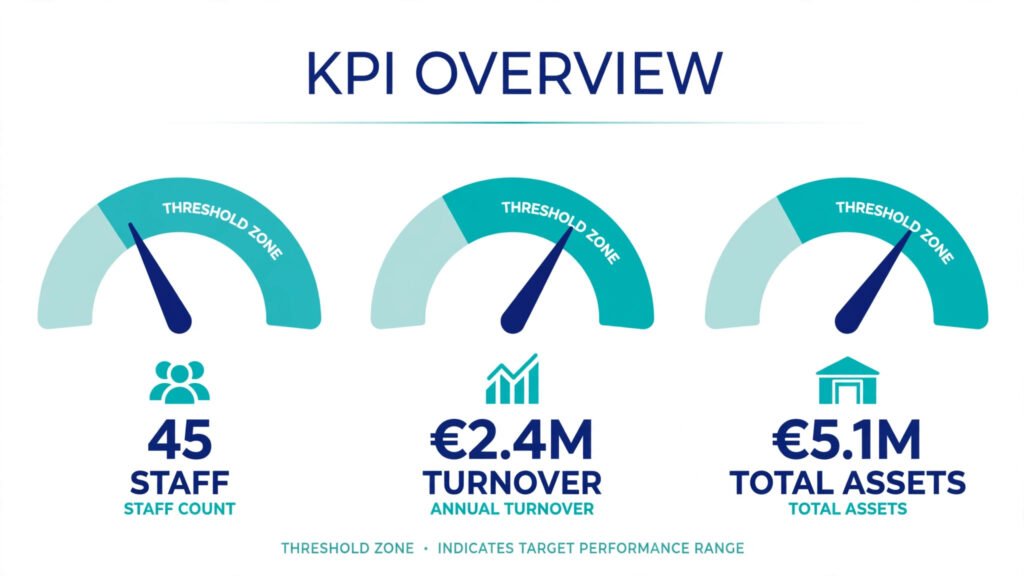
To qualify, an enterprise must stay within the staff headcount ceiling for its class and within one of the two financial limits:
| Class | Staff headcount (max) | and turnover (max) | or balance sheet total (max) |
|---|---|---|---|
| Small enterprise | 50 | €10 million | €10 million |
| Medium enterprise | 250 | €50 million | €43 million |
Source: TIOPA 2010, section 166; HMRC International Manual INTM412080.
Three details catch people out. The limits are in euros (EU Recommendation 2003/361/EC), so HMRC says to convert at the period’s average exchange rate — and warns businesses near a limit not to rely on exchange-rate movements. “Staff” includes employees, secondees, owner-managers and partners, part-timers as fractions. Balance sheet total means total assets, before deducting liabilities. Status is tested period by period, on annualised figures.
The group trap: your size is your group’s size
This is the most common reason a “small” UK company is not an SME at all. Where your company is part of a group, or has associated (“linked” or “partnership”) enterprises, the limits apply to the whole group, not to your UK company alone (INTM412080; INTM412100). A UK subsidiary with 12 staff and £2 million of sales is not small if its overseas parent has 600 staff and €90 million of turnover. Add up the whole group, worldwide, before relying on the exemption.
Small and medium are not treated the same
Both classes are exempt, but HMRC’s power to disturb the exemption differs: for a medium-sized enterprise it can issue a transfer pricing notice at any time (section 168); for a small enterprise, only where a transaction feeds a Patent Box claim (section 167A). Small is close to absolute; medium-sized is a default HMRC can override.
When the exemption does NOT protect you
The exemption is generous, but it is not a blanket. Four situations matter in practice — and one removes the exemption entirely, whatever your size.
Your counterparty is in a non-qualifying territory
Section 167(3) removes the exemption where the other party is resident in a non-qualifying territory. Under section 173, a qualifying territory is the UK, or one whose UK tax arrangements include a non-discrimination provision (or which the Treasury has designated). No such treaty means non-qualifying — and the exemption never applies, however small you are.
This exception has real teeth: founder-owned companies in no-treaty jurisdictions are the classic case. Check the other company’s territory against HMRC’s published position first; it matters more than the size test.
HMRC issues a transfer pricing notice
HMRC can switch the rules back on for a medium-sized enterprise with a transfer pricing notice under section 168, applying section 147 to the provision for that period. For small enterprises, the equivalent power (section 167A) covers only Patent Box provisions (Part 8A, Corporation Tax Act 2010). Appeals sit under section 170.

You elect into the rules
Section 167(2) lets an SME elect for the exemption not to apply for a chargeable period — irrevocably. The usual reason is the other side of the border: where the overseas authority applies transfer pricing anyway, being inside the UK rules can support a matching adjustment and cut double taxation. A specialist move, not a default.
Exempt is not the same as nothing to do
Even where section 166 applies, other rules still police your pricing:
- Your records still matter. Records supporting a correct and complete return are required, exemption or not.
- Wholly and exclusively. A UK company cannot deduct costs not incurred wholly and exclusively for its own trade — paying a sister company’s expenses fails on that ground alone.
- The profit fragmentation rules. In force since April 2019 (Finance Act 2019; INTM610030): arrangements moving UK profit to a connected person overseas taxed at less than 80% of the UK rate — designed with SMEs in mind, no SME exemption.
- The other country’s rules — and other taxes. Your counterparty’s authority may have no SME exemption at all; customs and VAT follow their own connected-party rules.
Exempt or not? Six common situations:
| Scenario | Exempt? |
|---|---|
| Small enterprise, Irish counterparty (qualifying territory) | Yes — section 166 |
| Medium enterprise, German counterparty, no HMRC notice | Yes — section 166 (but HMRC can issue a notice) |
| Any SME, counterparty in a non-qualifying territory | No — the exemption never applies |
| UK company whose group has 400 staff / €90m turnover | No — not an SME on group figures |
| Medium enterprise, Patent Box provision, HMRC notice issued | No for that provision |
| Two UK companies, same CT rate, period from 1 Jan 2026 | Yes — section 164A, unless a disqualifying criterion applies |
UK-to-UK transactions: the rules changed on 1 January 2026
UK-to-UK deals used to be inside the rules in full — the SME exemption was the main shield, and compensating adjustments (section 174) usually made the result tax-neutral anyway. Finance Act 2026 replaced that burden with a direct exemption for most domestic provisions.
For chargeable periods beginning on or after 1 January 2026, the new section 164A exemption means the basic rule does not have to be applied to a qualifying UK-to-UK provision. HMRC’s INTM414320 sets out the qualifying criteria (section 164A(2)(a)–(d)):
- Both persons to the provision are UK-resident companies throughout the relevant period
- The provision is relevant to both companies’ profits, and those profits are chargeable to corporation tax
- Both companies are chargeable at the same statutory rate of corporation tax
- The same reference currency is used for the provision (normally the functional currency)
The exemption is withheld where any disqualifying criterion (section 164A(2)(e)–(h)) applies — cases where a net UK tax loss could arise: certain derivative contracts treated differently on each side (section 589, Corporation Tax Act 2009); provisions where a foreign permanent establishment exemption adjustment is made (section 18A of that Act); patent box provisions; and provisions where a party is an excluded company (section 164A(5)). A company can elect out (irrevocably), and HMRC can disapply the exemption by notice where expedient to avoid a loss of tax. Periods beginning before 1 January 2026 are not covered.
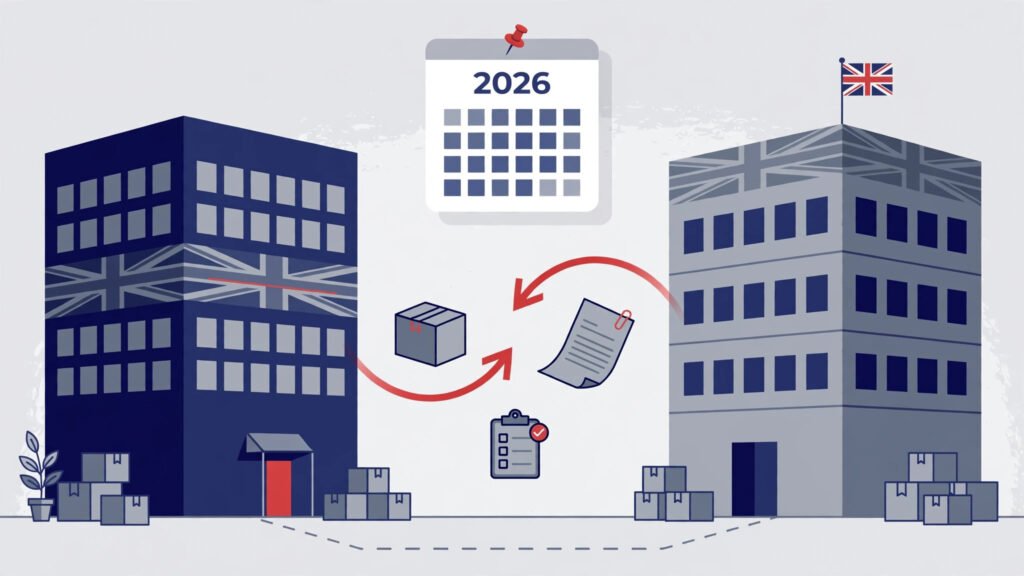
For most two-company UK groups, domestic transfer pricing paperwork largely falls away for 2026 periods onwards. Keep pricing sensible anyway — the disqualifying criteria, VAT and other anti-avoidance rules still apply — and see our round-up of the Autumn Budget 2025 small business changes for the wider package. (A separate exemption covers certain long-dormant companies, at section 165.)
Worked example: what an adjustment actually costs
The same figures run through three scenarios. A UK company sells components to a connected overseas company and charges £800,000. The arm’s length price is £1,000,000, so UK profit is understated by £200,000. Assume taxable profits already exceed £250,000, so extra profit is taxed at the 25% main rate.

Scenario A — exempt. The UK company is a small enterprise (30 staff, £4 million turnover, £3 million balance sheet — inside the limits on group figures too), selling to the founder’s company in Ireland, a qualifying territory. Section 166 applies: no UK adjustment at all, even though the price is not arm’s length. Irish Revenue may still examine the Irish side.
Scenario B — not exempt, because of the territory. Identical company and figures, but the buyer is resident in a non-qualifying territory — no UK treaty with a non-discrimination provision. The exemption never applies, so the company must self-assess on arm’s length figures:
- Extra UK profit: £200,000
- Extra corporation tax at 25%: £50,000
- If HMRC finds it in an enquiry instead: add late-payment interest from the original due date, plus a Schedule 24 (Finance Act 2007) penalty of up to 30% of the £50,000 for careless behaviour — up to £15,000 more (higher for deliberate behaviour and offshore matters)
One year of casual pricing can therefore cost around £65,000 plus interest — on a deal assumed to be exempt.
Scenario C — not exempt, because of size. Its group has 300 staff and €60 million turnover — above the medium ceiling, so nobody in the group is an SME. It charges its German subsidiary a management fee of £120,000; the arm’s length fee is £200,000. The £80,000 adjustment at 25% means £20,000 of extra corporation tax, plus interest. (In the marginal relief band: £21,200, at the 26.5% marginal rate.) The sting: no automatic matching deduction arises in Germany — relief depends on a German correction or the treaty procedure, so the same £80,000 can be taxed twice meanwhile.
The loans trap, in miniature. A UK parent lends its overseas subsidiary £2 million, interest-free. At an assumed arm’s length rate of 6%, that is £120,000 a year of interest it should have charged. Loans are the quietest transfer pricing risk in most SME groups, and a focus of the 2026 changes (next section). A director loan is a different problem — see our guide to the overdrawn director’s loan account; a group loan is transfer pricing.
What changed in 2026 — and what was dropped
Transfer pricing reform was consulted on through 2025, and the internet is full of articles describing the proposals as if they happened. Several did not. Here is the accurate position:
| Change | Status |
|---|---|
| Remove the SME exemption for medium-sized enterprises; convert thresholds from € to £ | Dropped — the government decided in November 2025 to keep both |
| UK-to-UK exemption (section 164A) | Law — Finance Act 2026, periods beginning on or after 1 January 2026 |
| Financial transactions and guarantees aligned to the OECD approach | Law — Finance Act 2026, new loans from 1 January 2026 |
| Diverted Profits Tax replaced by the Unassessed Transfer Pricing Profits charge | Law — Finance Act 2026, periods from 1 January 2026 |
| International Controlled Transactions Schedule | Announced — enabling power in Finance Act 2026; expected for periods from 1 January 2027; regulations to come |
The exemption decision came at the Autumn Budget on 26 November 2025: in its summary of responses, the government said “SMEs will continue to benefit from the existing exemption from transfer pricing”, exceptions retained. Finance Act 2026 (Royal Assent 18 March 2026) enacted the rest of the package for periods from 1 January 2026:
- The UK-to-UK exemption (section 164A), described above.
- Financial transactions aligned to OECD Chapter X: implicit support now counts when pricing loans; guarantees count towards the rate, not the amount a company can borrow. Applies to new loans from 1 January 2026; existing loans keep the old rules until the first period beginning on or after 1 January 2028, unless you elect in early.
- Diverted Profits Tax repealed, replaced by the Unassessed Transfer Pricing Profits charge inside corporation tax — aimed, like the old tax, at large multinationals; a business protected by section 166 is generally outside it.
So if you read that the SME exemption was abolished in 2026: that was a consultation proposal. It did not happen.
Coming in 2027: the International Controlled Transactions Schedule
The ICTS is a new annual schedule on which businesses report cross-border related-party transactions to HMRC alongside the tax return, so HMRC can risk-assess pricing before opening an enquiry. It is the one genuinely new burden in the package — and it is not law yet.
Finance Act 2026 contains only the power for HMRC to make regulations (in force on Royal Assent). The obligation will come from those regulations, after a technical consultation, and is expected for accounting periods beginning on or after 1 January 2027. The consultation design would require a schedule from businesses outside the small definition whose cross-border related-party transactions exceed £1 million, with a £100,000 de minimis per category and fuller loan data above £5 million. Whether medium-sized enterprises — exempt from transfer pricing itself — must file is still open.

What to do now is cheap: record, for each cross-border connected-party deal, the counterparty, the type, the value and how the price was set. If the ICTS arrives in the expected form, that list is most of the work — and it doubles as pricing evidence either way.
Documentation: what an SME actually needs
Formal documentation frightens people out of proportion to what the law asks of their size. The Transfer Pricing Records Regulations 2023 require a Master File and Local File — the OECD-format documents — only from UK entities in groups meeting the country-by-country threshold: consolidated revenue of €750 million or more, for periods from 1 April 2023. Files must be produced within 30 days of an HMRC request, with penalties for failure. Almost every reader of this guide will never prepare one.
| Group size | Formal TP documentation duty |
|---|---|
| SME (exempt) | None under the TP rules — but keep return-supporting records |
| SME in scope via an exception / group below €750m | No prescribed format; OECD-style evidence expected by HMRC |
| MNE group revenue of €750m or more | Master File + Local File (2023 Regulations); produce within 30 days of request |
Below the €750 million line there is no prescribed format, but HMRC’s stated view (INTM450080) is that OECD-style documentation is the appropriate evidence of arm’s length pricing, and its Guidelines for Compliance 7 (September 2024) set out the risk indicators case teams use. For an SME in scope only because of an exception, proportionate evidence is: written intercompany agreements for each material flow; a short pricing policy note (method, plus benchmarks); invoices matching the policy; and a board minute adopting it, refreshed yearly.
Context: HMRC’s published statistics show transfer pricing compliance brought in £3,387 million in 2024/25 — a record. Documentation written before you file is protection; written after an enquiry opens, it is an admission that you priced first and thought later. Advance pricing agreements (Part 5 of TIOPA 2010) exist, but HMRC agreed only 26 in 2024/25, averaging 44 months — a large-group tool.
Risks and common mistakes
Most SME transfer pricing problems come from a short list of avoidable errors:
- Assuming “SME” from the UK company’s own books. The test is group-wide; a UK subsidiary of a large group has none to rely on.
- Assuming the exemption covers a no-treaty company because “we’re small”. The non-qualifying territory exception ignores size — check it first, not last.
- Leaving intercompany loans interest-free and undocumented. Loans are the transaction HMRC can price most easily, and the 2026 changes put them in the spotlight.
- Setting management fees as a round number. A fee plucked from the air is the most commonly adjusted SME transaction — a cost-plus calculation with a simple benchmark behind it is far harder to move.
- Believing the exemption was abolished — or that the ICTS is already law. Stale 2025 articles describe a dropped proposal as live policy. The exemption survived; the ICTS starts, at the earliest, with periods from 1 January 2027.
- Forgetting the other side of the adjustment. A UK adjustment does not automatically reduce the overseas company’s profit. Without a correction abroad or a treaty mutual agreement procedure, the same profit is taxed twice — and HMRC’s statistics put the average MAP case at around 25 months in 2024/25.
Frequently asked questions
Are UK SMEs exempt from transfer pricing?
Generally, yes. Section 166 switches off the basic rule where the potentially advantaged person is an SME for the period. Exceptions: an election into the rules, an HMRC transfer pricing notice, and — most importantly — transactions with a connected person in a non-qualifying territory.
What size counts as an SME for transfer pricing?
A staff ceiling plus one financial limit, measured across the whole group: small — 50 or fewer staff, turnover or balance sheet total up to €10 million; medium — 250 or fewer staff, turnover up to €50 million or balance sheet total up to €43 million (INTM412080).
My only overseas company is in a country with no UK tax treaty. Am I still exempt?
No. Under sections 167 and 173, the exemption does not apply to provisions with a person resident in a non-qualifying territory — broadly, no UK tax arrangements containing a non-discrimination provision. Size does not save you.
Do transfer pricing rules apply between two UK companies?
They did, in full, until 2026. For periods from 1 January 2026, the section 164A exemption covers most UK-to-UK provisions between UK-resident companies paying the same corporation tax rate — subject to disqualifying criteria where a net UK tax loss could arise, such as patent box provisions.
Was the SME exemption abolished in 2026?
No. Consulted on in 2025, the proposal to remove it for medium-sized enterprises was dropped at the Autumn Budget 2025. The exemption, and its exceptions, are unchanged.
Do I need a master file and local file?
Only if your group meets the country-by-country threshold — consolidated revenue of €750 million or more — under the Transfer Pricing Records Regulations 2023. Everyone else has no prescribed format, but should keep proportionate evidence.
What is the ICTS and when does it start?
The International Controlled Transactions Schedule is a new annual report of cross-border related-party transactions. Finance Act 2026 gives HMRC the power to introduce it by regulations, expected for periods from 1 January 2027. Who must file is still being consulted on.
Conclusion
For most UK SMEs, transfer pricing is a ruleset you are exempt from — but the exemption rewards those who check its edges. Confirm your size on group figures; check the other company’s territory before its turnover; treat loans and management fees with respect even when exempt — other rules, and the other country’s authority, still apply. The 2026 changes removed paperwork from UK-to-UK deals and left the exemption intact; the 2027 schedule is the date to prepare for. An hour mapping your transactions against the scenario table above is the cheapest insurance in this area of tax.
Disclaimer: This article is general information about UK transfer pricing for SMEs, not tax advice. Transfer pricing turns on each group’s structure and transactions, and penalties are significant. Take specialist advice before setting or changing prices between connected companies, or making any election under these rules.