

Allowable expenses are business costs you can deduct from your income on a Self Assessment return. They cut your taxable profit, so you pay Income Tax and National Insurance on less. A cost qualifies only if you spent it wholly and exclusively on your business.
Last reviewed 5 October 2026. Covers your 2025/26 return, due 31 January 2027, and the 2026/27 tax year.
New for 2026: a 55p mileage rate, a 14% main writing down allowance, a new 40% first-year allowance, and Making Tax Digital for income above £50,000.
New to filing? Register for Self Assessment first.
What counts as an allowable expense?
An allowable expense is a business cost you deduct before tax is worked out. It must be wholly and exclusively for your business, a test set by section 34 of the Income Tax (Trading and Other Income) Act 2005. If a cost is part personal, claim only the business share. GOV.UK’s example: a £200 phone bill with £70 of business calls gives a £70 claim.
These rules cover sole traders and partners. Limited company directors follow Corporation Tax rules instead. If you’re weighing the switch, see sole trader to limited company.
Wholly and exclusively in practice
HMRC asks why you spent the money. In Mallalieu v Drummond, a barrister couldn’t claim plain dark court clothes, because clothes also keep you warm. A personal purpose usually blocks the claim.
How a claim cuts your tax
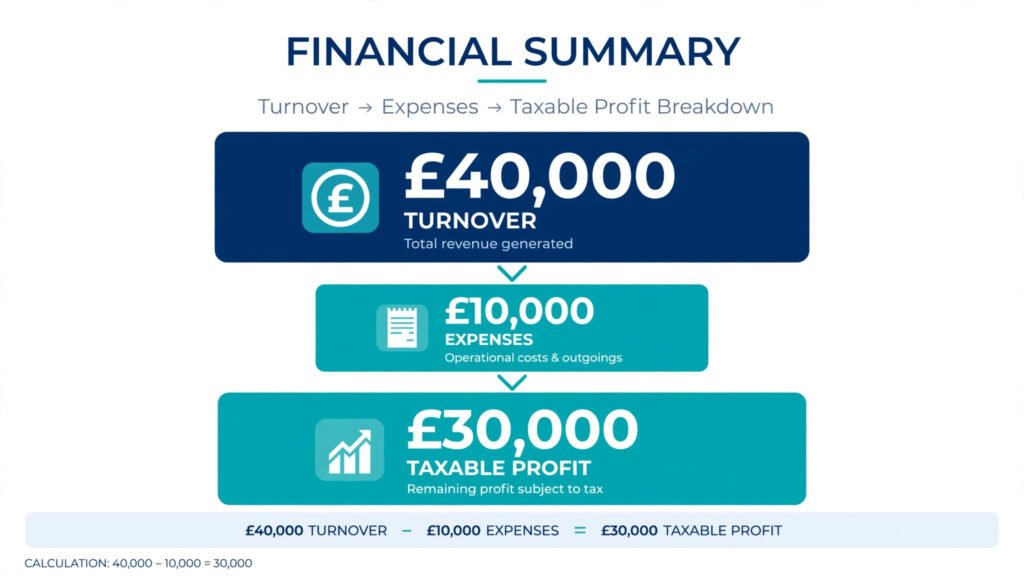
Expenses reduce your profit. They aren’t refunds. GOV.UK’s example: £40,000 turnover less £10,000 expenses leaves £30,000 taxable profit.
A basic-rate self-employed person pays a combined 26% on profit between £12,570 and £50,270: 20% Income Tax plus 6% Class 4 National Insurance. So £10,000 of expenses saves roughly £2,600 while your profit stays in that band.
Allowable expenses list: what you can claim
Most everyday business costs are allowable. HMRC groups them into categories that match the self-employment section of your return.
| Category | Usually allowable | Watch out for |
|---|---|---|
| Office and phone | Stationery, postage, printing, software, phone, broadband | Business share only for mixed-use lines |
| Travel | Fares, hotels, parking, tolls, meals on overnight trips | Normal commuting isn’t allowable |
| Premises | Rent, business rates, utilities, repairs | Buying property is a capital cost |
| Staff and subcontractors | Wages, employer NICs, pensions, subcontractor fees | Your own drawings don’t count; family pay must be fair for real work |
| Stock and materials | Goods for resale, raw materials | Stock you take home isn’t a business cost |
| Marketing | Ads, website, mailshots, samples | Client entertainment isn’t allowable |
| Professional fees and insurance | Accountant, solicitor, business insurance, professional indemnity cover | Only the part of an accountant’s fee covering your business accounts |
| Bank and finance | Account fees, overdraft and card charges, loan and hire purchase interest | Interest only, never loan capital |
| Subscriptions and training | Trade journals, relevant professional bodies, refresher courses | Courses giving a new skill or qualification don’t count |
| Clothing | Uniforms, protective gear, workwear with a permanent logo | Ordinary clothes don’t count |
| Bad debts | Specific invoices written off (traditional accounting) | No general estimates; cash basis gets relief automatically |
Unsure about a cost? Ask whether it was wholly and exclusively for the business, then check HMRC helpsheet HS222.
What you can’t claim
You can’t claim personal costs, your own pay, or costs the law blocks. The main ones:
- Fines and penalties, including parking and speeding fines on business trips
- Commuting between home and a regular workplace
- Client entertainment and event hospitality (staff-only events are different)
- Drawings. A sole trader can’t employ themselves
- Loan capital repayments (interest is fine)
- Income Tax and National Insurance you pay
- Charity donations. Some guides list them as expenses, but they aren’t. Gift Aid gives separate relief on your return
- Everyday meals, gym fees and ordinary clothes
Trading allowance or expenses?
Pick whichever gives the bigger deduction, because you can’t use both. The £1,000 trading allowance replaces your expenses. GOV.UK says you can’t claim expenses or capital allowances if you use it. If your trading income is £1,000 or less, you normally don’t need to report it.
Two examples, both with £8,000 income:
- Expenses of £600: take the allowance. Taxable profit is £7,000, not £7,400.
- Expenses of £2,500: claim them. Taxable profit is £5,500, not £7,000.
Rule of thumb: claim expenses once they pass £1,000.
Car, van and mileage
You can claim a flat mileage rate or the business share of your real vehicle costs. For 2026/27, cars and goods vehicles get 55p a mile for the first 10,000 business miles, then 25p a mile after that.
| Vehicle | 2025/26 return | 2026/27 |
|---|---|---|
| Cars and vans, first 10,000 miles | 45p | 55p |
| Cars and vans, over 10,000 miles | 25p | 25p |
| Motorcycles | 24p | 24p |
The government announced the rise on 21 May 2026 and backdated it to 6 April 2026. So your 2025/26 return still uses 45p. Rates beyond 2026/27 are under review for Budget 2026, so recheck each April.
GOV.UK’s example: 11,000 business miles is 10,000 at 55p plus 1,000 at 25p, a £5,750 claim.
Flat rates cover fuel, insurance, servicing and repairs. Keep a mileage log, and claim parking, tolls and train fares on top. Once you use flat rates for a vehicle, you must keep using them for it. You can’t use them on a vehicle you’ve claimed capital allowances for.
Actual costs mean the business share of fuel, insurance, MOT and repairs, plus capital allowances. Cheap, high-mileage cars usually do better on flat rates. GOV.UK’s simplified expenses checker compares both. Travel from home to changing client sites is allowable. Commuting to a fixed workplace isn’t.
Working from home
You can claim a flat monthly rate or a fair share of your actual home costs. The flat rate depends on your hours at home each month, and you need at least 25.
| Hours worked at home per month | Flat rate per month (2025/26 and 2026/27) |
|---|---|
| 25 to 50 | £10 |
| 51 to 100 | £18 |
| 101 or more | £26 |
The top rate is £312 a year, so actual costs often give more. The Low Incomes Tax Reform Group (LITRG) says you can still claim a business share of Council Tax, mortgage interest and broadband on top of the flat rate.
For actual costs, split bills by rooms used and time worked. GOV.UK’s example: a four-room home, one room used only as an office, and a £1,120 electricity bill gives £280. Work there one day a week and you claim £40.
If you own your home, using a room only for business can make part of your gain taxable for Capital Gains Tax when you sell. Rooms shared with family life usually avoid this, but check with an accountant. Our guide to running a business from home covers the practical side.

Equipment: expenses or capital allowances?
Cash basis users usually claim equipment as an ordinary expense, except cars. Traditional accounting users claim capital allowances instead. Cash basis has been HMRC’s default since 2024/25. Its old £500 cap on finance costs ended after 2023/24, so older guides may be wrong.
Capital allowances changed in 2026:
- The Annual Investment Allowance gives 100% relief on up to £1 million a year.
- The main pool writing down allowance was 18% for 2025/26 and falls to 14% from 6 April 2026.
- A new 40% first-year allowance covers new main-rate equipment bought from 1 January 2026. It excludes cars and second-hand items, and sole traders can use it. Full expensing is for companies only.
Bought equipment between 1 January and 5 April 2026? Ask an accountant which return it belongs on. Buying on finance? The interest is an expense, but how you claim the asset depends on your method. Our asset finance guide explains the options.
How to claim on your return
Add up your allowable expenses for the tax year and enter them in the self-employment section of your return.
- Choose your method: cash basis (the default) or traditional accounting.
- Total your expenses by category for 6 April to 5 April.
- Decide between the trading allowance, flat rates and actual costs.
- Complete the self-employment pages. With turnover under £90,000 (2025/26), you can usually enter one expenses total. Above that, enter category totals. On paper, the short pages are SA103S and the full pages SA103F.
- Keep your records. You don’t send receipts with the return.
- File and pay. For 2025/26, file online by 31 January 2027 or on paper by 31 October 2026. Any tax is due by 31 January 2027.
Records to keep
Keep records showing what you spent, when, and why it was for business. Keep them for at least five years after the 31 January filing deadline.
Useful records include receipts, invoices, bank and card statements, a mileage log, and notes on how you split home costs. HMRC doesn’t take them with your return, but it can ask later. Without proof, it can remove the claim and add tax, interest and penalties. Claims that look rounded or out of line with your turnover tend to draw questions. Our guide to sole trader record-keeping requirements has the detail.
Making Tax Digital and expenses
Making Tax Digital (MTD) doesn’t change what you can claim. It changes how you record and report it. The first phase of MTD for Income Tax started on 6 April 2026 for sole traders with qualifying income above £50,000, with £30,000 due in 2027 and £20,000 in 2028. The test uses gross income before expenses, not profit.
You keep a digital record of each transaction with its date, amount and category, and send quarterly updates. The digital rule covers those records. You don’t send receipts to HMRC. If your 2025/26 income is above £30,000, you join in April 2027. Your 2025/26 return is still a normal one. Free MTD software can handle the records.
FAQs
Can I claim expenses without receipts?
You can, but it’s risky. HMRC can ask for proof and remove claims it can’t verify. If you lose a receipt, keep the bank statement and a note of the business reason.
How far back can I claim expenses?
Claim in the tax year you spent the money. If you missed one, amend that return within 12 months after its 31 January deadline.
What happens if I over-claim?
HMRC can remove the claim, charge extra tax and interest, and add penalties. Careless or deliberate errors are treated more harshly than honest mistakes.
Can I claim expenses if my income is below the Personal Allowance?
You’ll owe no Income Tax, but still report them. They set your profit or loss. A loss can carry forward against future profits from the same trade, and profit figures can affect means-tested benefits.
Can I claim costs from before I started trading?
Often yes. Allowable costs from the seven years before you started are treated as incurred on your first trading day.
The short version
Test every cost against “wholly and exclusively”. Each year, choose between the trading allowance, flat rates and actual costs, and keep proof. This is general information, not personal tax advice. See our disclaimer.