
Sole Trader Record Keeping Requirements UK: The Complete Guide
If you’re self-employed in the UK, HMRC doesn’t just expect you to pay the right tax — it expects you to prove it. That means keeping records of every sale, every expense, and every pound that moves through your business, and holding onto them for years after you’ve filed your return.
The rules aren’t complicated, but getting them wrong is expensive. Poor record keeping is one of the most common reasons sole traders face HMRC penalties, disallowed expenses, or a stressful compliance check they can’t easily defend themselves in. This guide sets out exactly what you need to keep, how long to keep it, and what to do if something goes missing.
Why Is Record Keeping Legally Required for UK Sole Traders?
Record keeping isn’t optional. Under the Taxes Management Act 1970, every self-employed person in the UK has a legal duty to keep records that support the figures on their Self Assessment tax return.
Legal obligations under HMRC
Section 12B of the Taxes Management Act 1970 requires you to keep and preserve records that let you complete a correct and complete tax return. This applies whether you use an accountant or file it yourself, and whether you’re earning £2,000 a year or £200,000. HMRC can ask to see these records at any point, not just during an active enquiry.
What happens if you fail to keep adequate records? (Penalties & Fines)
HMRC can charge a penalty of up to £3,000 per tax year for failing to keep or preserve adequate records. In practice, these penalties are rarely issued in isolation — LITRG notes that a record-keeping failure usually surfaces alongside an under-declaration of profit, which is where the real financial risk sits. If you can’t produce a receipt for an expense you’ve claimed, HMRC is entitled to simply disallow it, and case law (including Mediability v HMRC) confirms that a bank statement alone isn’t enough to prove a business expense. That means poor records don’t just risk a fine — they risk losing legitimate deductions and paying more tax than you should.
The Core Checklist: What Records Must You Keep?
As a sole trader, you must keep records of all business income, all business expenses, your bank transactions, and any personal income that affects your tax position.
Business Income
Keep a record of every sale — sales invoices, cash books, till rolls, online sales platform statements, and any other proof of money coming into the business. If you invoice clients directly, a simple invoice template with sequential numbering makes this far easier to track.
Business Expenses
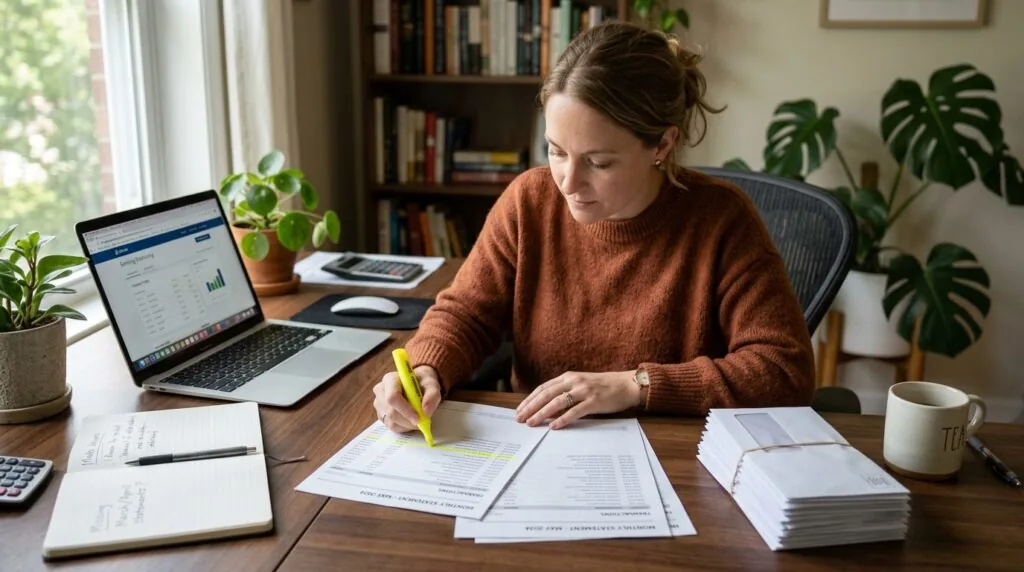
Keep receipts, purchase invoices, and utility bills for anything you’re claiming as a business expense. It helps to separate these into allowable expenses (wholly and exclusively for the business) and disallowable ones (personal costs, entertaining clients, most fines). If you drive for work, keep a mileage log — this is one of the most commonly under-recorded expenses, and the HMRC mileage allowance rates change how much you can claim per mile.
Bank and Cash Transactions
Keep statements for any account your business money passes through. Here’s the nuance most guides skip: legally, sole traders do not need a separate business bank account — HMRC only requires clear records, not a specific account structure. But in practice, mixing personal and business transactions in one account turns every tax return into a forensic exercise, and it makes an HMRC check far harder to sail through cleanly. If you haven’t separated the two yet, opening a dedicated account is one of the highest-value changes you can make to your bookkeeping. Compare business bank accounts before you commit to one.
Personal Income Records
If you have other income — employment (P60/P45), pensions, benefits, or savings interest — keep records of these too, since they affect your overall tax position and your Self Assessment calculation.
The Golden Rule: How Long Must You Keep Sole Trader Records?
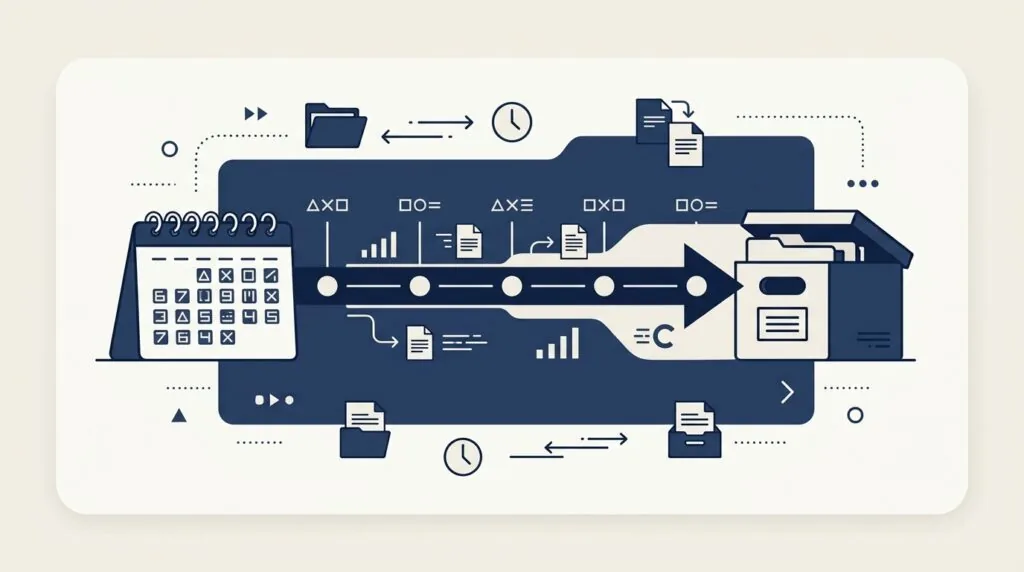
You must keep your business records for at least 5 years after the 31 January submission deadline of the relevant tax year.
The “5 years after 31 January” rule explained
This is longer than most people expect, and it’s the rule most sole traders get wrong. Here’s how it maps out in practice:
| Tax Year | Filing Deadline | Keep Records Until |
|---|---|---|
| 2023/24 | 31 January 2025 | 31 January 2030 |
| 2024/25 | 31 January 2026 | 31 January 2031 |
| 2025/26 | 31 January 2027 | 31 January 2032 |
| 2026/27 | 31 January 2028 | 31 January 2033 |
So a receipt from a purchase in May 2024 (part of the 2024/25 tax year) needs to be kept until 31 January 2031 — nearly seven years after the purchase itself.
Special circumstances (late returns, HMRC investigations)
If you file your return late, or HMRC opens an enquiry into it, keep everything until that matter is fully resolved — even if that pushes you past the standard five-year point. If you’re ever unsure whether it’s safe to shred something, the safer default is always to keep it a little longer.
Cash Basis vs. Traditional Accruals Accounting: Record Differences
Most sole traders can choose between two accounting methods, and the one you pick changes what you need to record.
How record keeping differs under the Cash Basis
Under the cash basis, you record income when money actually lands in your account and expenses when you actually pay them — not when the invoice was raised. This is simpler for most micro-businesses because your bookkeeping matches your bank statement almost exactly. Under traditional accruals accounting, you record income and expenses when they’re earned or incurred, regardless of when cash moves, which means you also need to track debtors (money owed to you) and creditors (money you owe).
Who qualifies for the £1,000 Trading Allowance?
If your total self-employment income is under £1,000 a year before expenses, you may not need to register with HMRC or file a return at all, thanks to the Trading Allowance. If you do register but claim the allowance instead of your actual expenses, you only need to keep records of your income — not a full expense breakdown. It’s a useful option for very small side income, though it stops making sense once your genuine expenses exceed £1,000.
How to Store Your Records: Paper vs. Digital Scans
You can store your records on paper or digitally — HMRC accepts both, provided they’re accurate, complete and readable.
Does HMRC accept digital photos of receipts?
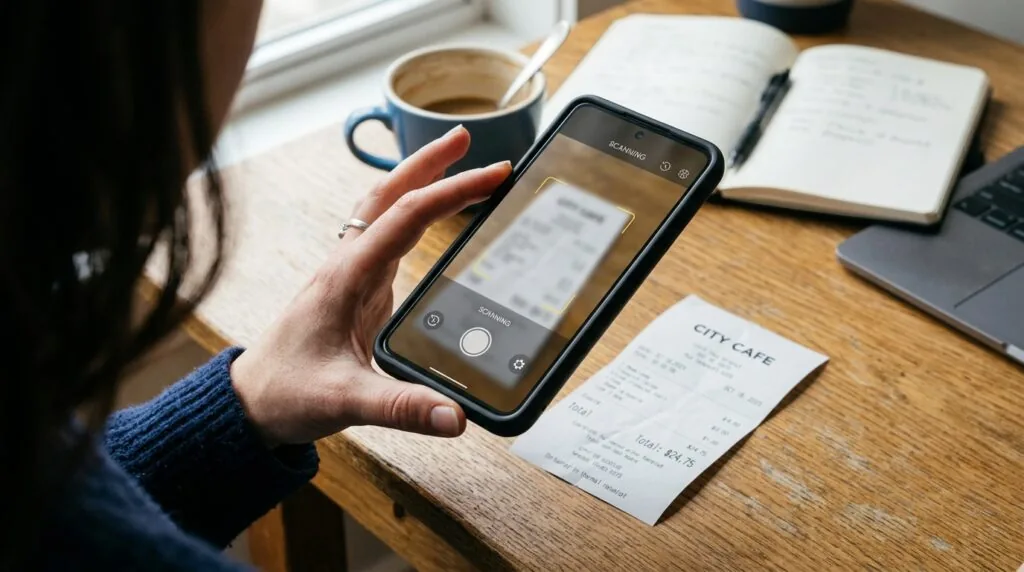
Yes. HMRC accepts digital photos and scans of receipts as valid records, and you don’t need to keep the physical paper copy once you’ve scanned it. The only requirement is that the image is legible — if there’s writing or a stamp on the back of a receipt, photograph that side too. Cloud storage or a dedicated receipt-scanning app is generally more reliable than a folder of paper that fades, gets lost, or gets left in a coat pocket through the wash.
Making Tax Digital (MTD) for ITSA: What you need to prepare for
Making Tax Digital for Income Tax Self Assessment is being rolled out in three phases based on gross income, and it changes digital record keeping from a good habit into a legal requirement:
- From April 2026: Mandatory for sole traders and landlords with gross income over £50,000
- From April 2027: Threshold drops to gross income over £30,000
- From April 2028: Threshold drops further to gross income over £20,000
Under MTD, you’ll need compatible software to keep digital records and send HMRC a quarterly update, rather than filing one annual Self Assessment return. If your income is close to any of these thresholds, it’s worth reading our guide on preparing for Making Tax Digital now rather than scrambling in the months before your mandatory start date.
What to Do If Your Sole Trader Records Are Lost, Stolen, or Destroyed
If your records are genuinely lost — through theft, fire, flood, or a crashed hard drive — HMRC allows you to file using estimated or provisional figures, but the two aren’t the same thing and mixing them up can cause problems later.
Recreating records and submitting “estimated” vs “provisional” figures
A provisional figure is a placeholder you use because you’re waiting on information you know you’ll get — a supplier invoice still in the post, for example. You must update HMRC with the real figure as soon as it’s available.
An estimated figure is your best genuine attempt at a number you’ll never be able to fully verify, typically because the original records are permanently gone. You should tell HMRC clearly that a figure is estimated, and be ready to explain how you arrived at it.
To rebuild lost records, start with your bank and card statements — most banks provide several years of history on request. Contact suppliers and major clients for duplicate invoices, and check email confirmations for online purchases. Document your recovery process as you go; if HMRC ever queries an estimated figure, showing your working carries real weight.
FAQs About Sole Trader Bookkeeping
How long do self-employed people keep records in the UK?
At least 5 years after the 31 January Self Assessment deadline for the relevant tax year.
Can I throw away paper receipts after scanning them for HMRC?
Yes. HMRC accepts clear digital copies as valid records, so the paper original doesn’t need to be kept once it’s been scanned legibly.
Do sole traders need a separate business bank account?
No, it isn’t a legal requirement. It is, however, strongly recommended, since mixing personal and business transactions makes bookkeeping and HMRC checks much harder.
What happens if I lose my business receipts?
You can use estimated figures on your tax return, clearly marked as such, and should try to rebuild records from bank statements and supplier copies. Genuine, well-documented estimates are treated very differently from records that were simply never kept.
What’s the penalty for not keeping proper records?
Up to £3,000 per tax year, though HMRC more commonly disallows unsupported expense claims rather than issuing a standalone penalty.
Quick Action Checklist
Getting compliant doesn’t need to happen all at once. Start here:
- Open a separate business bank account if you haven’t already.
- Choose one place to store records — a folder, a spreadsheet, or bookkeeping software — and commit to it.
- Scan or photograph every receipt the week you get it, not the week before your tax return is due.
- Note the exact retention date for each tax year’s records so nothing gets shredded early.
- Check where your income sits against the MTD thresholds so you’re not caught out by 2026 or 2027.
Sole trader bookkeeping is genuinely simpler than limited company accounting — but only if you build the habit early. A little consistency each week beats a frantic scramble every January.
—