

Updated 5 October 2026
Small businesses do pay customs duties after Brexit, but not on every shipment. What you owe depends on what the goods are, where they were made and what they are worth.
This guide shows how to work it out, with a worked example and the dates that matter up to 2028.
Short answer: Since 1 January 2021, goods moving between Great Britain and the EU need customs declarations. Duty follows the UK Global Tariff unless your goods qualify for 0% under the UK–EU Trade and Cooperation Agreement (TCA) and you can prove origin. Import VAT, usually 20%, is separate.
What changed for customs duties after Brexit
The UK left the EU customs union on 1 January 2021. Goods crossing between Great Britain and the EU are now imports and exports, with declarations, duty checks and VAT. Before 2021, EU trade had none of that.
Customs duty vs import VAT
Customs duty is a tax on imported goods. Import VAT is a separate tax on top. Owners often mix them up.
| Customs duty | Import VAT | |
|---|---|---|
| Based on | Code, origin, value | Customs value plus duty |
| Typical rate | 0% to 12% or more | 20% on most goods |
| Recoverable? | No, it is a cost | Yes, if VAT-registered |
| Can you postpone it? | Only via deferment or a relief | Yes, with postponed VAT accounting |
When you pay duty
Duty depends on your route.
| Route | Duty | VAT | Key document |
|---|---|---|---|
| EU to Great Britain | 0% if UK or EU origin and proven; otherwise UK Global Tariff | 20% on most goods | Supplier statement on origin |
| Rest of world to Great Britain | UK Global Tariff, or lower under a trade deal | 20% on most goods | Invoice; origin proof for lower rates |
| Great Britain to EU | EU duty, unless UK-origin goods qualify for 0% | EU import VAT | Statement on origin |
| Great Britain to Northern Ireland | Different rules | Different rules | XI EORI |
Northern Ireland follows the Windsor Framework. If you trade with it, check HMRC’s guidance for your case.
How customs duty is calculated
Duty is the customs value multiplied by the duty rate for your commodity code. Import VAT is then charged on value plus duty.
Duty = customs value × duty rate
Import VAT = 20% × (customs value + duty)
Three inputs drive the result: the code, the origin and the value.
Commodity code
A commodity code is a 10-digit number that classifies your product. The UK Trade Tariff shows its duty rate and extra measures such as anti-dumping duty. Use it, not the EU’s TARIC. A wrong code means the wrong rate, and HMRC can bill the difference with interest.
Origin
Origin is where goods were made or substantially transformed, not where they shipped from. A product made in China and sent via Germany is still Chinese origin.
Customs value
Customs value is the price paid plus transport and insurance to the UK border (known as CIF). Leaving freight out understates it, even by accident.
Worked example
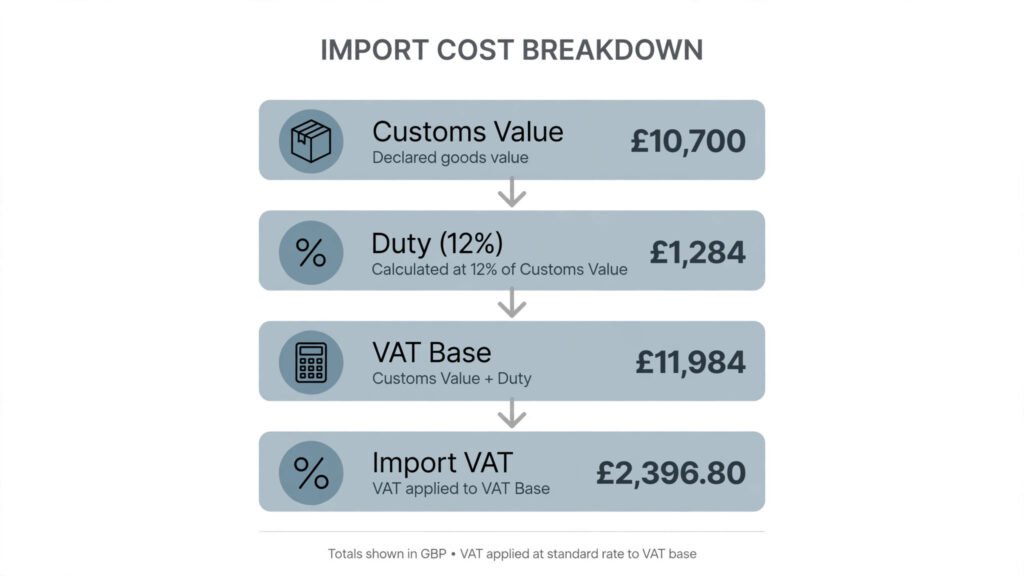
You buy £10,000 of goods from outside the EU. Freight and insurance add £700. The code carries a 12% rate (illustrative, so check yours).
| Step | Amount |
|---|---|
| Customs value (£10,000 + £700) | £10,700 |
| Duty at 12% | £1,284 |
| VAT base (£10,700 + £1,284) | £11,984 |
| Import VAT at 20% | £2,396.80 |
With postponed VAT accounting, you pay £1,284 duty at the border. You account for the £2,396.80 VAT on your VAT return and reclaim it there. Without it, you pay £3,680.80 up front and wait for a refund. Record the duty as part of your stock cost in your accounting software.
Zero duty on EU goods: proving origin
EU goods enter Great Britain duty-free only if they originate in the UK or EU and you can prove it. Zero tariffs under the TCA are not automatic. Shipping from the EU does not make goods EU origin.
Origin rules are set product by product. Goods usually need enough processing in the UK or EU, such as a change of tariff heading.
Statement on origin
A statement on origin is set wording on an invoice or other commercial document. Your EU supplier makes it. You can also rely on your own knowledge of origin, if you hold evidence. For consignments above €6,000, EU suppliers generally need REX registration.
To claim 0%:
- Check the TCA origin rule for your commodity code.
- Ask the supplier for a statement on origin on every invoice.
- Have your agent claim the preference on the declaration.
- Keep the evidence.
What HMRC checks
HMRC can check origin claims after goods clear, and advisers report more checks on claims since 2021. Without evidence, HMRC can reassess the full duty with interest and penalties. Keep supplier statements for four years.
Ways to reduce or defer duty and VAT
You cannot skip duty, but you can lower, delay or remove it legally.
Postponed VAT accounting
VAT-registered importers can account for import VAT on their VAT return instead of paying at the border. There is no application. Choose it on the declaration, then report the VAT in Box 1 and Box 4 for a net cash cost of zero. You file the return through Making Tax Digital software. Duty is not postponed.
Free trade agreement rates
The UK has its own trade deals, including with Australia and New Zealand, and has joined CPTPP. Qualifying goods can pay a lower rate or none, with proof of origin. Clothing typically carries a 12% standard rate, so the saving can be large.
Reliefs and suspensions
- Inward processing relief: goods imported, processed in the UK, then re-exported.
- Customs warehousing: duty is due only when goods leave the warehouse.
- Returned goods relief: UK goods you exported that come back.
- Temporary admission and ATA carnets: trade show goods that will leave again.
Duty deferment
A duty deferment account lets you pay duty in one monthly payment. HMRC may ask for a guarantee. It suits regular importers.
What a small importer needs in place
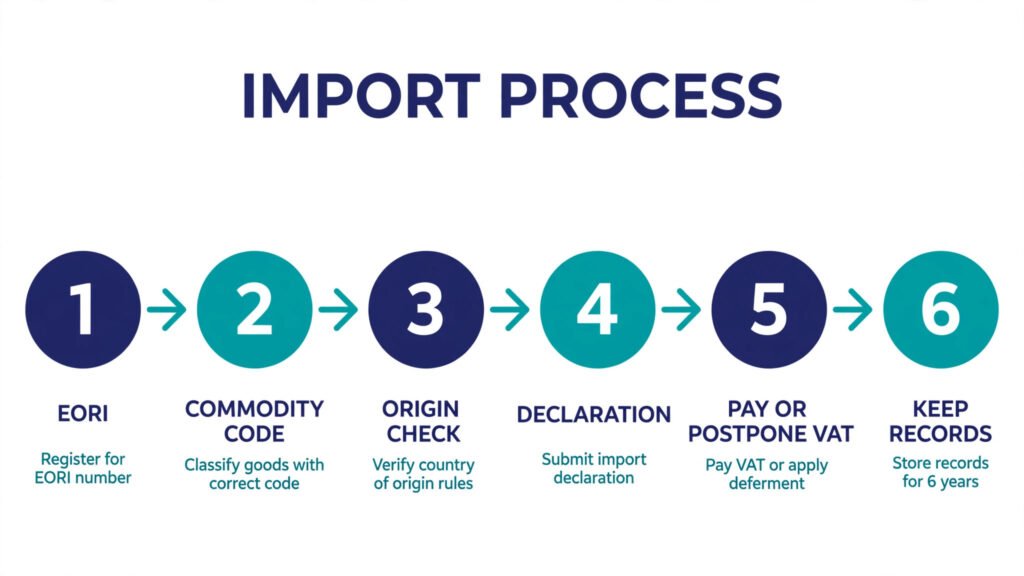
To import into Great Britain, follow six steps:
- Get a GB EORI number.
- Find each product’s commodity code.
- Check origin and any trade deal rate.
- Appoint an agent or set up declaration software.
- Pay duty and postpone VAT if you can.
- Keep your records.
EORI numbers
An EORI number identifies your business on customs declarations. Great Britain numbers start with GB, and without one goods can be held. It is free on GOV.UK and usually takes a few working days. Our guide to getting an EORI number walks through it. Trade with Northern Ireland may need an XI number. Clearing goods in the EU yourself needs an EU one.
Agent or self-declare
All declarations go through HMRC’s Customs Declaration Service (CDS). Most small businesses use an agent, forwarder or courier. Since 31 January 2025, EU goods also need a safety and security declaration before arrival, which your carrier usually files.
- Few shipments a year: use the courier’s clearance service, and ask about handling fees upfront.
- Regular shipments: appoint an agent and consider a deferment account.
- High volume: consider customs software.
You stay responsible for accuracy. Ask whether your agent acts in your name (direct) or theirs (indirect). With indirect, the agent can share liability for the debt.
Records and product rules
Keep customs records for four years and VAT records for six. That means invoices, declarations, origin statements and proof of payment. Our sole trader record keeping guide shows how to organise them.
Duty is not the only check. Great Britain recognises CE marking indefinitely for most products. Chemicals may need UK REACH compliance, and some goods need licences.
Selling to the EU after July 2026
When you sell to the EU, the EU country charges duty and VAT, not HMRC. You still need an export declaration. Our guide to exporting goods from the UK covers the process.
UK-origin goods that meet the TCA rules can enter the EU at 0% duty if the invoice carries a statement on origin. You do not need to register to make one. Without it, EU tariff rates apply and your customer pays them.
If you sell DDP (delivered duty paid), you pay duty and VAT for the buyer, so build it into your price. You may need an EU EORI and EU VAT registration.
The EU’s July 2026 changes
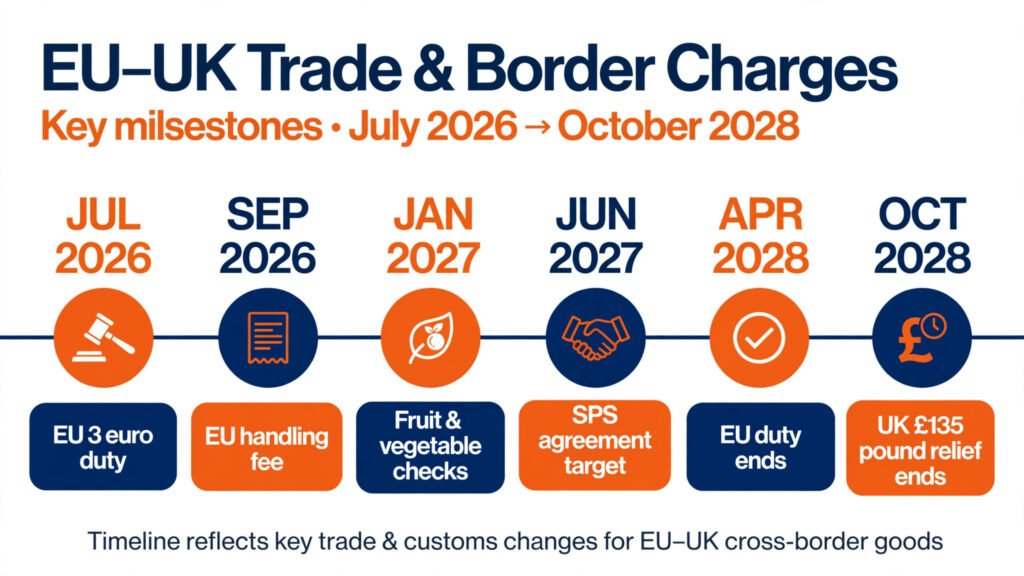
From 1 July 2026, the EU ended its €150 duty exemption. A flat €3 duty now applies to small parcels worth under €150 sold by non-EU sellers registered for IOSS. A €2 handling fee is expected from November 2026, and the €3 ends on 1 July 2028. Check current EU guidance on whether a statement on origin removes the charge. Shipping stock in bulk to an EU address may cost less, because it clears once as a commercial consignment.
Low-value imports and the end of the £135 relief
Consignments worth £135 or less are currently free of customs duty. The government has confirmed this relief will end by October 2028.
The deadline moved forward from March 2029 on 23 June 2026, and HMRC published its policy paper on 13 July 2026. Small parcels will move into a new regime with less data, quarterly duty payments and a UK “fiscal representative” for overseas sellers. October 2028 is the latest date, not a fixed start. The UK will not copy the EU’s €3 duty.
VAT on these parcels is still charged at the point of sale by the seller or marketplace.
If you buy samples or test orders from abroad by post, budget for duty from 2028. Marketplaces such as Amazon, eBay and Etsy handle VAT on small consignments, but stock you import yourself needs your own EORI and declaration.
Dates for your diary
| Date | What changes |
|---|---|
| 1 Jul 2026 | EU €3 duty on small parcels starts |
| Nov 2026 | EU €2 handling fee expected |
| 31 Jan 2027 | Physical checks on medium-risk EU fruit and vegetables currently postponed to this date |
| Mid-2027 | Government’s target start for the UK–EU SPS agreement; customs rules do not change |
| 1 Jul 2028 | EU interim €3 duty ends |
| Oct 2028 (latest) | UK £135 duty relief ends |
Common mistakes and penalties
HMRC treats any error on a customs declaration as a breach of customs rules. A first penalty for a non-serious error normally starts at £250. HMRC’s penalty wording allows up to £2,500 per breach for incorrect details. An error that understates duty by £10,000 or more is “serious”, and HMRC may go straight to a penalty.
The most common mistakes:
- Using the wrong commodity code.
- Claiming 0% without origin evidence.
- Leaving freight and insurance out of the customs value.
- Using an EU EORI on UK declarations.
- Treating Northern Ireland like Great Britain.
If you find an error, tell HMRC straight away. Disclosing it yourself is treated more favourably than waiting to be found.
FAQs
Do small businesses pay customs duty after Brexit?
Yes, when the goods attract duty. EU goods can enter at 0% if they originate in the UK or EU and you hold proof. Other goods pay the UK Global Tariff rate unless a trade deal applies.
Do I need an EORI number to import?
Yes. You need a GB EORI to make a customs declaration in Great Britain. It is free to apply for on GOV.UK.
Is there customs duty on goods under £135?
Not yet. Consignments of £135 or less are duty-free for now, though VAT is charged at the point of sale. The relief ends by October 2028.
How long should I keep customs records?
Keep customs records for four years and VAT records for six.
Do I need a customs agent?
No, but most small businesses use one. The agent files the declaration, but you stay responsible for the details.
Next steps and official sources
Start with one product. Find its commodity code, check its origin and work out the duty with the formula above. Then decide whether an agent makes sense. Customs rules change often, so check each rule on the official pages below before relying on it. This guide is general information, not tax or legal advice.