
Most UK business owners spend decades building something valuable and almost no time planning how to leave it. That gap is expensive. It shows up as unnecessary tax bills, rushed sales, and family businesses that don’t survive the handover.
This guide sets out the exit routes available to UK owners, the tax rules that apply from 2026 onward, and a practical framework for building a plan that protects both the business and your family’s wealth.
What is Business Succession Planning?
Business succession planning is the process of preparing for the transfer of ownership, management, or both, from a current business leader to their successor. It covers who takes over, how the transfer is funded, what tax applies, and how operations continue without disruption.
A good plan answers three questions: who runs the business next, who owns it next, and how the transition is paid for. Those three answers rarely have the same solution, which is why succession planning is more involved than simply naming an heir or listing the business for sale.
The Dual Focus: Ownership vs Management Succession
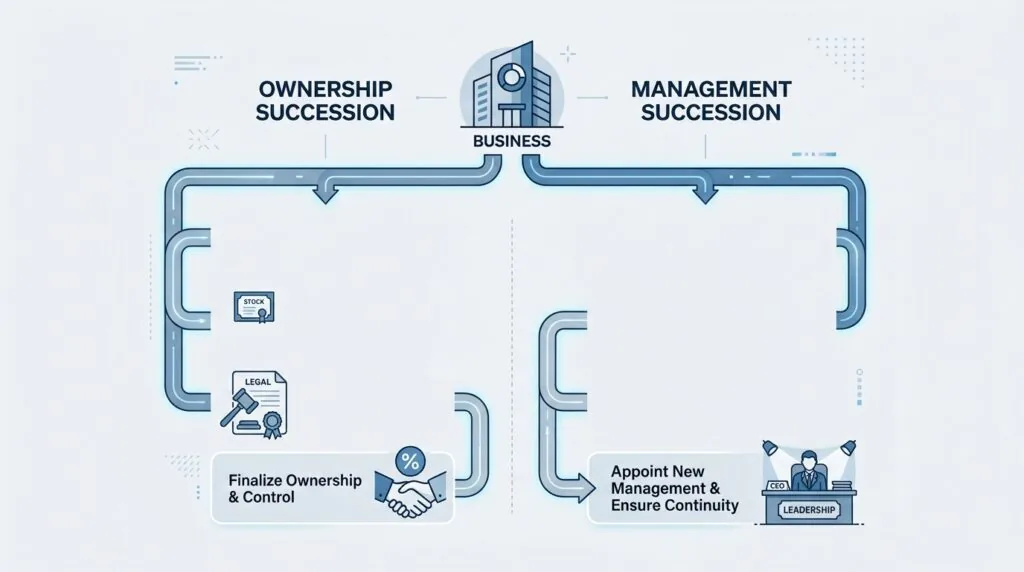
Ownership succession and management succession are not the same thing, and conflating them is one of the most common mistakes UK founders make.
Ownership succession deals with who holds the shares, and therefore who receives the financial value of the business. This is a legal and tax question, governed by your shareholder agreement, articles of association, and HMRC rules.
Management succession deals with who runs the business day to day. This is an HR and leadership question. A founder’s child might inherit shares without wanting, or being suited to, the managing director role. Equally, a trusted operations manager might be the right person to run the business without ever owning a majority stake.
Separating these two tracks early opens up options that a single “hand it to the eldest child” plan does not: a family member can hold equity while a professional manager runs operations, for example, or an EOT can own the business while the existing leadership team stays in place.
Why Having a Succession Plan is Non-Negotiable for UK Businesses
Research from the Federation of Small Businesses suggests only around a third of UK small firms have a formal exit or succession strategy in place, despite the fact that most owners eventually stop working, whether by choice, illness, or death. Among family firms specifically, only about 30% survive the transition to a second generation, and the businesses most likely to fail are the ones where planning started too late or not at all.
The risk isn’t abstract. Without a plan, a sudden departure can trigger a leadership vacuum, an unplanned tax bill on death, or a forced fire-sale at a fraction of the business’s real value. A director’s death without a cross-option agreement in place, for instance, can leave surviving shareholders and the deceased’s family in a legal standoff over who actually controls the company. Reviewing your company director responsibilities is a sensible starting point, since succession planning is, in part, a governance obligation.
The Core Routes of Business Succession in the UK
The four main exit routes for UK business owners are a family transfer, a management buyout, a sale to an Employee Ownership Trust, and a third-party trade sale. A fifth option, members’ voluntary liquidation, applies when none of these are suitable and the owner simply wants to wind the company down.
1. Passing the Business to Family Members
A family transfer moves shares to a spouse, child, or other relative, either as a lifetime gift or on death. It preserves the founder’s legacy and can be structured gradually, giving the next generation time to grow into the role.
The main risks are emotional rather than legal: sibling rivalry over control, resentment from family members not involved in the business, and successors who are willing but not yet capable. A formal family governance framework, such as a family constitution or council, helps separate business decisions from family dynamics before conflict sets in.
2. Management Buyouts (MBOs) and Buy-Ins (MBIs)
In an MBO, the existing management team buys the business from the owner, usually funded through a mix of personal investment, vendor finance, and bank or private equity debt. An MBI is the same structure but led by an external manager brought in specifically to take over.
MBOs work well when there’s a capable internal team but no family successor. The transition tends to be smoother because the buyers already understand the business, its customers, and its culture. The trade-off is financing: management teams rarely have the personal capital to pay full market value upfront, so owners often accept deferred consideration or an earn-out structured over several years.
3. Employee Ownership Trusts (EOTs)
An EOT is a trust that buys a controlling interest in the company on behalf of all employees, rather than a single buyer or family member. The trust is funded by future company profits, so the owner typically doesn’t need to find an external buyer at all.
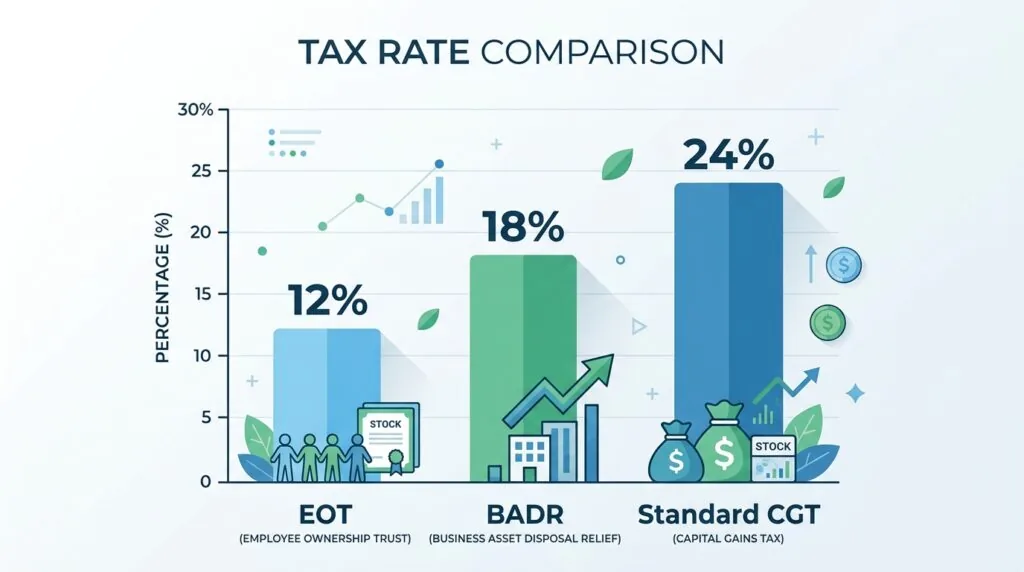
EOTs come with a meaningful tax incentive. For disposals from 26 November 2025 onward, half of the gain on a qualifying sale to an EOT is exempt from Capital Gains Tax, with the remaining half taxed at standard rates. For a higher-rate taxpayer, that works out to an effective rate of roughly 12%, still lower than the 18% rate that applies under Business Asset Disposal Relief from April 2026. The sale can also be free of income tax and inheritance tax where the conditions are met. In exchange, the owner gives up the option to sell to the highest bidder and hands long-term control to an independent trustee body acting for the workforce.
4. Third-Party Trade Sale
A trade sale means selling the business outright to an external buyer, often a competitor, supplier, or private equity firm. It usually delivers the highest headline price, since a strategic buyer may pay a premium for market share, customer relationships, or intellectual property.
Trade sales bring the most due diligence and the least certainty over culture and staff retention. The process typically starts with a letter of intent setting out heads of terms, followed by weeks or months of financial and legal due diligence before completion.
5. Voluntary Liquidation (Members’ Voluntary Liquidation)
An MVL is used when a solvent company has no ongoing successor and the owner wants to extract retained profits and close the business formally. A licensed insolvency practitioner distributes the company’s assets to shareholders, and those distributions are usually treated as capital rather than income, which can qualify for Business Asset Disposal Relief. If you’re weighing this route, our guide on how to close a limited company in the UK covers the process step by step.
| Exit Route | Best For | Typical Timeline | Tax Treatment (2026/27) |
|---|---|---|---|
| Family Transfer | Founders with a willing, capable successor | 5–10 years | IHT: BPR up to £2.5m combined threshold; CGT holdover relief may apply |
| MBO/MBI | Strong internal team, no family successor | 1–3 years | CGT on sale, BADR at 18% up to £1m lifetime limit |
| EOT | Owners prioritising legacy and staff continuity | 1–2 years | 50% CGT exemption, effective ~12% rate; no income or IHT on qualifying disposal |
| Trade Sale | Maximising sale price | 6–18 months | CGT at 18–24%, or BADR at 18% up to £1m if eligible |
| MVL | Solvent wind-down, no successor | 2–6 months | Capital treatment on distributions, BADR may apply |
The UK Tax Landscape: Protecting Your Wealth Upon Exit
Succession planning and tax planning cannot be separated. The route you choose determines whether your exit is taxed at roughly 12%, 18%, 24%, or 40%, so understanding the current rules is essential before you commit to a structure.
Business Property Relief (BPR) and Inheritance Tax (IHT) Changes
From 6 April 2026, the 100% rate of Business Property Relief and Agricultural Property Relief is capped at a combined £2.5 million of qualifying assets per individual. Any value above that threshold receives only 50% relief, which creates an effective 20% Inheritance Tax charge on the excess. This cap was raised from an originally proposed £1 million after industry consultation, and any unused allowance can now be transferred between spouses and civil partners, meaning a married couple could shelter up to £5 million combined.
The standard IHT nil-rate band remains £325,000, and both the nil-rate band and residence nil-rate band are frozen until 2030. Lifetime gifts of business assets made from 30 October 2024 onward fall under the new regime if the donor dies on or after 6 April 2026 within seven years of the gift, so timing a family transfer now needs more care than it did before these changes.
Capital Gains Tax (CGT) and Business Asset Disposal Relief (BADR)
To qualify for Business Asset Disposal Relief, you must have owned the business, or at least 5% of its shares and voting rights, for a minimum of two years, and been an officer or employee of the company throughout that period. From 6 April 2026, qualifying gains under BADR are taxed at 18%, up from 14% in the 2025/26 tax year and 10% before April 2025, applied to a lifetime limit of £1 million in gains. Gains above that limit, or from disposals that don’t qualify, are taxed at the standard rates of 18% or 24%, depending on the seller’s income tax band.
Worked example: A founder sells their business for a £500,000 gain, has their full BADR allowance available, and is a higher-rate taxpayer.
- Under BADR (18%): tax due is £90,000
- Under standard CGT (24%): tax due is £120,000
- Sold to an EOT (effective ~12%): tax due is roughly £60,000
The EOT route saves £30,000 against BADR and £60,000 against a standard sale on this example, though it comes with the trade-offs to control and price described above.
Structuring Shares: Cross-Option Agreements and Articles of Association
A cross-option agreement gives surviving shareholders the option to buy a deceased or critically ill shareholder’s shares, and gives that shareholder’s estate the option to sell them, typically funded by keyperson insurance held in trust. Without one, a shareholder’s shares can pass to family members who have no interest in, or understanding of, the business, creating exactly the kind of ownership deadlock succession planning is meant to prevent.
Your articles of association should also set out pre-emption rights, drag-along and tag-along clauses, and any restrictions on who can hold shares. These documents, alongside your shareholder agreement, form the legal backbone that makes any of the five exit routes above actually executable when the time comes. It’s also worth reviewing your business insurance cover to confirm keyperson protection is in place and adequately valued.
How to Build Your Succession Plan: A Step-by-Step UK Framework
Building a succession plan follows four broad stages: setting your goals, identifying your successor, formalising the legal and financial structure, and executing a controlled handover. Most advisers recommend starting this process five to ten years before you intend to step back.
Step 1: Establish Your Personal and Business Valuation Goals
Start by defining what you actually need from the exit: a target income in retirement, a legacy for your family, continued involvement at a reduced level, or a clean break. Get an independent business valuation early, since it’s common for owners to overestimate what their business is worth and underestimate how long it takes to close that gap. This is also a natural point to revisit your business plan, since a credible growth story materially affects valuation.
Step 2: Identify and Assess Potential Successors
The CIPD’s approach to succession planning treats it as an ongoing talent pipeline rather than a one-off decision. In practice, that means mapping your leadership bench against future capability needs, not just current performance, and being honest about gaps between where a candidate is now and where they need to be.
- List every role that would be vacant if you left tomorrow.
- Score internal candidates against the capabilities each role actually needs, not just tenure or loyalty.
- Identify development gaps and build a structured plan, such as shadowing, mentoring, or formal training, to close them.
- Revisit the assessment annually, since capability and circumstances change on both sides.
Where the internal talent pool is thin, HR software built for smaller UK businesses can help formalise performance data that would otherwise live only in the owner’s head, which becomes essential once someone else is doing the assessing.
Step 3: Formalise the Legal and Financial Structures
This is where the tax and legal decisions from the section above get implemented: drafting or updating the shareholder agreement, setting up a cross-option agreement, choosing between an MBO, EOT, trade sale, or family transfer structure, and getting sign-off from an accountant and solicitor. Rushing this stage is the single most common cause of deals collapsing or of unnecessary tax bills further down the line.
Step 4: Execute a Controlled Handover and Transition Period
A handover is rarely a single event. Most successful transitions include a defined period, often six months to two years, where the outgoing owner remains available in an advisory capacity while the new leader takes on full authority. Set a hard end date for this period in advance. Open-ended arrangements are a common source of friction, since the outgoing owner and the incoming leader often disagree, without realising it, about when “advising” should stop and “running” should start.
Common Pitfalls in UK Succession Planning (and How to Avoid Them)
- Leaving it too late. Planning that starts less than two years before an intended exit rarely leaves enough time to develop a successor properly or to optimise the tax structure. Start the conversation five to ten years out.
- Assuming a family member wants the business. Ask directly and early. A significant share of failed family transfers stem from an owner assuming interest that was never actually confirmed.
- No cross-option agreement. Without one, death or serious illness can leave shares tied up in an estate for months, with surviving shareholders unable to act.
- Treating succession as purely a legal exercise. A watertight shareholder agreement doesn’t fix a leadership gap. The management and ownership tracks both need attention.
- Ignoring the 2026 BPR and BADR changes. Plans built around pre-2024 tax rules will materially understate the tax due on both family transfers and business sales going forward.
- No written valuation baseline. Without a documented valuation, it’s difficult to structure fair buyout terms for an MBO or agree a credible asking price for a trade sale.
Frequently Asked Questions
How do I pass my business to my children tax-free in the UK?
There is no fully tax-free route, but the tax burden can be minimised. From April 2026, the first £2.5 million of combined business and agricultural assets qualifies for 100% Business Property Relief from Inheritance Tax, with 50% relief above that. CGT holdover relief can also defer Capital Gains Tax on a lifetime gift of qualifying business assets, though this requires both parties’ agreement and specialist advice.
What is the difference between ownership and management succession?
Ownership succession decides who holds the shares and receives the financial value of the business. Management succession decides who runs day-to-day operations. The two do not need to go to the same person.
How long does a business succession plan take to implement?
Most advisers recommend starting five to ten years before an intended exit. A management buyout or trade sale can complete in six months to three years once the decision is made, while a phased family transfer or leadership development plan often takes longer to execute properly.
How does an Employee Ownership Trust work in the UK?
An EOT buys a controlling stake in the company on behalf of all employees, funded from future profits rather than an external buyer. Sellers qualify for a 50% Capital Gains Tax exemption on disposals from 26 November 2025 onward, giving an effective rate of around 12% for higher-rate taxpayers, and the sale can also be free of income tax and Inheritance Tax where the conditions are met.
Do I need a solicitor and accountant for succession planning?
Yes. The legal structure (shareholder agreements, cross-option agreements, articles of association) and the tax structure (CGT, BADR, BPR, IHT) are complex enough, and change often enough, that DIY planning carries real financial risk. Bring both in well before you intend to act.