


A Letter of Intent (LOI) is a short document that sets out the main terms of a business sale before the parties draft the full legal contract. In UK practice, most solicitors call it “Heads of Terms” rather than “Letter of Intent,” though buyers, sellers and brokers use both names for the same thing.
The LOI records what’s been agreed so far: who is buying, what they’re buying, roughly how much they’ll pay, and how the deal moves forward from there. It isn’t meant to replace the Share Purchase Agreement (SPA) or Asset Purchase Agreement (APA) that eventually completes the sale — it’s the bridge between informal negotiation and formal due diligence.
What is a Letter of Intent in a business purchase?
A Letter of Intent (LOI) is a document, usually marked “subject to contract,” that outlines the proposed terms of a business acquisition — including price, structure and timeline — before the parties sign a legally binding sale agreement. In UK transactions it’s most often called Heads of Terms, and only specific clauses within it (such as exclusivity and confidentiality) are intended to be enforceable.
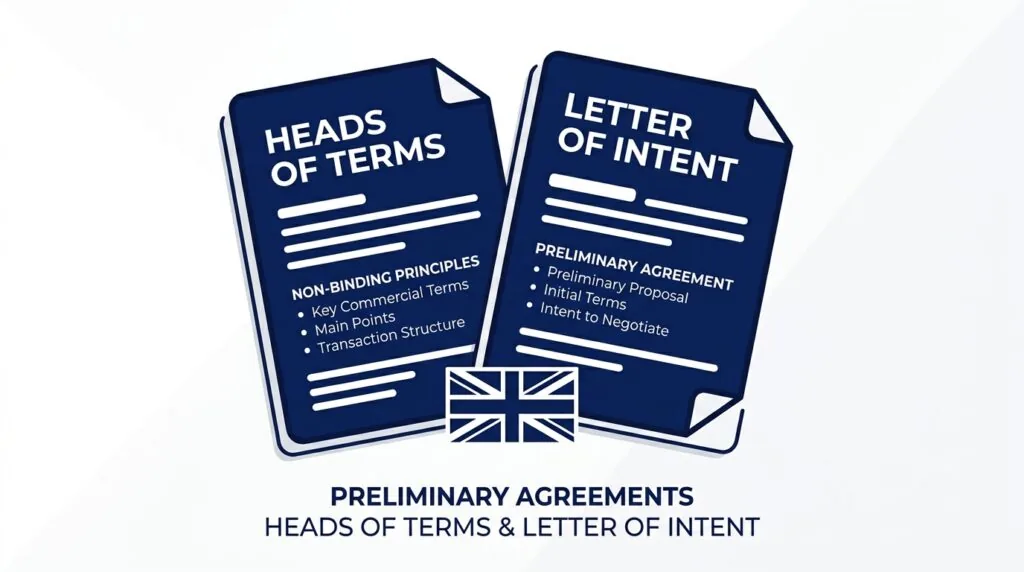
LOI vs Heads of Terms vs MoU: What’s the Difference in the UK?
There’s no strict legal difference between a Letter of Intent, Heads of Terms and a Memorandum of Understanding (MoU) in England and Wales. All three describe a preliminary, mostly non-binding record of proposed deal terms — the difference is mainly one of convention.
UK solicitors and corporate finance advisers usually draft “Heads of Terms” (sometimes “Heads of Agreement”) for a domestic sale. “Letter of Intent” tends to appear in deals with US involvement. “Memorandum of Understanding” is rarer in private business sales, appearing more in cross-border or public-sector deals.
None of this changes the legal analysis. What matters is the wording inside the document, not the label on the front page. A “Letter of Intent” that behaves like a binding contract will be treated as one, regardless of its name.
Is a Letter of Intent Legally Binding under English Law?
An LOI is generally not legally binding in England and Wales, but parts of it usually are. The default position is that a document marked “subject to contract” does not create a binding agreement until a formal contract is signed. However, courts look at the substance of what the parties did, not just the label they used.
The Critical “Subject to Contract” Label
Marking the document “subject to contract” is the standard way to preserve its non-binding status. It tells both parties — and any court reviewing the deal later — that neither side intends to be bound until the SPA or APA is signed. Every LOI should carry this label clearly, at the top of the document and again above the signature block.
Which Clauses Should Be Legally Binding?
Even though the commercial terms are non-binding, certain clauses are drafted to be enforceable from the moment the document is signed: exclusivity, confidentiality, costs allocation and governing law. Leaving these non-binding would defeat their purpose — a seller not bound to exclusivity, for example, could keep negotiating with other buyers while the LOI is in place.
| Clause Type | Legally Binding? | Why It Matters |
|---|---|---|
| Purchase price | No | Price is indicative until due diligence and final negotiation confirm it |
| Deal structure (share vs. asset) | No | May change once tax and liability review is complete |
| Exclusivity (lock-out) | Yes | Stops the seller negotiating with other buyers during the period |
| Confidentiality (NDA) | Yes | Protects sensitive financial and operational information already shared |
| Governing law and jurisdiction | Yes | Confirms disputes over the LOI itself are settled under English law |
| Costs allocation | Yes | Sets who pays legal and advisory fees if the deal falls through |
| Conditions precedent | No (descriptive) | Lists what must happen before completion, not an enforceable promise |
Key Elements of a UK Business Purchase LOI Checklist
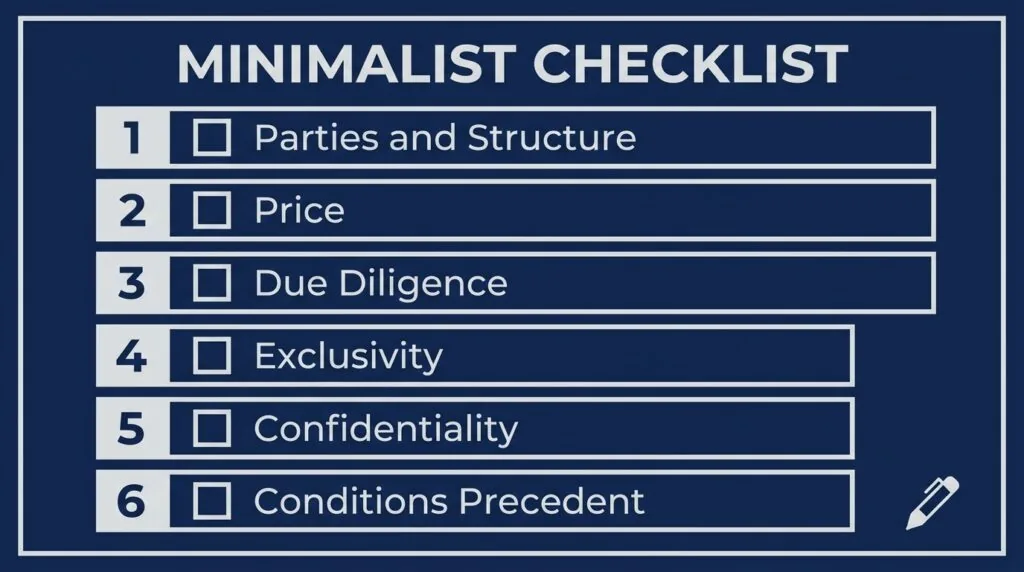
A well-drafted LOI covers six core areas. Missing any of these tends to cause disputes later, once due diligence uncovers details the parties assumed were already settled.
1. Identification of Parties and Transaction Structure
The LOI should name the buyer, seller and target company precisely, then state whether the deal is a share purchase or an asset purchase — a distinction that changes almost everything else in the document. A share purchase transfers the whole company, including its liabilities, contracts and memorandum of association, and usually means updating the target’s shareholder agreement after completion. An asset purchase lets the buyer choose specific assets — plant, machinery, stock, goodwill, customer contracts — leaving unwanted liabilities behind. HMRC treats the two structures very differently for corporation tax and capital gains tax purposes, so the LOI should state the intended structure early. A buyer becoming an officer of the target should also understand their new director responsibilities before signing.
2. Indicative Purchase Price and Payment Structure
The LOI should set out the headline price, how it was calculated, and any adjustment mechanisms — a cash-free, debt-free basis, an earn-out tied to future performance, or deferred consideration paid in instalments. None of this is binding, but writing it down avoids the awkward conversation later where one side thought the earn-out was capped and the other didn’t.
3. Due Diligence (DD) Framework and Target Timeline
This section sets expectations for how due diligence will run: what information the seller will provide, which advisers are involved, and a realistic target date for completion. A typical UK SME acquisition allows 4 to 8 weeks for financial, legal and commercial due diligence, though this varies with the size and complexity of the business. Buyers should also confirm the target meets baseline legal requirements for UK small businesses as part of this review.
4. Exclusivity (The ‘Lock-Out’ Agreement)
Exclusivity stops the seller negotiating with, or accepting offers from, other buyers while the LOI is in force. In the UK market, exclusivity periods typically run for 30 to 60 days; longer periods are usually reserved for more complex deals. A well-drafted clause includes a fixed end date, and often a carve-out letting the seller respond to (but not solicit) unsolicited approaches, so the buyer keeps protection without trapping the seller if talks stall.
5. Confidentiality and Non-Disclosure (NDA) Provisions
Confidentiality obligations protect information already exchanged, such as management accounts, customer lists or supplier terms. Many deals use a standalone NDA signed before the LOI, with the confidentiality clause confirming it still applies, or setting new terms if none exists yet.
6. Conditions Precedent
Conditions precedent list what needs to happen before completion: satisfactory due diligence, board or shareholder approval, third-party consents (such as landlord consent to assign a lease), regulatory approval where relevant, and confirmation of financing. These are descriptive rather than binding promises, but a clear list reduces the risk of a late-stage surprise once the SPA is being drafted.
The Legal Trap: How a Non-Binding LOI Can Accidentally Become Binding
Marking a document “subject to contract” doesn’t guarantee it stays non-binding. English courts look at what the parties actually did, not just what the document says. If a buyer starts integrating the target business, paying deposits, or the seller lets the buyer take over supplier relationships before the SPA is signed, a court can find their conduct overrode the “subject to contract” label and created a binding agreement by implication.
The leading case is RTS Flexible Systems Ltd v Molkerei Alois Müller GmbH & Co KG [2010] UKSC 14. The dispute involved a letter of intent for packaging equipment, sent “subject to contract” and expected to be replaced by a full contract once terms were finalised. That contract was never signed. Work carried on for months regardless, and the letter of intent itself expired without a replacement. When a dispute arose, the Supreme Court held that a binding contract had, in fact, been formed — based on the parties’ conduct and objective intentions, not the unsigned paperwork. It’s now the standard warning English lawyers cite whenever a client wants to start acting on a deal before the contract is signed.
The lesson for a UK business purchase is direct: don’t begin operational integration, transfer staff, or make payments outside the agreed exclusivity and cost clauses until the SPA is signed. If time pressure makes early action unavoidable, get specific legal advice on ring-fencing that conduct so it can’t be read as acceptance of the wider deal.
Benefits of Drafting an LOI Before the SPA
An LOI earns its place even though most of it isn’t enforceable. It forces both sides to agree the headline terms — price, structure, timeline — before anyone spends money on lawyers drafting a 60-page SPA. That saves legal fees, because disagreements over fundamentals surface early, when they’re cheap to resolve, rather than midway through drafting.
It also builds momentum. A signed LOI signals genuine commitment, which matters when a seller is juggling more than one interested buyer. And it’s a reality check: if the parties can’t agree on price or structure at LOI stage, they’re unlikely to agree three weeks into due diligence, so the LOI can save both sides from a deal that was never going to close. On the seller’s side, agreeing terms early also helps with practical planning, whether that means transferring specific assets or eventually closing the remaining limited company after an asset sale.
Frequently Asked Questions
Do I need a solicitor to draft a Letter of Intent?
It isn’t a legal requirement, but it’s strongly recommended. A solicitor ensures the binding clauses — exclusivity, confidentiality, costs, governing law — are properly drafted, while the commercial terms stay clearly ring-fenced with “subject to contract” wording.
Can a seller back out of an LOI in the UK?
Yes, in most cases. Because the commercial terms are non-binding, a seller can generally walk away from the price and structure without breaching the document — unless they breach a binding clause, such as negotiating with another buyer during an active exclusivity period.
Who pays the legal costs of drafting an LOI?
This is usually set out in the LOI’s costs clause, one of the few provisions intended to be binding. The common UK approach is that each party bears its own costs regardless of whether the deal completes, though some LOIs include a break fee if one side withdraws without good reason once due diligence has started.
Does an LOI need to be registered with Companies House or HMRC?
No. A Letter of Intent is a private document between the buyer and seller and has no filing requirement. Only later stages of the transaction, such as changes to company officers or shareholdings following completion, trigger a Companies House filing. Once the deal is close to completion, it’s also worth reviewing business insurance requirements as part of the handover.