

If you own shares in a UK private limited company, the law does not automatically protect you from being outvoted, diluted, or pushed out by a co-founder. That protection comes from a shareholder agreement. It’s one of the most overlooked documents in early-stage business, and one of the most expensive to live without.
What is a Shareholder Agreement (SHA) in the UK?
Definition of a Shareholders’ Agreement
A shareholder agreement (SHA) is a private, legally binding contract between the shareholders of a UK company. It sets out how the business will be run, how decisions get made, how shares can be sold or transferred, and what happens if a shareholder leaves, dies, or wants out. Unlike the Articles of Association, it is not filed at Companies House and stays confidential between the parties who sign it.
Is a Shareholder Agreement Legally Required in the UK?
No. You can legally form and run a limited company without one. Companies House only requires Articles of Association, which are usually the free “Model Articles” set by default during incorporation. But those default rules are generic and were never written with your specific business, your co-founders, or your investors in mind. If you’re still working through the wider legal requirements for UK small businesses, a shareholder agreement should sit near the top of that list, even though no regulator forces you to have one.
Shareholder Agreement vs. Articles of Association: Key Differences
These two documents work together, but they’re not the same thing, and confusing them is one of the most common founder mistakes.
| Feature | Articles of Association | Shareholder Agreement |
|---|---|---|
| Filed at Companies House | Yes, public record | No, stays private |
| Who can read it | Anyone, via public search | Only the signing shareholders |
| Legally required | Yes | No |
| Ease of amendment | Requires a special resolution (75% vote) | Usually requires unanimous or agreed consent |
| Covers personal deal terms | Rarely | Yes, e.g. leaver terms, valuations, vesting |
| What if the two conflict | — | SHA usually includes a “supremacy clause” so it prevails between shareholders |
Public vs. Private Document
Your Articles are searchable by anyone, including competitors, journalists, and potential acquirers. An SHA is not. This matters if you want to keep sensitive terms, like how much a departing founder gets paid for their shares, out of public view.
Ease of Amendment
Articles can be changed with a 75% shareholder vote under a special resolution. An SHA typically needs everyone’s agreement to change, which gives minority shareholders a genuine say they wouldn’t otherwise have.
Statutory Supremacy
Here’s the part most guides skip. If the Articles and the SHA say different things, which one wins? Legally, the Articles govern the company’s relationship with Companies House and third parties, so they can’t simply be ignored. But a well-drafted SHA includes a supremacy clause, stating that between the shareholders themselves, the SHA’s terms take priority. In practice, most solicitors then update the Articles to mirror the SHA’s key terms, so there’s no daylight between the two documents at all.
What Happens If You Do Not Have a Shareholder Agreement?
Without an SHA, your company defaults entirely to the Companies Act 2006 and whatever Articles you adopted at incorporation, usually the Model Articles. Those rules were written to be broadly workable for any company, not to protect you specifically.
| Situation | Companies Act 2006 Default | With a Custom Shareholder Agreement |
|---|---|---|
| A 51% shareholder wants to sell the whole company | Minority shareholders can be outvoted with no exit rights | Tag-along rights force the buyer to offer the same deal to everyone |
| A founder wants to sell their shares to an outsider | No restriction; shares can generally be sold to anyone | Pre-emption rights give existing shareholders first refusal |
| Two 50/50 shareholders disagree on a major decision | No built-in resolution mechanism; can lead to deadlock | Deadlock clause (e.g. mediation or a Russian Roulette clause) forces resolution |
| A shareholder leaves the business early | No formal distinction between leaving well or badly | Good leaver/bad leaver terms set fair valuation rules |
| Dividend decisions | Directors decide, subject to general duties | SHA can fix a distribution policy shareholders agreed in advance |
Protecting Minority Shareholders
Minority shareholders are the most exposed under the default rules. A majority shareholder can generally outvote them on ordinary resolutions, and without pre-emption rights, there’s nothing stopping shares being sold to someone the minority never agreed to work with. An SHA fixes this with transfer restrictions and voting thresholds that require broader consent for major decisions.
Protecting Majority Shareholders and Investors
Majority shareholders and outside investors face a different risk: being stuck with a disengaged or underperforming co-founder who still owns a large equity stake. Investors coming in through routes like angel investment will almost always require an SHA as a condition of funding, and will typically want board representation and veto rights written into it before any money changes hands. If the round involves reliefs like SEIS, your SHA also needs to avoid clauses that could accidentally breach scheme conditions, so it’s worth having a solicitor check this specifically.
7 Crucial Clauses Every UK Shareholder Agreement Should Contain
1. Share Transfer Restrictions & Pre-emption Rights
These clauses stop shareholders selling to outsiders without first offering shares to existing shareholders. Pre-emption rights ensure that existing shareholders have the first opportunity to buy shares before they go to a third party. This keeps control inside the group you chose to work with.
2. Drag-Along and Tag-Along Provisions
Drag-along rights let a majority shareholder force a minority to sell when the company is bought, so a deal can’t be blocked by one holdout. Tag-along rights protect minority shareholders in the other direction, letting them join a sale on the same terms the majority negotiated, rather than being left behind as a minority stakeholder in someone else’s company.
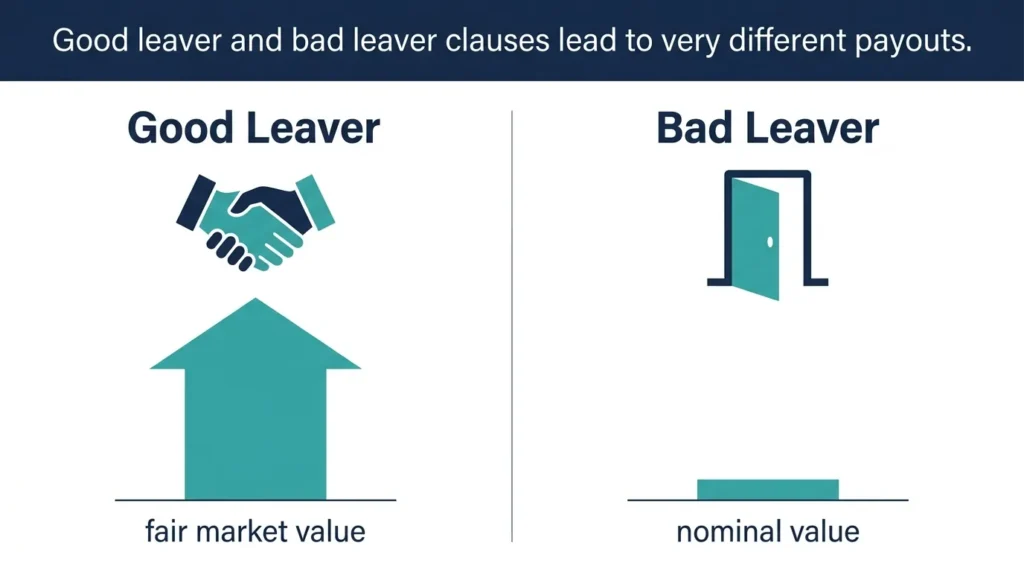
3. Good Leaver vs. Bad Leaver Clauses
This is where most competitor guides stay vague, and it’s the clause that causes the most disputes in practice. The label “leaver” only matters because of what it does to the price of your shares.
- Good leaver (death, illness, redundancy without cause): the departing shareholder is usually paid fair market value, often based on an independent valuation.
- Bad leaver (resignation early, dismissal for cause, breach of the agreement): the departing shareholder often receives only nominal or par value, sometimes just £1 a share, regardless of what the company is actually worth.
The financial gap between these two outcomes can run into hundreds of thousands of pounds. Vesting schedules are often layered on top, so a founder who leaves in year one might forfeit shares entirely, while one who leaves in year three keeps a larger, partly vested stake. Define both triggers and both valuation methods in plain numbers before anyone signs, not after someone has already decided to leave.
4. Board Representation & Decision-Making Thresholds
This clause sets who sits on the board and which decisions need an ordinary resolution (over 50% approval) versus a special resolution (75% approval), plus any matters that require unanimous shareholder consent, such as issuing new shares or taking on significant debt.
5. Dividend Distribution Policy
The SHA can fix how and when profits are distributed, which matters enormously if shareholders take income differently, for example a working director drawing a salary versus a passive investor relying purely on dividends. This connects directly to how directors pay themselves and to planning around the dividend tax rate, so it’s worth aligning this clause with your wider tax strategy rather than treating it as boilerplate.
6. Restrictive Covenants (Non-Compete & Confidentiality)
These stop a departing shareholder from setting up a rival business or poaching staff and clients for a defined period after they leave, and they keep commercially sensitive information, like your customer list or pricing model, out of a competitor’s hands.
7. Dispute Resolution & Deadlock Provisions
In the event of a dispute or deadlock, especially common in 50/50 companies, the SHA should set a clear process: mediation first, then arbitration, then, as a last resort, a forced buyout mechanism such as a Russian Roulette clause (one shareholder names a price; the other must buy or sell at that price) or a Texas Shoot-out clause (both submit sealed bids). Without one of these, deadlock can freeze a company indefinitely.
How to Legally Implement and Manage a Shareholder Agreement
When is the Best Time to Create One?
The best time is before you need it, ideally when you set up the company or immediately after, while relationships are still good and no one has a reason to disagree. It’s also worth drafting alongside your business plan, since decisions about roles, funding, and equity split naturally feed into the clauses you’ll need. Waiting until a dispute is brewing is the worst time, because by then, agreeing on fair terms is far harder.
What is a Deed of Adherence? (Adding New Shareholders)
You don’t need to redraft the whole agreement every time someone new buys or is issued shares. A Deed of Adherence is a short, separate document a new shareholder signs to confirm they agree to be bound by the existing SHA’s terms in full. It’s attached to the original agreement and takes only a few paragraphs, making it the standard way to bring in new investors, employees receiving equity, or a shareholder’s transferee.
How to Legally Amend an Existing Agreement
Because an SHA is a private contract, not a filed statutory document, changing it does not involve Companies House. Instead:
- Shareholders agree the proposed changes, usually in writing.
- The agreement is checked for its own amendment clause, most require unanimous consent, though some allow a lower threshold for minor changes.
- A formal amendment or a restated agreement is drafted and signed.
- If terms were mirrored in the Articles, those are updated too via special resolution and filed at Companies House.
- All shareholders, including any who joined later by Deed of Adherence, receive a signed copy of the updated agreement.
Because an SHA is usually executed as a deed, both the original and any major restatement typically need signatures witnessed, not just signed, to be enforceable.
Frequently Asked Questions
Why do I need a shareholder agreement? Without one, your company relies entirely on the generic Companies Act 2006 default rules, which offer minimal protection against being outvoted, diluted, or stuck in a deadlock with no exit route.
Is a shareholder agreement public? No. Unlike the Articles of Association, a shareholder agreement is not filed at Companies House and is only seen by the shareholders who sign it.
What is the difference between Articles of Association and a shareholder agreement? Articles are a public, statutory document required by law. A shareholder agreement is a private, optional contract that usually covers more personal and commercial terms, like leaver provisions and valuation methods.
Can a shareholder agreement override the Articles of Association? Between shareholders, yes, if it includes a supremacy clause. Against third parties and Companies House, the Articles still govern, which is why solicitors usually update both documents to match.
What happens if there is no shareholder agreement in the UK? The company falls back on the Companies Act 2006 and its Articles alone, which typically leaves minority shareholders exposed to being outvoted and gives no clear process for resolving deadlock or valuing a departing shareholder’s stake.
Do I need a solicitor to write one? Templates exist, but given how much money can turn on a single valuation clause, most founders use a solicitor at least to review the final draft before signing