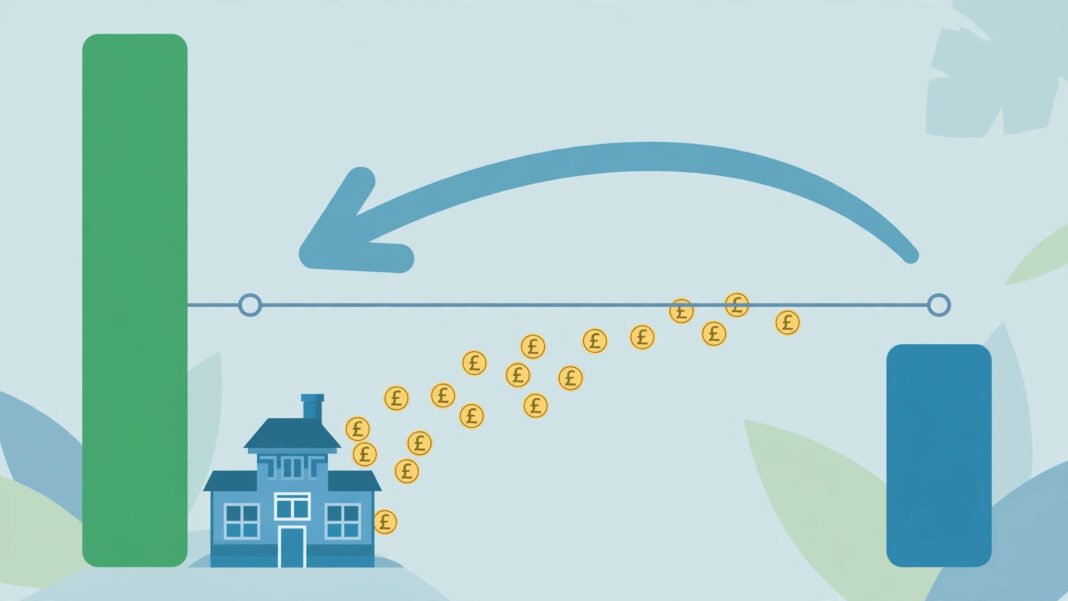


UK Corporation Tax loss carry back lets a company set a trading loss against its total profits of the previous 12 months. HMRC then repays Corporation Tax already paid on those profits. The company uses the loss against same-period profits first, and must claim within two years of the loss-making period’s end.
A company that stops trading can go further. Terminal loss relief carries final-year losses back three years. The temporary pandemic extension has ended.
This guide shows how the rules work, what you could get back, and how to claim. Last checked against GOV.UK on 5 October 2026.
What is Corporation Tax loss carry back?
Loss carry back is a claim that sets a current trading loss against profits from an earlier period, so you recover tax already paid. It is optional. If you don’t claim, the loss carries forward to a later accounting period.
It covers trading losses only. You adjust accounts profit for tax. Capital allowances increase the loss, and balancing charges reduce it.
The order of relief
Loss relief follows a set order:
- Set the loss against other profits of the same accounting period.
- Carry back what is left to the previous 12 months, or surrender it to group companies.
- Carry forward anything still unused.
If the loss is bigger than the earlier profits, the balance stays available to carry forward.
UK loss carry back rules at a glance
The standard rules fit in one table.
| Rule | Position |
|---|---|
| Who can claim | Companies and organisations liable to Corporation Tax |
| Which losses | Trading losses |
| How far back | The previous 12 months |
| Cap on the amount | None for standard carry back |
| Same trade | Must have been carried on in the earlier period |
| Claim deadline | 2 years after the end of the loss-making accounting period |
| Where to claim | Company Tax Return, amended return or letter |
| Company stops trading | Terminal loss relief: 3 years |
| UK property losses | Can’t be carried back; set against same-period profits, with the rest carried forward |
| Capital losses | Can’t be set against trading income |
The 12-month window: months, not accounting periods
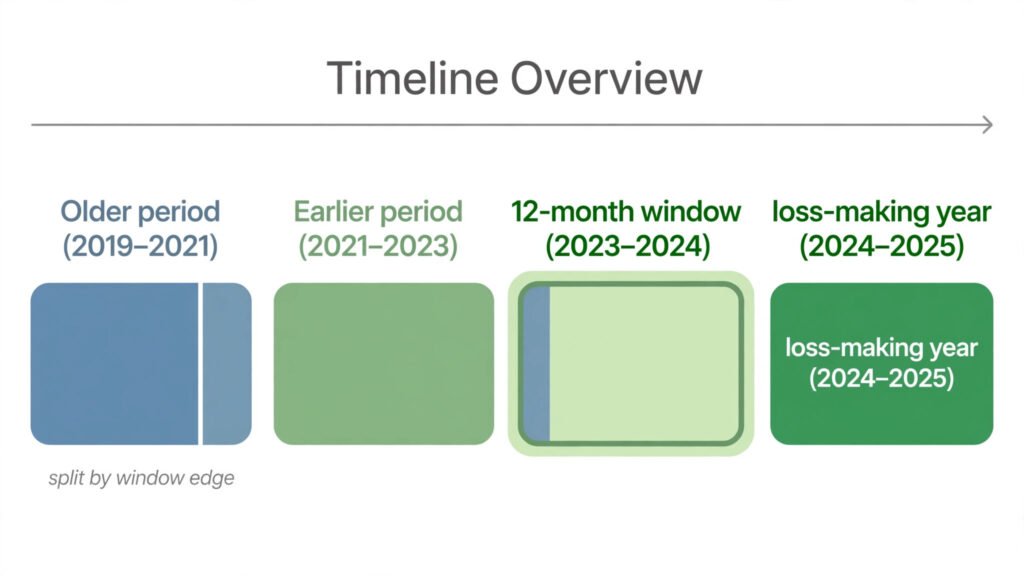
The window is the 12 months before the loss-making period starts. HMRC measures it in months, not accounting periods, so “last year” is only a rough guide.
If an earlier accounting period only partly falls inside the window, you apportion its profit. Only the slice inside the window can absorb the loss. This catches companies that changed their year-end or had a short period.
The same-trade condition
The company must have carried on the same trade at some point in the accounting periods that fall inside the window. If the trade didn’t exist then, or changed completely, there is nothing to carry back to. HMRC can ask about this in later returns.
How much tax will carry back get you? Three worked examples
Your refund depends on the rate that applied to the earlier profits. The small profits rate is 19% on profits up to £50,000, and the main rate is 25% above £250,000, with marginal relief in between. Inside that band, each extra pound of profit is taxed at an effective 26.5%.
Example 1: the 19% rate
Last year a company made £40,000 profit and paid £7,600 tax. This year it makes a £15,000 trading loss and has no other profits. Carrying the loss back cuts last year’s profit to £25,000. Tax falls to £4,750. The refund is £2,850.
Example 2: the marginal relief band
Last year’s profit was £120,000. This year’s loss is £30,000.
| Before carry back | After carry back | |
|---|---|---|
| Profit | £120,000 | £90,000 |
| Tax at 25% | £30,000 | £22,500 |
| Marginal relief | £1,950 | £2,400 |
| Tax payable | £28,050 | £20,100 |
The refund is £7,950, which is 26.5% of the loss. That is more per pound than Example 1. This assumes no associated companies, no exempt distributions and a standard 12-month period.
Example 3: a straddling period
A company makes an £8,000 loss in the year ended 31 December 2025. Its window runs from 1 January to 31 December 2024. It changed its year-end, so the earlier periods look like this:
- Six months to 31 December 2024: £2,000 profit, all inside the window.
- Year to 30 June 2024: £10,000 profit, six months inside the window.
The company absorbs £2,000 in the first period and £5,000 (6 ÷ 12 × £10,000) in the second. That is £7,000 carried back. The other £1,000 stays available to carry forward. At 19%, the refund is £1,330.
Carry back or carry forward?
Carry back usually wins when you need cash now and the earlier profits were taxed. Carry forward can win if you expect much bigger profits soon.
| Factor | Carry back | Carry forward |
|---|---|---|
| Cash | Refund of tax already paid | Lower tax bill in a later year |
| Timing | Once HMRC processes the claim | Only when profits arrive |
| Tax saved per £1 of loss | Rate on earlier profits (19% to 26.5%) | Rate on future profits (19% to 26.5%) |
| Risk | Needs earlier profit and the same trade | Needs future profits that may not come |
The £5 million allowance and 50% restriction
Carried-forward losses face a cap on profits from 1 April 2017. A company or group can use losses up to a £5 million allowance in each 12 months. Above that, losses can cover only 50% of the remaining profits. Most small companies never reach £5 million. A large one-off loss, or a group sharing one allowance, might.
If your company is in a qualifying group, you can also surrender certain losses, including trading losses, to other group members instead.
How to claim loss carry back, step by step
You claim in the Company Tax Return for the loss-making period, in an amended return, or by letter to HMRC. The deadline is two years from the end of that period.
Five steps and CT600 entries
- Work out the trading loss in your tax computation. Clean books help, and free accounting software for UK small businesses can keep them in order.
- Use the loss against same-period profits first.
- Check that the previous 12 months show profit from the same trade.
- Make the claim. In the return, mark the box for a claim affecting an earlier period and show the amount carried back in the computations. Box numbers change between CT600 versions, so follow your software’s prompts.
- Tell HMRC the company name, loss period, loss amount and how you will use it.
Software provider TaxCalc reports that some filers still needed an amended earlier-year return or a follow-up letter before a repayment arrived.
Deadline
You have two years from the end of the accounting period in which you made the loss. For a year ending 31 December 2025, that is 31 December 2027.
Can you claim early?
Yes, but only by asking. No statutory route exists for claiming before you file the loss-making period’s return. Accountants report that HMRC will consider a request to amend the earlier period’s return if you can show a loss is coming. Your case is stronger if the loss period has just ended, or the loss is already clear mid-year, and the prior period was profitable. HMRC decides case by case.
Refunds, HMRC checks and mistakes to avoid
If you already paid tax for the earlier period, HMRC sends a repayment. If you owe other Corporation Tax, HMRC deducts that first.
The loss becomes final if HMRC opens no compliance check. HMRC can still ask later whether the same trade continues. Directors answer for accurate filings, so see our guide to company director responsibilities.
Avoid these errors:
- Counting accounting periods instead of the 12-month window.
- Missing the two-year deadline.
- Carrying back property or capital losses.
- Skipping the same-trade test.
- Following guides that still describe the pandemic rule.
Terminal loss relief: three years back when a company stops trading
Terminal loss relief lets a company that stops trading carry its final-12-month trading losses back against profits of the previous three years, most recent year first.
Two windows, two sets of losses
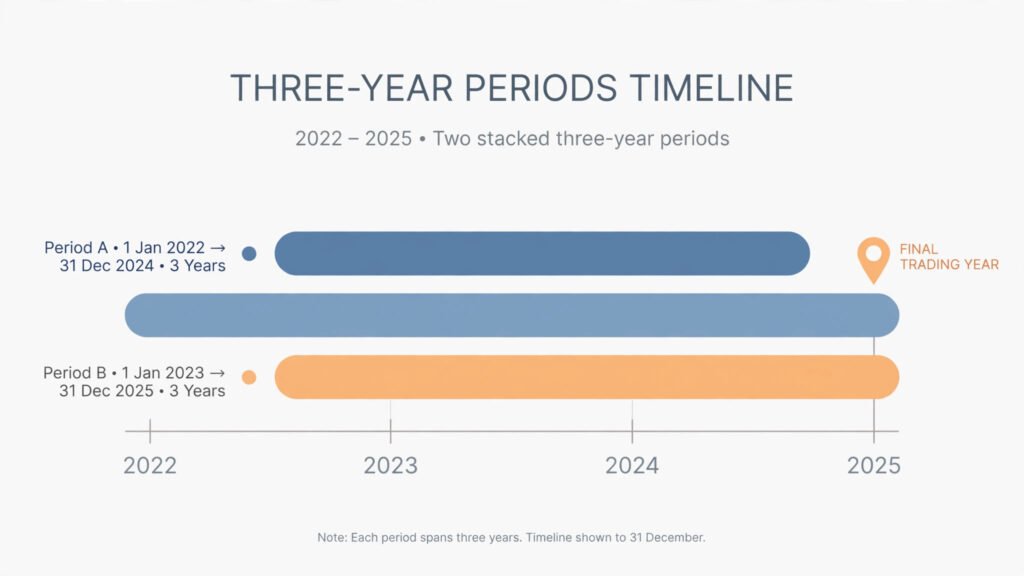
Two different three-year windows exist, and mixing them up is a common error.
- Final-12-month losses go back against profits in the three years ending immediately before the loss-making period.
- Losses carried forward to the final period can reduce profits of that final period and earlier periods up to three years before its end. This strand covers profits from 1 April 2017 only, sits outside the £5 million restriction, and can’t reach the period when the loss first arose.
Take a final period running from 1 January 2025 to 31 December 2025. Final-12-month losses reach back across 1 January 2022 to 31 December 2024. Carried-forward losses reach across 1 January 2023 to 31 December 2025.
Apportion profits if the year-end changed or an earlier period ran under 12 months. Claim within two years of the end of the period when the loss was made. For carried-forward losses, that is the period in which trading stopped. HMRC denies relief where a trade is transferred mainly to obtain it. If you are winding up, read our guide to closing a limited company.
Is the 3-year pandemic carry back still available?
No. The extended carry back has ended, and GOV.UK says the last date for claims was 31 March 2024. It covered losses in accounting periods ending between 1 April 2020 and 31 March 2022. It capped the two extra years at £2 million for each loss period.
Any guide that still presents it as live is out of date. Today’s rule is 12 months, plus terminal relief for closing companies. Loss rules can change at a Budget, so check GOV.UK before you file.
Not a limited company?
Sole traders and partnerships don’t use Corporation Tax loss carry back. They claim loss relief through Income Tax on their Self Assessment return, under different rules. If you haven’t registered yet, see how to register for Self Assessment.
FAQs
Can a limited company carry back a trading loss?
Yes. A company liable to Corporation Tax can claim to set a trading loss against profits of the previous 12 months, if it carried on the same trade in that period.
How far back can you carry back a Corporation Tax loss?
The standard limit is 12 months. A company that stops trading can carry losses from its final 12 months back three years.
How long do I have to claim?
Two years from the end of the accounting period in which the loss arose. For carried-forward terminal losses, it is two years from the end of the period in which trading stopped.
Can property or capital losses be carried back?
No. UK property losses must be set against other profits of the same period, with any balance carried forward. Capital losses can’t be set against trading income.
Can group companies surrender losses instead?
Yes. In a qualifying group, certain losses, including trading losses, can be offset against profits of other group members instead of being carried forward or back.
Key takeaways
Carry back turns a trading loss into a refund of tax already paid. Use the 12-month window, check the same-trade test, and claim within two years. Compare carry forward before you decide. This guide is general information, not tax advice. Speak to a qualified accountant or HMRC before you file.