


Yes. Your limited company can pay into your pension up to your available annual allowance. That is £60,000 in 2026/27 before carry forward. The company can deduct the payment from its taxable profit if it is made wholly and exclusively for the business. You pay no income tax or employee National Insurance on it, and your salary does not limit it.
Figures checked against GOV.UK on 5 October 2026. The Autumn Budget is on Wednesday 28 October, so this page will be updated afterwards.
How tax relief works when your company pays
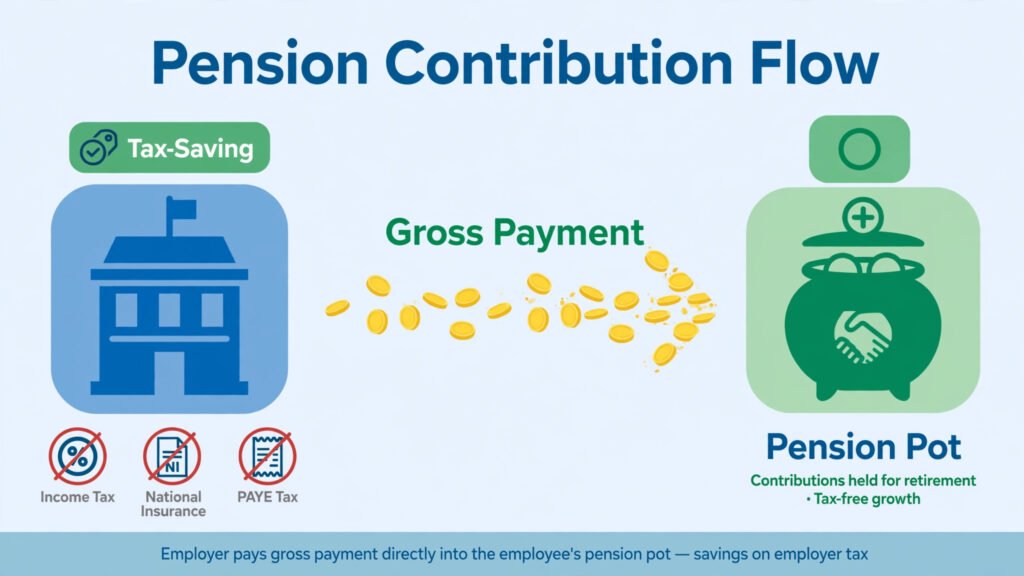
When your company pays into your pension, the company gets the tax relief, not you. The payment cuts the company’s taxable profit, so it pays less corporation tax. The money goes in gross, with no HMRC top-up.
What the company gets: a corporation tax deduction
The deduction is worth your company’s corporation tax rate. That is 19% on profits up to £50,000 and 25% above £250,000. In between, marginal relief applies, so each extra pound is effectively taxed at 26.5%. A £10,000 contribution therefore saves £1,900, £2,500 or £2,650. Associated companies share the £50,000 and £250,000 limits.
What you avoid: income tax, NI and dividend tax
Employer contributions to a registered pension scheme are not treated as your earnings. You avoid income tax, employee National Insurance and dividend tax. The company also avoids the 15% employer NI that salary would cost.
Why there is no 25% top-up
Personal contributions get relief at source: you pay £80 and the provider claims £20 from HMRC, making £100. Company contributions skip that step. The company pays the full £100 and gets its relief through its tax bill. A guide promising a 25% top-up on company payments is describing personal contributions.
How much can your company pay into your pension?
Your company can pay up to your available annual allowance. That is £60,000 for 2026/27, unless carry forward, tapering or the money purchase annual allowance changes it. Your salary does not set the limit.
The £60,000 annual allowance
The allowance covers everything paid into all your pensions in the tax year. That includes company payments, your own payments and any tax relief added. If your company pays £40,000 and you add £8,000 (£10,000 with relief), you have used £50,000. HMRC publishes the figures on its pension schemes rates page.
| Limit | 2026/27 | What it means |
|---|---|---|
| Annual allowance | £60,000 | Total input across all your pensions |
| Carry forward | Previous 3 tax years | Unused allowance, if you were in a registered scheme |
| Tapered allowance | Down to £10,000 | Falls £1 for every £2 of adjusted income over £260,000, if threshold income is above £200,000 |
| MPAA | £10,000 | Applies once you have flexibly accessed a defined contribution pension |
Carry forward: order of use and conditions
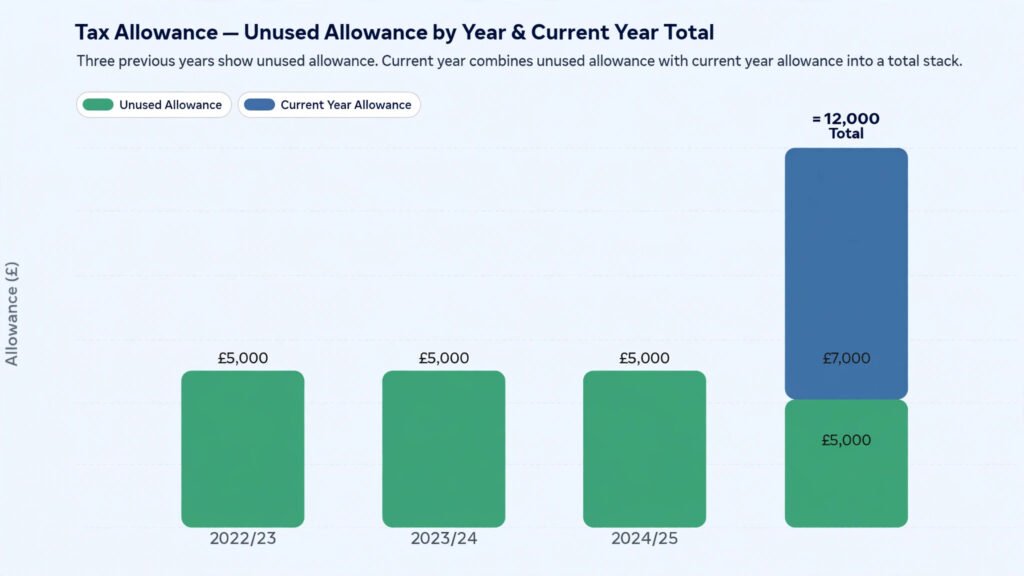
Carry forward lets you use unused allowance from the previous three tax years. You must have belonged to a registered pension scheme in each year you use. Use this year’s allowance first, then the earliest year. Unused MPAA cannot be carried forward. The earnings test applies to personal contributions, not employer ones.
Example: you paid £10,000 a year for the last three years. That leaves £50,000 unused each year, so up to £210,000 could go in this year (£60,000 plus £150,000). The company still needs the cash, and the HMRC test still applies. HMRC’s annual allowance calculator helps you check.
Is there a limit based on profits?
No. No law caps a company pension contribution at its profits, although some guides claim one does. A contribution above profits creates a trading loss. That loss can usually be carried forward, and sometimes back, but your accountant should confirm. The real limits are your allowance, HMRC’s business-purpose test and the cash in the bank.
Will HMRC allow the deduction?
HMRC normally allows an employer pension contribution unless it has a non-trade purpose. The test is whether the payment is wholly and exclusively for the purposes of the trade. For a director-owner, HMRC looks at the whole remuneration package, not just the pension.
The “wholly and exclusively” test and your pay package
HMRC’s manual (BIM46035) says a payment can fail where the overall package is excessive for the work done. HMRC accepts the test is met where the package matches what unconnected employees get for similar duties. Keep a note of why the amount is fair, based on your role, profits and past pay. Acting in the company’s interests is also part of your company director responsibilities.
Large payments, timing and spreading
Relief is given for the accounting period in which the company actually pays. A board minute is not payment. Spreading rules can split relief across several years if a contribution is more than 210% of the previous period’s and the increase is £500,000 or more. A first-ever contribution is not spread. Note the timing gap: corporation tax relief follows the company’s year-end, but your allowance follows the tax year, 6 April to 5 April.
Paying into a spouse’s or employee’s pension
A spouse who genuinely works for the company can receive employer contributions too. Their total pay must match what you would pay an unconnected employee for the same duties. A big payment for a spouse who does little work is the classic challenge. Two edge cases: property or investment companies may be tested differently, and contributions made while winding up are not treated as business spending, so see closing a limited company. Ask your accountant.
Company vs personal contributions
For most directors with spare profit, company contributions are usually more tax-efficient, because they do not depend on salary and avoid personal tax. Personal contributions still help when you have taxable salary and the company has little spare profit.
| Company (employer) | Personal | |
|---|---|---|
| Limit | Your available annual allowance | Lower of allowance and earnings (at least £3,600 gross) |
| Dividends count as earnings? | Not relevant | No |
| Who gets relief | Company, through corporation tax | You: 20% at source, the rest via Self Assessment (Scottish bands differ) |
| Income tax and NI | None | Paid on the pay used |
| Paid from | Company bank account | Your own income |
| Uses allowance? | Yes | Yes, including relief |
You can use both, as long as the total stays inside your allowance. Still a sole trader? These rules start once you trade through a company. Our guide to moving from sole trader to limited company covers the switch.
Pension vs salary vs dividends: what £10,000 of profit is worth
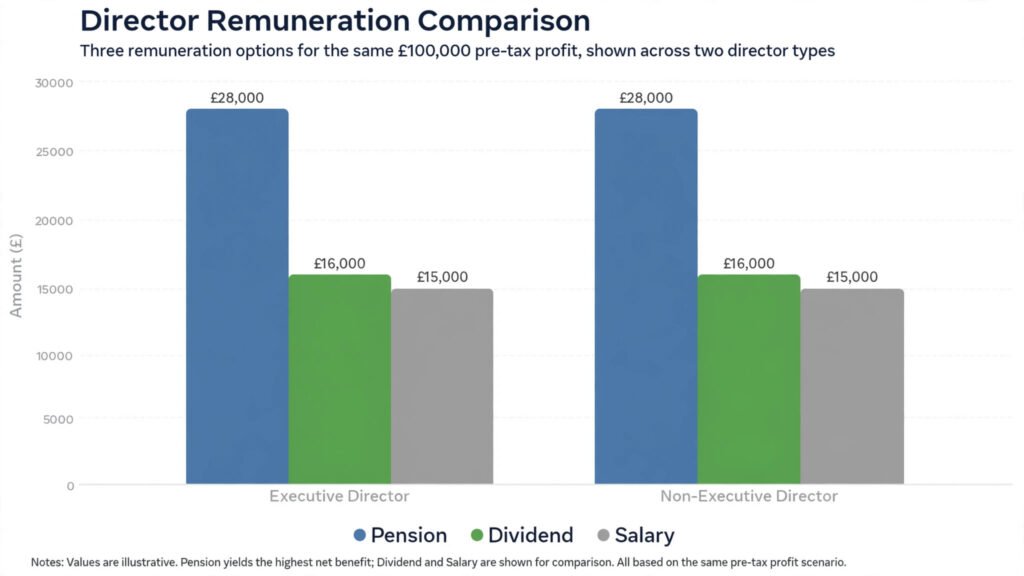
£10,000 of pre-tax profit is worth far more inside a pension than in your pocket, but you cannot touch it until minimum pension age. The figures assume 2026/27 rates, 15% employer NI, the dividend allowance already used and no Employment Allowance.
| £10,000 of pre-tax profit | Basic-rate director, 19% CT | Higher-rate director, 25% CT |
|---|---|---|
| Into pension | £10,000 | £10,000 |
| As dividend (net in hand) | £7,229 | £4,819 |
| As salary or bonus (net in hand) | £6,261 | £5,043 |
| Pension after tax in retirement* | about £8,500 | about £7,000 |
*Assumes 25% tax-free cash and the rest taxed at 20% or 40%. The tax-free amount is capped by the £268,275 lump sum allowance.
The gap exists because salary costs employer NI, income tax and employee NI, and dividends are paid after corporation tax. A pension payment skips both.
Three questions decide it:
- Will you need the money before minimum pension age (55, rising to 57 on 6 April 2028)? If so, a pension is the wrong home.
- Can the company spare the cash after tax bills, wages and planned spending?
- Do you have allowance left after other pensions, tapering and the MPAA?
If you answer no, yes, yes, the table shows why a company contribution usually delivers more after tax.
How to make a company contribution
A company contribution takes five steps.
- Check your allowance. Add up this year’s input to every pension, and check carry forward.
- Choose a scheme that accepts employer contributions. A SIPP or personal pension usually does.
- Pay from the company bank account and tell the provider it is an employer contribution. A payment recorded as personal is treated as personal, which changes the tax.
- Pay early enough. The provider must receive the money before the company’s year-end for relief in that period.
- Record it. Keep the board minute, bank record, provider confirmation and your reasoning. Have your accountant code it correctly in your accounting software.
If you employ staff, automatic enrolment duties apply to them. A sole director with no employees generally has none.
Mistakes that trigger tax charges
Most tax charges come from five avoidable mistakes.
- Overshooting the allowance. Every pension counts, including a workplace scheme.
- Missing the MPAA or taper. Flexible access cuts your limit to £10,000. Employer contributions also count towards adjusted income, which can trigger tapering above £260,000.
- Mislabelling the payment. If the provider records it as personal, the tax treatment changes.
- Ignoring cash flow. Pension money is locked in. Keep enough for tax bills, wages and suppliers.
- Skipping the paperwork. Without records, a challenge on reasonableness is hard to answer.
What’s changing, and what isn’t
Several dated changes affect pension planning. None alters the basic mechanics above for direct employer contributions.
- 28 October 2026: The Autumn Budget is on Wednesday 28 October. Rumours are common, so avoid large one-off decisions based on speculation.
- 6 April 2027: Unused pension pots become part of your estate for inheritance tax. Ask an adviser how this affects building a large pot.
- 6 April 2028: The minimum pension age rises from 55 to 57.
- 6 April 2029: Salary-sacrificed pension contributions above £2,000 a year lose their National Insurance exemption. All employer pension contributions stay free of National Insurance. That cap became law in April 2026.
FAQs
Do company pension contributions get 25% tax relief?
No. The 25% top-up applies to personal contributions. Company contributions go in gross and cut corporation tax instead, at 19%, 25% or an effective 26.5%.
Can my company pay more into my pension than my salary?
Yes. Employer contributions are not limited by salary. They must fit your available annual allowance and meet HMRC’s wholly and exclusively test.
Can my company pay in if I only take dividends?
Yes. Dividends do not stop employer contributions. They just do not count as earnings for personal relief, which is why company payments suit directors on a small salary.
Can contributions exceed company profits?
Yes, but it creates a trading loss and invites questions. No law caps contributions at profits. Check the loss treatment and your cash position with your accountant first.
Do company contributions count towards my annual allowance?
Yes. They count alongside personal contributions, added relief and pension input from every other scheme. The 2026/27 allowance is £60,000.
What happens if I exceed the annual allowance?
The excess is taxed at your marginal income tax rate. You report it on your Self Assessment return, although a scheme can sometimes pay it from your pot. Carry forward may remove the charge.
Before you pay in
Company pension contributions are one of the few tax breaks a limited company has. The allowance, the timing and the HMRC test all have to line up, so take your figures to an accountant or regulated adviser before paying in a large sum. Planning to sell? Surplus cash can affect a sale, so see how to sell a small business. This guide is general information, not tax or financial advice, and rules can change.