


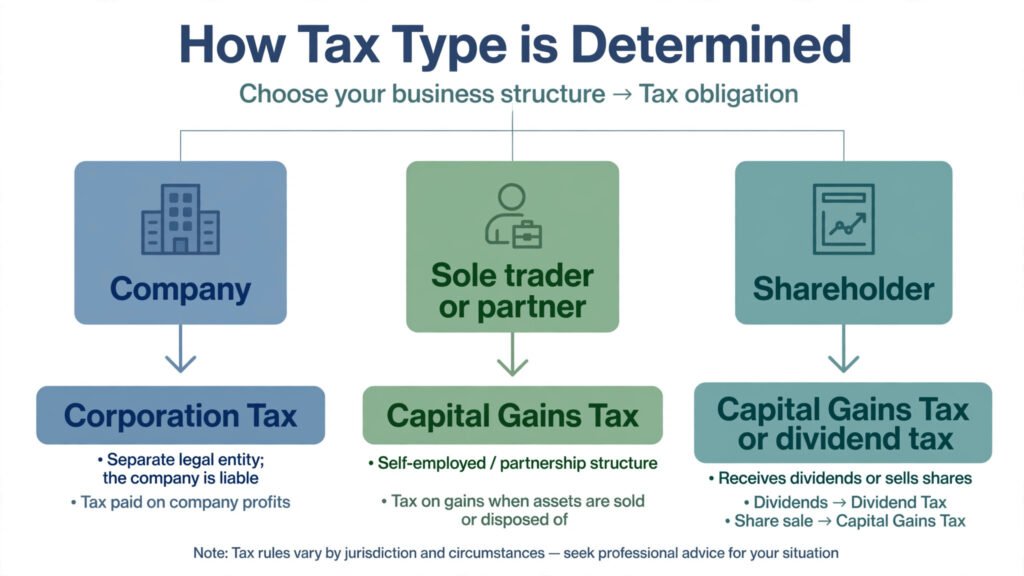
The tax you pay when you sell business assets depends on who owns them. A limited company pays Corporation Tax on the gain. A sole trader or partner pays Capital Gains Tax (CGT) at 18% or 24%, or 18% on qualifying gains with Business Asset Disposal Relief (BADR). VAT, Stamp Duty Land Tax (SDLT) and capital allowance clawbacks can add to the bill.
The rates below are for 2026/27 and were checked in October 2026. The Autumn Budget is on 28 October, so recheck before you sign. This is general information, not tax advice.
Which tax applies to your sale?
Find the row that matches who is selling.
| Who sells | Main tax | 2026/27 rate | Reported on |
|---|---|---|---|
| Limited company sells assets | Corporation Tax on chargeable gains | 19% to 25% | Company Tax Return |
| Sole trader or partner sells business assets | CGT | 18% or 24% (18% with BADR) | Self Assessment |
| Shareholder sells company shares | CGT | 18% or 24% (18% with BADR) | Self Assessment |
| Shareholder takes cash out after a company asset sale | Dividend tax or CGT | Up to 39.35% on dividends | Self Assessment |
How to work out your taxable gain
A chargeable gain is the profit you make when you sell an asset for more than it cost. Tax applies to the gain, not the sale price.
- Start with the sale price. Use market value if you gave the asset away or sold it cheaply.
- Subtract what you paid.
- Subtract the costs of buying, improving and selling, such as legal fees. Repairs don’t count.
- Subtract any allowable losses.
- Companies only: for assets bought before December 2017, also subtract the indexation allowance.
Example: limited company
A company bought a workshop for £250,000. It sells it for £400,000 and pays £10,000 in costs. The gain is £140,000. If total profits are above £250,000, the 25% rate applies and the Corporation Tax is £35,000.
Example: sole trader, with and without BADR
A sole trader sells the whole business, including premises, with a £140,000 gain. After the £3,000 annual exempt amount, £137,000 is taxable. A higher-rate taxpayer pays £32,880 at 24%. With BADR the bill is £24,660 at 18%. That saves £8,220.
Selling assets through a limited company
Corporation Tax on chargeable gains
The company adds its gains to its profits. The rate is 19% on profits up to £50,000 and 25% above £250,000, with marginal relief in between. Companies get no annual exempt amount. Capital losses can only offset capital gains.
Goodwill and intellectual property the company created or acquired after 31 March 2002 are taxed as trading profits instead.
Capital allowances and balancing charges
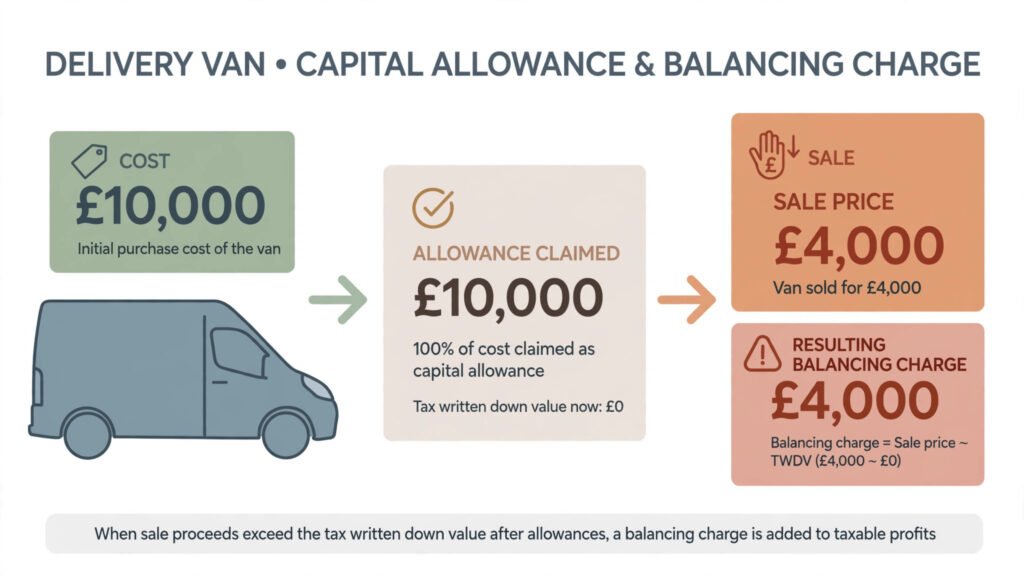
When you sell equipment you claimed allowances on, the sale value comes off your allowance pool. If the value is more than the pool balance, the excess is a balancing charge. It is added to your taxable profit.
Say a van cost £10,000 and you claimed 100% under the Annual Investment Allowance. You sell it for £4,000 and the pool is empty. The full £4,000 is a balancing charge. You can only deduct the original cost, so any sale value above £10,000 is a chargeable gain instead.
The rules have shifted too. A new 40% first-year allowance started in January 2026, and the main writing-down rate falls from 18% to 14% from April 2026. Check which pool each asset sits in before you sell.
Getting the cash out
An asset sale leaves the money inside the company. Taking it out triggers a second tax. This is the double taxation problem: Corporation Tax first, then personal tax.
- Dividends: Rates in 2026/27 are 10.75%, 35.75% and 39.35%, above a £500 allowance.
- Members’ voluntary liquidation (MVL): Payouts count as capital, so CGT applies and BADR may cut the rate.
- Strike-off: Distributions up to £25,000 can get capital treatment. Above that, HMRC treats the whole amount as income.
If you close the company and start a similar trade within two years, HMRC can treat the payout as income. Read our guide to closing a limited company before you choose a route.
Selling assets as a sole trader or partner
A sole trader or partner pays tax once. There is no company layer. Gains are reported on your own return.
For 2026/27 the first £3,000 of gains is tax-free. The rest is taxed at 18% while it sits inside your basic rate band (£37,700 after your taxable income) and 24% above it. A large sale can push you into the higher band. Partners report their own share of each gain.
Asset sale vs share sale
A share sale is usually cheaper for the seller, because only the shareholder is taxed, once. Buyers often prefer an asset sale, because they avoid the company’s hidden liabilities.
| Asset sale | Share sale | |
|---|---|---|
| Seller’s tax | Corporation Tax, then tax on extraction | CGT only (BADR possible) |
| Buyer’s extra costs | Possible VAT, SDLT on property | 0.5% stamp duty on shares |
| Liabilities | Stay with the seller’s company | Pass to the buyer |
| Usually preferred by | Buyers | Sellers |
Agree the structure early, ideally in your letter of intent. Our guide to a letter of intent for a business purchase shows what to include. For the wider process, see how to sell a small business.
Reliefs that can cut or delay the bill
Business Asset Disposal Relief
BADR is a CGT relief that lowers the rate on gains from selling all or part of a business, or shares in your personal company. It is 18% from 6 April 2026. It was 14% in 2025/26 and 10% before that. The lifetime limit is £1 million.
To qualify, you must have held the position for at least two years:
- Sole trader or partner: you owned the business for two years.
- Shareholder: you were an employee or office holder, held 5% of the shares and voting rights, and the company was a trading company.
Selling one machine while you keep trading doesn’t qualify. If non-trading income or activity is substantial, often judged at around 20%, BADR can be lost. BADR is not a Corporation Tax relief, so a company can’t claim it. For a 2026/27 sale, claim by 31 January 2029.
Business Asset Rollover Relief
Rollover relief delays CGT if you reinvest the proceeds in new qualifying assets. You must buy them up to one year before or three years after the sale. The business must be trading, and you must use the assets only for trade. Land, buildings and fixed plant qualify. Partial reinvestment gives partial relief.
It is a deferral, not an exemption. The gain is held over until you sell the new asset. Claim within four years of the end of the tax year. If you plan to replace equipment, our asset finance guide covers funding options.
Other reliefs
- Gift hold-over relief: if you give assets away or sell them below value, the recipient takes on the gain.
- Incorporation relief: if you moved from sole trader to company, you must claim it actively from 6 April 2026. See sole trader to limited company.
- Employee Ownership Trust (EOT): CGT relief fell from 100% to 50% for disposals from 26 November 2025. BADR can’t reduce the taxed half. A management buyout is the other common insider route.
VAT, SDLT and other transaction taxes
Selling assets can add VAT at 20%, unless the deal is a Transfer of a Going Concern (TOGC). A TOGC is outside the scope of VAT. <cite index=”43-1″>The main conditions are that the buyer takes over a going concern, there is no series of consecutive transfers, and the buyer is or becomes VAT-registered.</cite> Property adds extra conditions, including option-to-tax notices. <cite index=”38-1″>HMRC doesn’t give advance clearance</cite>, so a mistake can mean an unexpected VAT bill.
If the sale includes commercial property, the buyer pays SDLT. In England and Northern Ireland, non-residential rates are 0% to £150,000, 2% to £250,000 and 5% above. Scotland and Wales use their own taxes. On a share sale, the buyer pays 0.5% stamp duty.
Common mistakes and edge cases
- Using old rates. BADR was 10%, then 14%. The annual exempt amount was once £6,000 and is now £3,000. Many pages still show the old figures.
- Treating BADR as automatic. It needs the two-year tests and a qualifying disposal.
- Missing the balancing charge. Selling kit you fully claimed creates taxable profit.
- Using the wrong date. For CGT, the disposal date is usually when contracts are exchanged unconditionally, not completion. A deal that straddles 5 April or a Budget can land in a different year.
- Selling to family below value. HMRC uses market value instead.
- Ignoring earn-outs. Tax on deferred payments can fall due before you receive the cash. Ask your adviser how future instalments are treated.
- Ignoring price allocation. How you split the price between goodwill, equipment, stock and property changes the tax, because each follows different rules.
- Skipping the report. If you file Self Assessment and total proceeds top £50,000, you must report even when no tax is due.
Planning checklist before you sell
- Choose the structure, asset sale or share sale, before you agree terms.
- Check your BADR two-year tests now, not at completion.
- Agree the price allocation with your accountant.
- Confirm TOGC and SDLT treatment with your advisers.
- Plan any reinvestment for rollover relief.
- Take surplus cash out well before the sale, so it isn’t taxed in one lump.
- Keep contracts, valuations, receipts and calculations. Our record-keeping guide shows what to hold and for how long.
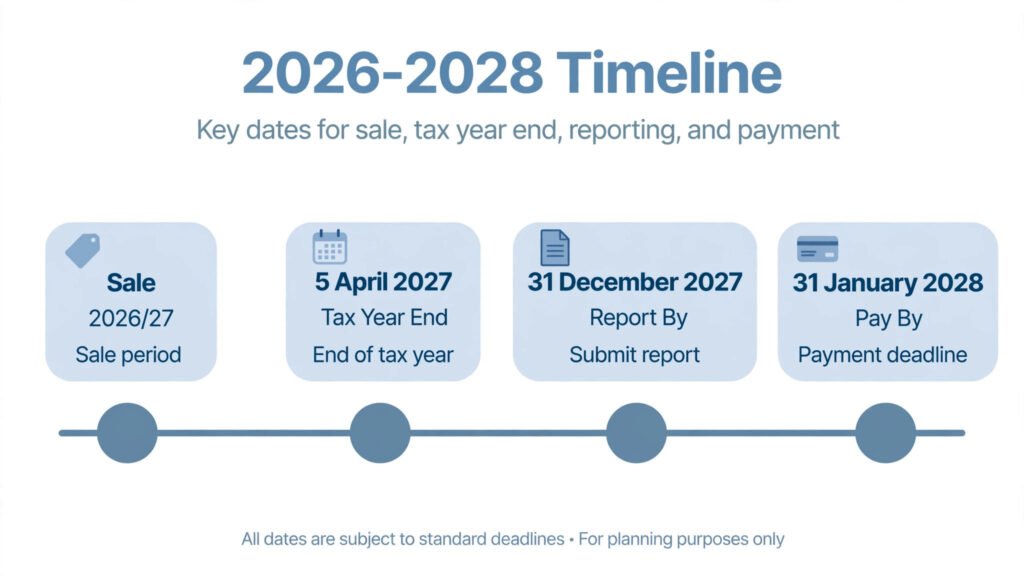
- Report and pay on time. Use your Self Assessment account or HMRC’s real-time CGT service. For a 2026/27 sale, report by 31 December 2027 and pay by 31 January 2028. Companies report on the Company Tax Return.
Planning an exit over several years? Start with business succession planning.
What could change after the Autumn Budget
The Autumn Budget is on 28 October 2026. CGT is widely discussed, but nothing is confirmed. Commentators suggest the government could remove BADR’s lower rate or cut the £1 million limit. Changes usually start in April, though October 2024 changes applied immediately.
Don’t rush or delay a commercial sale purely on speculation. Ask your adviser to model the deal under today’s rules and a higher-rate scenario.
FAQs
Do I pay tax when a company sells assets?
Yes. The company pays Corporation Tax on the gain, at 19% to 25%. Shareholders then pay tax again when they take the money out.
How much CGT do I pay on business assets in 2026/27?
You pay 18% on gains within the basic rate band and 24% above it. Qualifying gains under BADR are taxed at 18%, up to £1 million. The first £3,000 of gains is tax-free.
Can I sell business assets without paying tax?
Rarely. Rollover relief can defer the tax if you reinvest, and the £3,000 exempt amount shelters small gains. A sale to an EOT now exempts only half the gain.
Do I charge VAT when I sell business assets?
Usually yes, at 20% on standard-rated items. A Transfer of a Going Concern is outside the scope of VAT, if every condition is met.
Is an asset sale or a share sale better for the seller?
A share sale is usually better. Only one tax layer applies, and BADR may be available. Buyers often push for an asset sale.
Before you accept an offer, ask an accountant to model both structures with your own figures.