


The April 2026 minimum wage rise is not coming — it is already in your payroll. The National Living Wage has been £12.71 an hour since 1 April 2026, and the questions that matter now are different. What is the rise really costing you once National Insurance and pension are added? Is every member of staff actually receiving it, including the salaried ones? And have you seen the April 2027 rates, announced on 28 October 2026, which put the Living Wage at £13.21?
This guide reflects HMRC guidance as reviewed on 2 November 2026.
The 2026 rates in force now: National Living Wage (21+) £12.71 an hour; 18–20 £10.85; 16–17 and apprentices £8.00; accommodation offset £11.10 a day. Every £1 of minimum wage rise costs you about £1.18 once employer National Insurance and pension are added. Underpay — even by accident — and the penalty can reach 200% of the arrears. April 2027 is already set: £13.21.
The April 2026 minimum wage rates — in force now
The April 2026 rates took effect from 1 April 2026, applying to every pay reference period that started on or after that date. The government accepted the Low Pay Commission’s recommendations in full, and GOV.UK’s publication “Minimum wage rates for 2026” sets out the figures your payroll should already be using.
One date is worth getting right. Some guides say the rates changed on 6 April 2026. That is the start of the tax year — not the wage date. Minimum wage rates change on 1 April every year, as GOV.UK’s rates page confirms. If your payroll only caught up from 6 April, check the first days of April: you may owe arrears.
| Band | April 2025 | April 2026 | Increase (£) | Increase (%) |
|---|---|---|---|---|
| National Living Wage (21 and over) | £12.21 | £12.71 | +50p | +4.1% |
| 18–20 years old | £10.00 | £10.85 | +85p | +8.5% |
| 16–17 years old | £7.55 | £8.00 | +45p | +6.0% |
| Apprentice | £7.55 | £8.00 | +45p | +6.0% |
| Accommodation offset (per day) | £10.66 | £11.10 | +44p | +4.1% |
Who gets which rate
Your worker’s rate depends on their age, and the bands move with birthdays — a worker who turns 18 or 21 moves up to the higher rate from the first pay reference period starting on or after their birthday, so payroll needs their date of birth, not just their starting rate.
The apprentice rate is the most misapplied of all. GOV.UK’s rates page is clear: it covers only apprentices aged under 19, or apprentices aged 19 or over still in the first year of their apprenticeship. A 21-year-old apprentice in their second year is entitled to the full £12.71. Keep an apprentice on £8.00 past that point and you underpay every hour they work — and apprentices are the group the Low Pay Commission finds underpaid most often.
The rates apply across the whole UK, as the Autumn Budget 2025 small business changes round-up covered at the time.
The shrinking youth gap
The 18–20 rate rose by 8.5% in April 2026 — more than twice the Living Wage rise of 4.1%. The gap between the two rates narrowed from £2.21 an hour in 2025 to £1.86 an hour in 2026.
That is deliberate. The Low Pay Commission’s remit, set in September 2024, asks it to gradually abolish the 18–20 rate so the Living Wage eventually applies from age 18. If you employ younger staff, budget on their rate continuing to close on the adult rate. As the April 2027 section explains, the narrowing pauses for a year — but the direction of travel has not changed.
What the 2026 rise really costs your business
The headline rate is only part of the cost: employer National Insurance and workplace pension contributions ride on top of every pound of the rise, so a 50p increase costs you roughly 59p an hour for a full-time worker on the Living Wage.
Employer Class 1 contributions are charged at 15% on earnings above the secondary threshold — £5,000 a year (£96 a week, £417 a month) in 2026/27, per GOV.UK’s rates and thresholds for employers. You may see it claimed that employer National Insurance adds “15p on every £1 of wages”. That is wrong: nothing is charged on the first £5,000 each employee earns. But once a worker is over the threshold — and every full-time minimum wage worker is — each extra £1 of pay attracts the full 15p.
Then add the pension. Under auto-enrolment, the minimum total contribution is 8% of qualifying earnings, of which you must pay at least 3%. Qualifying earnings in 2026/27 are the slice of pay between £6,240 and £50,270 a year, and staff aged 22 to State Pension age earning over £10,000 must be enrolled. Our guide to employer National Insurance contributions 2026 covers the payroll side in more detail.
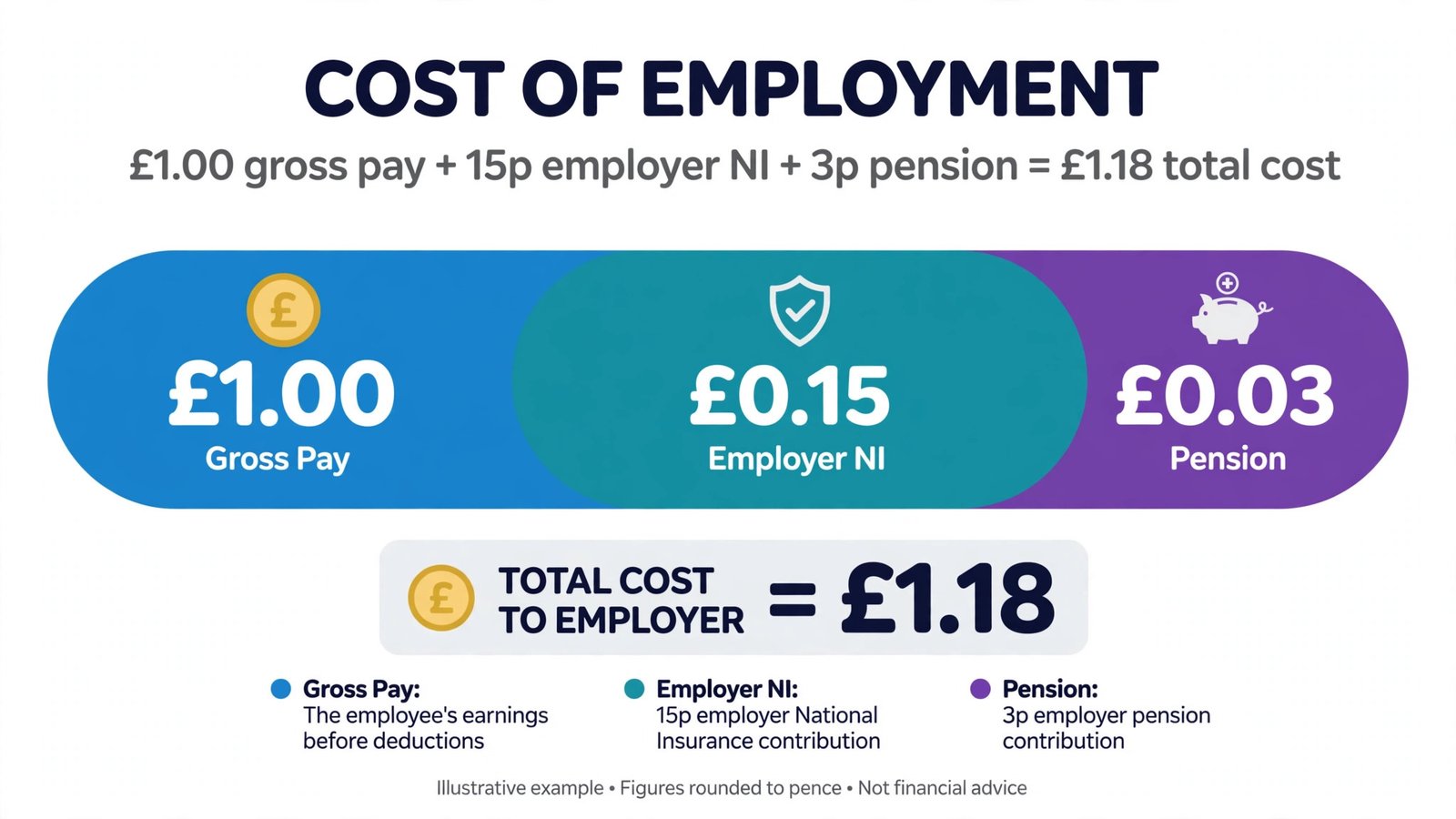
Put the two together and you get the rule worth remembering: where an employee is over the National Insurance threshold and inside the pension band, every £1 of pay rise costs you about £1.18 — £1.00 of gross pay, 15p of National Insurance and 3p of pension. It is a marginal rule: it applies to the rise itself, which is exactly what you are budgeting for.
Worked example: a café with three full-time staff
Take an independent café with three full-time employees, all 21 or over, all paid exactly the National Living Wage, working 37.5 hours a week for 52 weeks — 1,950 paid hours a year each. Here is what the April 2026 rise did to the wage bill, per employee:
| Cost line (per employee) | At £12.21 (2025/26) | At £12.71 (2026/27) | Change |
|---|---|---|---|
| Gross pay (1,950 hours) | £23,809.50 | £24,784.50 | +£975.00 |
| Employer National Insurance (15% above £5,000) | £2,821.43 | £2,967.68 | +£146.25 |
| Employer pension (3% of qualifying earnings above £6,240) | £527.09 | £556.34 | +£29.25 |
| Total employer cost | £27,158.02 | £28,308.52 | +£1,150.50 |
For all three staff, the café’s wage bill rises from £81,474.05 to £84,925.55 a year — an extra £3,451.50 a year, about £287.63 a month. The 50p headline rise really costs about 59p an hour once on-costs are added (£1,150.50 divided by 1,950 hours) — and budgeting on gross pay alone would have under-budgeted the rise by £526.50 a year for this team.
The assumptions, stated plainly: all three staff are 21 or over, paid exactly the Living Wage, 37.5 hours a week for 52 weeks; no overtime or salary sacrifice; National Insurance at 15% above the £5,000 threshold; pension at the 3% employer minimum on qualifying earnings above £6,240; and no Employment Allowance in the main figures.

The Employment Allowance could wipe out the National Insurance rise
There is a relief many small employers forget or never claim. The Employment Allowance lets eligible employers reduce their employer Class 1 National Insurance bill by up to £10,500 a year, per GOV.UK’s Employment Allowance guidance. The café’s entire employer National Insurance bill at the 2026 rates is £8,903.03 — less than the allowance. If it is eligible and claims, the National Insurance part of the rise is fully absorbed.
The main conditions: you claim through payroll software, using the Employer Payment Summary, and you must claim each tax year — it is not automatic. The old rule shutting out employers whose previous year’s National Insurance bill topped £100,000 has gone. But a limited company whose only employee paid above the secondary threshold is a director cannot claim — the single-director exclusion still applies. Never ticked the box? Check today: claims can be backdated up to four tax years.
Pay compression: the supervisor problem
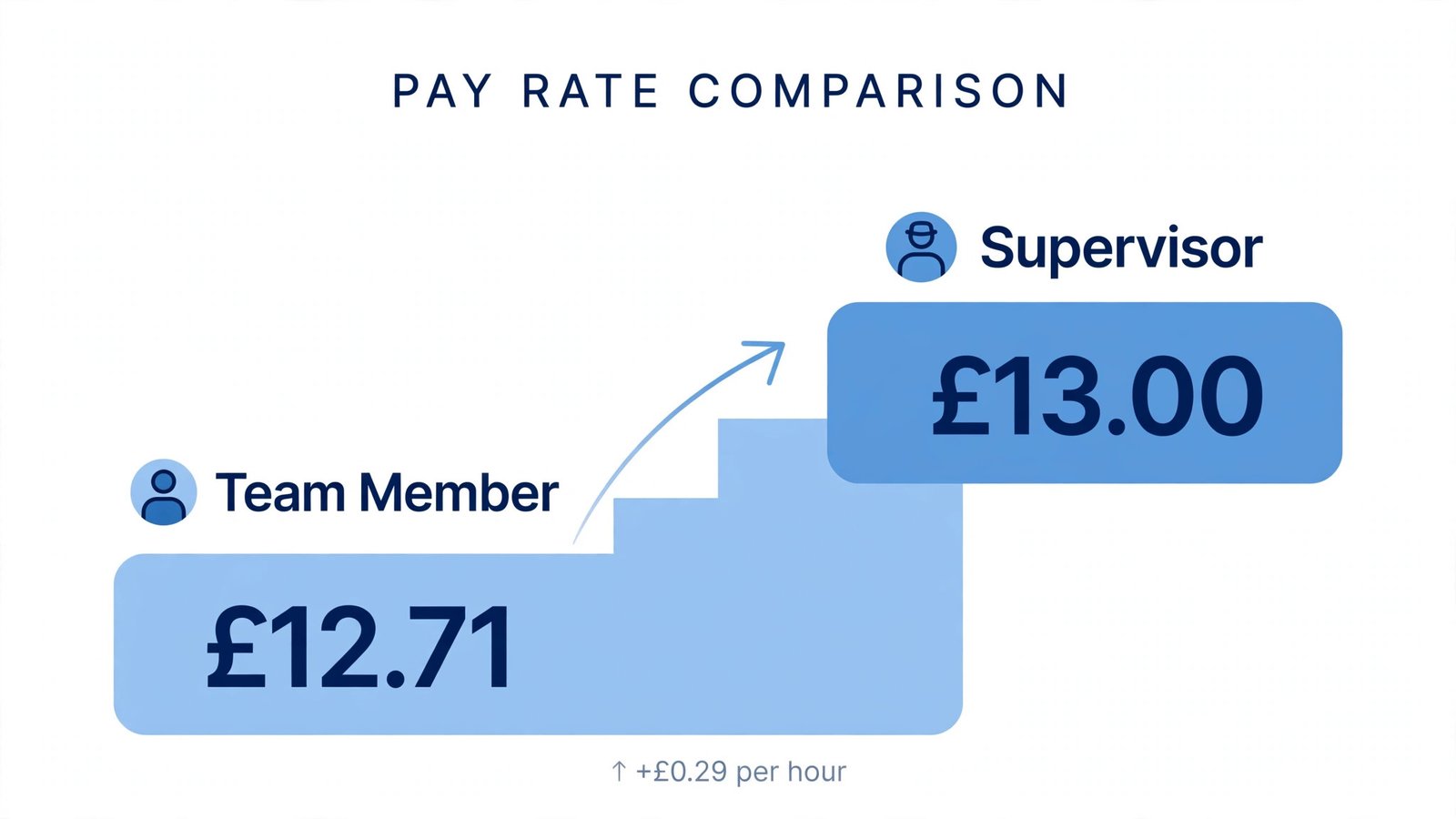
A rising floor squeezes the gaps above it. If your team members moved to £12.71 in April and your supervisor sits at £13.00, the premium for carrying the keys, the training and the difficult customers is now 29p an hour. The risk is practical, not legal: staff who feel their differential has vanished are the ones who leave.
The Low Pay Commission’s own analysis shows this spillover is real: rises push up pay well beyond the workers directly covered — in its work on the April 2025 rise, up to around £15.17 an hour — because employers defend differentials. Decide deliberately: a small rise for supervisors now usually costs less than replacing them later.
The underpayment traps that catch careful employers
Most underpayment is accidental, not deliberate — the Low Pay Commission’s 2025 report found 445,000 jobs were paid below the relevant rate in 2025, which is 22% of all jobs covered by the minimum wage, up from 19.8% in 2024. For salaried staff it is worse: 44% of salaried jobs covered by the minimum wage were underpaid. The rate on the contract is rarely the problem. The calculation is.
The minimum wage is tested over each pay reference period — the period a worker is paid for, up to one calendar month. Pay is divided by the hours actually worked in that period, and the result must reach the worker’s rate. GOV.UK’s guidance on calculating the minimum wage sets out what counts as pay and as working time. These are the traps that catch employers who are trying to get it right:
| Trap | Why it breaches the minimum wage | The fix |
|---|---|---|
| Salaried staff working unpaid extra hours | The test divides salary by actual hours worked, including unpaid overtime. As salaries drift closer to the floor, regular extra hours pull the average below it | Test each salaried worker’s salary against the hours they really work |
| Uniform and tool costs | If staff must buy a uniform or tools, or you deduct the cost from pay, that money comes off their pay for minimum wage purposes | Provide required kit free, or lift pay so the cost never takes anyone below the floor |
| Unpaid training time | Training required for the job is working time, before a shift, after it, or online at home | Pay for all required training hours and record them |
| Travel time between jobs | Travelling between customers or sites during the working day counts as working time (the ordinary commute does not) | Pay for travel between assignments and include it in the hours test |
| Salary sacrifice | Pay given up for a pension, cycle scheme or car is no longer pay — the cash left must still reach the minimum on its own | Block sacrifice arrangements that would take pay below the floor; check every April |
| Accommodation charged above the offset | Only £11.10 a day (2026 rate) of any accommodation charge can count towards minimum wage pay | Keep charges at or below the offset, or top up pay to cover the difference |
| Apprentice rate kept too long | The rate ends at 19 for many apprentices, and at the end of the first year for those 19 and over | Diary each apprentice’s 19th birthday and first-year anniversary; move them to their age rate |
| Tips counted as pay — and missed birthdays | Tips, gratuities and service charges never count towards the minimum wage. And a worker’s rate rises on their 18th and 21st birthdays | Never rely on tips to reach the floor; diarise birthdays in payroll |
A related warning: benefits in kind do not count towards minimum wage pay either, however valuable — the only exception is accommodation, covered by the offset above. Our guide to benefits in kind tax for small business explains how benefits are taxed, a separate question from whether they count towards the wage floor. They do not.
What happens if you are found to have underpaid
If an investigation finds underpayment, the consequences stack up. You will be issued with a notice of underpayment and must repay the arrears — worked out at the current rates, not the rates that applied when the underpayment happened, so old mistakes grow more expensive every April. On top sits a penalty of 200% of the underpayment, minimum £100 per notice, maximum £20,000 per worker. Pay everything within 14 days and the penalty is halved to 100%.
You can also be named publicly. Employers whose total arrears exceed £500 are eligible for the government’s naming scheme, run by the Department for Business and Trade. The most recent round, in September 2026, named 658 employers; around £4 million was repaid to over 27,000 workers, with penalties of about £7 million. Deliberate refusal to pay can lead to prosecution.
Enforcement is not small-scale. The government’s enforcement and compliance report for 2024/25 records that HMRC opened 5,200 cases and closed 4,800, around 1,200 of them involving arrears; £5.8 million was identified for 25,200 workers, around 750 penalties totalling £4.2 million were issued, and 3 employers were prosecuted. You must keep records — pay, deductions and hours actually worked — sufficient to prove compliance, for at least 6 years.
Since April 2026, responsibility for enforcement has sat with the new Fair Work Agency. HMRC still carries out minimum wage checks on its behalf during the transition, until April 2027 — so the letter, if it comes, may still say HMRC. The rules have not softened in the move: the penalty is now charged under the Employment Rights Act 2025.
April 2027: the next rise is already announced
The April 2027 rates are already known — announced on 28 October 2026 and now shown on GOV.UK’s rates page — so they can go into this winter’s budgets rather than landing as a spring surprise. The National Living Wage rises to £13.21 an hour, up 3.9%.
| Band | April 2026 | April 2027 | Increase |
|---|---|---|---|
| National Living Wage (21 and over) | £12.71 | £13.21 | +3.9% |
| 18–20 years old | £10.85 | £11.27 | +3.9% |
| Under 18 | £8.00 | £8.31 | +3.9% |
| Apprentice | £8.00 | £8.31 | +3.9% |
| Accommodation offset (per day) | £11.10 | £11.53 | +3.9% |
Why the youth gap stops narrowing in 2027
Every band rises by the same 3.9% in 2027, so the cash gap between the youth rate and the Living Wage widens slightly, from £1.86 to £1.94 an hour. The House of Commons Library’s briefing on minimum wage statistics explains why: the Low Pay Commission recommended pausing progress towards abolishing the 18–20 rate because the youth labour market is weak, and its recommended 2027 Living Wage also falls below the 66%-of-median-earnings floor in its remit, for the same reason.
Read that as a pause, not a reversal. One adult rate from 18 remains government policy. If your business model leans on the 18–20 rate, use 2027 to adjust rather than assuming the gap will stay.
For the café, April 2027 repeats the exercise: another 50p rise means roughly another £3,451.50 a year for the same three staff at the same assumptions — close to £6,903 a year added against 2025/26 across the two rises, before any supervisor differentials are defended.
Your action plan: audit now, budget for April 2027
Three jobs will put you ahead of both rises: check this year’s payroll properly, settle your differentials policy, and build April 2027 into next year’s numbers now.
- Re-test every worker’s effective hourly rate. For hourly staff this is simple; for salaried staff, divide pay by the hours they actually work, including unpaid overtime, training and travel between jobs — salaried workers are where underpayment is worst.
- Audit deductions and sacrifice arrangements. Uniforms, tools, accommodation charges and salary sacrifice all eat into the pay that counts. Test each against the floor, per pay reference period.
- Diary the birthdays and apprenticeship milestones. Every 18th and 21st birthday, and every apprentice’s first-year anniversary — rate changes apply from the next pay reference period, and missing one creates arrears automatically.
- Claim the Employment Allowance if you are eligible. If your employer National Insurance bill is under £10,500, the allowance could cover all of it — but only if you claim, each year, through payroll.
- Decide your supervisor differential before staff ask. A written position — even “we will hold a 50p gap” — is cheaper than renegotiating under pressure.
- Budget April 2027 now. Put £13.21 (and £11.27 for 18–20s) into your 2027/28 budgets, rotas and pricing reviews. The Low Pay Commission’s evidence is that price rises are consistently one of the main ways firms absorb these increases, alongside rota and efficiency changes and absorbing cost in margin. A small planned price rise beats a panicked one.
- Keep your records for 6 years. Pay, deductions and actual hours, per pay reference period. If your records cannot prove compliance, the argument is lost before it starts.

Businesses that invest to raise output per hour feel these rises least — if new kit is part of your answer, capital allowances for small businesses and the annual investment allowance can bring the tax relief forward.
Frequently asked questions
What is the National Minimum Wage in 2026?
From 1 April 2026, the National Living Wage for workers 21 and over is £12.71 an hour. The 18–20 rate is £10.85, and the rate for 16 to 17-year-olds and eligible apprentices is £8.00. The accommodation offset is £11.10 a day.
When did the 2026 rates start — and what if a pay period straddles 1 April?
The rates changed on 1 April 2026 (not 6 April, the tax year start). GOV.UK’s guidance on calculating the minimum wage explains that an increase applies from the first pay reference period starting on or after the change date. So if a worker’s monthly period runs from 16 March to 15 April, the old rate applies to that whole period, and the new rate from 16 April.
How much does the rise actually cost me per hour, with National Insurance and pension on top?
About £1.18 for every £1 of rise, at the margin, for a worker over the National Insurance secondary threshold and in the pension band — 15p of employer National Insurance and 3p of employer pension on top of each £1 of gross pay. In the worked example, the 50p rise cost the café about 59p an hour per full-timer.
Do I have to raise pay for staff who already earn above the minimum?
No — there is no legal duty to increase pay above the statutory floor. But if you do nothing, the gap between your lowest-paid staff and their supervisors shrinks every April, and the Low Pay Commission’s evidence shows most employers defend differentials because retention suffers otherwise. It is a business decision, not a compliance one — just make it deliberately.
What happens if I have underpaid by mistake?
The underpayment does not go away because it was accidental. If found, you must repay arrears to the workers, worked out at today’s rates, and a penalty of 200% of the underpayment can be charged (halved to 100% if everything is paid within 14 days of the notice), subject to a £20,000 cap per worker. Employers with arrears over £500 can be named publicly. Find and fix mistakes yourself, promptly, before an investigation does it for you.
Can salary sacrifice or deductions for uniforms take pay below the minimum wage?
No. Salary sacrifice reduces the pay that counts — the cash left after the sacrifice must still reach the floor. The same applies where staff pay for a required uniform or tools, by deduction or out of their own pocket: that cost comes off their pay for the minimum wage test. Tips and service charges never count either, however they are paid.
What are the minimum wage rates for April 2027?
Already announced: National Living Wage £13.21, 18–20 rate £11.27, and £8.31 for under-18s and apprentices — a 3.9% rise across every band, from 1 April 2027. The Low Pay Commission paused the narrowing of the youth gap for 2027 because of the weak youth labour market, but the plan to abolish the separate 18–20 rate remains.
Conclusion
The April 2026 rise is already seven months into your payroll, so the useful questions are practical ones. The 50p headline rise costs a full-time employer about 59p an hour once National Insurance and pension are added. The real financial risk is not the rise itself but accidental underpayment: salaried hours, deductions, sacrifice schemes and missed birthdays are what fill the naming lists, and arrears plus a 200% penalty cost far more than the original shortfall.
April 2027 is already priced at £13.21. Employers who audit this year’s payroll now, fix what they find, settle their differentials policy and build the new rates into budgets and prices will absorb both rises calmly. Those who wait usually meet the problem in an enforcement letter instead.

Disclaimer: This article is general information about the National Minimum Wage and National Living Wage for UK small businesses, based on GOV.UK, Low Pay Commission and House of Commons Library sources checked in November 2026. It is not legal, HR or payroll advice for your specific circumstances. If you think you may have underpaid staff, or your pay arrangements are unusual, speak to an employment adviser promptly — arrears are calculated at current rates, so delay increases the bill.