


Quick answer: UK audit exemption limits
A UK company can skip its statutory audit if it qualifies as a small company. For financial years beginning on or after 6 April 2025, that means meeting at least two of three tests: turnover of £15 million or less, a balance sheet total of £7.5 million or less, and 50 or fewer employees on average.
Size is not the only test. The company must not be an excluded type, such as a public company or a bank. If it belongs to a group, the group must pass too. And shareholders holding 10% of the shares can still demand an audit.
Everything below was checked in October 2026.
Audit exemption limits at a glance
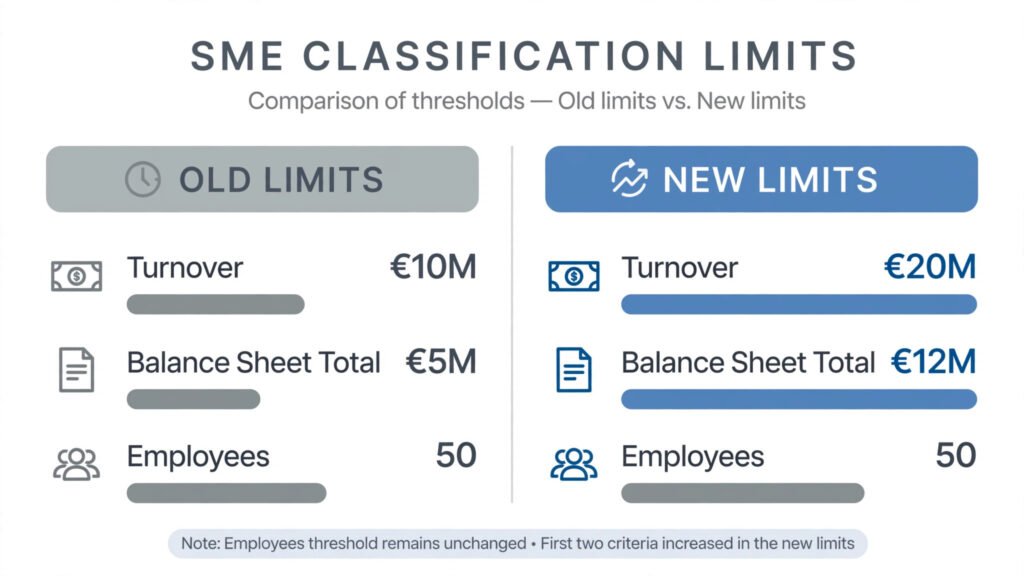
The small company limits rose by almost half in April 2025. The employee limit stayed at 50.
| Test | Years beginning 1 Jan 2016 to 5 Apr 2025 | Years beginning on or after 6 Apr 2025 |
|---|---|---|
| Turnover | £10.2m or less | £15m or less |
| Balance sheet total | £5.1m or less | £7.5m or less |
| Average employees | 50 or fewer | 50 or fewer |
A company must meet at least two of the three. “Balance sheet total” means total assets before you deduct liabilities. It is not net assets.
The same limits apply to LLPs, so a limited liability partnership can use them too. Micro-entities are small companies, so they qualify as well.
ICAEW has estimated that around 14,000 companies moved from medium to small. Some businesses that needed an audit last year may not need one now.
Which limits apply to your financial year?
The limits depend on when your financial year began, not when it ended. If it began on or after 6 April 2025, use the new limits.
| Financial year | Limits that apply |
|---|---|
| 1 Jan 2025 to 31 Dec 2025 | Old (£10.2m / £5.1m) |
| 1 Apr 2025 to 31 Mar 2026 | Old, as it began before 6 April 2025 |
| 6 Apr 2025 to 5 Apr 2026 | New (£15m / £7.5m) |
| 1 Jan 2026 to 31 Dec 2026 | New (£15m / £7.5m) |
A common mistake is to look at the year-end. A 31 March 2026 year-end sounds recent, but that year began on 1 April 2025. If your year straddles the change, ask your accountant whether a transitional rule applies.
The two-year rule
Crossing a limit once does not cost you the exemption. A company changes size category only when it meets, or stops meeting, the conditions in two consecutive financial years.
Say a small company’s turnover hits £16 million and its balance sheet total hits £8 million in 2027. It is over two limits but stays small for 2027. If the same happens in 2028, it loses small status for 2028 and needs an audit.
The rule works in reverse. A company that falls below the limits needs two consecutive years before it counts as small. New companies are tested on their first year.
Turnover is pro-rated for years longer or shorter than 12 months. A 15-month period with £17 million turnover is compared as £13.6 million. In the first year under the new limits, you can assume they applied to the prior year too.
Four routes to audit exemption
A company can avoid an audit in four situations:
- It is dormant, with no significant accounting transactions in the year.
- It is a small standalone company.
- It is a small company in a small group.
- It is a subsidiary of a UK parent that gives a guarantee, whatever its size.
Each route has conditions. Routes 3 and 4 are covered in the groups section below. If your dormant company has no future, our guide to closing a limited company explains the alternative.
Companies that can never claim the small company exemption
Some companies need an audit whatever their size. The test is whether the company was one of these types at any time during the financial year.
- A public company (unless it is dormant)
- An authorised insurance company, or a company carrying out insurance market activity
- A banking company
- An e-money issuer
- A MiFID investment firm
- A UCITS management company
- A Master Trust pension scheme funder
- A special register body or an employers’ association
The words “at any time” matter. A company that was a bank for only part of the year is still excluded for the whole year. Charitable companies follow separate charity audit rules, so this guide does not cover them.
Groups and subsidiaries
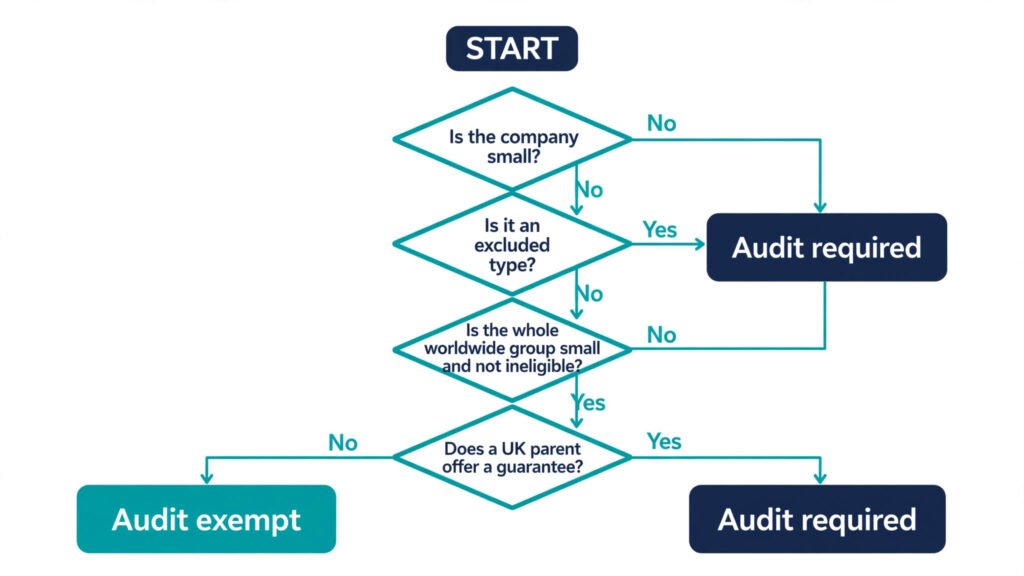
A company in a group can claim exemption only if it is small itself and the group is small and not ineligible. “The group” means the whole worldwide group, including overseas companies.
Small group limits
A group is small if it meets two of three tests. You can use the net figures, the gross figures, or a mix. Net means after consolidation adjustments. Gross means adding the companies’ figures together first.
| Test | Net | Gross |
|---|---|---|
| Turnover | £15m or less | £18m or less |
| Balance sheet total | £7.5m or less | £9m or less |
| Average employees | 50 or fewer | 50 or fewer |
Ineligible groups
A group cannot be small if any member was one of these at any time in the year:
- A traded company, or a body whose shares trade on a UK regulated market
- A firm with Part 4A permission under the Financial Services and Markets Act 2000, unless it is a small company
- An e-money issuer or a Master Trust scheme funder
- A small company that is an insurer, bank, MiFID investment firm or UCITS management company
Parent guarantee (section 479A)
Any subsidiary with a UK parent can be exempt, whatever its size, if the parent guarantees its liabilities at the year-end. The subsidiary must be included in the parent’s consolidated accounts. Those accounts and the guarantee are filed at Companies House. Minority shareholders must also agree. A parent based outside the UK cannot use this route.
Example: a UK company has £2 million turnover and 12 staff. Its US parent group has £40 million turnover. The UK company is small on its own, but the group is not small, and a US parent cannot give a section 479A guarantee. The UK company needs an audit.
When shareholders can force an audit
Shareholders holding at least 10% of the shares, by number or value, can require an audit even when the company qualifies for exemption. One shareholder can do it, or several can act together.
The request must be in writing and sent to the company’s registered office address. It must arrive at least one month before the end of the financial year the audit is for. A later request cannot force an audit for that year.
Check your articles of association too, because they can require an audit whatever the size. So can a shareholders’ agreement or loan terms.
What to put on your balance sheet
A company claiming exemption must include an audit exemption statement on its balance sheet. It must say four things:
- The company was entitled to exemption from audit under section 477 of the Companies Act 2006 for the year.
- The members have not required an audit under section 476.
- The directors accept their responsibility for keeping accounting records and preparing accounts.
- The accounts follow the small companies regime.
Use the exact wording published on GOV.UK, or the wording built into your accounting software. The directors’ acknowledgement links to your wider company director responsibilities.
On the register, accounts that claim exemption but give full detail are labelled “total exemption full”.
What changes from April 2028
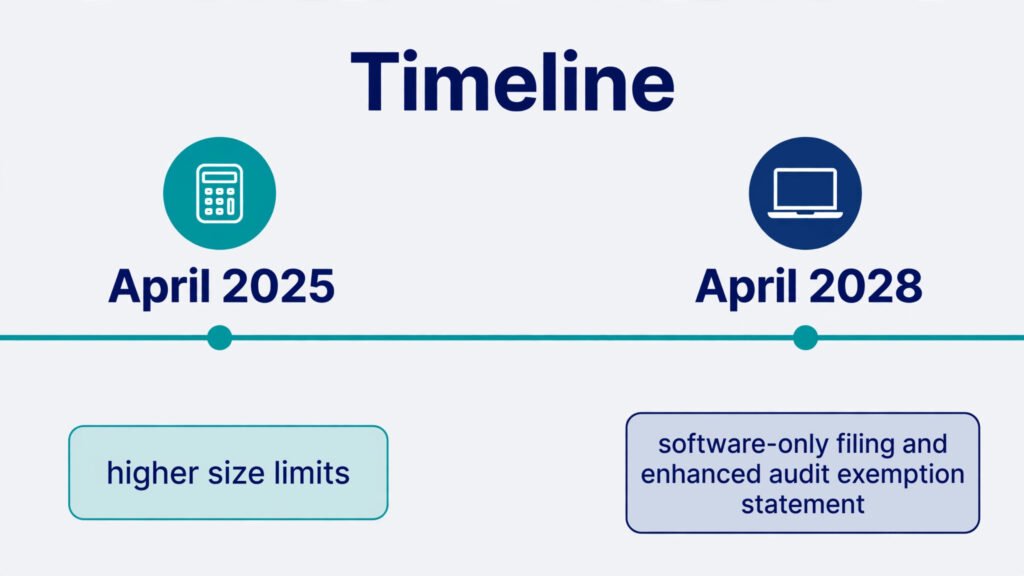
The Companies House accounts reforms start on 1 April 2028. The Government confirmed in June 2026 that the reforms go ahead from 1 April 2028; they were originally due in April 2027. Guides that still quote 2027 are out of date.
From 1 April 2028:
- All accounts must be filed through commercial software in iXBRL format. The web and paper routes close for accounts.
- Small and micro-entity companies must file a profit and loss account, with an option to keep it off the public register.
- Abridged accounts are no longer allowed.
- Any company claiming audit exemption must give an enhanced directors’ statement. It must name the exemption and confirm the company qualifies.
Nothing in the announcement changes the size limits. What changes is how you claim the exemption and how you file. Choosing the right software will matter more, so our Xero vs QuickBooks comparison is a useful starting point.
Should you still have an audit?
An audit is optional once you qualify. But the law no longer requiring one does not mean you do not need one. Ask yourself:
- Do lenders or investors expect audited accounts? Loan agreements and investor terms can require them. If you are raising money, see our British Business Bank loans guide.
- Is your finance team small? Auditors can spot control weaknesses that an internal team misses.
- Are you planning to sell? An audit history can help when you sell a small business.
- Might you cross the limits again? Skipping audits can leave opening balances unaudited. A later audit may then be qualified, potentially for up to three years.
- Are you close to £7.5 million in assets? FRS 102 lease changes for periods beginning on or after 1 January 2026 can bring leases onto the balance sheet and push total assets up.
A limited assurance review is a middle path. It gives moderate assurance with less testing than a full audit.
FAQs
What is the audit exemption limit for small companies in the UK?
For financial years beginning on or after 6 April 2025, a company must meet two of three tests: turnover of £15 million or less, balance sheet total of £7.5 million or less, and 50 or fewer employees. Excluded companies and some group members still need an audit.
Did the audit thresholds change in 2025?
Yes. Turnover rose from £10.2 million to £15 million and balance sheet total from £5.1 million to £7.5 million. The 50-employee limit stayed the same.
Does exceeding the limit mean I need an audit straight away?
No. You must exceed the limits in two consecutive financial years before you lose small company status.
Can shareholders force an audit?
Yes. Holders of at least 10% of the shares can, if they send a written request to the registered office at least one month before the financial year ends.
Does a UK subsidiary of a foreign parent qualify?
Only if the company is small and the worldwide group is small and not ineligible. The section 479A guarantee route needs a UK parent.
Is audit exemption the same as not filing accounts?
No. You still prepare and file accounts, usually within nine months of the year-end for a private company. You only skip the audit and the auditor’s report.
Next steps: a quick eligibility check
- Find the date your financial year began and pick the matching limits.
- Test turnover, balance sheet total and average employees. You need to pass two of three.
- Apply the two-year rule if you have crossed a limit.
- Confirm you are not an excluded company or in an ineligible group.
- Test the whole group, or check for a UK parent guarantee.
- Check shareholder rights, your articles and any loan terms.
- Add the audit exemption statement to your balance sheet.
If anything is unclear, ask a qualified accountant before filing. This guide is general information, not professional advice; see our disclaimer. Last reviewed: 5 October 2026.