


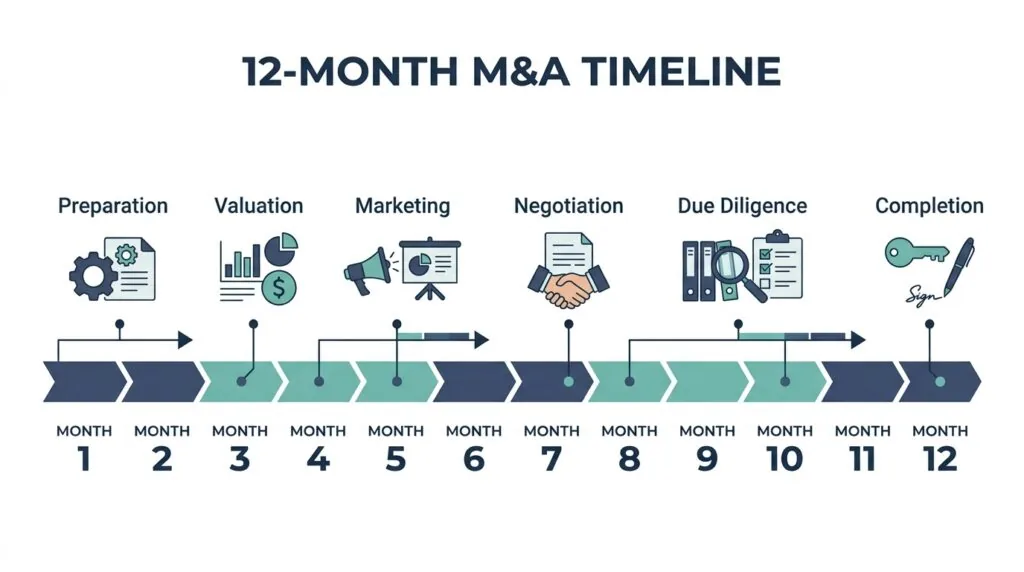
Selling a small business in the UK usually takes six to twelve months from the day you decide to exit to the day the money lands in your account. That surprises owners who assume a sale can happen as soon as they find a willing buyer. In reality, the buyer is only one part of it — you also need clean accounts, the right legal structure, a plan for staff under TUPE, and a tax strategy that protects your proceeds.
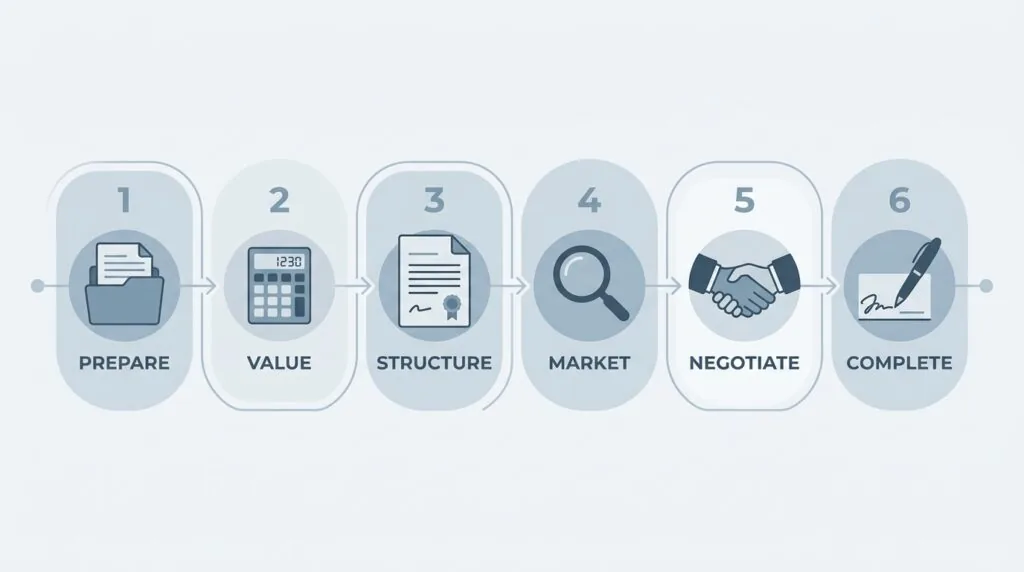
To sell a small business in the UK: prepare your accounts and operations 6–12 months ahead, get an independent valuation using an earnings multiple, choose between a share sale or asset sale, market the business confidentially through a teaser and NDA, negotiate Heads of Terms, get through due diligence, then complete with a Sale and Purchase Agreement (SPA) while handling TUPE staff transfers and Business Asset Disposal Relief (BADR) correctly.
The rest of this guide covers each step in the order you’ll actually do them.
Step 1: Prepare Your Business for Sale (6–12 Months Out)
Buyers pay more for businesses that look easy to run and hard to disrupt. Preparation is where you build that impression.
Clean up your accounts. Buyers will pick apart three years of financial statements. Remove personal expenses run through the business, tidy up director’s loan accounts, and make sure your figures match what you’ve filed at Companies House and HMRC. Most advisers recommend calculating Seller’s Discretionary Earnings (SDE) or EBITDA — your true, “normalised” profit once one-off costs and owner perks are stripped out. This is the figure buyers pay a multiple of.
Reduce owner-dependency. If the business can’t run without you chasing every client and signing every invoice, buyers will discount their offer. Document your processes and delegate client relationships where possible.
Build a data room. This is a secure folder holding everything a serious buyer will want: contracts, the commercial lease, tax filings, payroll records, and insurance. Getting this together early avoids a scramble later. It’s also worth reviewing your company director responsibilities, since some records need keeping in order regardless of a sale.
A common mistake is marketing the business before the accounts are ready — a buyer’s accountant will find the gaps during due diligence, right when trust matters most.
Step 2: Value Your Business Accurately
A defensible valuation lets you negotiate from strength instead of guessing.
Most UK small businesses are valued using an earnings multiple applied to SDE or EBITDA — typically 2x–5x, depending on sector, growth, customer concentration, and how dependent the business is on the owner. A service business with one big client and an owner who does all the selling sits at the low end; a business with recurring contracts and a management team commands more.
Pay for an independent valuation from an accountant rather than relying on a broker’s estimate alone, since brokers sometimes inflate valuations to win your instruction. If you’re weighing a family or management succession instead of an open-market sale, compare it against business succession planning first.
Step 3: Choose Your Deal Structure — Share Sale vs Asset Sale
This decision affects your tax bill, your legal exposure, and how attractive the deal looks to buyers.
A share sale means the buyer purchases your company’s shares directly, taking over the entire legal entity — assets, contracts, and liabilities, known and unknown. It’s usually more tax-efficient for sellers, since proceeds are taxed as a capital gain and can qualify for BADR.
An asset sale means the buyer purchases specific assets — equipment, stock, IP, contracts, and goodwill — rather than the company itself. You keep the legal entity and its historic liabilities. Buyers often prefer this, since it lets them avoid inheriting problems buried in the company’s past.
| Share Sale | Asset Sale | |
|---|---|---|
| What’s sold | Shares in the company | Specific assets and goodwill |
| Liabilities | Transfer to the buyer, including unknown ones | Mostly stay with the seller’s entity |
| Seller tax treatment | Capital gain, can qualify for BADR | Company pays Corporation Tax on the sale |
| Buyer preference | Less common — higher inherited risk | Usually preferred — lower risk exposure |
| TUPE impact | No transfer needed — same employer | Usually applies — staff transfer to the buyer |
If you trade as a limited company, check your shareholder agreement at this stage, since it may set conditions on selling shares to an outside buyer.
Step 4: Market the Business Confidentially and Find Buyers
Staff, suppliers, or competitors finding out too early can unsettle a business fast. A staged, confidential approach protects against that.
- The blind teaser — a one-page anonymous summary describing turnover, profit, sector, and location, without naming the business.
- The NDA — anyone wanting more detail signs a Non-Disclosure Agreement first. Have a solicitor draft or check it; a weak NDA offers little protection.
- The Information Memorandum (IM) — once signed, you share a full document covering financials, operations, customers, and growth potential.
Where you find buyers depends on your sector: brokers (5–10% commission) run the process for you; marketplaces like Rightbiz, BusinessesForSale.com, and Daltons Business reach a broad pool; trade competitors are often the most motivated but need the most confidentiality; MBOs move faster since the buyer already knows the business; and Employee Ownership Trusts (EOTs) let you sell to staff collectively, with tax advantages worth discussing with an accountant.

Step 5: Negotiate Heads of Terms and Get Through Due Diligence
Once a buyer makes a serious offer, you’ll usually sign Heads of Terms (HoT) — sometimes called a letter of intent — setting out price, structure, and key conditions before lawyers draft the full contract. It’s usually not binding on price, but exclusivity clauses within it are. Agree a realistic exclusivity period (commonly 60–90 days) rather than an open-ended one.
Due diligence is the buyer’s formal investigation, and for a small business it usually covers three areas:
- Financial — verifying accounts, tax position, and the SDE/EBITDA figure behind the price.
- Legal — checking contracts, the commercial lease, IP ownership, and compliance with relevant small business regulations.
- Operational — reviewing supplier relationships, staff structure, and owner-dependency.
A common snag is discovering the commercial lease can’t be assigned without landlord consent — check this in Step 1, not during due diligence. Expect the buyer’s solicitor to request warranties and possibly indemnities in the SPA, alongside a Disclosure Letter listing exceptions to those warranties — your main protection against post-completion claims over issues you disclosed honestly.
Step 6: Complete the Sale — Employee Transfers, Tax, and Legal Completion
Completion involves three things happening together: the legal contract, the staff transfer, and the tax position.
The Sale and Purchase Agreement (SPA) is the binding contract that finalises the deal, setting out the final price mechanism — either completion accounts (adjusted after completion) or a locked box (fixed as of a set date).
TUPE and your staff. Under the Transfer of Undertakings (Protection of Employment) Regulations, employees automatically transfer to the buyer on existing terms when a business is sold as a going concern. This applies to most asset sales, but not share sales, since the employer doesn’t change. As the seller, you must:
- Inform and, where changes are proposed, consult affected employees or their representatives in good time.
- Provide the buyer with Employee Liability Information — terms, service length, and any disputes.
- Avoid dismissing staff because of the transfer, which is automatically unfair dismissal without a genuine economic, technical, or organisational reason.
Getting TUPE wrong is one of the most expensive mistakes in a small business sale — tribunal claims aren’t capped, so take advice from a solicitor or ACAS before starting consultation.
Tax on the sale. Most sellers are taxed on a capital gain. If you qualify for BADR, gains are taxed at 18% (from 6 April 2026) up to a £1 million lifetime limit, rather than the standard 18% or 24% rates. To qualify, you generally need to have owned the business — or at least 5% of the company’s shares — for two years and been an officer or employee throughout. Earn-outs, where part of the price depends on future performance, complicate the tax treatment, so get advice before agreeing to one. Our guide to Capital Gains Tax on business assets covers the calculation in detail.
Finally, notify HMRC through your Self Assessment return and update Companies House if you’re stepping down as director. If you’re winding the seller entity down afterwards, see our guide on how to close a limited company.
How Long Does It Take, and What Does It Cost?
Most UK small business sales take 6 to 12 months from decision to completion. Straightforward deals with a motivated buyer can close faster; complex ones involving property can run longer.
| Cost | Typical Range |
|---|---|
| Business broker commission | 5–10% of sale price |
| Solicitor’s fees | £3,000–£15,000+ |
| Accountant’s fees (valuation, tax planning, completion accounts) | £1,500–£8,000+ |
These fees come off the top of your proceeds, so factor them into your asking price and tax planning from the start.
Frequently Asked Questions
How do I sell my small business in the UK?
Prepare your accounts, get a valuation, choose a share or asset sale, market confidentially with an NDA, negotiate Heads of Terms, complete due diligence, then sign an SPA while handling TUPE and tax.
What is the difference between a share sale and an asset sale in the UK?
A share sale transfers the whole company, including liabilities, and is usually taxed as a capital gain. An asset sale transfers specific assets and goodwill, leaving the seller with the legal entity.
Do employees automatically transfer when selling a business (TUPE)?
Yes, in most asset sales employees transfer automatically to the buyer under TUPE. In a share sale, they stay with the same employer, so TUPE doesn’t apply the same way.
How much tax do you pay when selling a business in the UK?
With BADR, qualifying gains are taxed at 18% (from 6 April 2026) up to a £1 million lifetime limit. Gains above that, or that don’t qualify, are taxed at standard CGT rates of 18% or 24%.
How long does it take to sell a UK small business?
Most sales take 6 to 12 months from the decision to sell through to completion.
This article provides general information and isn’t a substitute for advice from a solicitor or accountant on your specific transaction.