


From 1 April 2026, the National Living Wage is £12.71 an hour for workers aged 21 and over. That’s the headline number. But the full picture — what under-21s get, how apprentice pay works, and what happens if your employer gets it wrong — matters just as much, especially with enforcement tightening this year.
Here’s the complete breakdown.
Current Minimum Wage Rates (April 2026)
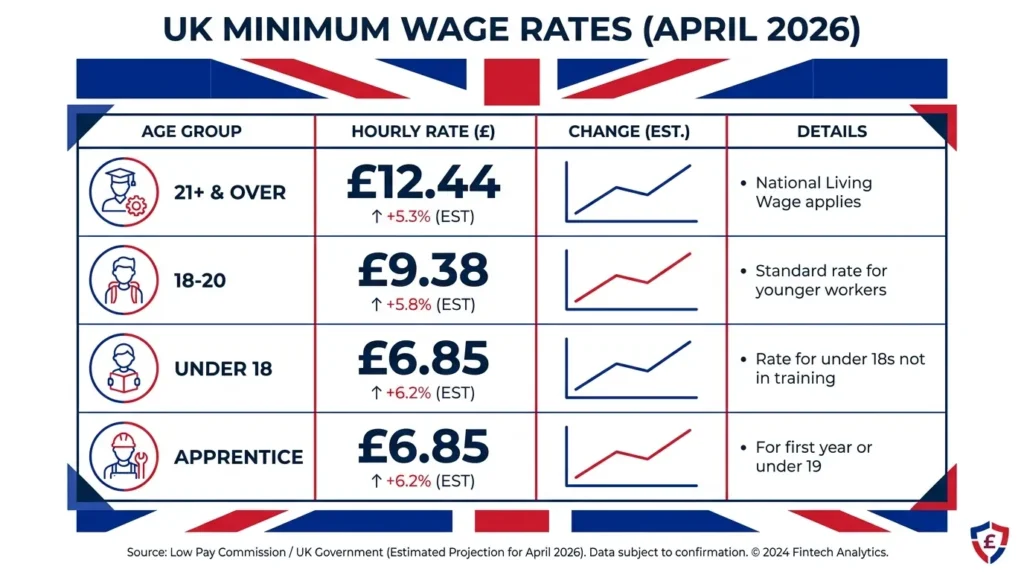
These are the legal minimum hourly rates that took effect on 1 April 2026.
| Age group | Hourly rate |
|---|---|
| 21 and over (National Living Wage) | £12.71 |
| 18 to 20 | £10.85 |
| Under 18 | £8.00 |
| Apprentice | £8.00 |
The 21-and-over rate rose from £12.21, a 4.1% increase. The 18-20 rate jumped from £10.00 to £10.85, continuing the government’s push to narrow the gap between age bands. Under-18s and apprentices moved from £7.55 to £8.00.
Nobody can legally be paid less than these figures, regardless of what’s written in a contract. A clause agreeing to a lower rate isn’t enforceable, even if the worker signed it.
What it means in annual salary terms
For a full-time worker on 37.5 hours a week, the new National Living Wage works out to roughly £24,785 a year before tax. That’s an annual increase of around £900 for someone on a standard full-time contract aged 21 or over. Around 2.7 million workers across the UK are directly affected by the April 2026 uplift.
If you’re running payroll and want to check how this interacts with employer National Insurance rates, it’s worth reviewing both changes together, since they land in the same pay period.
National Minimum Wage vs National Living Wage — What’s the Difference?
These two terms get mixed up constantly, so here’s the plain version.
The National Living Wage (NLW) applies only to workers aged 21 and over. The National Minimum Wage (NMW) is the umbrella term for everyone younger — the 18-20 rate, the under-18 rate, and the apprentice rate all sit under it.
This wasn’t always the age split. Before April 2021, the NLW only applied to workers aged 25 and over. Between 2021 and 2024, the threshold dropped to 23. Since April 2024, it’s been 21. The government has signalled it wants to bring the two rates fully in line eventually, which is part of why the 18-20 band has been rising faster than the 21+ band in recent years.
Both rates are set annually by the government, based on recommendations from the Low Pay Commission, an independent body. The Low Pay Commission has been instructed to keep the National Living Wage from falling below two-thirds of median earnings, which is part of the formula behind these yearly increases.
Apprentice Rates Explained
Apprentice pay confuses a lot of employers, so it’s worth getting precise.
You’re entitled to the £8.00 apprentice rate if you’re either:
- Under 19, regardless of how long you’ve been an apprentice
- 19 or over, but still in the first year of your apprenticeship
Once you turn 19 and finish your first year, you move onto the standard rate for your age group. So a 21-year-old apprentice who’s completed their first year is entitled to £12.71, not £8.00.
Example: An apprentice aged 21 in the first year of their apprenticeship gets £8.00. The same apprentice, a year later, having turned 22 and finished year one, gets £12.71.
This transition point is one of the most common sources of underpayment, because it requires payroll to track two separate triggers — age and apprenticeship duration — rather than one. If you’re a small business setting up apprenticeship pay for the first time, our guide on UK small business apprenticeships covers the practical setup side of this.
When Did the Rates Last Change — and When’s the Next Update?
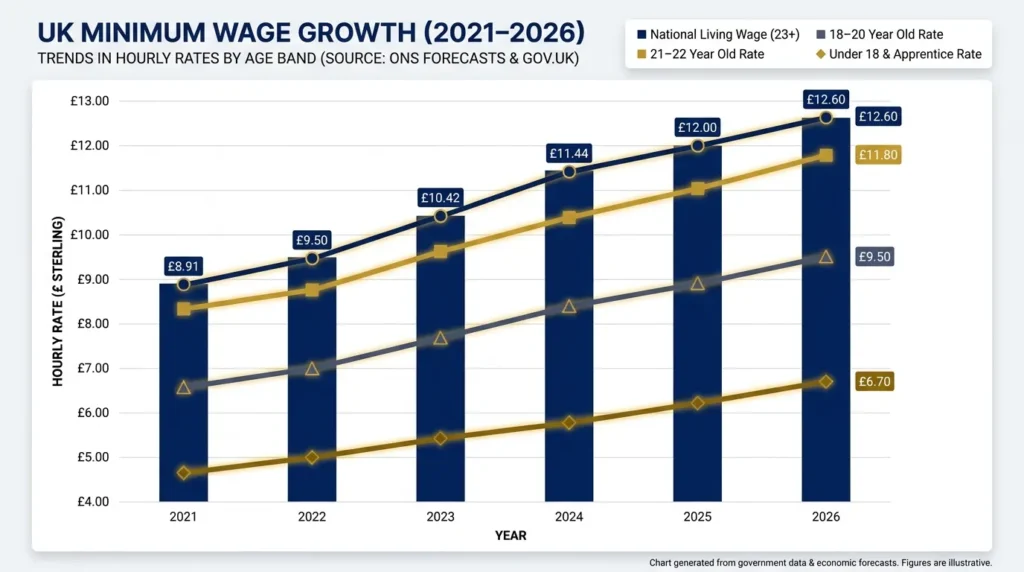
Rates change every year on 1 April. Here’s the recent history:
| Period | 21/23/25+ | 18-20 | Under 18 | Apprentice |
|---|---|---|---|---|
| April 2026 onwards | £12.71 | £10.85 | £8.00 | £8.00 |
| April 2025 – March 2026 | £12.21 | £10.00 | £7.55 | £7.55 |
| April 2024 – March 2025 | £11.44 | £8.60 | £6.40 | £6.40 |
| April 2023 – March 2024 | £10.42 | £7.49 | £5.28 | £5.28 |
| April 2022 – March 2023 | £9.50 | £6.83 | £4.81 | £4.81 |
| April 2021 – March 2022 | £8.91 | £6.56 | £4.62 | £4.30 |
Note the age threshold for the top rate has shifted over this period: 25+ before April 2021, 23+ from 2021-2024, and 21+ from April 2024 onwards. That’s why the top-rate column isn’t a single continuous age group across the table.
The next review will follow the usual cycle — the Low Pay Commission makes recommendations later in the year, and any new rate takes effect on 1 April 2027.
Who Is Entitled to the Minimum Wage
You’re entitled to the National Minimum Wage if you’ve reached school leaving age and you’re classed as a worker. This covers the vast majority of employees, including:
- Part-time and full-time staff
- Casual and agency workers
- Workers on probation
- Home workers paid by output (piece workers), subject to specific calculation rules
Who is excluded
A small number of categories sit outside the minimum wage rules, including:
- Genuinely self-employed people running their own business
- Company directors with no employment contract
- Volunteers and voluntary workers
- Members of the armed forces
- Some apprentices under formal training agreements that aren’t standard apprenticeships
- Family members working in a family business who live in the employer’s home
If you’re unsure whether you’re classed as a worker or genuinely self-employed, that distinction also affects your tax position. It’s worth reading our comparison of sole trader vs limited company status if you’re weighing up how to structure your own work.
How to Check You’re Being Paid Correctly
Three checks catch most underpayment issues:
- Confirm your age band is current. If you had a birthday in the last year, check whether it moved you into a higher rate.
- Check all your working time is paid. This includes time spent getting ready for a shift if it’s required by your employer, and time waiting between tasks if you can’t leave.
- Check deductions haven’t pulled you below the minimum. Deductions for uniforms, equipment, or accommodation can legally reduce your effective hourly pay if they’re not handled correctly — and that’s one of the most common breach categories HMRC finds.
If your numbers don’t add up, raise it with your employer in writing first. If that doesn’t resolve it, you can report the underpayment to HMRC.
What Happens If You’re Underpaid
Underpayment isn’t always deliberate. Government enforcement data consistently shows most breaches come from payroll processes that don’t catch common edge cases — not employers intentionally short-changing staff.
The three most common causes, based on the latest enforcement round, are:
- Deductions or reductions from pay (the largest single cause, accounting for around 40% of cases)
- Failing to pay for all working time, such as unpaid prep time or shift-change handovers (around a third of cases)
- Paying the wrong apprentice rate, usually around the age/year-one transition point (just under a fifth of cases)
Penalties for employers
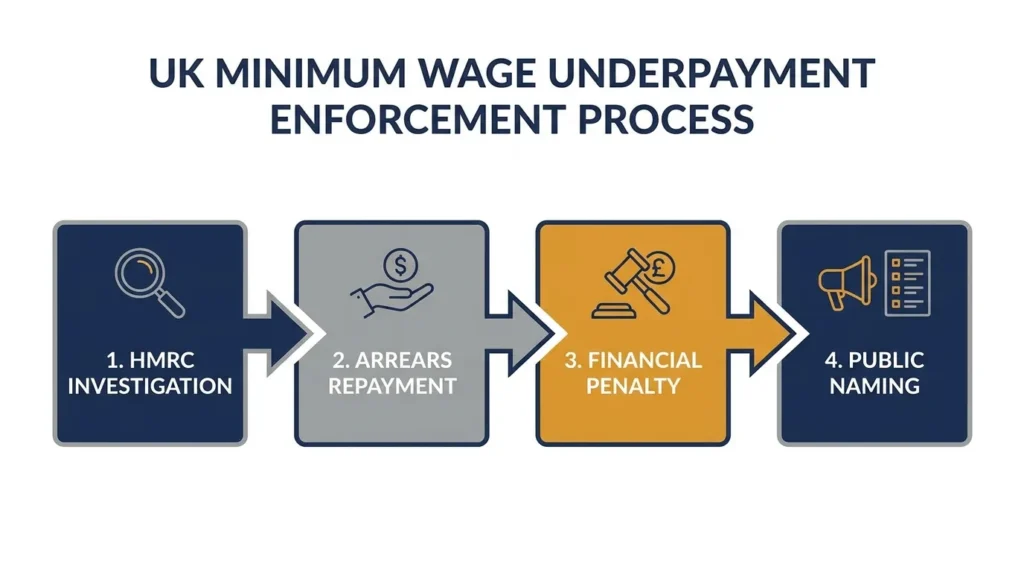
If HMRC investigates and confirms underpayment, the employer must:
- Repay the arrears in full, calculated at the current minimum wage rate, not the rate that applied when the underpayment happened
- Pay a financial penalty of up to 200% of the underpayment, capped at £20,000 per worker
- Accept being publicly named under the government’s naming scheme, unless the case is successfully appealed
HMRC can pursue underpayment going back up to six years from the date a notice is issued. In March 2026, the government published its latest naming round: 389 employers were named, covering roughly 60,000 underpaid workers and over £7.3 million in arrears, with a further £12.6 million in penalties on top of that repayment.
There’s an important exception: if an employer spots the error themselves and repays the arrears voluntarily before HMRC opens a compliance check, there’s no public naming and no financial penalty attached. Self-correction is treated very differently from getting caught.
If you’re reviewing your own payroll compliance as a business owner, it’s worth cross-checking your minimum wage calculations alongside your wider business expenses you can claim, since payroll costs and statutory deductions often get reviewed together at year-end.
The Fair Work Agency (new from April 2026)
From 7 April 2026, a new body called the Fair Work Agency took over minimum wage enforcement, created under the Employment Rights Act 2025. It consolidates HMRC’s National Minimum Wage enforcement function into a single regulator, rather than the previous, more fragmented system. This is the most significant structural change to enforcement in years, and it signals more frequent naming rounds going forward, following a Budget commitment to publish enforcement data more regularly.
FAQs
Is the minimum wage going up again in 2027? Rates change every 1 April, based on Low Pay Commission recommendations made later in the preceding year. A 2027 rate hasn’t been confirmed yet, but an increase is near-certain given the pattern of the last several years.
Do apprentices always get the lower rate? No. Only apprentices under 19, or those 19+ in their first year, get the £8.00 apprentice rate. After that, they’re entitled to the standard rate for their age.
Can my employer pay me less if I agree to it in writing? No. Any contract clause agreeing to a rate below the legal minimum is not enforceable, regardless of what’s been signed.
What’s the difference between NMW and NLW again? NLW is specifically the 21-and-over rate. NMW is the broader term covering every age band below that, including 18-20, under-18, and apprentice rates.
In short: the National Living Wage is now £12.71 for workers 21 and over, with clear, lower bands for younger workers and apprentices below that. The rules around age transitions and apprentice status are where most pay errors happen — for both employees checking their payslip and employers running payroll. With the Fair Work Agency now overseeing enforcement and naming rounds becoming more frequent, getting this right matters more in 2026 than it has in previous years.