Every UK business owns intellectual property the moment it creates something original: a logo, a piece of writing, a product design, or a new invention. The question isn’t whether you have IP. It’s whether you’re protecting it correctly, and most business owners aren’t.
This guide sets out exactly which UK rights apply to which assets, what registration costs at the Intellectual Property Office (IPO), and the practical steps that stop competitors, or careless contracts, from taking what’s yours. If you’re still at the idea stage, it’s worth reading our guide on how to protect your business idea before you approach investors or manufacturers.
What Is Intellectual Property in the UK?
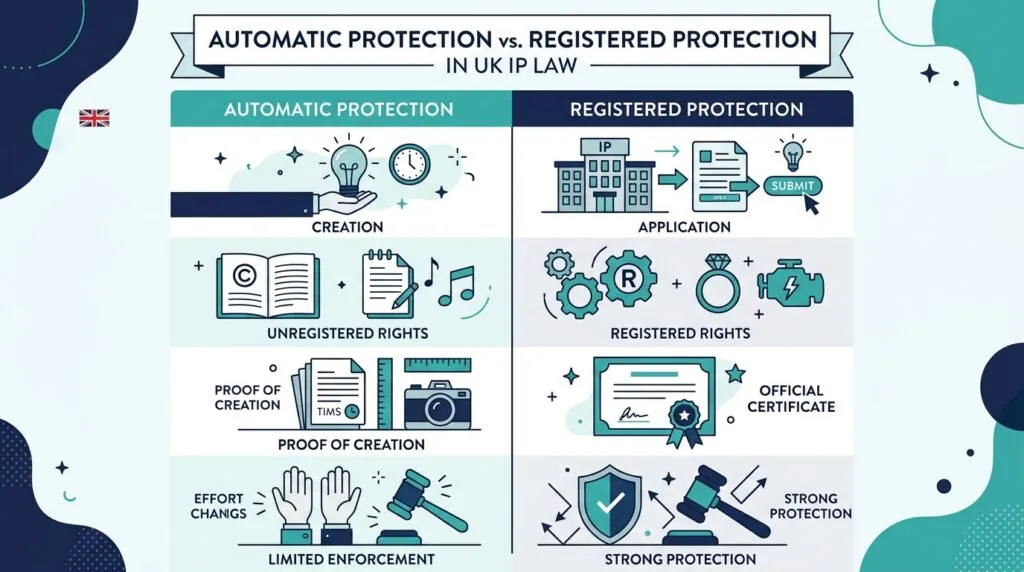
Intellectual property (IP) is a legal term for creations of the mind that the law lets you own and control: brand names, designs, inventions, written or artistic work, and business processes. In the UK, IP splits into two categories: rights that exist automatically the moment you create something, and rights you must actively register with the IPO.
Automatic Protection vs Registered Protection
Copyright and unregistered design rights are automatic. You don’t pay a fee, fill in a form, or wait for approval; protection starts the instant the work exists in a recorded, tangible form. Trade marks, registered designs, and patents work differently. None of them exist as a legal right until you apply to the IPO, pay the fee, and the application is granted. Registered rights cost money and take time, but they give you something automatic rights don’t: a certificate you can point to in court, and a public register that puts competitors on notice.
The 4 Core Types of Intellectual Property Rights in the UK
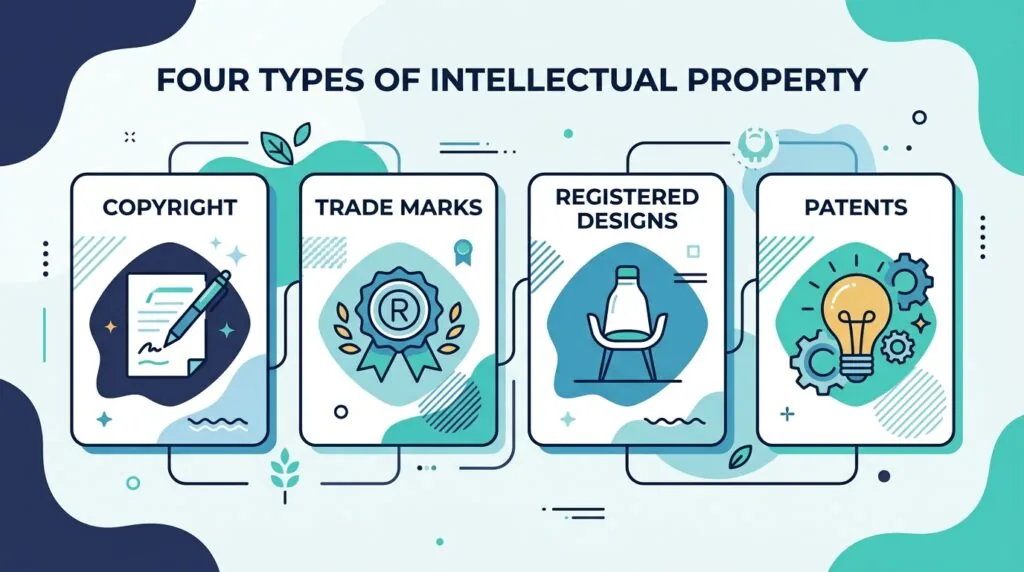
The four main types of intellectual property in the UK are copyright, trade marks, registered designs, and patents. Each protects a different kind of asset, and most growing businesses end up using more than one.
1. Copyright (Automatic Protection)
Copyright protects original literary, artistic, musical and dramatic works: website copy, photographs, software code, marketing materials, and video content. It’s governed by the Copyright, Designs and Patents Act 1988. Copyright is automatic in the UK, meaning you do not have to pay a fee or register to protect it. Protection typically lasts for the life of the creator plus 70 years. The main risk with copyright isn’t losing it; it’s not knowing who owns it in the first place, which we cover below. For a closer look at how this applies to creative and marketing assets, see our guide to copyright protection for UK small businesses.
2. Trade Marks (Registered Brand Assets)
A trade mark protects your brand identity: business name, logo, slogan, or a combination of these, tied to specific goods or services. To register a trade mark in the UK, your mark must be distinctive, not simply descriptive of what you sell, and not confusingly similar to an existing registered mark. Registration runs through the IPO under the Trade Marks Act 1994, using the Nice Classification system to define which classes of goods and services the mark covers. As of the 2026 fee schedule, an online UK trade mark application costs £205 for the first class and £60 for each additional class, with renewal due every 10 years at £245 for the first class. For a full walkthrough of the process, see how to trade mark a business name in the UK.
3. Registered Designs (Visual and Aesthetic Appeal)
A registered design protects how a product looks: its shape, contours, colours, texture, or ornamentation, rather than how it functions. Product packaging, furniture shapes, and app interfaces are common examples. Online applications cost £60 per design, and protection can be renewed every five years for up to 25 years in total. Unregistered design rights also exist automatically in the UK and cover the shape or configuration of an object for up to 10 years from first sale, but they carry weaker legal standing than a registered right.
4. Patents (Technical Inventions and Processes)
A patent protects a new invention: a product, process, or technical solution that is novel, involves an inventive step, and has industrial application. Patents are governed by the Patents Act 1977 and last up to 20 years from filing, subject to renewal fees. Online applications cost £75, plus a separate search fee. The single most important rule with patents: do not make your invention public before applying for a patent, as public disclosure will invalidate your application. That includes pitching to investors without an NDA, demonstrating a prototype at a trade fair, or posting details online.
Step-by-Step: How to Protect Your IP Assets in the UK
Protecting IP isn’t a single action; it’s a sequence. Here’s the order that actually works.
- Conduct an internal IP audit. List every asset your business has created: brand names, logos, product designs, written content, software, and inventions. For each one, note whether it’s automatically protected, needs registration, or currently belongs to nobody (or worse, to a contractor). This audit is the foundation everything else builds on.
- Search the IPO databases for existing rights. Before spending money registering anything, search the UK Trade Mark Registry and Espacenet, the UK’s patent database, to check whether someone already holds rights to a similar name, logo, or invention. Skipping this step is how businesses end up rebranding six months after launch.
- Put NDAs and IP clauses into your contracts. This is where most small businesses lose IP without realising it. If you hire a freelancer to design your logo, write your website copy, or build your app, the freelancer, not you, owns the copyright by default under UK law, unless a written IP Assignment Agreement transfers it to your business. A verbal agreement, or an invoice marked “paid in full”, does not transfer ownership. Employment contracts should explicitly state that all IP created during employment belongs to the business too, since the default rule only covers work created “in the course of employment”, a phrase that gets argued over more often than you’d think. Use a confidentiality agreement or NDA before sharing unregistered ideas with anyone outside the business, including investors, manufacturers, or potential partners.
- Submit registrations to the IPO. Once you’ve audited your assets, cleared the databases, and locked down ownership through contracts, register what needs registering. For most small businesses, that means trade marks and designs first, since brand and product appearance tend to get copied before anything else, then patents where an invention is involved.
How to Enforce and Defend Your IP Rights Against Infringement
The Legal Reality of “Passing Off”
If someone copies your unregistered brand name, logo, or trade dress, you can’t sue for trade mark infringement, because you never registered the mark. UK law offers a common law claim instead, called “passing off.” To succeed, you must prove three things: that you have goodwill attached to your brand, that the other party has misrepresented their goods or services as connected to yours, and that this has caused you damage. Passing off claims are harder and more expensive to win than registered trade mark infringement claims, which is exactly why registering your brand name early is worth the fee.
Resolving Disputes: From Cease-and-Desist to IPEC
Most IP disputes start with a cease-and-desist letter, a formal request to stop the infringing activity, and many resolve there. If not, UK businesses can escalate to the Intellectual Property Enterprise Court (IPEC), which runs a small claims track for disputes worth up to £10,000. It’s designed specifically to let small businesses enforce IP rights without the cost of a full High Court case.
Extending Protection Beyond the UK
UK IP rights are territorial. Registering a trade mark or design with the IPO only protects you within the UK. If you sell internationally, or plan to start exporting goods, you’ll need separate protection abroad. The Madrid System, run by the World Intellectual Property Organization (WIPO), lets you file one application to extend trade mark protection to multiple countries at once. The Patent Cooperation Treaty (PCT) does the same for patents, and the Hague System covers international design registrations. Since Brexit, UK and EU trade marks are entirely separate rights: a UK registration no longer covers the EU, so businesses trading in both markets typically need to hold both.
Summary Table: UK IP Types, Costs, and Protection Durations
| IP Right | Registration Needed? | Online Application Fee (2026) | Typical Duration |
|---|---|---|---|
| Copyright | No, automatic | None | Life of creator + 70 years |
| Trade Mark | Yes | £205 (1st class) + £60 per extra class | 10 years, renewable indefinitely |
| Registered Design | Yes | £60 | Up to 25 years, renewed every 5 |
| Unregistered Design Right | No, automatic | None | Up to 10 years from first sale |
| Patent | Yes | £75, plus search fee | Up to 20 years from filing |
Frequently Asked Questions
Is copyright automatic in the UK?
Yes. Copyright applies automatically the moment an original work is created and recorded in some form. There’s no register, no fee, and no need to apply.
How much does it cost to register a trade mark with the UK IPO?
An online UK trade mark application costs £205 for the first class of goods or services, plus £60 for each additional class, under the 2026 fee schedule.
Who owns the copyright when I hire a freelance designer?
The freelancer does, by default, unless you have a signed IP Assignment Agreement transferring ownership to your business. Get this in writing before the work starts, not after.
What’s the difference between a registered design and a patent?
A registered design protects how a product looks. A patent protects how it works, the technical function or process behind it. Many products need both.
Can I protect my business idea before I’ve built anything?
Not directly. UK IP law protects specific expressions of an idea, such as a design, a piece of writing, or an invention, rather than the idea in the abstract. Use an NDA to protect the idea itself while you develop it into something registrable.
IP protection is only one part of running a compliant UK business. For everything else that applies once you’re trading, see our broader guide to legal requirements for UK small businesses.