


Most co-founder disputes don’t start with money. They start with an assumption nobody wrote down — who owns what, who decides what, and what happens if someone walks away. A founders’ agreement exists to close that gap before it becomes a problem.
If you’re starting a business with one or more co-founders in the UK, this guide covers exactly what the document is, whether it’s legally binding, and which clauses actually matter.
What Is a Founders’ Agreement?
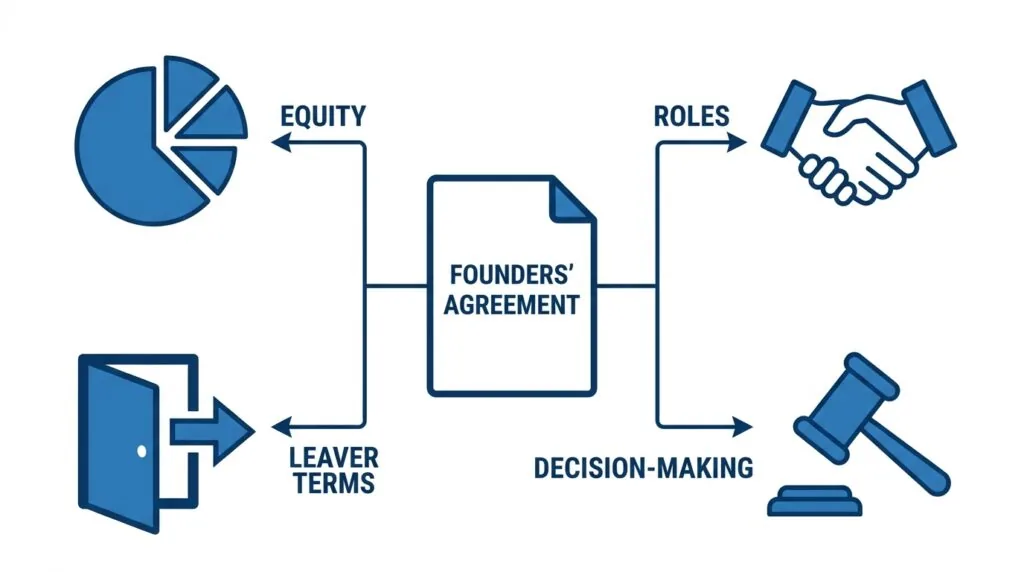
A founders’ agreement is a legally binding contract between the co-founders of a startup. It sets out each founder’s equity share, roles and responsibilities, decision-making powers, and what happens if a founder leaves the business.
Unlike your company’s Articles of Association, it isn’t filed at Companies House. It’s a private contract, usually drafted before or shortly after incorporation, that reflects what founders have actually agreed between themselves — separate from the formal governance documents required by law.
Is a Founders’ Agreement Legally Binding in the UK?
Yes. A founders’ agreement is legally binding in the UK provided it meets the standard requirements of English contract law. It becomes enforceable when the following conditions are met:
- Offer and acceptance — all founders agree to the same terms.
- Consideration — each founder gives something of value, such as time, skills, capital, or IP.
- Intention to create legal relations — the document is clearly intended as a binding contract, not an informal understanding.
- Signatures — all parties sign the agreement, ideally with a witness for each signature.
- Capacity — every founder is legally able to enter into a contract.
A verbal agreement between co-founders can technically be binding too, but proving its exact terms in a dispute is difficult. Put it in writing, and put it in writing early.
Founders’ Agreement vs Shareholders’ Agreement vs Articles of Association
These three documents are often confused, but they serve different purposes and apply at different stages of a company’s life.
The Core Differences Explained
| Founders’ Agreement | Shareholders’ Agreement | Articles of Association | |
|---|---|---|---|
| When it applies | Before or just after incorporation | After incorporation, often when new investors join | From the moment the company is registered |
| Filed at Companies House? | No — private document | No — private document | Yes — public record |
| Who it covers | Founders only | All shareholders, including investors | All shareholders |
| Typical content | Equity split, roles, IP, vesting, leaver terms | Share transfers, voting rights, exit rights, investor protections | Company constitution, director powers, share classes |
| Legal status | Binding contract between the parties | Binding contract between the parties | Binding under the [[Companies Act 2006]] |
A shareholders’ agreement usually replaces or absorbs the founders’ agreement once outside investors come on board, since it covers a wider group of shareholders and typically includes stronger protections for minority holders. The Articles of Association, by contrast, is a public document that sets the company’s formal constitution and applies regardless of what founders privately agree.
When Does a Founders’ Agreement Become Redundant?
A founders’ agreement doesn’t disappear once you incorporate or raise investment, but its role narrows. Once a shareholders’ agreement is signed — typically at your first funding round — it usually takes precedence on matters like share transfers and voting. Founders often keep the original agreement in place for anything the shareholders’ agreement doesn’t cover, such as day-to-day role definitions or informal understandings about workload.
Why Your UK Startup Needs a Founders’ Agreement
1. Preventing Co-Founder Disputes
Most co-founder fallouts trace back to unclear expectations, not bad faith. One founder assumes they’ll be CEO. Another assumes equal pay regardless of hours worked. A founders’ agreement forces these conversations to happen upfront, while everyone is still getting along, rather than mid-crisis.
2. Protecting Intellectual Property (IP)
Without a formal IP assignment, code, designs, or brand assets created by a founder before incorporation can legally remain that founder’s personal property — not the company’s. If that founder later leaves, the business could lose the right to use its own core assets. A founders’ agreement should require every founder to assign pre-existing and future IP to the company.
3. Satisfying Future Venture Capital (VC) & Angel Investors
Investors will expect to see clean equity ownership, vesting in place, and no ambiguity over who controls what. Due diligence for a seed round routinely uncovers founders’ agreements that were never signed — and it slows deals down. Having one in place signals that your business plan and cap table have been thought through before you approach angel investors or pitch to VCs.
8 Key Terms Every UK Founders’ Agreement Must Include
1. Equity Split and Roles
Set out exactly who owns what percentage of the company and what each founder is responsible for day to day. An equal split feels fair at the outset but can cause problems later if one founder’s contribution turns out to be significantly larger. Tie the split to defined roles, not just goodwill.
2. Vesting Schedules and Reverse Vesting
Vesting means founders earn their equity over time rather than receiving it all upfront. A standard structure is a four-year vesting period with a one-year cliff — meaning a founder who leaves within the first 12 months keeps nothing, and the remaining shares vest monthly or quarterly after that.
For UK companies, reverse vesting carries a tax trap competitors rarely mention. If a founder already legally owns their shares but those shares are subject to forfeiture if they leave (the reverse vesting structure), HMRC can treat the shares as “restricted securities” under ITEPA 2003. Without filing a Section 431 election within 14 days of the shares being issued, the founder risks being taxed later on the shares’ unrestricted market value as they vest — not the (usually much lower) value at the time of issue. This can create an unexpected income tax bill. Founders should take advice on filing a Section 431 election alongside any reverse vesting arrangement.
3. Intellectual Property (IP) Assignment
Saying “the company owns the IP” isn’t enough — it needs to happen formally. Each founder should sign an IP Assignment Deed, transferring any relevant intellectual property they created (code, designs, trademarks, trade secrets) from themselves personally into the limited company. Without this deed, ownership can stay with the individual, which becomes a serious problem during due diligence or if a founder later disputes the company’s right to use the work. If your brand name or product name is central to the business, consider trademarking it once the IP sits with the company.
4. Decision-Making, Voting Rights, and Deadlocks
Define which decisions need unanimous agreement (such as taking on debt or selling the company), which need a majority vote, and which a single founder can make alone (day-to-day operational calls). This should align with how directors’ duties are structured once the company is formally registered.
5. Good Leaver and Bad Leaver Provisions
These clauses determine what happens to a departing founder’s equity. A good leaver — someone who leaves for a legitimate reason, such as illness — typically keeps their vested shares, sometimes at full value. A bad leaver — someone who resigns without cause, is dismissed for misconduct, or breaches the agreement — may be forced to sell their shares back at a reduced price, or lose unvested shares entirely. Defining these categories in advance prevents a messy negotiation at exactly the moment trust has broken down.
6. Exit Strategy and Transfer of Shares
Set out how and when founders can sell their shares, whether other founders get first refusal, and what happens on a company sale. Include drag-along rights (majority shareholders can force a minority to sell in an acquisition) and tag-along rights (minority shareholders can join a sale on the same terms), since these protect both sides if the company is acquired.
7. Restrictive Covenants and Non-Compete Clauses
A leaving founder shouldn’t be free to immediately set up a competing business using what they learned at your company. Restrictive covenants typically cover non-compete periods, non-solicitation of staff and clients, and confidentiality. UK courts will only enforce these if they’re reasonable in scope, geography, and duration — an overly broad non-compete clause can be struck out entirely, so keep the terms proportionate.
8. Dispute Resolution Mechanisms
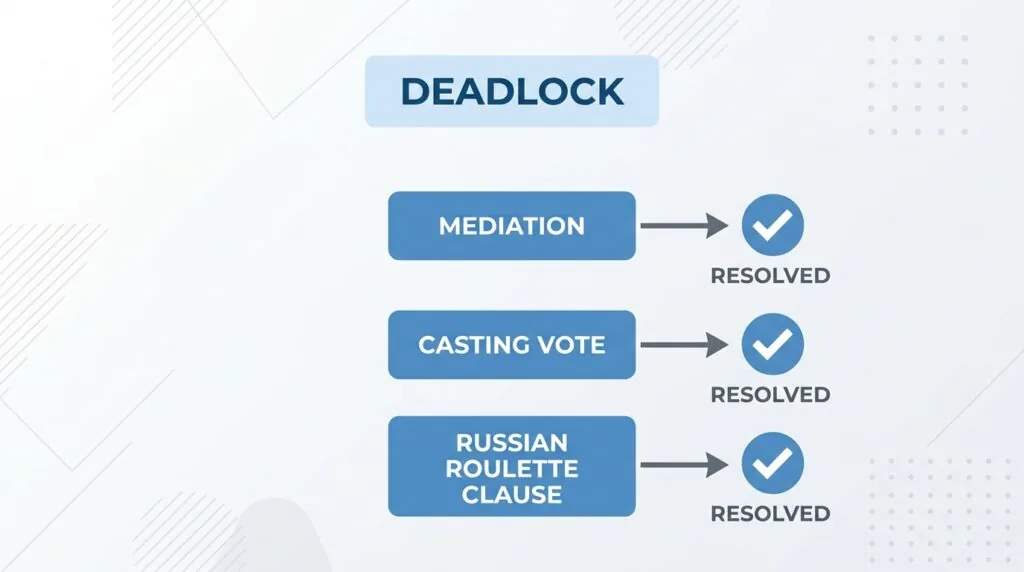
Listing “dispute resolution” as a clause isn’t enough on its own — you need a mechanism that actually breaks a deadlock. In a 50/50 equity split, a genuine disagreement can otherwise freeze the company. Common UK approaches include:
- Mediation — an independent, neutral mediator is brought in before any legal action.
- Casting vote — a non-founder chairperson or advisor holds a tie-breaking vote on deadlocked issues.
- Russian roulette clause — one founder names a price for the shares; the other must either buy them out at that price or sell their own shares at the same price. This forces a fair price because the person naming it doesn’t know which side of the deal they’ll end up on.
- Shotgun clause — a variation on the above, sometimes with a fixed timeframe for the other party to respond.
Naming a specific mechanism in the agreement — not just “we’ll resolve disputes fairly” — is what actually protects the company when tensions rise.
When Should You Sign a Founders’ Agreement?
Sign a founders’ agreement as early as possible — ideally before you incorporate the company, and no later than immediately after. Waiting until the business has traction, revenue, or outside interest makes it far harder to agree terms objectively, because equity and control now have real value attached to them.
Pre-Incorporation vs. Post-Incorporation
This is a distinction most competing guides blur, but it matters. A founders’ agreement can act as a bridge before the company legally exists.
Pre-incorporation: Before you register the company at Companies House, there are no Articles of Association and no shareholders’ agreement yet — there’s no legal entity to attach them to. A pre-incorporation founders’ agreement covers this gap, recording what founders have agreed to before formal structures exist, including who will hold what percentage once shares are issued.
Post-incorporation: Once the company is registered and shares are allotted, the founders’ agreement sits alongside the Articles of Association and works as a private supplement — covering things like vesting and leaver terms that the Articles don’t typically address. Review and update it as part of your first steps after registering the company.
How to Draft a Founders’ Agreement in the UK
There are two realistic routes, and the right one depends on how much is at stake.
Option A: Legal Tech Platforms & Templates (SaaS)
Platforms such as SeedLegals and Rocket Lawyer offer founders’ agreement templates that are quicker and cheaper than instructing a solicitor. These work well for simple, low-risk setups — for example, two founders with a straightforward equal split and no immediate investment plans. The trade-off is limited customisation for unusual arrangements, such as uneven contributions, complex vesting, or multiple share classes.
Option B: Bespoke Legal Advice from UK Startup Lawyers
Specialist startup law firms, such as Harper James or JPP Law, draft agreements tailored to your specific situation. This is worth the extra cost when equity is split unevenly, when significant IP is involved, when you’re planning to raise investment soon, or when founders have already disagreed on anything material. A solicitor will also flag the Section 431 election deadline and other UK-specific tax and compliance risks that generic templates often miss.
If you’re still deciding on your legal structure entirely, it’s worth comparing a limited company against a sole trader setup or reviewing whether an LLP structure suits your co-founder arrangement better before drafting anything.
Frequently Asked Questions (FAQs)
Is a founders’ agreement legally binding in the UK?
Yes, provided it meets the standard requirements of a contract under English law: offer, acceptance, consideration, intention to create legal relations, and signatures from all parties.
What’s the difference between a founders’ agreement and a shareholders’ agreement?
A founders’ agreement covers only the founders, usually before or shortly after incorporation. A shareholders’ agreement covers all shareholders, including later investors, and typically takes over once outside funding is raised.
Do I need a founders’ agreement before incorporating my company?
It’s strongly recommended. A pre-incorporation founders’ agreement records equity, roles, and IP ownership before the company legally exists, avoiding disputes once shares are formally issued.
What happens if a co-founder leaves early?
This depends on the good leaver/bad leaver terms in the agreement, combined with the vesting schedule. A founder who leaves before their cliff typically forfeits unvested shares; what happens to vested shares depends on whether they’re classed as a good or bad leaver.
Can a founders’ agreement be changed later?
Yes, if all founders agree to the amendment in writing. Many agreements include a clause specifying how changes should be made and how many founders need to approve them.
How much does a founders’ agreement cost in the UK?
Template-based platforms typically start from under £100, while bespoke agreements drafted by a solicitor generally range from £500 to £2,000+, depending on complexity.