


Business Asset Disposal Relief (BADR) cuts the Capital Gains Tax (CGT) you pay when you sell or close a business. Since 6 April 2026, it taxes qualifying gains at 18%. That matches the basic rate of CGT, so the relief is worth much less than it used to be.
It still saves money if you pay higher-rate tax. This guide covers who qualifies, what BADR saves in pounds, how the £1 million limit works and how to claim. Planning a wider exit? Start with our guide on how to sell a small business in the UK.
Last updated: 21 September 2026.
| BADR at a glance | |
|---|---|
| Rate (disposals from 6 April 2026) | 18% |
| Lifetime limit | £1 million of qualifying gains |
| Core test | Two years of ownership or a qualifying role before the sale |
| Share test | 5% of shares and voting rights (except EMI shares) |
| Claim deadline for 2026/27 sales | 31 January 2029 |
| How to claim | Self Assessment return |
What is Business Asset Disposal Relief?
Business Asset Disposal Relief (BADR), formerly Entrepreneurs’ Relief, is a UK Capital Gains Tax relief. It lowers the tax rate on gains from selling or closing a business, or selling shares in your own trading company, on up to £1 million of lifetime gains.
The name changed on 6 April 2020. The lifetime limit also fell from £10 million to £1 million for disposals from 11 March 2020.
BADR is for individuals and some trustees. Companies can’t claim it. It also doesn’t cover investment assets, because the relief targets trading businesses.
BADR rates by disposal date
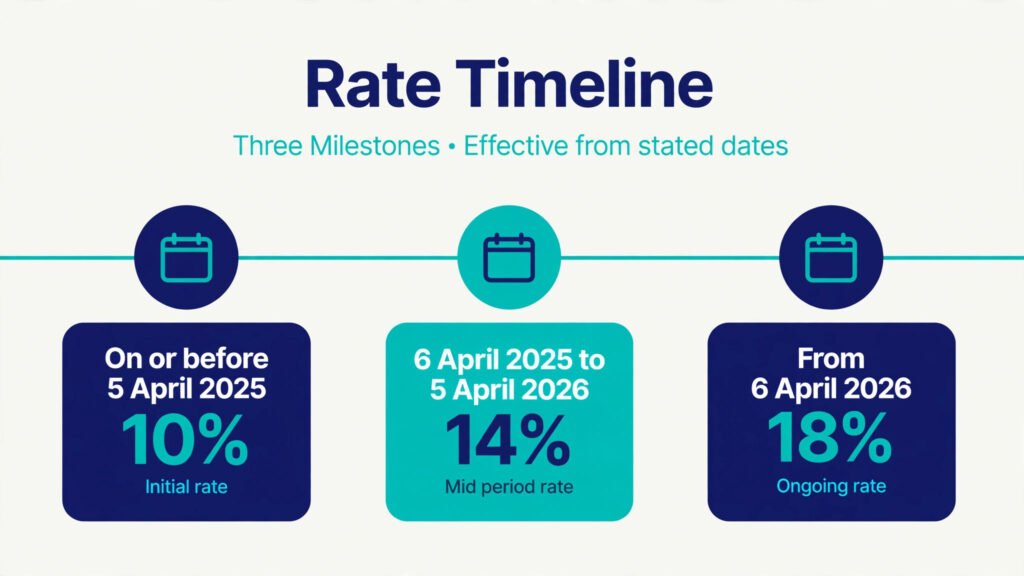
The BADR rate depends on the date you dispose of the asset. It does not depend on when you file your return.
| Disposal date | BADR rate |
|---|---|
| On or before 5 April 2025 | 10% |
| 6 April 2025 to 5 April 2026 | 14% |
| From 6 April 2026 | 18% |
Deduct your annual exempt amount first. It is £3,000 for 2026/27. The rate then applies to what is left.
Without BADR, most gains are taxed at 18% inside your basic-rate band and 24% above it. Anti-forestalling rules stop people locking in an older rate through contracts made mainly for tax reasons.
Is BADR still worth claiming at 18%?
Yes, if you pay higher-rate or additional-rate tax. BADR now saves 6 percentage points against the 24% rate. If your gain fits inside your unused basic-rate band, it saves nothing, because the standard rate is also 18%.
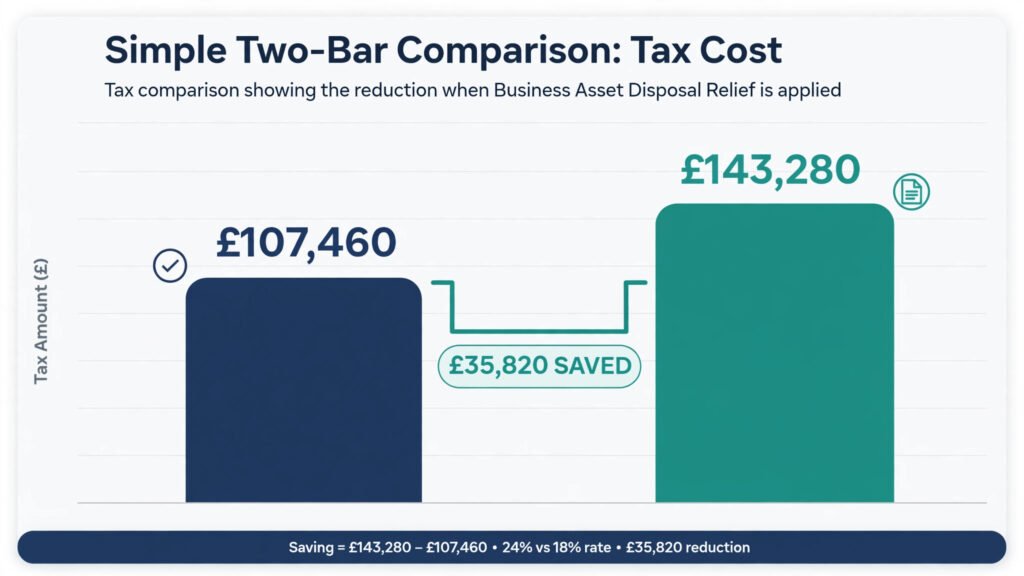
Here is a worked example for 2026/27. Amira is a higher-rate taxpayer. She sells her company shares for a £600,000 gain that qualifies for BADR. After the £3,000 exempt amount, £597,000 is taxable.
| With BADR | Without BADR | |
|---|---|---|
| Rate | 18% | 24% |
| Tax due | £107,460 | £143,280 |
BADR saves Amira £35,820.
The most BADR can save on a full £1 million gain is £60,000 against the 24% rate. One adviser puts the tax on a £1 million qualifying gain at £100,000 under the old 10% rate, against £180,000 today.
Use this quick test:
- Do you pass the ownership, role and trading tests below?
- Will your gain take you above your basic-rate band? If so, BADR saves 6% on those pounds.
- Have you used any of your £1 million limit on an earlier sale?
Who qualifies for BADR?
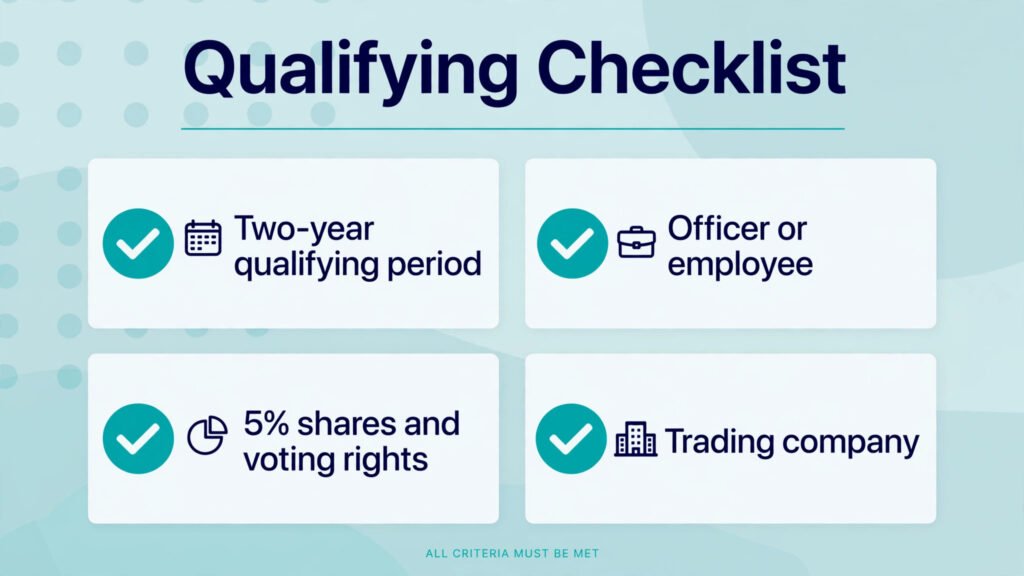
You qualify if you sell all or part of a business you have owned for two years. You also qualify if you sell shares in a trading company where you were an officer or employee and held 5% for two years.
Selling a sole trader or partnership business
You must have owned the business throughout the two years ending on the sale date. If you sell only part, that part must be able to run as a business in its own right. Selling one asset on its own is unlikely to qualify.
If you close the business first, you must sell the assets within three years of closing. The two-year test then runs up to the closure date. Partners follow the same rules, so it helps to have a clear partnership agreement on the record.
Selling shares in your company
All of these must apply for at least two years up to the sale:
- You are an officer or employee of the company or another company in its group. There is no minimum hours rule, so part-timers can qualify.
- It is your “personal company”. You hold at least 5% of the ordinary share capital (by nominal value) and 5% of the voting rights. You must also be entitled to 5% of the profits and assets on a winding up, or 5% of the sale proceeds.
- It is a trading company, or the holding company of a trading group.
Sam holds 4% of his company. He fails the personal company test, however long he has worked there. Alphabet shares can still qualify if they give at least 5% of sale proceeds. If the company stops trading, you can still claim if you sell within three years.
Selling assets you lent to the business
You may qualify on a building or asset the business uses if you sell it alongside your shares or partnership interest. You must sell at least 5% of your interest, and the sale must be part of stepping back from the business. Rent paid by the business can restrict relief. Professional guidance points to two years of business use and three years of ownership, so check HMRC’s helpsheet HS275 for your dates.
EMI shares and trustees
EMI shares are easier. You must have bought them after 5 April 2013 and been granted the option at least two years before selling. There is no 5% test. Trustees can also claim in some cases.
What doesn’t qualify
- Property rental businesses, which are not trading
- Investment companies, including most family investment companies
- A company selling its own assets
- A single asset sold on its own
Property development and land dealing may count as trading, so the facts matter.
The £1 million lifetime limit
You can claim BADR on £1 million of qualifying gains over your lifetime. There is no limit on how many times you claim. Gains above £1 million are taxed at normal CGT rates.
Spouses and civil partners are separate individuals, and each can claim up to the full individual limit. If both of you hold qualifying shares, that can double the relief. But each person must pass every test alone, and shares transferred late may not have the two years behind them.
Sold a business before 11 March 2020? You may have more limit available, so contact HMRC. Outside investors use a different relief, Investors’ Relief, which has its own £1 million limit.
How to claim BADR and deadlines
You claim BADR through your Self Assessment return, or by completing Section A of HMRC’s helpsheet HS275. The deadline is the first anniversary of the 31 January after the tax year of the sale.
- Work out the gain on each qualifying asset and net off any allowable losses.
- Report the disposal in the capital gains section of your return and make the claim there. If you are new to the system, see how to register for Self Assessment.
- Keep evidence: share registers, Companies House filings and proof of your role. Good record keeping makes a claim much easier to defend.
| Tax year of sale or closure | Claim by |
|---|---|
| 2024 to 2025 | 31 January 2027 |
| 2025 to 2026 | 31 January 2028 |
| 2026 to 2027 | 31 January 2029 |
HMRC does not give advance confirmation that BADR will apply to a sale. Narrow points, such as whether a company counts as trading, are sometimes put to HMRC for non-statutory clearance. Ask your adviser.
Closing your company: BADR, MVLs and strike-off
You can claim BADR when a company closes through a formal liquidation, such as a Members’ Voluntary Liquidation (MVL), if you pass the usual tests. The date the money reaches you sets which rules and rate apply.
An MVL needs a licensed insolvency practitioner. It usually suits companies with more than £25,000 to distribute. Payouts are taxed as capital gains, not dividends. That matters because dividend rates are 10.75%, 35.75% and 39.35%. HMRC’s manual confirms BADR is available on capital distributions from a winding up, if the conditions are met.
Strike-off using form DS01 is cheaper, but if the funds distributed are more than £25,000, the whole amount is taxed as dividends. Advisers differ on whether BADR can be claimed after a strike-off, and some say it can’t. Take advice before you rely on it.
Watch the two-year rule. If you start a same or similar business within two years of closing, HMRC can tax the payout as income. Our guide to closing a limited company covers the routes in more detail.
Common mistakes that cost you the relief
- Dropping below 5%. New share issues can dilute you. You can elect to be treated as having sold and re-bought before the dilution, which locks in a BADR gain up to that point.
- Too much non-trading activity. HMRC has long used 20% as a rule of thumb for “substantial” non-trading activity, but recent case law questions it. Large cash piles, property or investment income are all risks.
- Changing share rights. New rights can restart the 24-month clock. Review your shareholder agreement and articles before you amend them.
- Resigning too early. You must stay an officer or employee up to the sale date. Make sure Companies House records match.
- Assuming you’re covered. Property, holding-company structures and family shareholdings all need checking early.
What could change at the Autumn Budget
The Autumn Budget is on 28 October 2026. Commentators say the government could cut the £1 million lifetime limit. Nothing is confirmed, so don’t sell or restructure purely on speculation.
Selling to staff is also less generous. For qualifying disposals from 26 November 2025, only 50% of the gain is exempt under Employee Ownership Trust relief, and BADR can’t be claimed where that relief applies. If you’re weighing that route, read our business succession planning guide. We will update this section after the Budget.
BADR FAQs
Is BADR the same as Entrepreneurs’ Relief?
Yes. Entrepreneurs’ Relief was renamed BADR on 6 April 2020. The lifetime limit fell from £10 million to £1 million for disposals from 11 March 2020.
What is the BADR rate in 2026/27?
It is 18% on qualifying gains for disposals from 6 April 2026, after your annual exempt amount.
Can I claim BADR more than once?
Yes. There is no limit on the number of claims. The total gains you claim on across your lifetime can’t pass £1 million.
Do I need 5% of the company to claim?
Most shareholders do: 5% of ordinary share capital and voting rights, held for two years. Sole traders, partners and EMI shareholders follow different tests.
Can I claim BADR on a rental property business?
No. Property rental isn’t trading, so it doesn’t qualify. Property development may qualify if it counts as trading.
Can I change or withdraw a BADR claim?
Yes, within the time limit. HMRC’s manual says a BADR claim isn’t irrevocable and can be amended or revoked within the time limit.
When to get advice
BADR rules are technical, and HMRC checks claims. Speak to a chartered tax adviser before you agree a sale, not after. It is worth paying for advice if your shareholding is near 5%, your company has property or investment income, you plan a share reorganisation, or family members hold shares.
This guide is general information, not personal tax advice. Rates and rules are correct as at September 2026.