

If you sell a business in the UK in 2026/27, you pay Capital Gains Tax (CGT) on your profit, not on the sale price. Most owners pay 18% or 24%. If you qualify for Business Asset Disposal Relief (BADR), the first £1 million of qualifying gains is taxed at 18%.
That BADR rate rose from 14% on 6 April 2026, so the relief now saves less than it did. Your final bill also depends on how you own the business, how the deal is structured and when contracts are exchanged. This guide covers each one with worked numbers. For the wider process, see our guide on how to sell a small business in the UK.
Key facts for 2026/27
- Main CGT rates: 18% within the basic-rate band, 24% above it
- BADR rate: 18%, up to a £1 million lifetime limit
- Annual exempt amount: £3,000
- Employee Ownership Trust (EOT) sales: 50% of the gain is exempt for disposals from 26 November 2025
- Next Budget: Wednesday 28 October 2026
- Last verified: 21 September 2026 (rates checked against GOV.UK)
What CGT rates apply when you sell a business in 2026/27?
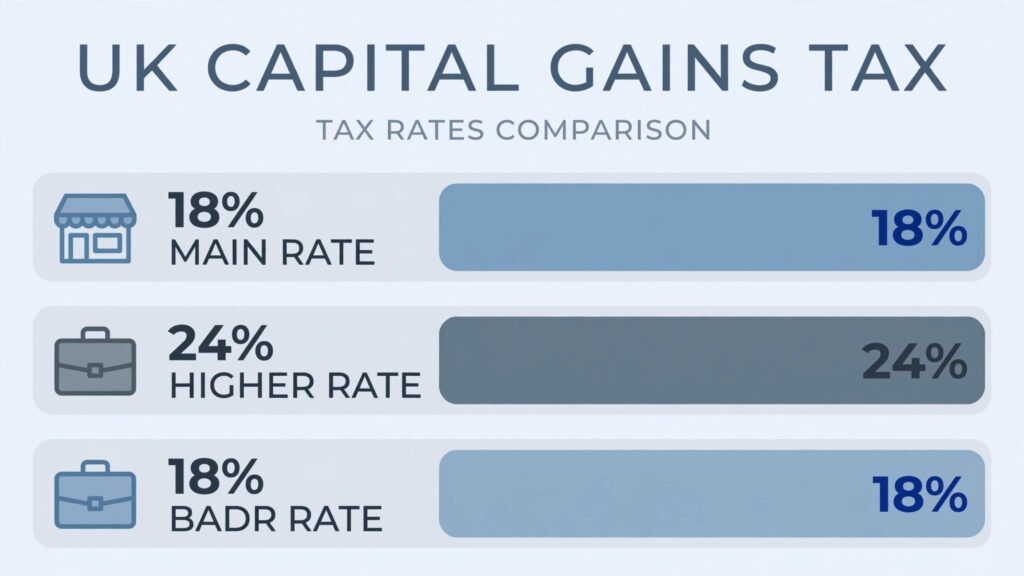
Selling a business in 2026/27 triggers CGT at 18% or 24%. If BADR applies, the first £1 million of qualifying gains is taxed at 18%.
| Situation | CGT rate 2026/27 |
|---|---|
| Gain within the basic-rate band | 18% |
| Gain above the basic-rate band | 24% |
| Gain qualifying for BADR (first £1m, lifetime) | 18% |
| Investors’ Relief (first £1m, lifetime) | 18% |
| Trustees and personal representatives | 24% |
| Sale to an Employee Ownership Trust | 50% of gain exempt, rest at normal rates |
| Annual exempt amount | £3,000 |
Main rates: 18% and 24%
Your rate depends on your income. Take your taxable income, add your gain (after the annual exempt amount) and see where the total lands. The part inside the £37,700 basic-rate band is taxed at 18%. Everything above it is taxed at 24%. Trustees and personal representatives pay 24%.
Business gains are often large. That pushes most of a sale into the 24% band.
The BADR rate: 18%
BADR is a reduced rate for qualifying business sales. It is 18% from 6 April 2026, and the lifetime limit is £1 million of gains. Anything above that is taxed at your normal rate.
Investors’ Relief covers outside investors in unlisted trading companies. It follows the same 18% rate and £1 million limit.
The annual exempt amount: £3,000
The first £3,000 of gains in a tax year is tax-free. It’s small, but every spouse gets one. If your gains are taxed at different rates, you can set the allowance against the gains taxed at the highest rate.
Business Asset Disposal Relief: do you qualify?
BADR applies if you meet its conditions for at least two years up to the date of sale. It’s the most valuable relief for owners, and the easiest to lose by accident.
The £1 million limit covers your whole lifetime. Gains you claimed under its old name, Entrepreneurs’ Relief, count towards it.
Sole traders and partners
You must have owned the business for at least two years up to the date of sale. You can also qualify if you sell business assets within three years of stopping trading.
Company shareholders
To claim BADR on shares, you must meet all four tests for two years up to the sale:
- Hold at least 5% of the ordinary share capital and voting rights.
- Be entitled to at least 5% of distributable profits and of assets on a winding up, or 5% of the sale proceeds.
- Be an officer or employee of the company or a group company. Being a company director counts.
- The company must be a trading company, or the holding company of a trading group.
How owners lose BADR
- Dilution below 5%. A funding round or new share issue can push you under the line. An election may let you keep the relief, but you need to know before you sign. A clear shareholder agreement helps you spot this early.
- Stepping back too early. Resigning as director or employee before the sale can break the two-year test. “Consultant” roles without a contract often fail.
- Too much non-trading activity. As a rule of thumb, if more than 20% of your assets, income or management time sits in investments, such as a large cash pile or rental property, you risk losing trading status.
- Messy share classes or group structures. These often surface during due diligence, when it’s too late to fix them.
You claim BADR on your Self Assessment return.
How much CGT will you actually pay? A worked example
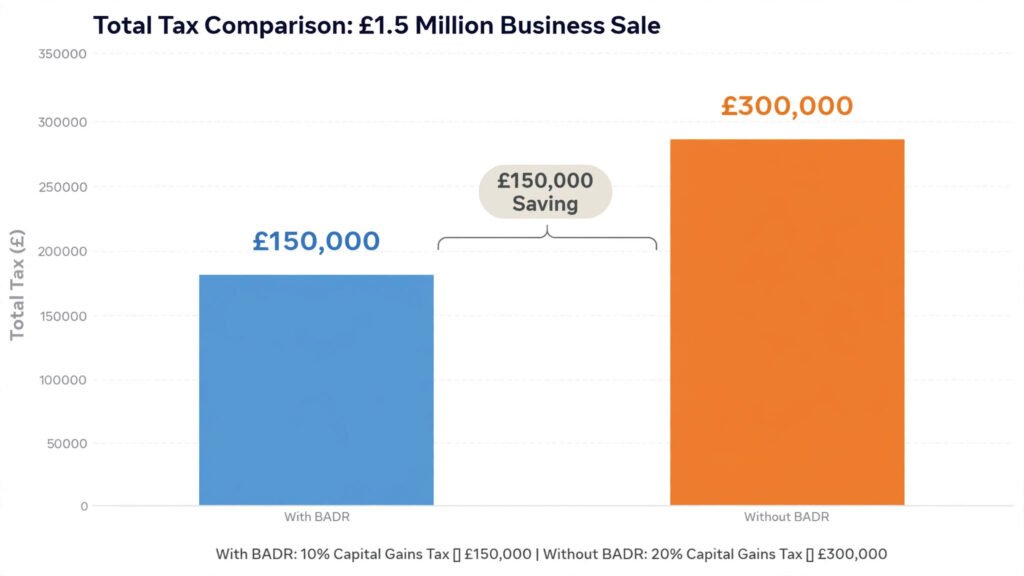
A £1.5 million gain that fully qualifies for BADR costs £299,280 in CGT in 2026/27. Without BADR, the same gain costs £359,280.
Example at 2026/27 rates
Sam owns 100% of a trading company and sells the shares. After deducting the original cost of the shares and the sale costs (legal, accountancy and adviser fees), the gain is £1.5 million. Sam is an additional-rate taxpayer who qualifies for BADR and has never claimed it before.
| Step | With BADR | Without BADR |
|---|---|---|
| Total gain | £1,500,000 | £1,500,000 |
| Taxed at 18% (BADR) | £1,000,000 = £180,000 | Not applicable |
| Less annual exempt amount | £3,000 | £3,000 |
| Taxed at 24% | £497,000 = £119,280 | £1,497,000 = £359,280 |
| Total CGT | £299,280 | £359,280 |
BADR saves £60,000. The example assumes Sam has no unused basic-rate band and uses the £3,000 allowance against the 24% gain. Your figures will differ, so treat this as a guide.
What if ownership is split? Suppose Sam and their spouse each genuinely owned 50% for two years and both qualified. Each has a £750,000 gain inside their own £1 million limit. Each pays (£750,000 − £3,000) × 18% = £134,460. The total is £268,920, about £30,000 less. The transfer must be real, and the spouse must pass every BADR test.
What the BADR rate rises cost
| Date of sale | BADR rate | Tax on a £1m gain |
|---|---|---|
| Before 6 April 2025 | 10% | £100,000 |
| 6 April 2025 to 5 April 2026 | 14% | £140,000 |
| From 6 April 2026 | 18% | £180,000 |
Compared with the 24% rate, BADR now saves up to £60,000. Before April 2025 it saved up to £140,000. It is still worth claiming, but it no longer justifies rushing a sale on its own.
Sole trader, partnership or limited company: how the tax differs
Sole traders and partners pay tax on the assets they sell. Company owners usually sell shares and pay CGT personally.
Sole traders and partners sell the business’s assets. The price is split across goodwill, equipment, vehicles and stock. Goodwill is usually the biggest part and is taxed as a capital gain. But if you sell equipment for more than its tax value, you may face an income tax charge at 20%, 40% or 45%. In a business partnership, each partner reports their own share of the gain. One nominated partner files form SA803 for the partnership.
Selling shares: one layer of tax
In a share sale, you sell your shares to the buyer and pay CGT on the gain yourself. BADR is available if you qualify. The buyer pays 0.5% stamp duty. Most sellers prefer this route because it’s a clean break.
Selling assets from the company: the double-tax trap
In an asset sale, the company sells its goodwill, equipment or contracts. The company pays Corporation Tax on the gain, at up to 25%. You then pay tax again when you take the cash out. From April 2026, dividends are taxed at 10.75% (basic rate), 35.75% (higher rate) and 39.35% (additional rate).
Buyers often prefer asset deals because they avoid the company’s past liabilities. Some owners wind up the company and take the proceeds as capital instead. Anti-avoidance rules apply, so take advice first. If you’re closing rather than selling, our guide to closing a limited company explains the options.
| Share sale | Asset sale | |
|---|---|---|
| Who is taxed first | You, through CGT | The company, through Corporation Tax |
| Layers of tax | One | Two |
| BADR on the sale | Yes, if you qualify | Not on the company’s own gain |
| Buyer’s view | Takes on past liabilities | Chooses the assets it wants |
How your deal structure changes the tax bill
The way you’re paid decides when you pay tax, and sometimes how much. Settle the structure early in your heads of terms. A letter of intent for a business purchase is the usual place to do it.
Earn-outs and deferred consideration
You’re taxed when contracts are exchanged, not when the cash arrives. Fixed deferred payments are taxed up front. If the amount depends on future results, you’re taxed on an estimated value at the start. Any extra you receive later counts as a separate disposal. You may be able to pay the tax by instalments.
Ask your accountant to model your cash flow before you agree to a long earn-out. They are also common in a management buyout.
Shares or loan notes as payment
If the buyer pays with its own shares or qualifying loan notes, you may have no CGT bill on completion. The gain is rolled over until you sell those securities. The catch is that you may lose BADR, and the paper can fall in value or be hard to sell. Check whether an election is available before you accept.
Selling to an Employee Ownership Trust
EOT sales used to be fully exempt from CGT. For disposals on or after 26 November 2025, only 50% of the gain is exempt. The rest is taxed at normal rates, and you can’t claim BADR or Investors’ Relief on the same gain.
HMRC also checks EOTs more closely. An EOT works best as a planned exit, not as a fallback when a trade sale collapses.
Legitimate ways to reduce CGT on a business sale
Most savings come from planning at least two years before the sale. These are the main options:
- Use both spouses’ allowances. Transfers between spouses and civil partners don’t trigger CGT. Each person gets a £3,000 allowance and a £1 million BADR limit, if they qualify.
- Deduct every allowable cost. Legal, accountancy, valuation and broker fees reduce your gain.
- Protect BADR early. Review shareholdings, roles and non-trading assets 12 to 24 months before the sale.
- Use losses. Allowable losses can be set against gains, including carried-forward losses you reported to HMRC in time.
- Consider pension contributions. Larger contributions can extend your basic-rate band, so more of the gain is taxed at 18% instead of 24%. Watch your annual allowance.
- Use rollover relief on asset sales. If you reinvest in qualifying business assets within one year before or three years after the sale, you can defer the tax.
- Consider gift hold-over relief. Gifting shares to family or trusts before a sale can shift the gain, but the rules are complex.
- Plan for Inheritance Tax. Business Relief can protect shares in a trading company, but cash from a sale usually isn’t covered. Get advice on trusts and gifting before you sell.
Avoid last-minute restructures. HMRC looks hard at deals set up mainly for tax. For reorganisations, ask for statutory clearance first. Our guide to business succession planning covers timing in more depth.
Should you sell before the Autumn Budget on 28 October 2026?
Nothing has been announced on CGT for business sales, but the Chancellor delivers the Budget on 28 October 2026. Advisers expect capital taxes to draw attention. Nobody knows what will change.
Ask yourself three questions:
- Would I sell anyway? If the business is ready and a buyer is serious, timing is one factor among many. If not, don’t force it.
- Can I realistically complete in time? Your disposal date is usually when unconditional contracts are exchanged. Most sales take months, not weeks.
- Is my BADR position secure? Fix any two-year test or trading-status problems now, whatever the Budget says.
Rate changes can take effect on Budget day itself. The main CGT rise in October 2024 applied from 30 October 2024. But every extra percentage point on a £1.5 million gain costs about £15,000. A rushed sale that lowers your price by more than that isn’t a saving.
How and when to report and pay
You report a business sale on your Self Assessment return for the tax year of the sale. You pay by 31 January after that year ends. A sale in 2026/27 is due by 31 January 2028.
- Find your disposal date. This is normally when unconditional contracts are exchanged.
- Work out your gain. Deduct the original cost and allowable costs from the sale proceeds.
- Claim reliefs. Claim BADR or other reliefs on your return.
- Report the gain. Use your Self Assessment return or HMRC’s real-time CGT service. If you don’t already file returns, register for Self Assessment in good time.
- Pay by 31 January. Set the money aside as soon as the sale completes.
Keep contracts, valuations and cost records. You may need them if HMRC asks questions.
FAQs
Do I pay tax straight after selling my business?
No. You report the sale on your Self Assessment return and pay by 31 January after the tax year ends. For a 2026/27 sale, that’s 31 January 2028. Set the money aside early.
Can I sell my business without paying CGT?
Rarely. You have a £3,000 annual exempt amount, and some routes defer tax, such as rollover relief or paper-for-paper exchanges. A sale to an EOT exempts 50% of the gain. Most sellers still pay something.
Is BADR still worth it at 18%?
Yes, if you’re a higher or additional-rate taxpayer. It saves up to £60,000 against the 24% rate. If your whole gain falls inside the basic-rate band, the normal rate is also 18%, so BADR adds little.
Do I pay CGT if I sell my limited company?
Yes. If you sell your shares, you pay CGT personally on the gain. If the company sells its assets, it pays Corporation Tax, and you pay more tax when you take the cash out.
What happens if I move abroad after selling?
Leaving the UK doesn’t automatically remove the bill. Under the temporary non-residence rules, gains made while abroad can be taxed if you return within five years. Your residence status in the year of sale also matters, so get advice before you move.
This guide is general information, not tax advice. Rates and reliefs can change, including at the 28 October 2026 Budget. Speak to a qualified accountant about your own situation before you sell.