


Entrepreneurs’ Relief and Business Asset Disposal Relief (BADR) are the same tax relief. The government renamed it on 6 April 2020. The name is not what matters. The numbers are. The lifetime limit dropped from £10 million to £1 million, and the tax rate has risen from 10% to 18%.
If you are selling or closing a business in 2026-27, the BADR rules below apply to you. This guide is general information, not tax advice. Check your own facts with an accountant before you act.
Is Entrepreneurs’ Relief the same as Business Asset Disposal Relief?
Yes. BADR is Entrepreneurs’ Relief under a new name, with a much smaller allowance and a higher tax rate. The core idea is unchanged: qualifying business owners pay a reduced rate of Capital Gains Tax (CGT) when they sell or close a business.
| Feature | Entrepreneurs’ Relief (before April 2020) | BADR (2026-27) |
|---|---|---|
| Reduced CGT rate | 10% | 18% (disposals from 6 April 2026) |
| Lifetime limit | £10 million | £1 million |
| Qualifying period | 12 months, then 24 months from April 2019 | 24 months |
| Main higher CGT rate it beat | 20% | 24% |
| Maximum saving at the limit | About £1 million | About £60,000 |
The “maximum saving” row is the one most competitors skip. Under the old rules, a full claim could save around £1 million. Today the most you can save is 6% of £1 million, which is £60,000.
A short timeline of the changes
- 6 April 2019: the qualifying period rose from 12 to 24 months.
- 11 March 2020: the lifetime limit fell from £10 million to £1 million.
- 6 April 2020: Entrepreneurs’ Relief became Business Asset Disposal Relief.
- 30 October 2024: the main CGT rates rose, and the higher rate became 24%.
- 6 April 2025: the BADR rate rose from 10% to 14%.
- 6 April 2026: the BADR rate rose from 14% to 18%.
Rules like these can change at any Budget. The government also uses anti-forestalling rules to stop people locking in an old rate through contracts signed just before a rise. Check the current position on GOV.UK before you sign anything.
BADR rates: what you pay in 2026
The BADR rate depends on when you sell. GOV.UK sets out three rates:
| Disposal date | BADR rate |
|---|---|
| On or before 5 April 2025 | 10% |
| 6 April 2025 to 5 April 2026 | 14% |
| From 6 April 2026 | 18% |
The rate applies to all qualifying gains, up to your £1 million lifetime limit. Gains above the limit are taxed at the normal CGT rates.
Why the relief is worth less than it used to be
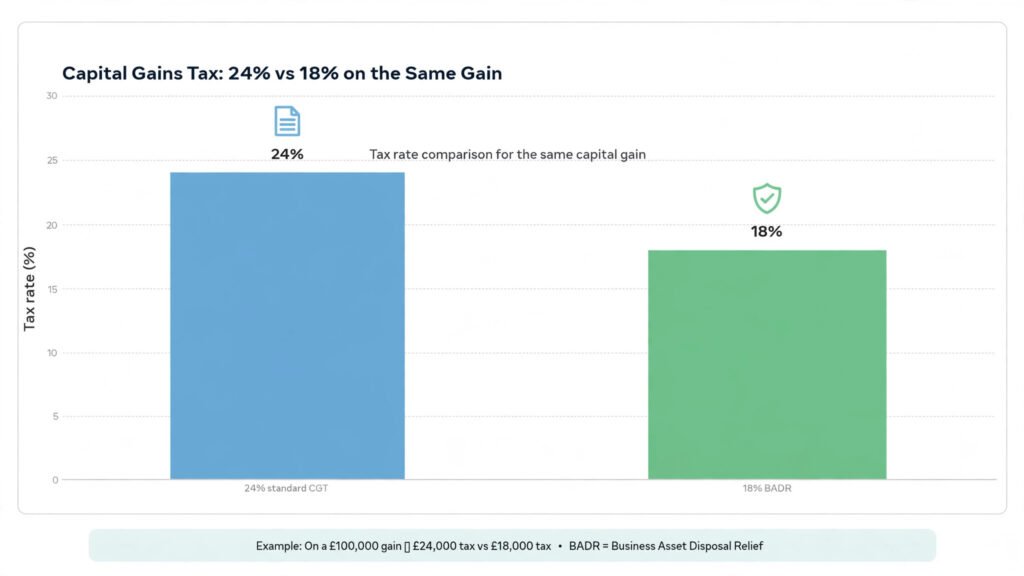
BADR now charges 18%. The standard CGT rate is also 18% for gains that fall within your basic rate band. So BADR saves you nothing on that slice of a gain. It only helps on gains that would otherwise be taxed at 24%.
Worked example. Priya sells her company shares in 2026-27 for a £400,000 gain. Her other income already puts her in the higher rate band. She has not used her £3,000 annual exempt amount elsewhere.
- Taxable gain: £400,000 minus £3,000 = £397,000
- Without BADR at 24%: £95,280
- With BADR at 18%: £71,460
- Saving: £23,820
If Priya’s gain were small and fell inside the basic rate band, her saving would be close to zero. That is why timing and total income matter more than they once did.
Each person has their own £1 million allowance. Spouses and civil partners get one each, which can create planning options when both own part of a company.
Who qualifies for BADR?
You qualify if you sell, or close down, all or part of a trading business and meet the ownership and role tests for a full two years. The tests differ depending on what you sell.
Sole traders and business partners
You must have been a sole trader or partner and owned the business for at least two years up to the sale. If you close the business instead, you must dispose of the assets within three years. Selling one asset on its own usually does not qualify. You need to sell the whole business, or a part that could run on its own.
Thinking of changing structure first? Our guide to moving from sole trader to limited company explains how that change can affect your plans.
Company shareholders
If you sell shares, you must meet all of these for two years before the sale:
- You are an employee or office holder of the company, or of a company in the same group. Part-time staff can qualify, as there is no minimum hours rule.
- It is your “personal company”. You hold at least 5% of the shares and 5% of the voting rights.
- You are also entitled to at least 5% of either the distributable profits and assets on a winding up, or the sale proceeds.
- The company is a trading company, or the holding company of a trading group.
Directors should also understand their wider company director responsibilities, because “office holder” status is part of the test.
EMI shares
Employees with Enterprise Management Incentive shares get a gentler rule. You must have bought the shares after 5 April 2013, and your option must have been granted at least two years before the sale. You do not need to meet the 5% test.
Assets you lent to the business
A building or equipment you owned and let your company or partnership use can qualify. You must sell at least 5% of your shares or partnership interest, and the business must have used the asset for at least a year before the sale or closure. Rent paid for the asset can reduce the relief.
Trustees
Trustees can qualify in some cases when selling trust assets. These rules are narrow, so take advice.
Common reasons BADR claims fail
Most failed claims come from a few repeat problems. Check each one before you sell.
- Too much investment activity. A company must be mainly trading. HMRC long treated “substantial” as more than 20% of things like income, assets or staff time. Recent case law has cast doubt on that rule of thumb, so mixed companies sit in a grey area.
- Property rental. Letting property is not trading, so shares in a rental company generally do not qualify.
- Shareholding diluted below 5%. New share issues can push you under the line. You may be able to elect to treat yourself as having sold and re-bought the shares, which fixes a gain eligible for BADR. A clear shareholder agreement helps you spot dilution early.
- Missing the two-year window. A sale a few weeks early can cost thousands.
- Selling to a company you control. Group and share-exchange rules can remove the relief.
- No clearance. You cannot ask HMRC to confirm in advance that BADR will apply. You decide, and HMRC can challenge later.
HMRC has increased its scrutiny of reliefs in recent years. Keep clear records of your role, your shareholding and the company’s activities. Our sole trader record keeping guide covers what to hold on to.
BADR when you close a company
You can claim BADR when you close a solvent company through a formal liquidation, such as a Members’ Voluntary Liquidation (MVL). In an MVL, a licensed insolvency practitioner collects the assets and pays out the cash. The payout is taxed as a capital gain, not as dividend income.
That matters because dividend tax is heavy. Paystream lists 2026-27 dividend rates of 10.75%, 35.75% and 39.35%. A capital gain taxed at 18% under BADR is often cheaper, and you also get the £3,000 annual exempt amount.
Three points to remember:
- Date of payout. The distribution date decides which rules apply, not the date the MVL started.
- Strike-off. Advisers disagree about BADR on a simple strike-off. Some insolvency firms say you cannot claim it. Small payouts may be treated as capital under an HMRC concession, but get advice first.
- Anti-avoidance. If you start a similar business within two years, with tax avoidance as a main purpose, HMRC can tax the payout as income.
MVLs are usually suited to companies with more than about £25,000 to distribute. For the closure process itself, read our guide to closing a limited company.
How to claim BADR: step by step
- Confirm you meet the two-year and 5% tests on the sale date.
- Work out the gain on the sale, then deduct your annual exempt amount if it is unused.
- Report the disposal on your Self Assessment return and make the BADR claim there. If you do not file a return, write to HMRC.
- Pay the tax by the normal deadline.
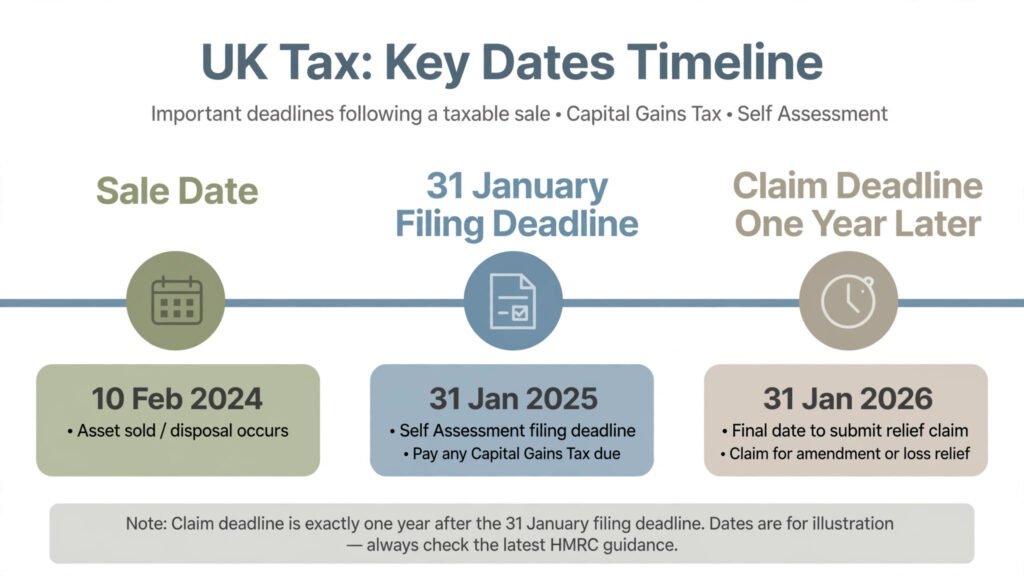
- Make your claim before the deadline: the first anniversary of 31 January after the tax year of sale.
For example, a sale in 2025-26 must be claimed by 31 January 2028. A sale in 2026-27 must be claimed by 31 January 2029. If you are new to the system, start with how to register for Self Assessment.
BADR vs Investors’ Relief
Investors’ Relief is a close cousin. It is for outside investors who hold newly issued shares in an unlisted trading company, and who are not employees or officers. Its rate has been aligned with BADR, and its lifetime limit was cut to £1 million from 30 October 2024. If you work in the business, you will usually use BADR. If you are a passive investor, look at Investors’ Relief.
Should you plan around BADR? A quick decision check
Ask these questions in order:
- Will my gain be taxed at 24 percent? If most of it falls in the basic rate band, BADR adds little.
- Have I held the right role and shareholding for two years? If not, would waiting save more than a delay costs?
- Is my company mainly trading? If investments or rentals are large, get a specialist view before you sell.
- Is a sale the best exit? A management buyout, a family handover or an employee ownership trust may suit you better. See our guides on business succession planning and how to sell a small business.
Frequently asked questions
What is the difference between Entrepreneurs’ Relief and BADR?
There is no difference in purpose. BADR is the new name for Entrepreneurs’ Relief. The differences are the £1 million lifetime limit, the 24-month qualifying period and the 18% rate from 6 April 2026.
What is the BADR rate now?
BADR is 18% on qualifying gains from disposals made on or after 6 April 2026. It was 14% from 6 April 2025 to 5 April 2026, and 10% before that.
What is the BADR lifetime limit?
The lifetime limit is £1 million of qualifying gains per person. It applies to disposals on or after 11 March 2020.
Do I need to own 5% of the company?
Yes, in most cases. You need at least 5% of the shares and voting rights, plus matching economic rights. Holders of qualifying EMI shares are the main exception.
Can I claim BADR if I am still working in the business after the sale?
Often yes, if your ownership has fallen enough. For linked asset sales, HMRC looks at your withdrawal from ownership, not whether you keep working there.
Is BADR still worth claiming?
For higher rate taxpayers with large gains, yes. The saving is 6 percentage points, up to £60,000 over a lifetime. For gains within the basic rate band, the benefit is small.