


A tax deductible business expense is a cost you can subtract from your business income before tax is worked out. In the UK, it must be incurred wholly and exclusively for the business. Deducting it lowers your taxable profit, so you pay less Income Tax or Corporation Tax.
Below: the full list, the rules behind it and the 2026/27 figures, for sole traders and limited companies.
Key figures for 2026/27:
- Mileage: 55p a mile for the first 10,000 business miles (up from 45p), then 25p.
- Trading allowance: £1,000 of income, instead of claiming expenses.
- Annual Investment Allowance: 100% relief on up to £1 million of equipment.
What makes a business expense tax deductible?
An expense is tax deductible when you pay it wholly and exclusively for the business and it is a running cost, not a long-lasting asset.
The “wholly and exclusively” test
The cost needs a business purpose and no private one alongside it. In Mallalieu v Drummond, a barrister’s black court clothes failed because they also served as everyday wear. The test applies to sole traders and companies alike.
Revenue costs vs capital costs
Revenue costs are used up or short-lived: rent, fuel, ink, software subscriptions. Capital costs buy something lasting, like a van or laptop. If it will last over a year, treat it as capital. Sole traders on the cash basis, HMRC’s default since 2024/25, can usually deduct most equipment straight away. Cars are the exception.
Mixed personal and business use
Claim only the business share, using a fair method such as miles, hours or floor area. A £600 phone bill used 70% for work gives a £420 deduction.
What a deduction is worth
Each £1,000 of allowable expenses cuts your tax bill by roughly:
| Business | Tax rate that applies | Saving per £1,000 |
|---|---|---|
| Company, profits up to £50,000 | 19% | £190 |
| Company, profits £50,000 to £250,000 | 26.5% (marginal relief band) | £265 |
| Company, profits over £250,000 | 25% | £250 |
| Sole trader, basic rate | 20% tax + 6% Class 4 NIC | £260 |
| Sole trader, higher rate | 40% tax + 2% Class 4 NIC | £420 |
Rates shown are for England, Wales and Northern Ireland. Scotland’s income tax bands differ.
Full list of tax deductible business expenses
Use this table as a checklist. The last column shows where claims go wrong.
| Category | What you can claim | Watch-out |
|---|---|---|
| Office, phone and software | Stationery, printing, postage, broadband, mobile, software licences | Claim only the business share of mixed-use phone or broadband. |
| Premises | Rent, business rates, utilities, repairs, cleaning | Repairs yes, improvements no. |
| Travel and vehicles | Fares, hotels, parking, tolls, congestion charges, mileage or actual vehicle costs | Commuting is out. Parking fines are never allowed. |
| Staff and subcontractors | Wages, bonuses, employer NI, employer pension contributions, staff welfare, subcontractor fees | Pay must be reasonable. A sole trader’s own drawings don’t count. |
| Professional fees | Accountant, solicitor, surveyor, debt recovery | Legal fees on buying a capital asset join its cost. |
| Insurance | Public liability, professional indemnity, employers’ liability, equipment cover. See our UK business insurance guide. | Personal insurance isn’t deductible. |
| Marketing and website | Advertising, hosting, domain names, business cards, samples | Client entertaining isn’t marketing. |
| Finance costs | Bank charges, business loan and overdraft interest, arrangement fees, hire purchase interest | Interest and fees only, never the capital repaid. |
| Stock and materials | Goods for resale, raw materials, packaging | Accruals accounting needs a year-end stock value. |
| Clothing | Protective clothing, safety boots, uniforms with a permanent logo | Everyday clothes never qualify. |
| Training, subscriptions and fees | Courses that update existing skills, trade journals, relevant professional body fees, the ICO data protection fee | Training for a brand-new skill is capital. |
| Bad debts | Specific invoices written off as unrecoverable | Accruals only, and no general provision. |
| Start-up costs | Costs from up to 7 years before you start trading | They must be costs you could claim once trading. |
Home office and working-from-home costs
Sole traders can claim a flat rate or a fair share of real bills. Limited companies take a different route.
Sole traders: flat rate or actual costs
The flat rate needs at least 25 hours a month at home. It is £10 a month for 25 to 50 hours, £18 for 51 to 100 hours and £26 for 101 or more. Or claim a fair share of heating, electricity, water, council tax and rent or mortgage interest, based on rooms and time.
A room used only for business can create a Capital Gains Tax bill when you sell your home, so check before claiming it. Our guide to running a business from home covers the setup.
Limited companies: the £6 a week route
Limited companies can’t use the flat rates. Under a homeworking arrangement, the company can pay a director or employee up to £6 a week tax-free, with no receipts. Since 6 April 2026, employees and directors can’t claim personal tax relief for unreimbursed home-working costs. The self-employed are not affected.
Vehicle, mileage and travel costs
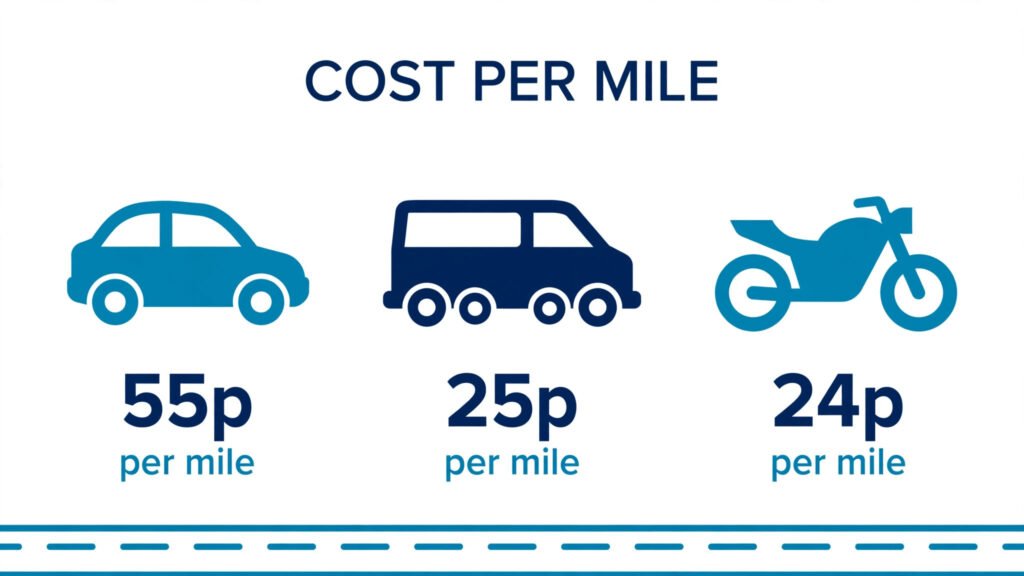
In 2026/27, sole traders can claim 55p a mile for the first 10,000 business miles in a car or van, then 25p. Motorcycles get 24p.
| Vehicle | 2026/27 rate | Before 6 April 2026 |
|---|---|---|
| Cars and vans, first 10,000 miles | 55p | 45p |
| Cars and vans, after 10,000 miles | 25p | 25p |
| Motorcycles | 24p | 24p |
HMRC’s example: 11,000 miles is £5,500 plus £250, so £5,750.
Pick flat rate or actual costs for each vehicle, not both. Once you choose flat rate for a vehicle, keep using it. You can’t use it if you’ve claimed capital allowances on that vehicle. Parking and train fares are claimable on top.
Commuting to your usual workplace isn’t deductible. Trips to clients or temporary sites usually are. Meals count on overnight trips, not everyday lunches.
Limited companies can’t use simplified expenses. They can pay staff and directors up to the same rates for business miles in their own cars, tax-free, and deduct the payment.
Equipment, laptops and capital allowances
Equipment is usually a capital cost, so you claim capital allowances instead of a normal expense.
Most small businesses use the Annual Investment Allowance: 100% relief on up to £1 million a year of qualifying equipment. A £1,500 laptop is deducted in full in year one. Companies can also use full expensing on new equipment. Cars are treated separately.
A new 40% first-year allowance covers new main-rate equipment bought from 1 January 2026. It mainly helps where other reliefs don’t apply, such as leased assets. Anything left goes into the main pool at 14% a year (18% before April 2026).
Buying on finance? The interest is usually deductible, and capital allowances normally cover the asset. Our asset finance guide explains the options.
What you can’t claim
You can’t claim personal costs, client entertaining, fines, everyday clothes or the capital part of loan repayments. Most have a claimable alternative.
- Client entertaining: staff entertaining is allowed. So are branded gifts up to £50 per person, if they aren’t food, drink or tobacco.
- Fines and parking tickets: never allowed, even on a business trip.
- Commuting: claim trips to other work sites instead.
- Everyday clothes: claim protective clothing or logo uniforms instead.
- Your own drawings as a sole trader: not an expense. A company can deduct a director’s salary.
- Loan repayments: claim the interest and fees, not the capital.
- Charity donations: sole traders use Gift Aid on their personal tax. Companies get a separate donation deduction.
Mistakes that trigger HMRC questions
Common triggers: mixing personal and business spending on one card, claiming mileage and fuel together, claiming 100% of a part-personal bill, and keeping no records. Personal costs paid from a company account become a director’s loan or taxable benefit.
Sole trader vs limited company: what changes
| Sole trader | Limited company | |
|---|---|---|
| Tax reduced | Income Tax and Class 4 NIC | Corporation Tax |
| Where you claim | Self Assessment return, or MTD quarterly updates | Company tax return and accounts |
| Flat-rate simplified expenses | Yes | No |
| Own pay | Drawings aren’t deductible | Salary and employer NI are deductible |
| Pensions | Personal contributions get relief, but aren’t a business expense | Employer contributions are deductible |
Thinking of switching? See our guide to moving from sole trader to limited company.
How to claim and keep records
Keep a receipt for every expense, total them by category, then enter them on your tax return or company accounts. You don’t send receipts, but you must keep them.
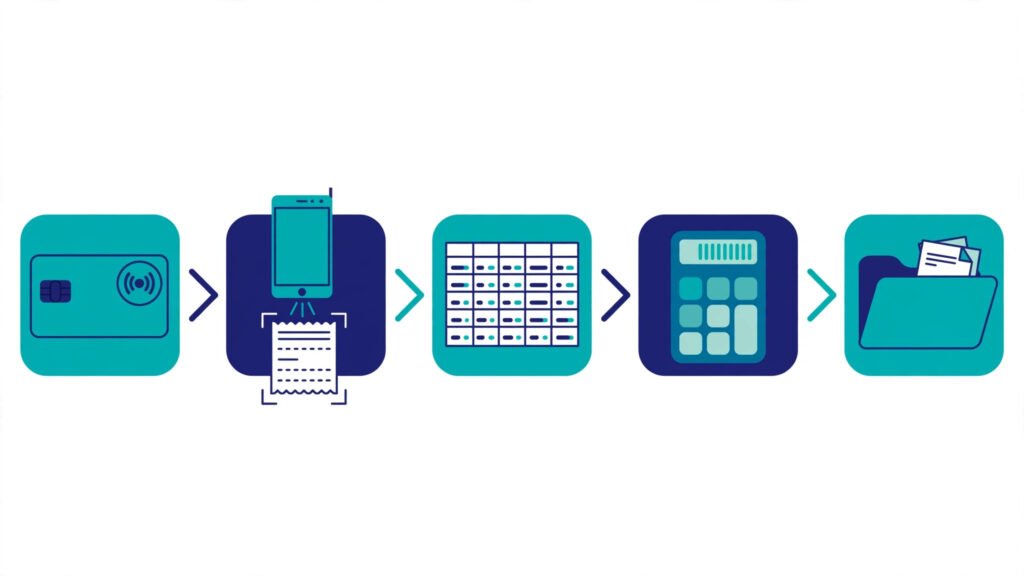
- Pay business costs from a separate business account.
- Keep the receipt or invoice, or a clear scan. Note the business purpose of mixed-use items.
- Log each cost by category in a spreadsheet or free accounting software.
- At year end, total each category. Under £90,000 turnover, you can usually enter one expenses total on the return.
- Keep records for at least 5 years after the 31 January deadline (sole traders) or 6 years (limited companies).
Self-employment income of £1,000 or less is tax-free. Above that, you can use the £1,000 trading allowance instead of expenses, which only pays if your real costs are lower. You can’t do both.
Making Tax Digital and expenses
Making Tax Digital for Income Tax started on 6 April 2026 for sole traders and landlords with income over £50,000. The threshold falls to £30,000 in April 2027 and £20,000 in April 2028. If you’re in scope, you keep digital records of each expense and send quarterly updates. HMRC isn’t issuing penalty points for late quarterly updates in 2026/27. Free Making Tax Digital software can handle it.
FAQs
Can I claim expenses without receipts?
You need proof the cost happened and was for business. A receipt or invoice is best. A bank statement with a short note can fill gaps. If records are lost, give HMRC your best figures and say they’re estimates. Our sole trader record keeping guide lists what to keep.
Can I claim my laptop?
Yes, for the business share. Most businesses claim 100% through the Annual Investment Allowance in the year they buy it. Sole traders on the cash basis can usually deduct it like a normal expense.
Can a limited company claim mileage?
Yes. The company can pay directors and staff for business miles in their own cars, up to 55p for the first 10,000 miles and 25p after. The payment is tax-free and the company deducts it.
How far back can I claim expenses?
Claim costs in the tax year you paid or incurred them. If you missed one, you can usually amend a Self Assessment return up to 12 months after the 31 January deadline.
What happens if I over-claim?
HMRC can ask for proof. A wrong claim can mean extra tax, interest and possibly a penalty. Correct mistakes as soon as you spot them.
Last reviewed: October 2026. This guide is general information, not tax advice. Ask a qualified accountant about your own situation.