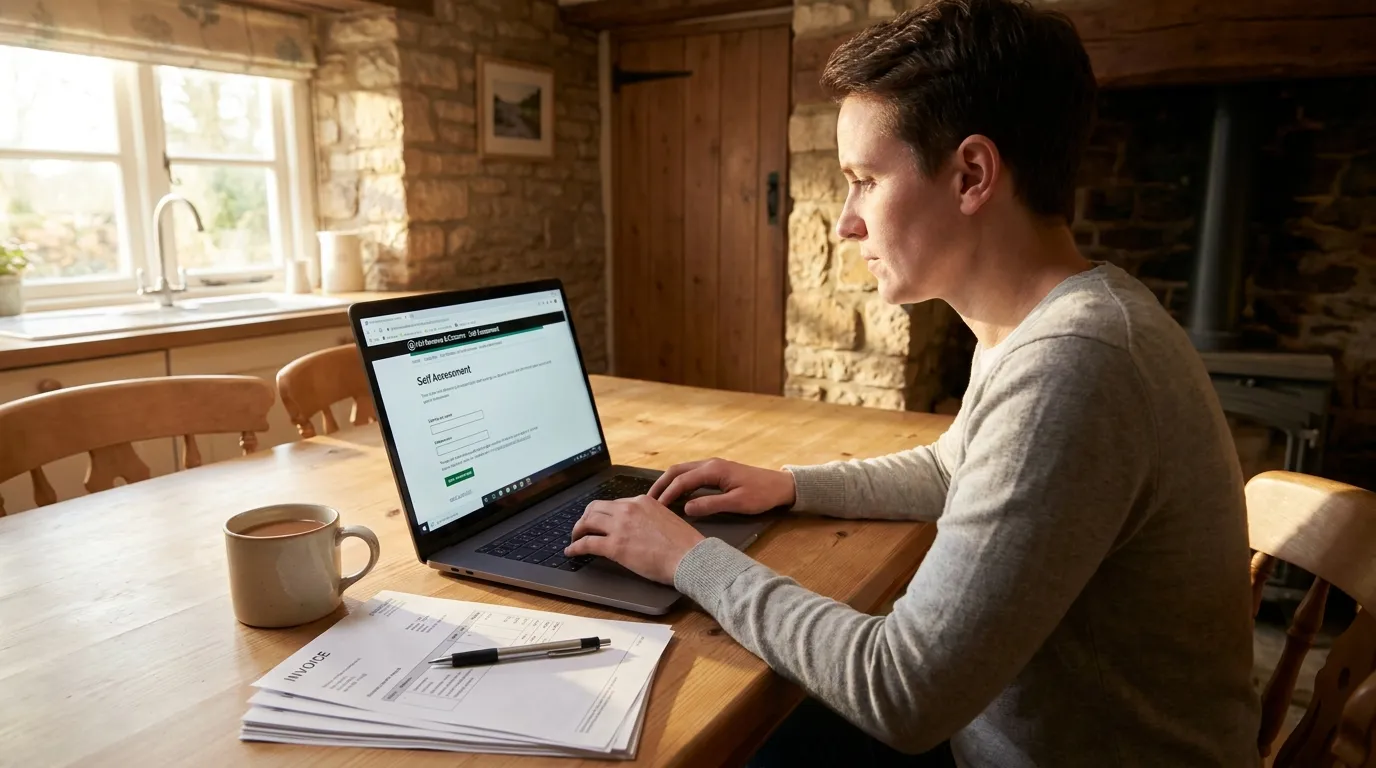
Self Assessment is HMRC’s system for collecting income tax from people whose tax isn’t automatically deducted from their wages. If you’re self-employed, a landlord, or earning money outside a PAYE job, you’ll need to complete one every year.
This guide walks you through the entire process — from registering for the first time to submitting your return and paying your bill — in the right order, with the right numbers.
What Is a Self Assessment Tax Return?
A Self Assessment tax return is a form submitted to HMRC that declares your income, expenses, and other taxable earnings for a tax year. The UK tax year runs from 6 April to 5 April. So the 2024–25 tax year covers 6 April 2024 to 5 April 2025.
HMRC uses your submission to calculate how much Income Tax and National Insurance you owe. Unlike employed workers — where tax comes off wages automatically through PAYE — people with untaxed income have to report it themselves.
The core document is the SA100. Depending on your income type, you’ll complete supplementary pages alongside it.
Do You Need to File a Self Assessment Tax Return?
You must complete a return if any of the following applied to you in the 2024–25 tax year:
- You were self-employed (sole trader) with income over £1,000
- You earned rental income from a UK or overseas property
- You earned more than £100,000 from employment
- You received untaxed income from dividends or savings interest beyond your allowance
- You or your partner claimed Child Benefit and either of you earned more than £60,000
- You had foreign income or are a non-domiciled UK resident
- You’re a company director
- You want to make voluntary Class 2 National Insurance contributions to protect your State Pension record
The £1,000 trading allowance matters here. If your self-employed income was £1,000 or less in the year, you don’t need to file — unless you want to pay Class 2 NICs to maintain your State Pension entitlement. If you’ve recently started working for yourself, read our guide on starting your first business in the UK — it covers the foundations you need to put in place from day one.
Not sure whether you need to file? Use the “Check if you need to send a tax return” tool on GOV.UK. It takes under five minutes.
Key Deadlines for 2025–26 You Cannot Miss
Missing a Self Assessment deadline triggers an automatic £100 penalty — even if you have nothing to pay.
| Deadline | What It Covers |
|---|---|
| 5 October 2025 | Deadline to register for Self Assessment (new filers) |
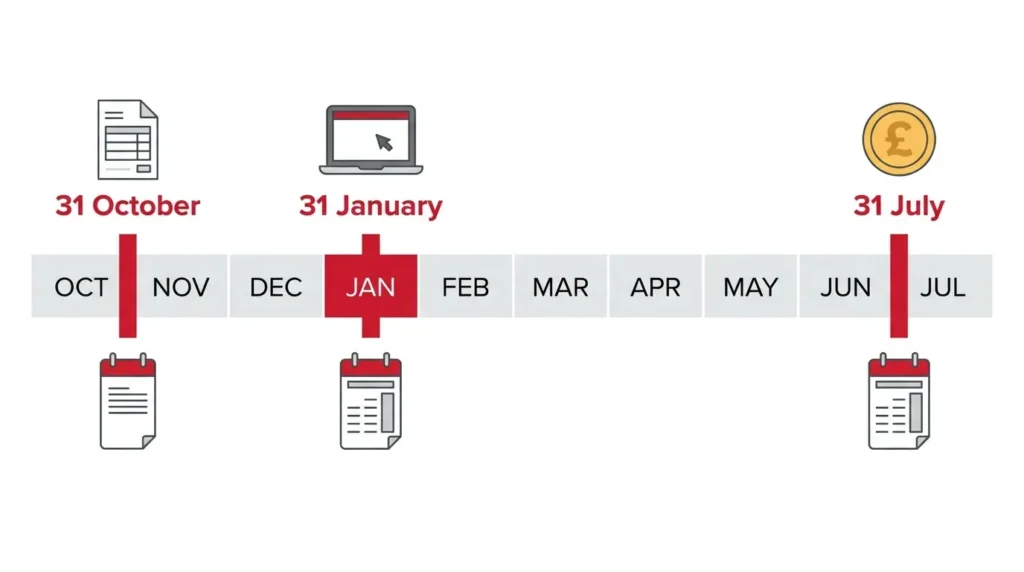
| 31 October 2025 | Submit paper return for 2024–25 |
| 31 January 2026 | Submit online return for 2024–25 + pay tax owed |
| 31 July 2026 | Second payment on account |
Most people file online, which gives you until 31 January. That’s nine months after the tax year ends — which sounds generous until December arrives. HMRC’s systems get heavily congested in January, and a technical issue on their end won’t be accepted as a valid excuse. File early.
Step 1 — Register for Self Assessment and Get Your UTR
First-time filers must register with HMRC before they can file anything. Registration must be completed by 5 October in the same tax year you started earning untaxed income.
How to register:
- Go to GOV.UK and search “register for Self Assessment”
- Select your situation — self-employed, not self-employed, or a business partner
- Log in or create a Government Gateway account (you’ll need your National Insurance number)
- Enter your name, address, date of birth, and income type
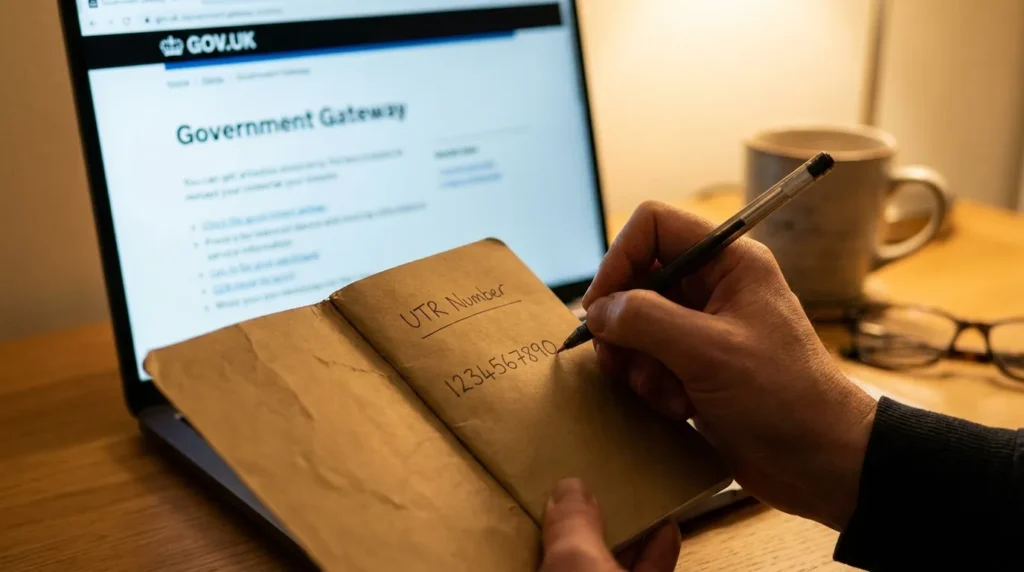
- Wait for your Unique Taxpayer Reference (UTR) — a 10-digit code HMRC posts to you within 10 working days
Your UTR is permanent. You’ll use the same number every year. Keep it somewhere you won’t lose it.
Already registered in a previous year but haven’t filed recently? You may need to reactivate your account before filing. Check your HMRC online account before assuming it’s still active.
If you haven’t yet formally set up your business, our guide on how to register your business in the UK explains the different structures — sole trader, limited company, partnership — and what each one requires at the start.
Step 2 — Gather Your Records Before You Start
Most people open the online form first and then scramble to find documents. Get everything in one place before you log in — it makes the whole process considerably faster and reduces the chance of entering wrong figures.
What to collect:
- Self-employment income — invoices issued, bank statements showing payments received
- Employment income — P60 from your employer, or P45 if you left mid-year
- Rental income — rent received, letting agent statements, mortgage interest statements
- Other income — dividend vouchers, P11D, taxable savings interest statements
- Expenses — receipts, mileage logs, software invoice records, home-working cost calculations
- Pension contributions and Gift Aid — provider statements and donation records
You don’t send any of these to HMRC. You keep them for at least 5 years after the 31 January deadline for that tax year. HMRC can request them at any point during that window.
Keeping records organised throughout the year — rather than hunting them down in January — saves hours. If you run a small business, free file-sharing tools built for UK businesses can help you store and share invoices and receipts securely without the paper pile.
Step 3 — Log In and Access Your Return
Go to GOV.UK and sign in using your Government Gateway credentials. From your Personal Tax Account, navigate to the Self Assessment section and select the correct tax year.
You can save your progress and come back to it — you don’t have to complete everything in one go. As you enter figures, HMRC’s online system calculates your tax automatically, so you can see roughly what you owe before you hit submit.
Step 4 — Complete the SA100 and Any Supplementary Pages
The SA100 is the main return. It covers your personal details, income sources, and any reliefs or allowances you’re claiming.
Depending on what income you received, you’ll also complete supplementary pages:
- SA103 — self-employment income (sole traders and freelancers)
- SA105 — UK rental and property income
- SA101 — additional income such as dividends, trust income, or foreign earnings
- SA109 — residence, remittance basis, or split-year treatment. Important: this page cannot be filed through HMRC’s own online portal — you need commercial software or a paper return
Claiming expenses on SA103:
Enter your total business income, then deduct your allowable expenses underneath. HMRC accepts costs that are “wholly and exclusively” for business. You can use simplified expenses for mileage (45p per mile for the first 10,000 miles) and home working, which removes the need to apportion exact costs.
Gift Aid and pension contributions:
If you made Gift Aid donations, enter the total. HMRC extends your basic-rate tax band by the gross donation amount, which can reduce your bill. Pension contributions paid personally also attract relief — check with your provider whether they’ve already claimed it before entering it again.
Step 5 — Review, Submit, and Save Your Confirmation
Before submitting, check the tax figure HMRC has calculated. It updates automatically as you enter data. If it looks unexpectedly high or low, go back and check your income figures first — a single digit error can move the number significantly.
Once everything looks right, submit the return. Print or save the confirmation page immediately. It contains your submission reference, which is your proof of filing if anything is disputed later.
You can amend a submitted return up to 12 months after the 31 January deadline for that tax year, using the same HMRC online account.
Step 6 — Pay Your Tax Bill
Accepted payment methods:
- Bank transfer (fastest — HMRC provides a specific sort code and account number)
- Direct Debit via your HMRC online account
- BACS transfer (allow 3 working days to clear)
- Cheque payable to “HM Revenue and Customs only”
Your payment reference is your UTR number followed by the letter K — for example, 1234567890K. Always use this exact reference. Without it, HMRC may not match the payment to your account, which creates unnecessary problems.
What is payment on account?
If your tax bill for the year exceeds £1,000, HMRC requires you to make two advance payments toward your next year’s bill. Each payment is 50% of your current bill.
Example: Your 2024–25 tax bill is £3,000. By 31 January 2026 you pay:
- £3,000 (your 2024–25 bill)
- £1,500 (first payment on account — 50% toward 2025–26)
- Total due in January: £4,500
The second payment on account of £1,500 follows on 31 July 2026.
If your income drops the following year, you can apply to reduce payments on account through your HMRC online account. You’ll then pay any remaining balance at the next January deadline.
If you can’t pay in full:
Contact HMRC before the deadline and ask for a Time to Pay arrangement. HMRC will typically agree to monthly instalments if you contact them proactively. Interest still runs from the due date, but you avoid the escalating late payment penalties.
What Expenses Can You Claim on Self Assessment?
Self-employed allowable expenses:
- Office costs (stationery, printer ink, software subscriptions)
- Business travel (mileage, train tickets, parking — commuting costs are not claimable)
- Equipment (laptops, cameras, tools — subject to capital allowances rules for large items)
- Staff costs (employee wages, subcontractor payments)
- Marketing and advertising (website hosting, ad spend)
- Professional fees (accountant charges, legal advice directly related to business)
- Use of home (a proportionate share of heating, electricity, broadband)
Tracking your working hours throughout the year helps calculate the business-use proportion of shared costs like a mobile phone or home internet. Free time tracking tools designed for UK small businesses make it easy to generate those records when tax time arrives.
What you cannot claim:
- Personal clothing (unless it’s a branded uniform or protective equipment)
- Client entertaining
- Fines and penalties of any kind
- Personal portions of any mixed-use expense
Landlord expenses:
Landlords can deduct letting agent fees, repair and maintenance costs, buildings insurance, and accountancy fees. Mortgage interest no longer qualifies as a direct deduction — it now attracts only a 20% basic-rate tax credit, a change that significantly increased bills for higher-rate taxpaying landlords.
Record-keeping rule:
Keep all expense records for 5 years after the 31 January deadline for the relevant tax year. Receipts, bank statements, and mileage logs are what HMRC will ask for in an enquiry.
Penalties for Late Filing and Late Payment
Late submissions attract automatic penalties from day one — no reminders, no grace period.
Late filing penalties:
- Up to 3 months late — £100 fixed penalty (applies even if no tax is owed)
- 3 to 6 months late — £10 per day, up to a maximum of £900
- 6 months late — the greater of £300 or 5% of the tax owed
- 12 months late — a further £300 or 5% charge on top
Interest on unpaid tax:
HMRC charges interest from 1 February on any unpaid balance. The current rate is the Bank of England base rate plus 2.5%, and it compounds daily on both the outstanding tax and any penalties.
Appealing a penalty:
If you received a penalty you believe was unfair, you have 30 days from the penalty notice date to submit an appeal through your HMRC online account. HMRC accepts “reasonable excuse” appeals — genuine circumstances like a serious illness, bereavement, or a proven HMRC system failure on the filing deadline date. Being disorganised, or relying on an accountant who filed late, is not accepted as a reasonable excuse.
Making Tax Digital — What’s Changing in 2026
Making Tax Digital for Income Tax Self Assessment (MTD ITSA) is the largest structural change to the UK self-employment tax system in a generation.
From April 2026, sole traders and landlords with gross income above £50,000 per year must move away from annual Self Assessment returns and instead submit quarterly digital updates to HMRC using HMRC-compatible software. A final end-of-year declaration then replaces the traditional return.
From April 2027, the same applies to those with income between £30,000 and £50,000. Those earning under £30,000 are not currently included, though that threshold may reduce further over time.
If MTD ITSA applies to you, you need to select compatible accounting software before your obligation begins. Spreadsheets and HMRC’s own free online portal will not satisfy MTD requirements. Start evaluating options now — switching mid-year is disruptive.
The broader regulatory pressure on small business owners is also increasing in 2026. Our analysis of what the UK Workers’ Rights Bill means for small businesses covers the other compliance changes hitting UK businesses this year.
Frequently Asked Questions
Can I do my Self Assessment without an accountant? Yes. There’s no legal requirement to use one. HMRC’s online system guides you through each field, calculates your tax automatically, and flags any missing information before you submit. An accountant adds value if your finances are complex — multiple income streams, overseas income, significant capital gains — but isn’t necessary for standard self-employment income.
How long does it take to complete a Self Assessment? With organised records, most sole traders with a single income source complete their return in 1–2 hours. More complex returns — with rental income, investments, or foreign earnings — can take several hours longer. The time invested in organising records throughout the year directly reduces filing time.
Can I amend a submitted return? Yes. You can make corrections online up to 12 months after the 31 January deadline for that tax year. After that window closes, you’d need to contact HMRC directly to make a change.
What if I’ve been issued a notice to file but don’t think I need to? You still have to respond to HMRC. Either file the return, or contact HMRC to formally request removal from Self Assessment. Ignoring a notice results in automatic penalties even when no tax is owed.
What does “payment on account” mean if I’m new to Self Assessment? It means HMRC starts collecting next year’s tax bill in advance, based on what you owed this year. It’s not an extra charge — it’s a prepayment that offsets your future liability. First-year filers often find it a surprise, because January’s bill can be 150% of what they expected.
A Few Final Points
Self Assessment is manageable once the process is familiar. The two things that cause the most problems are leaving registration too late and filing in January without organised records.
Register as soon as you have untaxed income. Keep a simple record of income and expenses throughout the year — even a spreadsheet is enough for most sole traders. File as early in the new tax year as you can. And if your bill is growing year on year, the MTD changes ahead will affect how you report income entirely, so start preparing now rather than waiting for the deadline.