
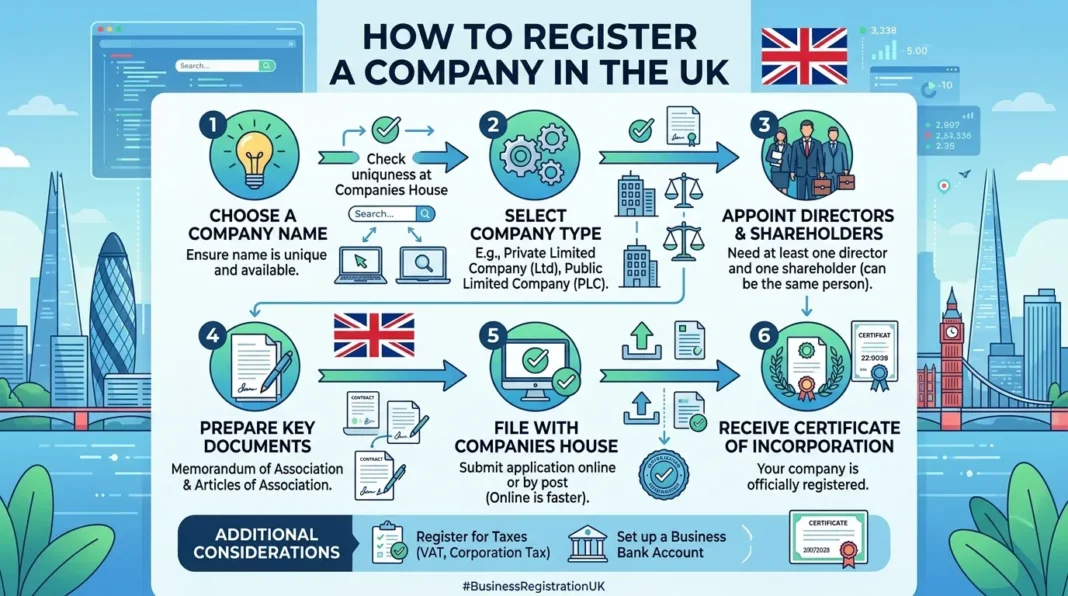

Registering a company in the UK means filing with Companies House — and the online process takes less than 30 minutes. The standard fee is £50, and most applications are approved within 24 hours. This guide covers every step: what you need to prepare, how to file, what it costs, and exactly what to do the moment your certificate of incorporation arrives.
What Type of Company Should You Register?
Before you touch the Companies House portal, you need to decide what type of company you’re forming. Getting this wrong means starting over.
Private Limited Company (Ltd) — Why Most People Choose This
A private limited company is the most common business structure in the UK for small and medium businesses. It’s a separate legal entity from you as an individual, which means your personal finances are protected if the business runs into debt — your liability is limited to the value of your shares.
Ltd companies pay Corporation Tax on profits (currently 19% for profits up to £50,000, and up to 25% for profits over £250,000 with marginal relief in between). Directors typically pay themselves a combination of salary and dividends to manage their personal tax efficiently.
If you’re moving from self-employment or weighing up your options, the detailed breakdown in our guide on sole trader vs limited company covers the tax and liability differences side by side. For a deeper look at what a limited company actually is and how it works in practice, our article on what is a limited company in the UK is worth reading first.
Other Options: LLP, PLC, and CIC
LLP (Limited Liability Partnership) — Used mainly by professional firms (solicitors, accountants). Partners have limited liability but are taxed individually like sole traders, not through Corporation Tax. Requires at least two designated members.
PLC (Public Limited Company) — Can offer shares to the public. Requires a minimum share capital of £50,000, with at least 25% paid up. Far more regulatory burden than a private Ltd. Very rarely the right choice for a new business.
CIC (Community Interest Company) — A limited company designed for social enterprises. Profits are locked in for the community purpose. Useful if you’re building a business with a defined social mission rather than a profit-maximising goal.
For most people reading this, a private limited company is the right answer. The rest of this guide focuses on that.
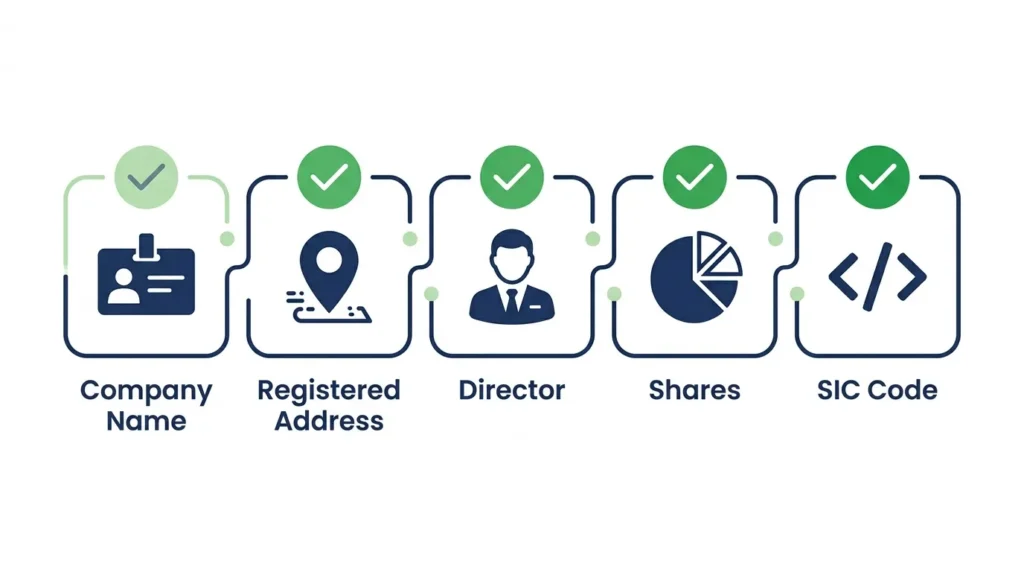
What You Need Before You Start
Choosing a Company Name — Rules and Restrictions
Your company name must be unique on the Companies House register. You can check availability using the Companies House name search tool.
Several rules apply:
- The name must end in “Limited” or “Ltd” (for a private limited company)
- It cannot be the same as or too similar to an existing registered company
- Certain words require permission or supporting documentation — “Royal,” “Bank,” “NHS,” “Chartered,” “Insurance,” and around 100 others
- It cannot be offensive or contain punctuation that isn’t permitted
Your trading name (the name you use with customers) can differ from your registered company name — you don’t need to re-register to trade under a different brand name, but you must display your registered name on all official documents.
If you’re still working out your business identity, our guide on how to choose a name for your UK small business covers the naming rules in more detail, including trademark checks.
Registered Office Address
Every UK limited company must have a registered office address in the same country it’s incorporated in (England and Wales, Scotland, or Northern Ireland). This address is publicly listed on Companies House and will receive official HMRC and Companies House correspondence.
You can use your home address — but it becomes public record permanently, even if you change it later. Many directors use a registered address service instead. These are legal, cost around £30–£100 per year, and keep your home address off the public register.
Directors, Shareholders, and the PSC Register
Directors — You need at least one director. There’s no upper limit. Directors must be at least 16 years old, must not be disqualified, and must not be an undischarged bankrupt. Directors are responsible for filing company accounts, confirmation statements, and meeting legal obligations.
Shareholders — You need at least one shareholder (also called a member). Directors and shareholders can be the same person. For a simple one-person company, you’d be both sole director and sole shareholder.
PSC Register (People with Significant Control) — This is mandatory. Any person who holds more than 25% of shares, more than 25% of voting rights, or has the right to appoint or remove the majority of directors must be listed as a PSC. For most small companies with one owner, that’s straightforward — the founder is the PSC. The register is publicly visible on Companies House.
SIC Code — What It Is and How to Pick One
A Standard Industrial Classification (SIC) code is a 5-digit code that describes what your company does. Companies House uses it to classify businesses.
You choose your SIC code at registration. There are over 700 codes listed by Companies House. Search for the one that most closely matches your main business activity — you can add up to four codes if your business spans multiple sectors.
Getting the SIC code slightly wrong doesn’t invalidate your registration and can be changed later via a confirmation statement. Choose the closest match and move on.
Share Capital
You need to issue at least one share. Most small companies issue 100 ordinary shares at £1 each — a total nominal share capital of £100. This is purely administrative; you don’t need to transfer £100 into the company. The value of those shares doesn’t have to reflect the actual value of the business.
If you have multiple shareholders, decide the split now. Whoever holds shares owns that percentage of the company.
How to Register a Company in the UK — Step by Step
There are three ways to register. Online is fastest and cheapest.
Step 1 — Register Online via Companies House WebFiling (Recommended)
Go to the Companies House WebFiling portal and create an account if you don’t already have one.
You’ll fill in:
- Your proposed company name
- Your registered office address (country of incorporation)
- Director details (full name, date of birth, nationality, occupation, service address, residential address — the residential address is not public)
- Shareholder details and share capital structure
- PSC information
- SIC code
- Whether you’re adopting model articles of association (recommended for most new companies — more on this below)
The fee is £50, paid by debit or credit card at submission. Most applications are reviewed and approved within 24 working hours. You’ll receive your certificate of incorporation by email as a PDF.
Step 2 — Or Use a Company Formation Agent
Formation agents like 1st Formations, The Formations Company, or Crunch handle the filing on your behalf. Prices start from around £12–£50 depending on the package, and some agents file via the Companies House API which can speed up processing.
Agents are useful if you want extras bundled in — a registered address service, model articles reviewed by a solicitor, or a business bank account referral. You’re still paying the £50 Companies House fee; the agent fee is on top.
For straightforward single-director limited companies, the DIY route via WebFiling is fine.
Step 3 — Or Apply by Post (IN01 Form)
Download and complete form IN01 from the Companies House website, then post it with a cheque or postal order for £71. Postal applications take 8–10 working days to process. There’s no advantage to this route unless you’re unable to file online.
How Much Does It Cost to Register a Company?
| Method | Fee | Processing Time |
|---|---|---|
| Online (WebFiling) | £50 | Within 24 hours |
| Same-day online service | £78 | Same business day |
| Software filing via agent | £50 | Varies by agent |
| Postal (IN01) | £71 | 8–10 working days |
The £50 online fee is the standard choice. The same-day service at £78 is useful if you need your company number urgently — for example, to open a bank account or sign a contract.
How Long Does Registration Take?
Online standard: Most applications are approved within 24 working hours, often the same day if submitted early.
Same-day service: Submitted before 3pm on a working day, approved that day. Costs £78.
Postal: 8–10 working days. Not recommended unless necessary.
Once approved, Companies House emails you a certificate of incorporation as a PDF. This includes your company registration number (CRN) — an 8-digit number that you’ll use on all official documents, invoices, and correspondence.
Articles of Association — What You Need to Know
The articles of association are the internal rulebook of your company. They set out how the company is run — how directors are appointed, how decisions are made, how shares are transferred.
Companies House provides model articles — a standard template that covers all the basics. For the vast majority of new limited companies, model articles are perfectly adequate. You adopt them simply by ticking a box during registration.
Custom articles are needed when you have investors with specific rights, complex share structures, multiple classes of shares, or specific shareholder agreements. They require a solicitor and cost significantly more. For a standard owner-managed Ltd, don’t overcomplicate it — use the model articles.
A memorandum of association is submitted alongside the articles. It’s a one-page document confirming the founders’ intention to form the company. Companies House generates this automatically during online registration.
What Happens After You Register?
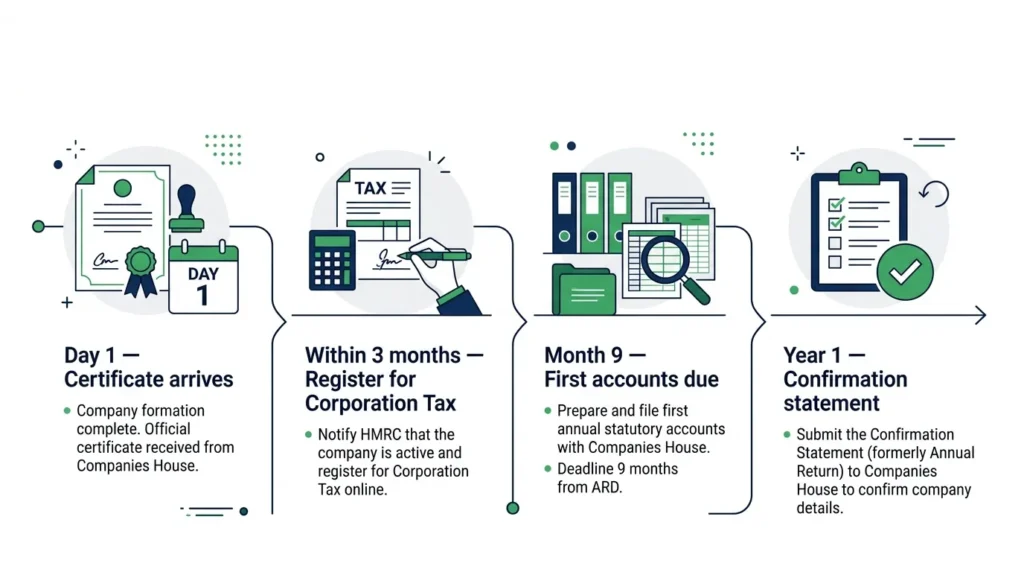
Notify HMRC for Corporation Tax
You must tell HMRC that your company is active within 3 months of starting to trade. Do this through your Government Gateway account. HMRC will issue a Corporation Tax reference and set your accounting reference date.
Miss this 3-month window and HMRC will issue a penalty automatically.
Your first Corporation Tax return (CT600) is due 12 months after your accounting period ends. Payment is due 9 months and 1 day after the period ends — earlier than the return itself.
Our guide on smart tax tips for UK small businesses covers Corporation Tax planning strategies worth knowing in your first year.
VAT Registration
You must register for VAT if your taxable turnover exceeds £90,000 in any rolling 12-month period. You can also register voluntarily below this threshold — useful if your clients are VAT-registered businesses, since you can reclaim input VAT.
VAT registration is done through HMRC’s online portal, separate from Companies House. Once registered, you’ll submit VAT returns (usually quarterly) and must keep digital records under Making Tax Digital rules. Our guide on understanding VAT for UK small businesses explains when voluntary registration makes sense and how to set up your first return.
PAYE — If You Pay Yourself or Have Employees
If you pay yourself a salary above the Lower Earnings Limit (£6,396 in 2025/26), or if you employ anyone, you must set up a PAYE scheme with HMRC before making the first payment. PAYE is how income tax and National Insurance are collected from salaries.
Most owner-directors pay themselves a small salary (typically around £12,570 — the personal allowance threshold) and draw the rest as dividends, which are taxed differently. An accountant can help structure this efficiently from day one.
Open a Business Bank Account
Limited companies must have a separate business bank account. Unlike sole traders, you cannot legally mix personal and company funds — the company is a separate legal entity and its money belongs to the company, not you personally.
Several banks and fintech providers offer accounts designed for new limited companies. Many can be opened in under 30 minutes online. See our guide on how to open a free UK small business bank account for the current best options and what to look for.
Your Companies House Authentication Code
Within a few days of incorporation, Companies House will post an authentication code to your registered office address. This is a 6-character alphanumeric code.
Do not lose it. You’ll need it every time you file anything with Companies House — your annual confirmation statement, accounts, or any changes to company details. If you lose it, you can request a new one, but it takes time and goes back to your registered address.
Registering a Company vs Going Sole Trader
| Limited Company | Sole Trader | |
|---|---|---|
| Legal structure | Separate legal entity | You and the business are one |
| Personal liability | Limited to share value | Unlimited personal liability |
| Tax on profits | Corporation Tax (19–25%) | Income Tax (20–45%) |
| Admin burden | Higher — accounts, filings | Lower — Self Assessment only |
| Perceived credibility | Higher with clients/investors | Lower |
| Setup cost | £50 | Free |
| Privacy | Director name public | Name public, less detail |
The right choice depends on your income level, risk exposure, and whether you’re dealing with clients who expect a registered company. For most people earning above £40,000 from self-employment, a limited company often produces a better tax outcome — but get specific advice from an accountant before you decide.
If sole trader is the right structure for your situation right now, our guide on how to register as a sole trader in the UK walks you through that process separately.
Can a Non-UK Resident Register a UK Company?
Yes. There is no requirement to be a UK resident or UK citizen to register a limited company in the UK. Non-residents can be directors and shareholders.
You will need:
- A valid address for the registered office (must be a physical UK address — a PO box is not acceptable)
- A UK-based registered address service is typically used
- A government-issued ID for identity verification on Companies House
Non-resident directors cannot hold a UK bank account in the company’s name at all banks — some providers require a UK residential address for the account holder. Fintech providers like Wise Business or Starling are generally more flexible.
Non-UK residents may also have tax obligations in their own country — speak to a tax adviser familiar with international business before registering.
Common Mistakes When Registering a Company
Choosing a name that’s too similar to an existing company. Companies House will reject it. Search the register before you commit to a name — and check trademark databases too. A name can be available on Companies House but still infringe a registered trademark.
Using your home address as the registered office without thinking it through. It becomes a permanent public record. Even if you move later and update Companies House, the historical address stays visible. Use a registered address service if privacy matters.
Ignoring the 3-month Corporation Tax notification deadline. HMRC doesn’t chase you — they just issue a penalty. Set a reminder for 3 months after you start trading and register then.
Not keeping the authentication code safe. It’s not in any email. It arrives by post and it’s easy to lose in the pile of letters that arrives after incorporation. File it immediately.
Skipping professional advice on share structure. If you’re setting up with co-founders or investors, get the share split right from the beginning. Changing it later is possible but involves legal steps and potential tax implications.
Not having a business plan in place before registering. Registration is the easy part. A clear plan for how the company will generate revenue, manage costs, and reach profitability matters far more. Our UK business plan template is a practical starting point if you haven’t done this yet.
Frequently Asked Questions
Can I register a company for free?
No. The minimum fee is £50 for online registration via Companies House WebFiling. Some formation agents advertise very low headline prices but the £50 Companies House fee is always included — it’s a statutory charge that cannot be waived.
Can I use my home address as the registered office?
Yes, this is legal. But your home address becomes permanently visible on the public Companies House register. Many directors use a registered address service to keep their personal address private.
Do I need a solicitor to register a company?
No. Most straightforward limited companies — one director, model articles, standard share structure — can be registered without any professional help using the Companies House WebFiling portal. A solicitor or formation agent adds value when you have multiple founders, investor agreements, or non-standard share classes.
Can a non-UK resident register a UK company?
Yes. Non-residents can be directors and shareholders of a UK limited company. You need a UK registered office address (a registered address service works) and valid identification. Some banking restrictions may apply.
What is a PSC register?
PSC stands for People with Significant Control. Any individual who holds more than 25% of shares, more than 25% of voting rights, or has the right to appoint or remove the majority of directors must be registered as a PSC. This register is publicly accessible on Companies House. For a one-person company, the owner is typically the sole PSC.
Final Thought
Registering a company in the UK is genuinely fast and affordable — £50 and 24 hours via Companies House online. The administration that follows registration is what demands consistent attention: Corporation Tax notification, annual accounts, confirmation statements, VAT if relevant, and PAYE if you’re paying salaries.