

The Annual Investment Allowance lets most UK businesses deduct the full cost of qualifying equipment from their profits in the year they buy it, up to £1 million. For the 2025/26 tax year, that limit hasn’t changed. What has changed is how some vehicles are taxed, how sole traders on the cash basis should treat capital spending, and what’s coming down the track from the Autumn Budget 2025. This guide covers all of it.
What Is the Annual Investment Allowance (AIA) for 2025/26?
The Annual Investment Allowance (AIA) is a capital allowance that lets businesses deduct 100% of the cost of most qualifying plant and machinery from their taxable profits in the same year they buy it, rather than spreading the deduction over several years.
For the 2025/26 tax year, the AIA limit is £1,000,000 per accounting period. This applies to:
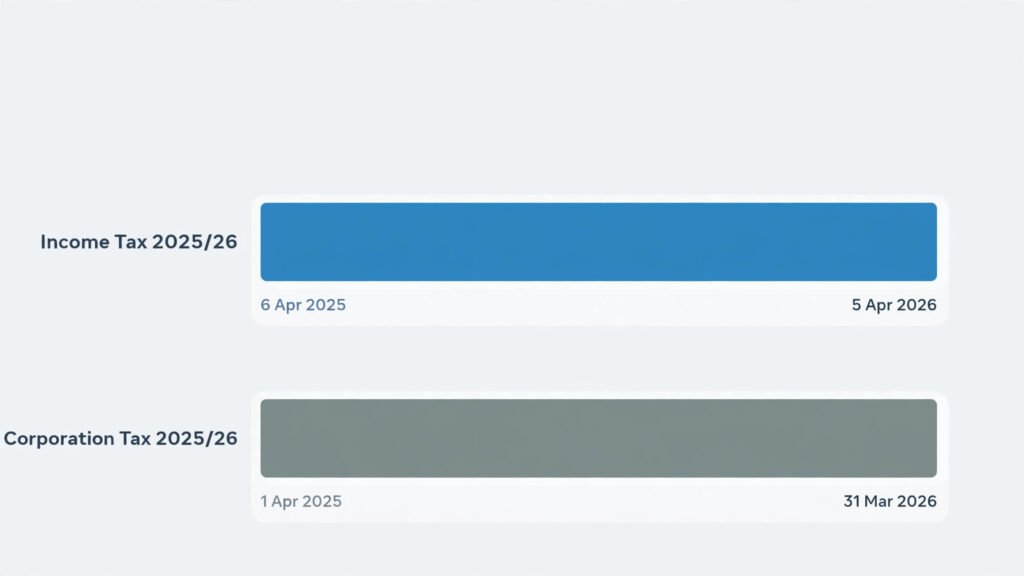
- Income Tax: 6 April 2025 to 5 April 2026
- Corporation Tax: 1 April 2025 to 31 March 2026
Any qualifying spend above £1 million, or on assets AIA doesn’t cover, gets relief more slowly through Writing Down Allowances instead.
The Permanent £1 Million Limit Explained
The £1 million cap has been permanent since 1 April 2023. Before that, the limit moved around a lot — it was £200,000 for several years, then temporarily raised to £1 million multiple times before the government finally locked it in. That history matters because if you’re claiming for an accounting period that straddled one of those changes, you need to apportion the allowance across the old and new rates. For any accounting period wholly within 2025/26, you don’t need to worry about that — the limit is £1 million throughout.
If your accounting period is shorter or longer than 12 months, the allowance is pro-rated. A 9-month accounting period gives you 9/12 × £1,000,000 = £750,000, for example. This trips people up when a company changes its year-end or when a new business’s first accounting period runs short.
Key Tax Dates and Financial Years for 2025/26
| Business type | 2025/26 period | AIA limit |
|---|---|---|
| Sole traders / partnerships (Income Tax) | 6 April 2025 – 5 April 2026 | £1,000,000 |
| Limited companies (Corporation Tax) | 1 April 2025 – 31 March 2026 (or company’s own accounting period) | £1,000,000 |
Companies with a non-standard year-end use their own 12-month accounting period, not the calendar tax year. A company with a 31 December year-end, for instance, claims AIA for the period 1 January 2025 to 31 December 2025 against that accounting period’s profits.
Who Is Eligible to Claim AIA?
Sole traders, partnerships made up entirely of individuals, and limited companies can all claim AIA. The main exclusion is partnerships with a corporate member, and connected businesses under common control that must share a single £1 million limit between them.
Companies, Partnerships, and Sole Traders
Any business carrying on a trade, profession, or vocation and paying Income Tax or Corporation Tax on its profits can claim AIA on qualifying capital expenditure, as long as it’s registered correctly with HMRC and keeps proper records. This covers:
- Sole traders
- Partnerships where every partner is an individual
- Limited companies
There’s no size threshold. A one-person consultancy and a multi-site manufacturer both claim against the same £1 million cap, unless they’re connected to another business (see below).
The “Mixed Partnership” Exclusion Trap
This is where a lot of professional practices get caught out. A partnership cannot claim AIA if one or more of its partners is itself a company rather than an individual. HMRC treats these as “mixed” or corporate partnerships, and they’re excluded from AIA entirely, regardless of how much the partnership spends on qualifying assets.
This matters most for law firms, medical practices, and property partnerships structured with a corporate partner for liability or tax reasons. If your partnership has a corporate member, any capital spending on plant and machinery has to go through Writing Down Allowances from year one — there’s no upfront deduction available. The new 40% First-Year Allowance introduced from January 2026 (covered below) is specifically designed to soften this gap for exactly this kind of business.
There’s a related rule for connected businesses. If two or more companies are under common control — for example, a parent company and its subsidiaries, or two businesses owned by the same person — they don’t each get their own £1 million allowance. They share one AIA limit between the group and have to agree how to split it.
Additional Eligibility Notes
If you’re deciding between structuring as a sole trader or limited company, AIA eligibility applies equally to both, so it shouldn’t be the deciding factor on its own. Newly incorporated businesses can claim from their very first accounting period, provided the company is properly registered before the expenditure is incurred.
What Assets Qualify for AIA in 2025/26?
AIA covers most plant and machinery bought for business use, including tools, computers, office furniture, and commercial vehicles. It specifically excludes cars, and — as of April 2025 — most double cab pickup trucks now count as cars for this purpose.
Qualifying Plant and Machinery
| Asset type | AIA eligible? | Notes |
|---|---|---|
| Machinery and production equipment | Yes | Core qualifying category |
| Computers, laptops, servers | Yes | Software licences can also qualify in some cases |
| Office furniture and fittings | Yes | Desks, chairs, shelving |
| Vans, lorries, tractors | Yes | Goods vehicles qualify; cars do not |
| Double cab pickups (bought before 6 April 2025) | Yes, under transitional rules | Treated as goods vehicles until disposal, lease end, or 5 April 2029 |
| Double cab pickups (bought from 6 April 2025) | No | Reclassified as cars — see below |
| Integral building features (heating, lifts, electrics) | Yes | Must meet the definition in Capital Allowances Act 2001 |
| Cars (all types, except via other reliefs) | No | Use Writing Down Allowances or First-Year Allowances instead |
| Items bought for leasing to someone else | Generally no | Excluded from Full Expensing; AIA may still apply in limited cases |
| Land and buildings (structure itself) | No | Structures and Buildings Allowance (3% per year) applies instead |
| Gifts and assets you owned before using them in the business | No | Must go through Writing Down Allowances at market value |
Integral Features and Building Alterations
Under Section 33A of the Capital Allowances Act 2001, certain fixed parts of a building count as “integral features” and qualify for capital allowances even though they’re built into the fabric of the property. This includes electrical and lighting systems, cold water systems, space and water heating, air conditioning and ventilation, and lifts and escalators.
These items go into the special rate pool rather than the main pool if not covered by AIA, which is important for the tax planning strategy covered further down. Pure structural work — walls, foundations, the roof as a structure — doesn’t qualify for AIA at all. That falls under the Structures and Buildings Allowance instead, which gives a flat 3% deduction a year over roughly 33 years.
If you’re planning a refit or renovation, it’s worth reviewing what other business expenses you can claim alongside your capital allowances, since not everything you spend during a refurbishment counts as capital expenditure.
What Cannot Be Claimed Under AIA? (The Car Exception)
Cars have never qualified for AIA, no matter how they’re used. Instead, cars get relief through Writing Down Allowances or, for zero-emission vehicles, a 100% First-Year Allowance. The rate you get depends on the car’s CO2 emissions:
- Zero-emission cars: 100% First-Year Allowance (extended to 31 March 2027 for companies, 5 April 2027 for Income Tax, following Budget 2025)
- Cars with CO2 emissions up to 50g/km: main rate pool, 18% Writing Down Allowance
- Cars with CO2 emissions above 50g/km: special rate pool, 6% Writing Down Allowance
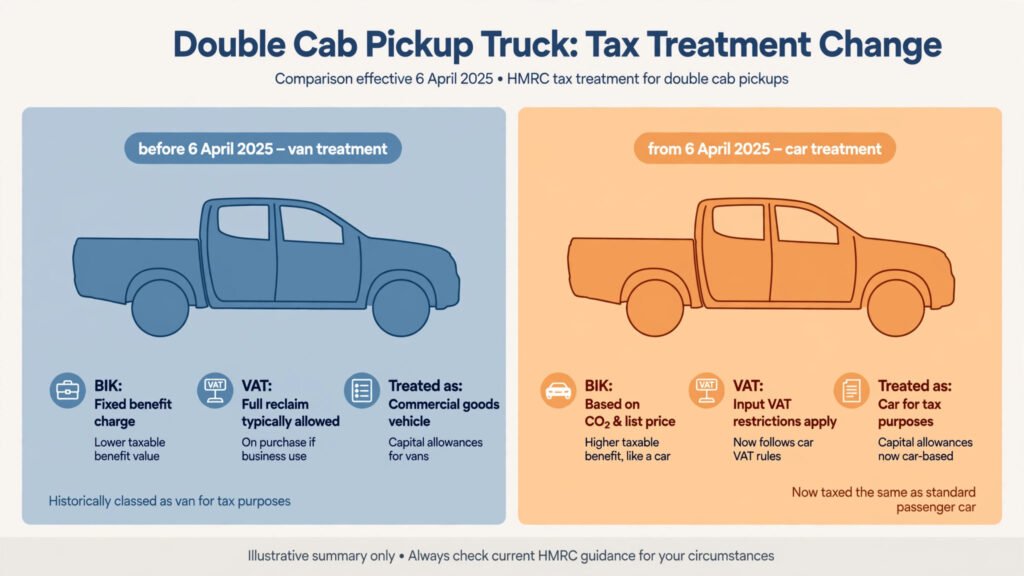
Double cab pickups have changed significantly for 2025/26, and this is one of the most common points of confusion right now. Until 5 April 2025, most double cab pickups with a payload of one tonne or more were treated as vans, which meant full AIA or Full Expensing was available. From 1 April 2025 (Corporation Tax) and 6 April 2025 (Income Tax), HMRC reinterpreted the legislation so that most double cab pickups are now classified as cars for capital allowances purposes, because they’re built to carry both people and goods rather than being primarily suited to carrying goods alone.
Transitional protection applies if you entered into a contract to buy, lease, or order the vehicle before those 2025 dates: you can still treat it under the old van rules until the vehicle is disposed of, the lease ends, or 5 April 2029, whichever comes first. Vehicles ordered or bought after those dates go straight into the car treatment, with no AIA and relief limited to Writing Down Allowances based on emissions. Note this doesn’t affect VAT — a double cab pickup with a payload over one tonne still qualifies for VAT recovery as before.
This distinction matters for planning mileage claims and vehicle costs as well, since the capital allowance treatment and the mileage allowance route are two separate ways of getting relief on a vehicle, and you can’t mix them for the same car.
AIA vs. Alternative Capital Allowances: How They Interact
AIA is almost always the first allowance to use, because it gives 100% relief immediately. Full Expensing, First-Year Allowances, and Writing Down Allowances pick up the slack for spending AIA doesn’t cover or the £1 million limit doesn’t stretch to.
AIA vs. Full Expensing (For Limited Companies)
Full Expensing is only available to companies paying Corporation Tax — sole traders and partnerships can’t use it. It’s been permanent since 1 April 2023 and gives a 100% deduction on new and unused main rate plant and machinery, with no upper limit at all. Special rate assets under Full Expensing get a 50% First-Year Allowance instead of 100%.
The practical difference from AIA: Full Expensing has no cap, but it only applies to brand-new assets, not second-hand ones, and not items bought to lease out. AIA covers second-hand assets too, but stops at £1 million. Most companies use AIA for the first £1 million of mixed new-and-used spend, then Full Expensing for anything above that on new main-rate assets. If your business is structured as a limited company, this combination usually means every pound of qualifying new plant and machinery gets 100% relief in year one, regardless of how much you spend.
| Feature | AIA | Full Expensing |
|---|---|---|
| Who can claim | Companies, partnerships, sole traders | Companies only |
| Spending limit | £1,000,000 per accounting period | No limit |
| New or second-hand assets | Both | New and unused only |
| Assets for leasing out | Generally excluded | Excluded |
| Special rate assets | 100% if within £1m limit | 50% first year, then WDA |
| Rate on cars | Not eligible | Not eligible |
First-Year Allowances (FYA) and Writing Down Allowances (WDA)
Anything not covered by AIA or Full Expensing goes into a pool and gets relief at a fixed percentage each year: 18% for the main pool, 6% for the special rate pool, both on a reducing balance basis, for expenditure during 2025/26.
Two changes from the Autumn Budget 2025 are worth flagging because they land right in the middle of this tax year and the one after:
- A new 40% First-Year Allowance took effect from 1 January 2026 for main rate plant and machinery. Unlike Full Expensing, it’s available to unincorporated businesses and to assets bought for leasing, which makes it particularly useful for partnerships with a corporate member (who can’t claim AIA) and for leasing and hire companies. Second-hand assets and cars are excluded.
- The main rate Writing Down Allowance is dropping from 18% to 14%, effective 1 April 2026 for Corporation Tax and 6 April 2026 for Income Tax. This falls just after the end of the 2025/26 tax year for most businesses, so it doesn’t change anything for spending incurred now — but if your accounting period straddles that date, a hybrid rate applies, blending 18% and 14% based on how much of the period falls either side. The special rate pool stays at 6%; that hasn’t changed. No relief is lost overall, it just arrives more slowly for balances carried forward.
If you have a large pool of unrelieved expenditure sitting at the old 18% rate, it’s worth reviewing your capital allowances position before April 2026 with whoever handles your Corporation Tax return.
How the Default Cash Basis Changes Impact Sole Trader Capital Claims in 2025/26
This is the single biggest source of outdated advice on this topic, and it catches a lot of sole traders out. Since the 2024/25 tax year, the cash basis is the default way for most sole traders and partnerships to calculate their profits, unless they actively elect to use traditional accruals accounting.
Under the cash basis, most capital expenditure — computers, tools, machinery, a delivery van — is simply deducted as a normal business expense in the year you pay for it. You don’t claim AIA on it at all, because it’s already fully relieved as a cost. AIA only becomes relevant for cash basis businesses in one main scenario: cars, which still can’t be deducted as a straightforward expense under the cash basis and instead need capital allowances (Writing Down Allowances, since AIA never covers cars anyway).
Practically, this means most sole traders using the cash basis in 2025/26 will barely interact with AIA. If you’ve switched to using Making Tax Digital software this year, check how it’s categorising equipment purchases — some systems still default to capital allowance treatment out of habit, which can misstate your profit if you’re on the cash basis.
If you’ve elected out of the cash basis and use traditional accounting, or you run your business through a partnership with a corporate member, AIA and the other capital allowances covered in this guide still apply in full.
Strategic Tax Planning & Edge Cases
Order of Claim: Maximizing Relief When Spending Exceeds £1 Million
When your qualifying spend goes over £1 million, which assets you allocate to AIA first makes a real difference to how much tax relief you get in year one. The rule of thumb: allocate AIA to special rate pool assets first, because they’d otherwise only get 6% Writing Down Allowance, compared to 18% for main pool assets left over.
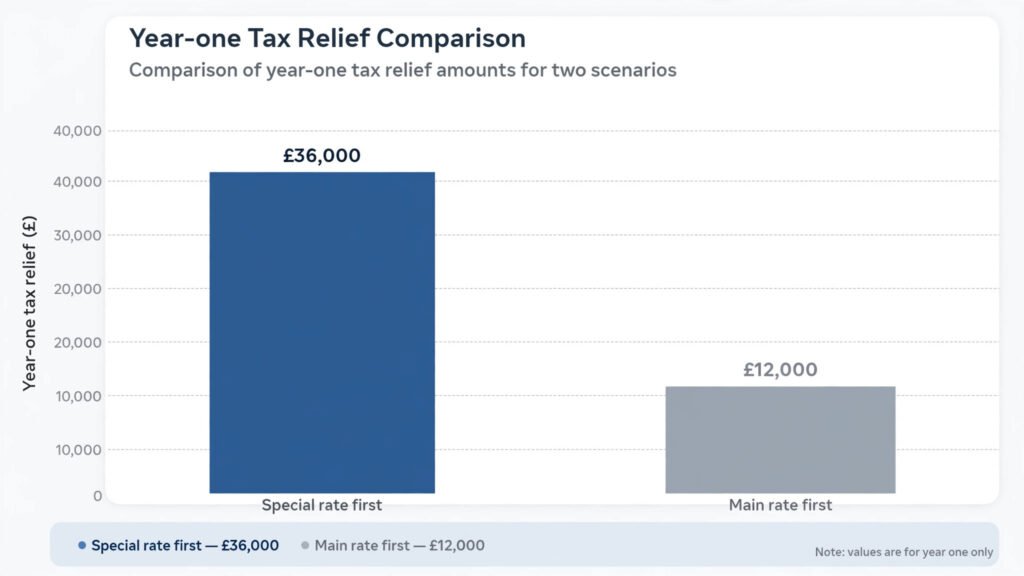
Worked example. A business spends £1.2 million in 2025/26: £300,000 on special rate assets (integral features like air conditioning) and £900,000 on main rate plant and machinery.
| Approach | AIA allocation | Leftover spend | WDA rate on leftover | Year 1 relief on leftover |
|---|---|---|---|---|
| Smart: special rate first | £300,000 special rate + £700,000 main rate = £1m | £200,000 main rate | 18% | £36,000 |
| Naive: main rate first | £900,000 main rate + £100,000 special rate = £1m | £200,000 special rate | 6% | £12,000 |
Both approaches use the full £1 million AIA. But allocating to special rate assets first delivers £36,000 of extra first-year relief versus £12,000 — a difference of £24,000 in year one alone, just from the order in which you make the claim. The total relief evens out over time, but the cash flow advantage of getting it sooner is real, especially for businesses reinvesting quickly.
Mixed-Use Assets (Sole Traders & Partnerships)
If a sole trader or partner uses an asset partly for business and partly for personal reasons — a van also used for family trips, for instance — the asset is kept in its own single-asset pool rather than the main pool, and the allowance is restricted to the business-use percentage. A vehicle used 80% for business only gets 80% of the AIA or WDA that would otherwise apply; the remaining 20% gets no relief at all. This restriction doesn’t apply to companies, because a company’s assets are owned by the company, not an individual, so there’s no personal-use element to strip out (any private use by a director or employee is dealt with separately through benefit-in-kind rules).
What Happens When You Sell an AIA Asset? (Balancing Charges)
If you sell, give away, or scrap an asset you previously claimed AIA on, you have to bring the sale proceeds (or market value, if given away) back into your capital allowances calculation. Because the asset’s tax value was already written down to zero when you claimed AIA, the proceeds you receive create a balancing charge — extra taxable profit — rather than being tax-free.
For example, if you claimed £15,000 of AIA on a machine, then sold it three years later for £6,000, that £6,000 becomes taxable as a balancing charge in the year of sale, added back to your profits. This catches people out because it feels like you’re being taxed on selling something you already own — but from HMRC’s perspective, you already had the full tax benefit of the cost, so the sale proceeds have to be accounted for. This is a different mechanism from Capital Gains Tax on business assets, which applies to different types of disposal — don’t assume the two rules apply the same way.
Keep a simple disposal log alongside your asset register: date bought, AIA claimed, date sold, and proceeds. It makes this calculation far less painful at year-end.
Accounting Periods Spanning Multiple Tax Years
Companies with a year-end that doesn’t fall on 31 March, and sole traders whose basis period rules create a short or long period, need to apportion the AIA to match the length of the actual accounting period, not the calendar tax year. A 6-month accounting period gets 6/12 × £1,000,000 = £500,000, for instance. If a change in the AIA rate ever falls mid-period (it hasn’t during 2025/26 itself), you’d apportion between the old and new limits pro-rata based on how much of the period falls either side of the change date — the same mechanism used for the upcoming Writing Down Allowance rate change.
How to Claim the Annual Investment Allowance (HMRC Compliance)
You claim AIA when you file your tax return — there’s no separate application or advance notification to HMRC. You simply calculate the allowance and include it in your profit figure.
- Identify all qualifying capital expenditure for the accounting period.
- Split spending between main rate, special rate, and excluded assets (cars, etc.).
- Decide how much of the £1 million limit to allocate to which assets — special rate first, if you’re near the cap.
- Calculate any remaining Writing Down Allowance or First-Year Allowance on leftover spend.
- Enter the total capital allowances figure on your return, reducing your taxable profit.
- Keep invoices, contracts, and an asset register in case HMRC opens an enquiry — they can go back up to six years.
Self Assessment (Helpsheet HS252) vs. Company Tax Return (CT600)
Sole traders and partners report capital allowances, including AIA, on the self-employment pages of their Self Assessment tax return (form SA103), following the guidance in HMRC’s Helpsheet HS252, which covers capital allowances and balancing charges for the self-employed. Filing late carries the usual Self Assessment penalties, so build your capital allowances calculation into your return well before the January deadline, not at the last minute.
Limited companies claim through the Company Tax Return, form CT600, with a supporting capital allowances computation showing the breakdown between AIA, Full Expensing, and any Writing Down Allowances. This sits alongside the rest of your Corporation Tax calculation.
Common Mistakes and Compliance Risks
- Claiming AIA on a car. This is one of HMRC’s most common capital allowances challenges. If in doubt about whether a vehicle counts as a car or a goods vehicle, check the construction test in HMRC’s manual, not just the payload figure — payload alone no longer decides it for double cab pickups.
- Forgetting balancing charges on disposal. Selling an asset you claimed AIA on almost always creates a taxable event. Missing this is a common trigger for HMRC enquiries when sale proceeds show up in bank records but not in the tax computation.
- Not sharing the limit between connected companies. If your business is part of a group or under common control with another business, claiming the full £1 million separately in each entity is a straightforward overclaim.
- Applying accruals-basis capital allowances logic to a cash basis return. Since the cash basis became the default, treating a straightforward expense as a capital allowance (or vice versa) is an increasingly common error in software-generated returns.
- Assuming a pickup truck still counts as a van. Given how recent the reclassification is, this is likely to be the single most common AIA-related mistake on 2025/26 returns.
Getting any of these wrong doesn’t just cost you relief — it can trigger an HMRC enquiry, and it’s worth understanding how a tax audit process works before you’re in the middle of one.
Frequently Asked Questions
What is the AIA limit for 2025/26? £1,000,000 per accounting period, for both Income Tax (6 April 2025 – 5 April 2026) and Corporation Tax (1 April 2025 – 31 March 2026) purposes.
Can limited companies claim AIA and Full Expensing? Yes. Companies typically use AIA for the first £1 million of qualifying spend, including second-hand assets, then Full Expensing for new, unused main-rate assets above that limit, since Full Expensing has no upper cap.
Do vans qualify for Annual Investment Allowance in 2025/26? Yes, vans and other goods vehicles qualify for AIA. Double cab pickups bought from 6 April 2025 (Income Tax) or 1 April 2025 (Corporation Tax) onward are the exception — they’re now treated as cars, not vans, unless bought under a contract entered into before those dates.
How do I claim AIA on Self Assessment? Sole traders and partners claim it on the self-employment pages (SA103) of their Self Assessment return, following HMRC’s Helpsheet HS252, deducting the allowance from trading profits before tax is calculated.
What happens when you sell an asset claimed under AIA? The sale proceeds (or market value if given away) are brought back into your capital allowances calculation as a balancing charge, which increases your taxable profit in the year of sale.
Does the cash basis change how sole traders claim AIA? Yes. Since the cash basis became the default in 2024/25, most capital spending is deducted as a normal expense rather than through AIA, except for cars, which still require capital allowances under the cash basis.