
Missing the Self Assessment deadline costs money from the very first day. HMRC issues an automatic £100 penalty the moment 31 January passes — even if you have no tax to pay. From there, the charges follow a fixed timetable that gets expensive fast. In January 2025, roughly 600,000 UK taxpayers missed the deadline, and HMRC collected £325 million in penalties and interest that year alone. The sooner you act, the less this costs you.
The Self Assessment Deadlines
There are two filing dates depending on how you submit.
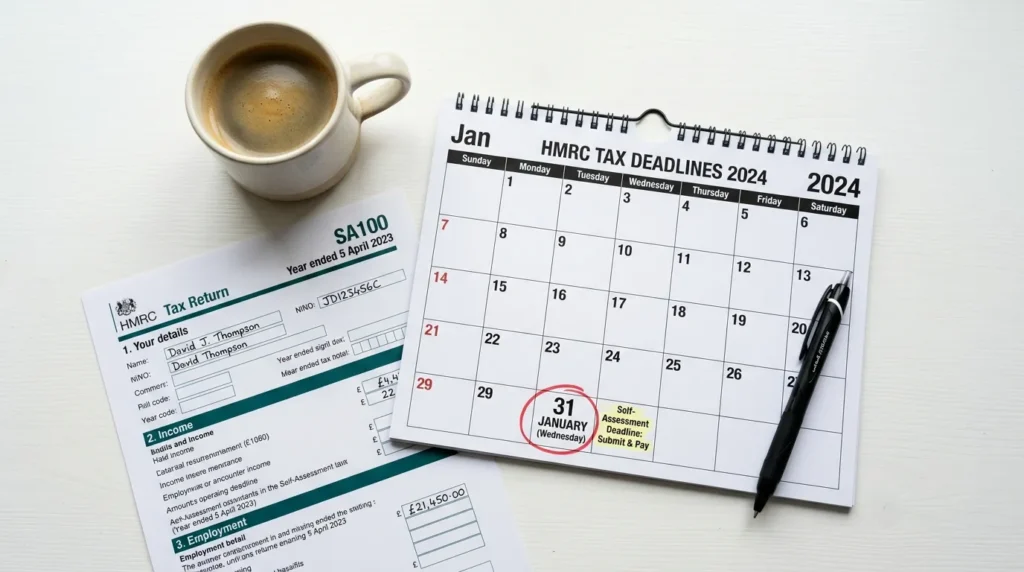
Online return: 31 January. This is the one that matters for most people. Online submissions for the 2024/25 tax year must reach HMRC by 31 January 2026.
Paper return: 31 October. Paper filers face a deadline three months earlier. Miss this and the same penalty structure applies.
Any tax owed is also due by 31 January — regardless of whether your return is paper or online. Miss the payment date and a separate penalty stream begins, running alongside the filing penalties.
Who Needs to File?
You must file Self Assessment if you’re self-employed, a sole trader earning over £1,000, a landlord with rental income above £2,500, a company director, or someone whose income exceeds £100,000. If HMRC sent you a notice to file, you’re legally required to complete a return — even if you believe no tax is owed.
If you’ve recently set up on your own and aren’t sure how Self Assessment fits with your obligations, our guide to starting a new business in the UK covers HMRC registration alongside your other setup steps.
Late Filing Penalties: The Full Breakdown
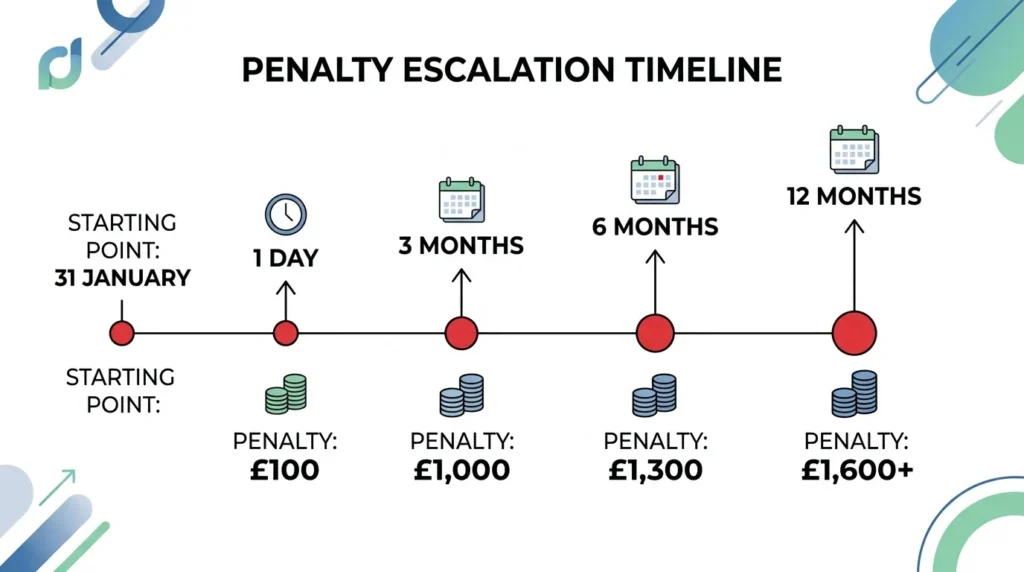
These penalties apply the moment your return is late. They apply even if you owe no tax.
| How Late | Penalty |
|---|---|
| 1 day late | £100 fixed penalty |
| 3 months late (by 30 April) | £10 per day for up to 90 days — maximum £900 |
| 6 months late (by 31 July) | £300 or 5% of tax due, whichever is greater |
| 12 months late (by 31 January following year) | £300 or 5% of tax due, whichever is greater |
A return filed three months and two weeks late carries the £100 day-one penalty plus up to £920 in daily charges — before any payment penalties are added.
The £100 Day-One Penalty
This catches people off guard. Even with a clean tax record and nothing owed, HMRC charges £100 automatically from the first day you’re late. There is no grace period.
Three Months: Daily Penalties Begin
From the three-month mark, HMRC adds £10 per day. That runs for up to 90 days, capping at £900. So at three months and one day, you’re already looking at up to £1,010 in filing penalties alone.
Six and Twelve Months: Tax-Geared Penalties
At six months and again at twelve months, the charge becomes tax-geared. HMRC applies whichever is greater — £300 or 5% of the tax you owe. For someone with a £7,000 tax bill, that’s £350 at each stage. For someone owing £4,000, it stays at £300.
Deliberate Withholding
If HMRC concludes you deliberately withheld information, the twelve-month penalty can rise to 100% of the tax owed. This applies where the delay is ruled intentional rather than circumstantial. Reductions are available for prompted or unprompted disclosure.
Late Payment Penalties: A Separate Charge That Stacks on Top
This is the part that surprises most people. Late filing and late payment are two entirely separate penalty streams. You can be hit by both at the same time, and they’re calculated independently.
| How Late | Payment Penalty |
|---|---|
| 30 days late | 5% of tax still unpaid |
| 6 months late | Additional 5% of any tax still unpaid at that point |
| 12 months late | Further 5% of any tax still unpaid at that point |
On top of those surcharges, HMRC charges interest at 8.00% per year on the unpaid amount (as of August 2025). That rate is the Bank of England base rate plus 4%. In early 2022, the equivalent rate was 2.75% — so the same delay costs more than three times as much in interest today.
Interest is calculated daily and runs from 1 February until the day full payment is received.
How the Interest Adds Up
On a £6,000 tax bill paid six months late, you’d pay around £240 in interest alone, plus a 5% surcharge of £300. That’s £540 on top of the original bill — and filing penalties are still separate from all of that.
Keeping on top of tax payment dates is part of basic financial housekeeping for any self-employed person. If you’re looking for tools to help manage deadlines and time alongside running your business, take a look at our roundup of free UK small business time tracking tools.
Real-World Example: What Late Filing and Late Payment Actually Costs
Suppose you owe £4,000 for the 2024/25 tax year. You miss the 31 January 2026 deadline and file nine months late — in October 2026 — paying in full on the same day.
Late filing penalties:
- Day one: £100
- Daily penalties (3 months): £900
- Six-month charge: £300 (5% of £4,000 = £200, so £300 applies as the greater)
- Filing subtotal: £1,300
Late payment penalties:
- 30-day surcharge: £200 (5% of £4,000)
- Six-month surcharge: £200 (5% of £4,000 still unpaid)
- Payment surcharge subtotal: £400
Interest:
- 8.00% per year on £4,000 for approximately nine months ≈ £240
Total additional cost: £1,940
That’s nearly half the original tax bill, added on top. And the £4,000 itself still has to be paid as well.
What to Do Right Now If You’ve Missed the Deadline
Every week of delay adds cost. Here’s the priority order.
Step 1 — File the Return Immediately
Do this even if you cannot pay. Filing stops the daily £10 penalty from continuing to run. It also opens the door to appealing any penalties already issued — HMRC will not consider an appeal while your return is still outstanding.
Step 2 — Pay What You Can
Paying part of the tax bill now directly reduces the amount on which future surcharges are calculated. The 30-day, six-month, and twelve-month payment penalties are all calculated on the balance still outstanding at that point — not the original amount owed.
Step 3 — Set Up a Time to Pay Arrangement
If you can’t pay the full amount, contact HMRC to arrange a payment plan before the penalties compound further. You can spread liabilities of up to £30,000 over up to 12 months. Interest still runs on the outstanding balance, but the penalty surcharges stop accumulating on amounts covered by the arrangement.
Call HMRC’s Self Assessment payment helpline on 0300 200 3822. Have your Unique Taxpayer Reference (UTR) ready before you call.
Step 4 — Check Whether You Should Be Filing at All
HMRC occasionally sends penalty notices to people who no longer need to file. If you stopped being self-employed, your income dropped below the filing threshold, or you believe the notice was issued in error, contact HMRC and ask them to remove the return from their records. Once they confirm you don’t need to file, linked penalties are cancelled automatically.
Understanding the criteria properly matters here. Our guide to how to register your business in the UK explains how HMRC registration works and when your obligations begin or end.
How to Appeal an HMRC Late Self Assessment Penalty
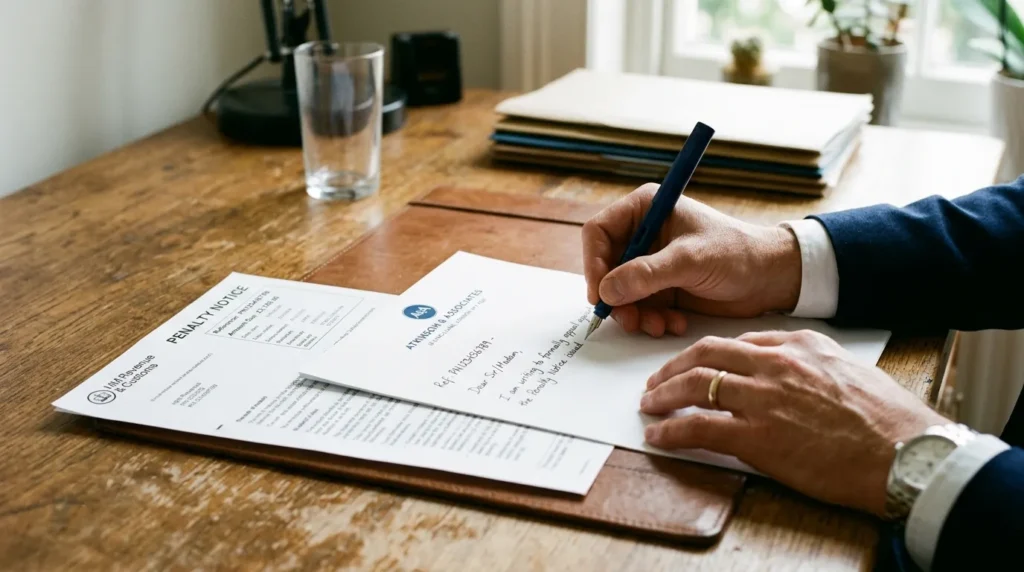
A penalty notice is not final. You have 30 days from the date on the notice to submit an appeal. Miss that window and HMRC may reject your appeal before even considering the reason.
What Counts as a Reasonable Excuse
HMRC defines a reasonable excuse as an unexpected or exceptional event, entirely outside your control, that directly prevented you from meeting the deadline. Events HMRC typically accepts:
- Serious or life-threatening illness that made filing physically impossible
- Death of a close partner or immediate family member near the deadline
- A genuine technical failure at HMRC’s end during submission
- A serious domestic emergency or natural disaster
The key test is whether someone with your circumstances, exercising reasonable care, would still have missed the deadline. The excuse must have directly caused the failure — not just made things difficult.
What HMRC Will Not Accept
- Forgetting the deadline
- Being too busy or overwhelmed with work
- Relying on an accountant who failed to file (unless they had their own reasonable excuse)
- Not knowing you needed to file
- Mild illness or general stress
If the excuse involves blaming a third party, HMRC expects you to show that person also had a genuine reasonable excuse.
How to Submit Your Appeal
Appeals are made online through your HMRC online account, or by post using form SA370. Be specific. Give the exact dates, state the reason clearly, and attach supporting documentation — a hospital letter, death certificate, or technical error correspondence from HMRC. Vague appeals are routinely rejected.
If HMRC rejects your appeal, you can request an independent review. If that also fails, you can escalate to the First-tier Tax Tribunal.
The New Points-Based System: What’s Changing from 2026
From April 2026, Self Assessment taxpayers with annual income over £50,000 who are brought into Making Tax Digital for Income Tax Self Assessment will move onto a points-based penalty system. It extends to those with income over £30,000 from April 2027.
Under this model, each late quarterly submission earns one penalty point. Once four points accumulate, a £200 penalty applies. Every subsequent late submission triggers another £200 charge. Points reset only after a 24-month period of full compliance.
The aim is to ease the burden on first-time or one-off late filers while still penalising persistent non-compliance. The same system has already been running for VAT-registered businesses since January 2023.
This shift is part of a broader tightening of UK tax compliance requirements. For context on how other recent UK business legislation is affecting small business owners, see our coverage of recent changes to UK employment and tax law.
Frequently Asked Questions
What is the HMRC penalty for filing Self Assessment one day late? £100. It’s automatic and fixed, regardless of whether you owe any tax or have already paid your bill.
Can an HMRC Self Assessment penalty be cancelled? Yes, if you appeal within 30 days of the penalty notice and provide clear evidence of a genuine, unexpected event that made filing impossible.
What if I can’t afford to pay my Self Assessment tax bill? File your return first — immediately. Then call HMRC on 0300 200 3822 to arrange a Time to Pay plan. You can spread up to £30,000 over 12 months.
Does the £100 penalty apply if I owe no tax? Yes. The day-one £100 penalty applies to every late return, including nil returns. Having nothing to pay does not reduce or remove the filing penalty.
What is the current HMRC late payment interest rate? 8.00% per year as of August 2025, charged daily on unpaid tax from 1 February. This rate adjusts when the Bank of England base rate changes.
Can I appeal after the 30-day window has passed? Possibly, but only in exceptional circumstances. HMRC sets the bar high for late appeals. Act within 30 days wherever you can.
Act Quickly — Every Day Matters
Miss the 31 January deadline and £100 goes immediately. Three months later that’s £1,000. Add in payment surcharges and 8.00% daily interest, and the total additional cost on a modest tax bill can easily exceed what you originally owed. The fastest way to limit the damage is straightforward: file now, even if payment has to follow. Then appeal if you have grounds.
Thousands of HMRC penalties are overturned every year. But the 30-day appeal window is firm, the evidence bar is real, and vague explanations get you nowhere.