
Quick answer: To export goods from a UK small business, you need an EORI number, a Customs Declaration Service (CDS) account, the correct HS commodity code for your product, a clear Incoterm agreed with your buyer, a compliant commercial invoice, and a plan for VAT and destination-country taxes. Government-backed support is available through the Department for Business and Trade (DBT) and UK Export Finance (UKEF) if you need funding or guidance.
None of this is complicated once you’ve done it once. It’s confusing the first time because the process is spread across five or six different government systems, each with its own login and its own acronym. This guide walks through it in order, using a small coffee roaster, Bramble & Bean, as a running example so the steps stay grounded in something real rather than legal theory.
Step 1: Secure Your Registrations (The Legal Entry Points)
Before you can move a single box out of the country, HMRC needs to know who you are and be able to process your declarations. Two registrations sit at the front of that process.
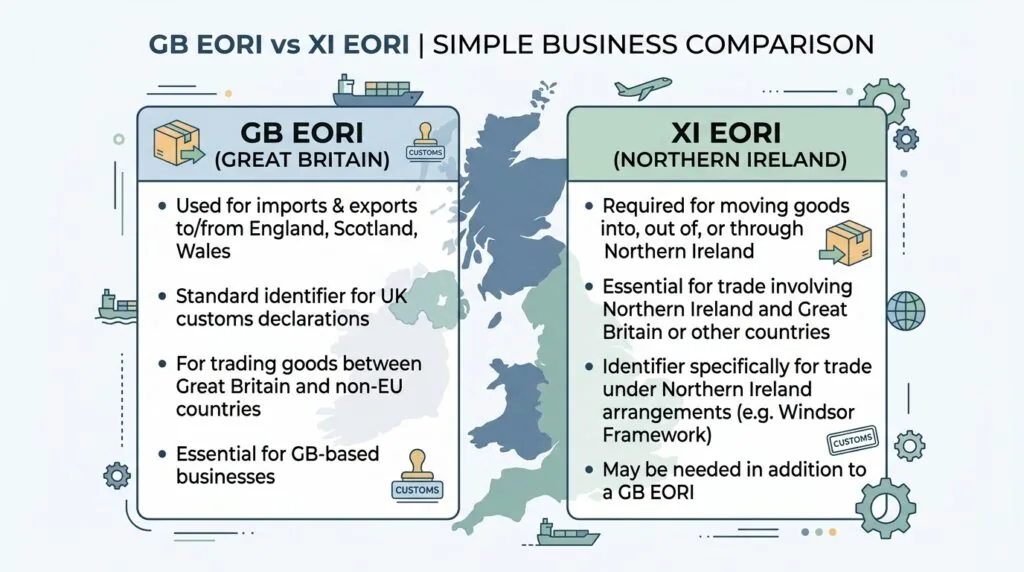
The UK EORI Number (GB EORI vs. XI EORI)
An EORI number (Economic Operators Registration and Identification number) is a unique ID that HMRC and other customs authorities use to track your shipments. You cannot submit a customs declaration without one, and you cannot get an EORI overnight if you leave it until the day you need it — apply as soon as you know you’re exporting.
Most Great Britain-based businesses need a GB EORI, which for VAT-registered businesses is usually your VAT number followed by three zeros. If Bramble & Bean is based in Bristol and ships beans to a café in Lisbon, GB EORI is all it needs.
If you’re based in Northern Ireland, the picture is different because of the Windsor Framework. You may also need an XI EORI number alongside your GB one, because goods moving into or through Northern Ireland can fall under different customs rules than the rest of Great Britain. If you’re an NI-based exporter, check your XI EORI status before you check anything else — getting this wrong is one of the most common reasons NI shipments get held.
Registering for the Customs Declaration Service (CDS)
CHIEF, the old customs system, is gone. HMRC switched off CHIEF for imports in September 2022 and for exports in March 2024, so every UK export declaration now goes through the Customs Declaration Service (CDS). If a guide, a broker, or a piece of software still references CHIEF, treat that as a sign the information is out of date.
To use CDS, log into your Government Gateway account, subscribe to CDS using your EORI number, and set up how you’ll pay any duties — either a CDS cash account (top up and pay as you go) or a duty deferment account (pay monthly, but this needs a bank guarantee). Registration is free and usually takes a few days to activate, so build that lead time into your first shipment.
Step 2: Classify Your Goods Correctly
Finding the Right HS Commodity Codes
Every product that crosses a border needs a commodity code (also called an HS code, from the Harmonized System). This code tells customs authorities exactly what your product is, so they can apply the right duty rate and check for restrictions. Get it wrong and you risk delays, fines, or paying more duty than you should.
You can look up your code using the UK Trade Tariff tool on GOV.UK. Search by product description first, then narrow down using the tool’s classification logic. If Bramble & Bean is shipping roasted coffee beans, that’s a different code — and a different duty treatment — from green (unroasted) beans, so precision matters even within one product line.
Why Commodity Codes Matter for Customs Duties and Rules of Origin
Your commodity code determines the duty rate the buyer’s country will apply, and it’s also the starting point for checking Rules of Origin — the criteria that decide whether your goods qualify for reduced or zero duty under a UK trade agreement. If your product is genuinely made or substantially transformed in the UK, you may be able to issue a statement on origin that lets your EU customer pay less duty. Skip this step and your customer could be charged full tariff rates on something that should have qualified for preferential treatment.
Step 3: Master the Logistics and Commercial Terms
Demystifying Incoterms: Who Pays for Duties and Shipping?
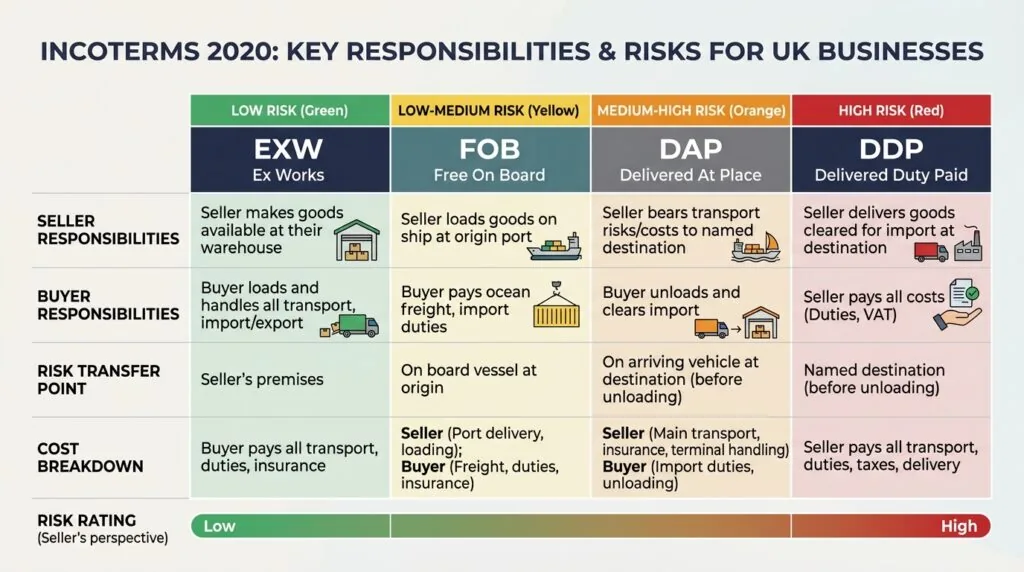
Incoterms (International Commercial Terms, published by the International Chamber of Commerce) define exactly where your responsibility as a seller ends and the buyer’s begins — for cost, risk, and paperwork. Get the wrong one and you can end up owing money, or owning a legal problem, in a country you’ve never registered a business in.
| Incoterm | What it means | Best for a small UK exporter? |
|---|---|---|
| EXW (Ex Works) | Buyer collects from your premises and handles everything from there | Low risk for you, but can put off buyers who want a simpler experience |
| FOB (Free on Board) | You deliver to the port; buyer takes over once goods are loaded | Common and manageable for sea freight |
| DAP (Delivered at Place) | You arrange delivery to the buyer’s country; buyer handles import duty and tax there | Good balance of service and low financial risk |
| DDP (Delivered Duty Paid) | You are responsible for paying import duty and tax in the destination country | High risk — avoid until you’re established |
A word of warning on DDP: it looks attractive because it promises the buyer a hassle-free experience, but it means your business becomes legally responsible for registering for, and paying, foreign VAT and customs duty. For a micro-business, an unexpected foreign tax bill on a single shipment can wipe out the profit on that order — and then some. Most small exporters are better served by DAP, which still delivers a smooth experience for the buyer without exposing you to a foreign tax authority.
Selecting a Customs Broker vs. Doing It Yourself
You can submit customs declarations yourself through CDS, but most small businesses use a customs broker or freight forwarder instead, at least for the first few shipments. A broker typically charges a flat fee per declaration and takes on the administrative burden of getting the CDS data fields right — there are over a hundred of them. DIY makes sense once you’re shipping the same product to the same country regularly and the paperwork has become routine; a broker makes more sense while you’re still learning what “correct” looks like.
Step 4: Prepare the Essential Export Documentation
The Commercial Invoice: The Most Important Document
The commercial invoice is the document customs officials use to value your shipment and calculate duty, so it needs to be accurate and complete every time. It should include a clear description of the goods (not a vague catch-all term), quantity, unit and total value, the commodity code, country of origin, the agreed Incoterm, and your EORI number. A vague or incomplete invoice is one of the most common reasons shipments get held at the border.
Export Licences and Certificates for Restricted Goods
Most everyday products don’t need a licence, but some do. Food, animal, and plant products often need certification from Defra or an equivalent body before they can leave the country. Certain goods — chemicals, dual-use technology, some electronics — need an export licence through the SPIRE system. Check this early: applying for a licence after you’ve promised a delivery date is how small exporters end up disappointing their first international customer.
Step 5: Navigate VAT, Taxes, and Duty Payments
How to Zero-Rate UK VAT on Exported Goods
You can zero-rate VAT on goods you export outside the UK, provided the goods physically leave the UK and you meet HMRC’s conditions under VAT Notice 703. In practice, that means obtaining valid proof of export — official evidence (your CDS export declaration), commercial evidence (a bill of lading, airway bill, or consignment note), or a mix of both — generally within three months of the sale. HMRC has tightened its guidance on what counts as acceptable evidence, and tribunal cases have gone against exporters who kept plenty of paperwork but not the right paperwork. Keep the evidence that clearly shows what was shipped, when, and to where, and hold onto it for your records even after the VAT return is filed.
Paying Taxes in the Destination Country
Zero-rating UK VAT doesn’t mean the shipment is tax-free — it means the tax liability moves to the destination country instead. Your buyer will typically pay import VAT and any customs duty when the goods arrive, unless you’ve agreed to DDP terms, in which case that liability sits with you. For EU sales, this is one of the most common points of confusion for UK exporters since Brexit: the goods are zero-rated for UK VAT, but EU import VAT still applies on arrival, and it’s usually the buyer who deals with it under standard terms.
Step 6: Leverage Government Support and Export Finance
Department for Business and Trade (DBT) Resources
The DBT’s export guidance and tools, now consolidated under business.gov.uk, include a step-by-step export planning tool, the free UK Export Academy training programme, and the Export Support Service, where you can put a specific question to a trade adviser rather than search through guidance pages. If Bramble & Bean wanted to check whether its packaging met EU labelling rules before its first Lisbon shipment, this is where that question gets answered.
UK Export Finance (UKEF) for Small Businesses
UK Export Finance is the UK’s export credit agency, and it exists specifically to fill gaps that commercial lenders won’t. Its Small Export Builder gives smaller exporters access to credit insurance starting at £15,000, and its General Export Facility can support working capital facilities. In 2026, UKEF also launched a joint scheme with the British Business Bank aimed squarely at smaller exporters who struggle to get lower-value working capital loans from mainstream lenders. If cash flow is the thing standing between you and your first international order, this is worth a call before you assume the answer is no.
Exporting Checklist for UK Small Businesses (Quick Reference)
- Apply for a GB EORI number (and an XI EORI if you’re based in Northern Ireland)
- Subscribe to CDS through your Government Gateway account
- Determine your commodity code using the UK Trade Tariff tool
- Check whether your goods qualify under Rules of Origin for reduced duty
- Agree an Incoterm with your buyer — avoid DDP as a small or first-time exporter
- Decide whether to use a customs broker or file declarations yourself
- Complete a full, accurate commercial invoice for every shipment
- Check if your goods need an export licence or certificate
- Retain proof of export within three months to zero-rate VAT
- Confirm who pays import VAT and duty at the destination
- Explore DBT’s Export Support Service and UKEF funding if you need guidance or capital

Frequently Asked Questions
How do I get an EORI number for my UK business?
Apply free through GOV.UK using your business details and VAT number if you have one. Most GB EORI applications are processed within a few working days, though it can take longer, so apply before you need it rather than when a shipment is ready to go.
Do I charge VAT when exporting goods from the UK?
No — you can zero-rate the sale, provided you obtain and keep valid proof that the goods physically left the UK within the required time frame, generally three months.
Who pays the import duty, the buyer or the seller?
It depends on the Incoterm you agree. Under DAP, the buyer pays import duty and tax. Under DDP, you do. Most small UK exporters are better protected using DAP.
What’s the difference between DAP and DDP for small businesses?
DAP means you deliver the goods to the buyer’s country, but the buyer handles import duty, tax, and clearance. DDP means you handle and pay for all of that yourself, including registering for foreign VAT if required — a significant financial and administrative risk for a small business.