
If your Self Assessment bill came back higher than you expected, payments on account are probably why. This one feature of the UK tax system catches out more first-time filers than almost anything else — not because it’s complicated, but because nobody explains it clearly before it lands on your statement.
This guide walks through exactly what payments on account are, who has to make them, how HMRC works out the number, and — most usefully — what you can legally do if the amount feels too high.
What Is a Payment on Account?
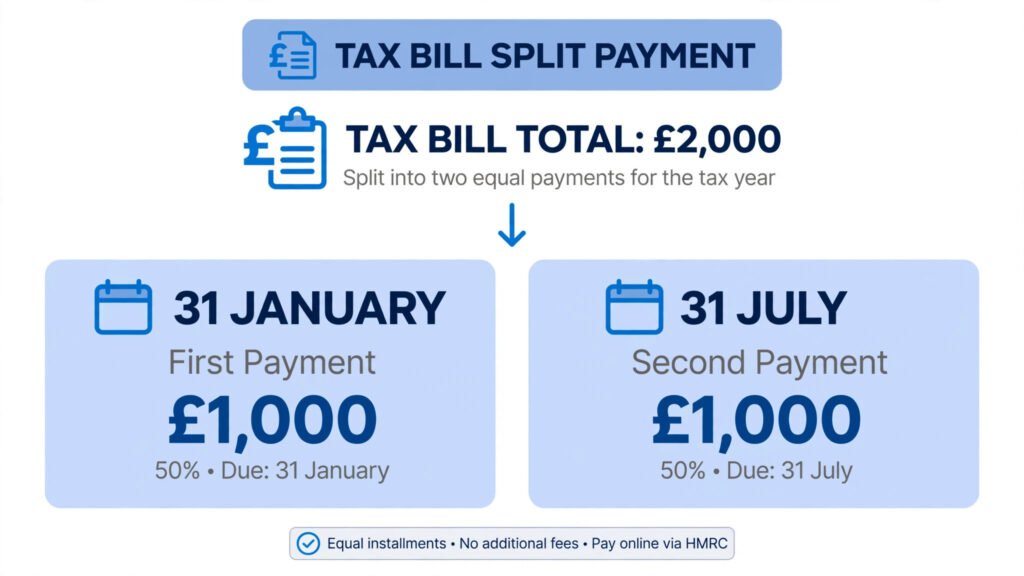
A payment on account is an advance payment towards next year’s Self Assessment tax bill. HMRC collects it in two instalments — one on 31 January and one on 31 July — and each instalment equals half of the tax and Class 4 National Insurance you owed for the previous tax year.
It isn’t a fine, a mistake, or an extra tax. It’s a prepayment. Whatever you pay through your payments on account gets deducted from your final bill once your actual income for the year is known.
Why Does HMRC Collect Tax in Advance?
Employees pay tax as they earn, through PAYE. Self-employed people and landlords don’t have that automatic deduction, so HMRC assumes your income this year will look roughly like last year’s and asks you to pay towards it in advance. It’s the self-employed equivalent of a payslip deduction — just collected twice a year instead of every month.
The system has worked this way since Self Assessment was introduced for the 1996/97 tax year, following the Finance Act 1994, and the basic mechanics haven’t changed since.
Who Has to Make Payments on Account?
You have to make payments on account if both of these are true:
- Your Self Assessment tax bill for the previous year was more than £1,000
- Less than 80% of the tax you owed was already collected at source (for example, through PAYE)
If either condition isn’t met, you won’t be asked to make payments on account — you’ll just pay your bill in full each January.
What counts toward the £1,000 threshold:
- Income tax
- Class 4 National Insurance
What’s excluded from the calculation entirely:
- Capital Gains Tax
- Class 2 National Insurance
- Student loan repayments
This exclusion trips a lot of people up. You can owe several thousand pounds in Capital Gains Tax and still have zero payments on account, because CGT simply isn’t part of the formula.
The 80% Rule, Explained Simply
If you’re employed and self-employed at the same time, the tax already deducted from your salary through PAYE counts towards that 80% figure. So someone with a modest side income and a full-time PAYE job often escapes payments on account entirely, even with a Self Assessment bill over £1,000 — because most of their total tax is already being collected automatically.
How Are Payments on Account Calculated?
Each payment on account is exactly 50% of your previous year’s Self Assessment tax liability for income tax and Class 4 National Insurance. There’s no separate estimate or forecast involved — HMRC simply halves last year’s number.
The formula in three steps:
- Take your total income tax plus Class 4 National Insurance from your last tax return
- Divide that figure by two
- Pay that amount on 31 January and again on 31 July
Worked Example: Mixed Income (Employed + Self-Employed)
Most guides only model a pure self-employed example. In practice, a lot of people have several income sources, so here’s a more realistic case.
Priya works full-time as a marketing coordinator and sells handmade candles on the side. In one tax year:
- Employment income: £28,000 (PAYE deducted: £2,100)
- Self-employed profit: £7,500
- Total income tax owed for the year: £3,400
Because £2,100 was already collected through PAYE, the balance owed under Self Assessment is £1,300 (£3,400 − £2,100). That £1,300 is above the £1,000 threshold, and the PAYE tax (£2,100) is less than 80% of her total tax bill (£2,100 / £3,400 = 62%). So Priya has to make payments on account of £650 each, due 31 January and 31 July.
Note that if Priya had also sold shares and owed Capital Gains Tax that year, that CGT amount would be added to her January bill directly — but it would never form part of the payment on account calculation itself.
When Are Payments on Account Due?
There are two fixed deadlines every tax year, and missing either one triggers interest.
| Deadline | What it covers |
|---|---|
| 31 January | Any balancing payment owed from the previous year, plus your first payment on account for the current year |
| 31 July | Your second payment on account for the current year |
This is why the January bill is so often the painful one — it can combine three separate amounts at once: last year’s balancing payment, this year’s first payment on account, and (if applicable) any Capital Gains Tax.
Your First Year of Self Assessment: The “150% Shock”
If this is the first year your tax bill has gone over £1,000, January can feel brutal. You’ll pay your entire tax bill for the year just finished, plus your first payment on account for the year ahead — all on the same date.
Example: Your 2024/25 tax bill is £5,000. Because this is the first time you’ve crossed the £1,000 threshold, your 31 January payment is:
- £5,000 (full 2024/25 bill)
- £2,500 (first payment on account for 2025/26, half of £5,000)
- = £7,500 total
Then on 31 July, you pay a further £2,500 (the second payment on account). That January bill is 150% of your actual annual tax liability — a genuine cash flow shock if you haven’t planned for it. If you’re weighing up whether to keep good separate records for exactly this reason, our guide on sole trader record keeping requirements in the UK covers what HMRC expects you to track.
What Is a Balancing Payment?
A balancing payment is the difference between what you’ve already paid through payments on account and what you actually owed once your real income is known. It’s due on 31 January.
- If your actual tax bill is higher than your two payments on account, you pay the shortfall as a balancing payment.
- If it’s lower, you’ve overpaid, and HMRC either refunds you or credits it against your next payment.
How to Check Your Payments on Account
You can see your payments on account in two ways:
- Online: Sign in to your HMRC online account, select your latest Self Assessment return, then “View statements”
- On paper: Check your most recent Self Assessment Statement if you filed by post
How to Reduce Your Payments on Account
If you expect this year’s income to be lower than last year’s, you can apply to reduce your payments on account. This is one of the most useful — and most underused — tools available to anyone with fluctuating income.
To reduce online:
- Sign in to your Government Gateway account
- Go to your Self Assessment section
- Select “Reduce payments on account”
- Enter the amount you expect your tax bill to actually be
- Submit — HMRC updates your payments automatically
To reduce by post: Complete form SA303 and send it to your tax office.
The Risk Nobody Explains Clearly Enough
Here’s the part most guides gloss over: interest and penalty are two different things, and confusing them leads to bad decisions.
- If you reduce your payments on account and it turns out you underestimated — you still owed more than you paid — HMRC charges interest on the shortfall, calculated from the original due date. Check the current HMRC late-payment interest rate before you decide, as it changes periodically.
- Penalties, separately, only apply if HMRC decides your reduction claim was careless or deliberately understated. A genuine, reasonable estimate that turns out to be wrong doesn’t automatically trigger a penalty — just interest on the gap.
In other words: guessing too low costs you interest, not necessarily a fine. But guessing with no basis at all — reducing to zero with no supporting reasoning — is where penalty risk starts to appear.
How to Pay Your Payments on Account
Faster methods (same day or next working day):
- Online banking or Faster Payments
- Debit card through your HMRC online account
- CHAPS (your bank may charge a fee)
Slower methods (allow several working days):
- Direct Debit (around 5 working days to set up the first time)
- Cheque by post
You can also spread the cost using HMRC’s Budget Payment Plan, which lets you pay weekly or monthly towards your next bill instead of two lump sums. This is separate from a Time to Pay arrangement and is best set up well before a deadline, ideally with the help of decent bookkeeping — tools compared in our FreeAgent vs Xero for UK sole traders guide can help you track what you’ll owe in real time.
What If You Can’t Afford to Pay?
If a deadline is approaching and you can’t cover it, act before the date passes, not after.
- Set up a Time to Pay arrangement by calling HMRC’s Self Assessment helpline. You’ll typically be offered up to 12 months to pay in instalments.
- Use the Budget Payment Plan going forward, so the same shortfall doesn’t happen again next year.
- Apply to reduce your payments on account if your income has genuinely dropped — this lowers the amount due immediately rather than just delaying it.
Missing a payment on account deadline doesn’t trigger an automatic fixed penalty the way missing your final balancing payment can. But interest accrues daily from the day after the deadline, and if the debt rolls into your final Self Assessment bill unpaid, the standard late-payment penalty regime (5% at 30 days, 6 months, and 12 months) can then apply to the combined amount.
What If You’ve Overpaid?
If your actual tax bill turns out lower than what you paid through payments on account, HMRC refunds the difference — usually automatically once your return is processed, if they hold your bank details. If it doesn’t arrive within a few weeks, you can request it manually through your online account, or choose to leave it as a credit against your next payment instead.
How to Plan Ahead and Avoid Being Caught Out
- Set aside 25–30% of your net profit as you earn it, in a separate account, so January and July don’t drain your working capital.
- File your tax return early. You don’t need to wait until January — filing in the autumn gives you months of notice on exactly what you’ll owe.
- Review your estimate mid-year. If your income has clearly dropped since your last return, don’t wait until the deadline to act on a reduction.
- Use accounting software to track your tax liability in real time rather than guessing at year-end. Comparisons like Xero vs QuickBooks for UK small businesses or a broader look at AI accounting software in the UK can help you pick a system that actually forecasts this for you.
A Note on Making Tax Digital
From April 2026, Making Tax Digital for Income Tax starts phasing in for sole traders and landlords earning over £50,000, extending to lower thresholds in later years. It changes how you report income — quarterly digital updates instead of one annual return — but it doesn’t remove payments on account. If anything, keeping digital records throughout the year makes it far easier to estimate your liability accurately and reduce payments on account with confidence rather than guesswork. If you’re not yet using compliant software, our guide to Making Tax Digital software options in the UK is a useful starting point, alongside a wider roundup of free accounting software for UK small businesses.
Self Assessment Payments on Account: FAQs
Are payments on account the same as paying tax twice?
No. They’re advance payments towards your current year’s bill, not an additional charge. Any overpayment is refunded or credited once your actual liability is calculated.
Do payments on account apply in your first year of Self Assessment?
No. In your very first year, you only pay the tax owed for that year. Payments on account begin the following January, based on that first bill — assuming it’s over £1,000.
Can payments on account be collected through my tax code instead?
Sometimes. If you’re employed as well as self-employed, HMRC may be able to collect amounts up to £3,000 through your PAYE tax code instead of a lump sum — known as “coding out.” Check your tax code notice or ask HMRC directly.
What happens to payments on account if I stop being self-employed?
If your next tax bill falls below £1,000, HMRC stops requiring payments on account. You can also apply to reduce them to zero straight away if you know your income has dropped significantly, such as when moving from sole trader to limited company.
Can I set up a Direct Debit for payments on account?
Yes. You can set one up through your HMRC online account so each instalment is paid automatically. Allow at least five working days before the first deadline to get it set up.
This article is for general information only and isn’t a substitute for professional tax advice. Tax rates, thresholds, and interest rates change — always check current figures on GOV.UK or with an accountant before making a decision. See our disclaimer for more.