

An HMRC investigation is a compliance check into your tax return, VAT return, payroll or company accounts. HMRC opens one when something in your figures, filing history or third-party data looks wrong or unusual. Most small businesses never receive one, and most enquiries end without a penalty.
This guide explains what triggers HMRC to look closer, how it picks who to check, and what to do if a letter lands on your doormat. It covers sole traders, partnerships and limited companies.
Quick Answer: What Triggers an HMRC Investigation?
The most common HMRC investigation triggers for small businesses are:
- Late or missing tax returns
- Income that doesn’t match bank, platform or third-party data
- Expenses that look high for your sector
- Round-number or repeated figures
- Cash-heavy trading with low declared profit
- VAT anomalies, especially repayment claims
- Sudden drops in turnover or profit
- Repeated losses
- Director’s loan and dividend irregularities
- Payroll and employment status errors
- Tip-offs from third parties
One trigger alone rarely means trouble. HMRC looks at patterns and compares your figures with similar businesses.
How HMRC Picks Who to Investigate
HMRC selects businesses using a mix of risk-based data analysis, random checks and outside information. Most enquiries come from the first route. Your return is scored against what HMRC expects to see, and anything unusual gets a closer look.
Risk Profiling and Connect
HMRC runs a data analytics system called Connect. It pulls together information from many sources and matches it against your tax return.
Those sources include:
- Bank and building society interest data
- Online marketplace and payment platform reports
- Land Registry records
- Companies House filings
- VAT returns and payroll (PAYE) submissions
- Information from overseas tax authorities
If your declared income sits well below what the data suggests, Connect flags it. A human officer then decides whether to act.
Random Checks
HMRC also runs random enquiries. These check overall compliance levels across the population, so a careful, honest business can still be picked. A random check is not an accusation. It can feel identical to a risk-based enquiry, so don’t assume the worst if you know your records are sound.
Tip-Offs and Campaigns
HMRC receives reports from former employees, ex-partners, competitors and members of the public. It also runs targeted campaigns aimed at particular groups, such as landlords through the Let Property Campaign. Being in a targeted group raises your odds, even if your figures are fine.
11 Common HMRC Investigation Triggers
Each trigger below shows what HMRC sees, why it matters, and what you can do now.
1. Late or Missing Returns
Filing late, or not filing, is one of the clearest flags. It suggests weak record-keeping or an attempt to avoid tax. Late filing also brings automatic penalties, starting at £100 for Self Assessment.
What to do: File early, and set reminders for the 31 January and 31 October deadlines. If you’re new to it, our guide on how to register for Self Assessment covers the basics.
2. Income That Doesn’t Match Third-Party Data
If your bank, an online platform or a client reports payments that you haven’t declared, HMRC’s systems will spot the gap.
Example: A freelancer sells through two online marketplaces. Both report her payouts to HMRC. She declares only the income from one. Connect flags the missing sales.
What to do: Reconcile every income source to your return before filing.
3. Expenses That Look Unusually High
HMRC compares your expenses with businesses of similar size and type. A hair salon claiming very high travel costs, or a consultant claiming large “entertainment” costs, stands out.
What to do: Claim only costs that are wholly and exclusively for business. Keep receipts and a note of the business purpose. Understanding sole trader record keeping requirements helps you back up every claim.
4. Round Numbers and Repeated Figures
Real costs are rarely neat. A return full of figures like £500, £1,000 or £2,500 suggests estimates. Identical amounts every month can look the same way.
What to do: Use actual figures from your bookkeeping software, not rough guesses.
5. Cash-Heavy Trading
Cafés, salons, takeaways, market traders and taxi firms handle a lot of cash. HMRC knows cash is easier to under-report, so it checks these sectors more closely.
Example: A café reports card sales making up 90% of its takings one year, then 40% the next, with no change in trade. Total sales drop. That shift will draw attention.
What to do: Bank cash takings regularly, keep till rolls, and record daily sales.
6. VAT Irregularities
VAT is a common source of enquiries because it produces frequent, detailed data. Triggers include large repayment claims, sudden changes in the ratio of sales to purchases, and late or nil returns from a business that appears to be trading. Businesses close to the £90,000 VAT registration threshold are watched for signs of splitting or holding back turnover.
What to do: Reconcile your VAT return to your accounts each quarter. Software that supports Making Tax Digital makes this easier.
7. Sudden Changes in Turnover or Profit
A sharp fall in profit, with no clear reason, prompts questions. So does an unexplained jump in costs while sales stay flat.
What to do: Keep a short note explaining big year-on-year changes, such as a lost client or a new premises.
8. Repeated Losses
Running at a loss in year one is normal. Reporting losses year after year while living comfortably is not. HMRC may check whether the activity is a real business run for profit.
What to do: Keep a business plan, records of marketing effort and evidence that you’re trying to make a profit.
9. Lifestyle That Doesn’t Match Declared Income
HMRC can compare your declared income with visible spending, such as property purchases, expensive cars or overseas travel. Large purchases against low reported profit raise questions.
What to do: Keep records showing where funds came from, such as savings, inheritance or a loan.
10. Payroll and Employment Status Errors
Wrongly treating workers as self-employed, missing PAYE submissions, or ignoring National Minimum Wage rules can all draw an employer compliance visit. If you use contractors, understanding how to take on a contractor under IR35 reduces the risk of status disputes.
What to do: Check status properly for each worker and keep the evidence.
11. Tip-Offs
Anyone can report a business to HMRC. Reports often come from disgruntled ex-employees or former business partners. HMRC assesses each tip and doesn’t act on all of them.
What to do: You can’t prevent tip-offs, but accurate records make them harmless.
Extra Risks for Limited Companies
A limited company faces all of the triggers above, plus some specific to company structures. HMRC looks closely at director-related transactions.
Common company triggers include:
- Overdrawn director’s loan accounts. Borrowing from the company without repaying it in time can create a tax charge (section 455). Understanding your duties as a director helps, and our company director responsibilities guide explains them.
- Dividends paid without enough profit. Dividends can only come from retained profits. Unlawful dividends attract scrutiny.
- Very low salary and high dividends. This is legal and common, but extreme splits can draw attention.
- Personal spending run through the company. Mixing personal and business costs creates benefit-in-kind risks.
- Late accounts or Corporation Tax returns. These trigger penalties and raise your risk profile.
If you’re moving from sole trader to company, the overlap year can create errors. See how to move from sole trader to limited company for the steps.
Types of HMRC Enquiry
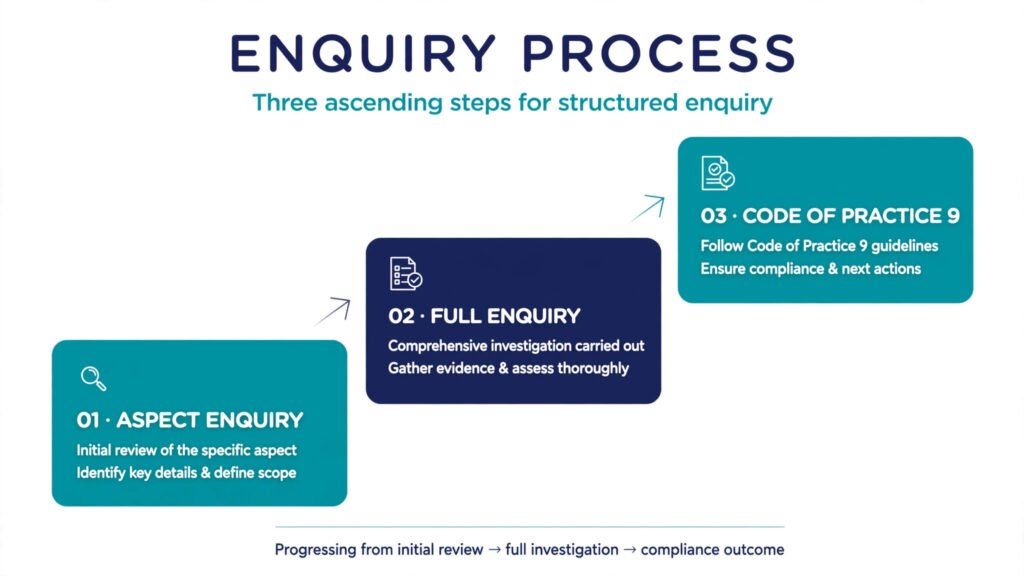
HMRC uses three broad levels of check. Knowing which one you face changes how you should respond.
| Type | What it covers | How serious? |
|---|---|---|
| Aspect enquiry | One item on your return, such as a single expense | Usually lower |
| Full enquiry | Your whole return, including all income and expenses | Higher |
| Code of Practice 9 (COP9) | Suspected serious tax fraud | Very serious |
Aspect enquiries are the most common. HMRC asks about one item and closes the check once you’ve explained it.
Full enquiries examine every part of the return. They take longer and involve more documents.
Code of Practice 9 is used when HMRC suspects deliberate evasion. It’s rare, and you should take professional advice immediately if you receive a COP9 letter. Code of Practice 8 covers cases where HMRC suspects avoidance rather than fraud.
HMRC also runs a Business Records Check, which is a visit or review to see whether your record-keeping is adequate. It’s a compliance check, not an accusation.
How Likely Is an HMRC Investigation?
For most small businesses the chance is low in any single year. HMRC opens a small percentage of enquiries relative to the millions of returns it receives. But the odds rise sharply if you have several red flags, work in a high-risk sector, or file inconsistent returns.
Being random doesn’t mean being frequent. Think of it this way: a clean return in a low-risk sector has a small chance of a check. A late return with round-number expenses and cash sales has a much bigger one.
For exact numbers, check HMRC’s latest published compliance figures on GOV.UK, as they change each year.
What to Do If HMRC Contacts You
If HMRC opens an enquiry, respond calmly and on time. A methodical reply is the best way to shorten the process.
- Read the letter carefully. Note whether it’s an aspect enquiry, full enquiry or a records check, and note the response deadline.
- Don’t ignore it. Missing deadlines can lead to penalties and information notices.
- Gather the records requested. Bank statements, invoices, receipts, contracts and accounts are typical.
- Check what HMRC actually asked. Answer the questions asked, no more and no less.
- Consider professional help. An accountant or tax adviser can handle correspondence and spot risks you might miss. Your business insurance may include tax investigation cover; our guide to UK business insurance explains what’s usually available.
- Correct any mistakes. If you find an error, tell HMRC. Disclosing errors voluntarily usually reduces penalties.
- Keep copies of everything. Log every call, letter and document you send.
HMRC has an enquiry window for Self Assessment returns. It normally runs for 12 months from the date you file. Enquiries into VAT and payroll follow different rules, and HMRC can also raise assessments outside the window in some cases.
Penalties and Time Limits
Penalties depend on the type of error and how it happened. HMRC assesses behaviour under Schedule 24 of the Finance Act 2007.
| Behaviour | Typical time limit | Maximum penalty (% of tax lost) |
|---|---|---|
| Innocent error despite reasonable care | 4 years | No penalty |
| Careless | 6 years | Up to 30% |
| Deliberate | 20 years | Up to 70% |
| Deliberate and concealed | 20 years | Up to 100% |
Penalties can be reduced if you disclose the error yourself and cooperate. Interest is also charged on unpaid tax from the original due date.
HMRC updates rates and rules from time to time, so confirm the current position on GOV.UK before you rely on any figure.
How to Reduce Your Risk
You can’t remove the chance of an enquiry, but you can make yours easy to close. Good records are your best defence.
- Keep clean records. Store invoices, receipts and bank statements for at least five years after the 31 January filing deadline.
- Separate business and personal money. Use a dedicated business bank account.
- Use bookkeeping software. Tools like FreeAgent and Xero create audit trails, and free accounting software works well for very small businesses. Receipt-capture tools such as Dext and Hubdoc cut down on lost paperwork.
- File on time, every time. Punctual returns lower your risk profile.
- Reconcile before filing. Match your return to bank statements, marketplace reports and VAT returns.
- Explain unusual changes. Keep a note for any big shift in profit or costs.
- Get advice on grey areas. If you’re unsure whether something is allowable, ask an accountant first.
- Look ahead. Making Tax Digital for Income Tax is being phased in for self-employed people and landlords, with quarterly updates replacing annual-only reporting. Check HMRC’s current timetable and thresholds.
Common Mistakes That Increase Risk
- Estimating figures instead of using records
- Claiming personal costs as business expenses
- Forgetting income from side projects or platforms
- Treating staff as self-employed without checking status
- Ignoring HMRC letters, hoping they go away
- Paying dividends without enough profit
- Throwing away records too early
FAQs
Can HMRC investigate me for no reason?
Yes. HMRC can open random enquiries without suspecting wrongdoing. Most checks come from risk analysis, but a random check is legally possible and doesn’t imply guilt.
How far back can HMRC investigate?
HMRC can go back 4 years for innocent errors, 6 years for careless errors and 20 years for deliberate behaviour. The limit depends on how the error arose.
How will I know if HMRC is investigating me?
You’ll normally get a letter or phone call. The letter states the type of check, the tax period involved and what HMRC wants from you. HMRC doesn’t usually investigate secretly.
Do I need an accountant if HMRC investigates me?
You aren’t legally required to hire one, but it’s wise for full enquiries or anything involving penalties. An adviser knows the process and can protect your position.
Is an HMRC compliance check the same as an investigation?
Not always. A compliance check can be a simple request for information or a records review. It becomes a formal enquiry only when HMRC states so in writing.
Do I have to tell HMRC if I’ve made a mistake?
Yes, if you spot a material error, you should correct it. Voluntary disclosure normally leads to lower penalties than if HMRC finds the error first.
Final Thoughts
HMRC investigation triggers for small businesses come down to patterns: late filing, figures that don’t fit the data, unusual expenses, cash-heavy trading and VAT or payroll errors. Most are avoidable with clear records and honest, punctual filing.
Start with the basics. Separate your finances, use reliable software, reconcile before you file and keep your paperwork. If a letter arrives, respond on time and get advice where the stakes are high. Being prepared turns an intimidating process into a manageable one.
This article is general guidance, not tax advice. Rules, thresholds and penalty rates change, so confirm current details on GOV.UK or with a qualified tax adviser.