

If you employ at least one person in Great Britain, auto enrolment almost certainly applies to you. The law requires you to put eligible staff into a workplace pension and pay in at least 3% of their qualifying earnings. It does not matter whether you have one employee or fifty.
This guide covers who counts as eligible, what you must pay, the steps to follow, and what happens if you slip up. It also clears up a common source of confusion: which reforms are already law, and which are not yet in force.
Last reviewed: September 2026. This guide covers Great Britain. Northern Ireland has its own separate legislation. It is general information, not personal financial advice.
Does auto enrolment apply to your business?
Auto enrolment applies to any UK employer with at least one eligible worker on the payroll. Business size, sector and legal structure do not create an exemption.
Here is a quick check by business type.
| Your situation | Do you need to auto enrol? |
|---|---|
| Sole trader with no staff | No |
| Sole trader with one or more employees | Yes, if they meet the eligibility tests |
| Limited company with one director and no other staff | No |
| Limited company with two or more directors, only one on payroll | Usually no duties, but you can choose to enrol |
| Limited company with a director plus one employee | Yes, for the employee |
| Partnership with employees | Yes, for the employees |
| Business using only genuine self-employed contractors | No |
Auto enrolment is the law that requires employers to automatically enrol eligible staff into a qualifying workplace pension and make minimum contributions. The Pensions Regulator (TPR) enforces it.
Who counts as an eligible employee?
You must automatically enrol any worker who is aged 22 or over, under State Pension age, earns more than £10,000 a year from you, and usually works in Great Britain. If all four apply, the person is an “eligible jobholder”.
The three worker categories
The law sorts your staff into three groups. Each group gets different treatment.
| Category | Who they are | What you must do |
|---|---|---|
| Eligible jobholder | Aged 22 to State Pension age, earns over £10,000 | Enrol automatically and pay contributions |
| Non-eligible jobholder | Aged 16 to 74 and earning between £6,240 and £10,000, or aged 16 to 21 or State Pension age to 74 and earning over £6,240 | Enrol only if they ask; you must pay contributions if they join |
| Entitled worker | Earns under £6,240 | Set up a scheme only if they ask; no employer contributions required |
Anyone in the second and third groups can ask to join. If they do, you must act on the request.
The 2026/27 thresholds
The government reviewed the thresholds for 2026/27 and held all three at their 2025/26 levels. That was confirmed in a written statement from the Department for Work and Pensions (DWP) on 18 December 2025.
| Threshold | Annual | Weekly | Every four weeks |
|---|---|---|---|
| Earnings trigger | £10,000 | £192 | £768 |
| Lower earnings limit (LEL) | £6,240 | £120 | £480 |
| Upper earnings limit (UEL) | £50,270 | £967 | £3,867 |
Check your figures against TPR’s current threshold table when you set up, because they are reviewed every year.
Pay reference periods
You assess earnings by pay period, not by annual salary. A worker paid weekly is tested against the weekly figure. A worker paid four-weekly is tested against £768. Mixed or irregular pay can push someone over the line in one month and back under in the next. Assess every pay period and keep records of each check.
Does auto enrolment apply to sole traders and company directors?
Sole traders with no employees do not need to auto enrol. They are self-employed, not workers of their own business. The duty starts the day you take on someone who qualifies.
Sole trader with no staff
You have no auto enrolment duties. You can still save for retirement through a personal pension or a SIPP, and you get tax relief on contributions. If you are unsure about your set-up, our guide to sole trader record keeping requirements covers what to track as your business grows.
Director-only limited company
If the only person on the payroll is a single director, you have no duty. Companies with two or more directors and no other staff are also usually exempt, because directors need an employment contract and at least one other worker to trigger the rules. TPR expects you to check your own position, so keep a note of your reasoning. Read more about company director responsibilities if you are unsure where you stand.
Director with one employee
The duty starts the moment you hire an eligible worker. That includes a family member on the payroll. Many owners assume a spouse or relative is exempt. They are not, provided they are a worker with a contract and meet the age and earnings tests.
The mistake to avoid is registering the business, hiring your first person, and forgetting to check. If you are still setting up, our first steps after registering a company guide is a useful companion. A new employee also means paperwork such as a free employment contract template.
Contractors and the self-employed
Genuinely self-employed contractors are not covered. But TPR looks at how someone actually works, not what the contract calls them. If you control when, where and how they work, they may count as a worker. The IR35 and contractor guide explains the wider test.
How much do small businesses have to pay in?
The minimum total contribution is 8% of qualifying earnings. Your share is at least 3%. The employee pays the other 5%, which includes tax relief. These rates have not changed since April 2019.
What “qualifying earnings” means
Qualifying earnings are the slice of pay between the lower earnings limit (£6,240) and the upper earnings limit (£50,270). Pay below £6,240 or above £50,270 does not count towards the minimum. Qualifying earnings include salary, wages, commission, bonuses, overtime, statutory sick pay and statutory maternity pay.
Some schemes use a wider base, such as basic pay or total pay. If your scheme does, the percentages apply to that base instead. Confirm which basis your scheme uses.
Worked examples
These use the 2026/27 thresholds. Your own payroll software will do the same sums, but seeing them once helps.
| Annual salary | Qualifying earnings | Employer 3% (yearly) | Employee 5% (yearly) |
|---|---|---|---|
| £12,000 | £5,760 | £172.80 | £288.00 |
| £24,000 | £17,760 | £532.80 | £888.00 |
| £40,000 | £33,760 | £1,012.80 | £1,688.00 |
Take the £24,000 example. Subtract £6,240 to get £17,760. Employer 3% is £532.80 a year. Employee 5% is £888.00, including tax relief.
Costs beyond the 3%
Budget for three extra items. First, payroll software may need a pension module or a paid tier. Second, some providers charge admin or set-up fees, though NEST and several others do not charge employers. Third, if you pay above the minimum, a bigger employer share will cost more.
If you are comparing tools, see our guides to the best free accounting software for UK small business and how to automate invoicing. Once you have staff, Xero and QuickBooks both connect to pension providers.
Step-by-step: what small business employers must do
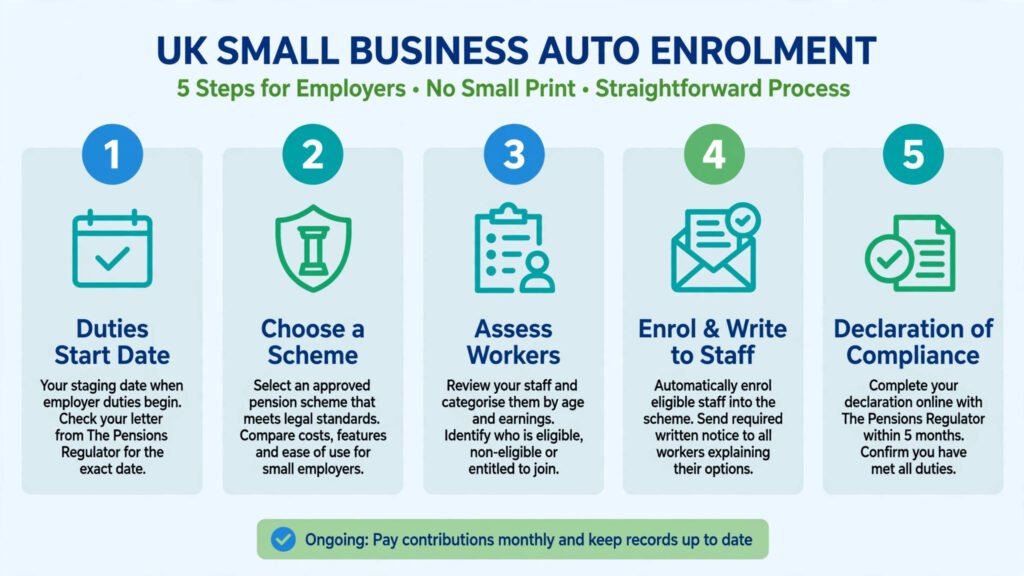
You have five main jobs, and you have five months to complete the last one. Follow them in order.
- Work out your duties start date. This is normally the day your first eligible worker starts. If you hire before you have any staff, your duties start with that hire. Use TPR’s online checker to confirm.
- Choose a qualifying pension scheme. It must meet the legal standard for auto enrolment. Do this before you enrol anyone.
- Assess your workforce. Put every worker into one of the three categories: eligible jobholder, non-eligible jobholder or entitled worker.
- Enrol and write to your staff. Enrol eligible jobholders and send each person the required written information within six weeks of the enrolment date. Contact those in the other groups if they have rights to join.
- Complete your declaration of compliance. Tell TPR what you have done. The deadline is five months from your duties start date.
Postponement: a useful option
You can delay assessing new workers for up to three months. This is called postponement. It is useful for seasonal or short-term hires who may leave before the three months end. You must still tell the worker in writing. It is not a way to avoid enrolment for staff you plan to keep.
Records to keep
Keep enrolment, opt-out and contribution records for six years. That includes the dates you assessed staff and copies of your letters. TPR can ask for them.
Choosing a pension scheme for your small business
Pick a scheme that is set up for auto enrolment and easy to run alongside your payroll. Four names come up most: NEST, NOW: Pensions, The People’s Pension and Aviva.
| Provider | Best for | Notable points |
|---|---|---|
| NEST | Micro and small employers | Created by government; accepts any employer; simple online set-up |
| NOW: Pensions | Businesses with varied or part-time staff | Suits employers with several pay patterns |
| The People’s Pension | Employers wanting broad payroll integration | Works with many payroll packages |
| Aviva | Employers who also want advice or extra features | Wider workplace pension range |
Treat this as a starting point, not a recommendation. Fees, charges and features change, so read each provider’s current terms. Check that the scheme works with your payroll software before you commit.
Salary sacrifice, relief at source and net pay are the three ways tax relief is applied. Ask your provider which one applies. Low earners can lose out under a net pay arrangement, so ask before you sign.
Ongoing duties after you set up
Auto enrolment does not end once your declaration is filed. You have four regular tasks.
New starters and staff who cross a threshold
Assess every new worker from day one. Also watch for employees whose pay rises above £10,000, who turn 22, or who move from a non-eligible group into eligible status. Each change can trigger a fresh duty to enrol.
Opt-outs and refunds
Workers can opt out within one month of joining. If they do, you must refund any contributions taken within the timeframe set by the rules. Never encourage or pressure someone to opt out. TPR treats that as prohibited conduct.
Re-enrolment every three years
Every three years you must re-enrol eligible staff who previously opted out or stopped saving. TPR gives you a re-enrolment window starting on the third anniversary of your duties start date. You can choose your own date within that window.
Re-declaration of compliance
After re-enrolment you must submit a re-declaration to TPR, usually within five months of the date your re-enrolment duties began. It is an online form that takes a few minutes. It is required even if nobody needed re-enrolling. Put the date in your calendar, or consider it part of your annual admin.
What happens if you get it wrong? Penalties and fines
TPR starts with warnings and notices. If you ignore them, fines follow. The regulator has used its powers in well over half a million cases in the last decade.
The penalty ladder
- Warning letter or compliance notice. You get a deadline to fix the problem.
- Fixed penalty notice. A flat £400 for failing to comply with a notice. The tribunal cannot reduce this figure.
- Escalating penalty notice. Daily fines from £50 for employers with one to four staff, up to £10,000 for employers with 500 or more. The fine keeps growing each day until you comply.
- Civil penalty for unpaid contributions. Up to £5,000 for individuals and £50,000 for organisations.
- Prohibited recruitment conduct penalty. Between £1,000 and £5,000, depending on staff numbers.
Ignoring a notice makes things worse. The tribunal has confirmed that inattention or a simple mistake is not a reasonable excuse.
What to do if you have already missed your deadline
Act now. The sooner you comply, the less it costs.
- Log in to TPR’s declaration service and check your status.
- Complete any missing enrolment and backdate contributions where required.
- Submit your declaration of compliance.
- Answer every letter from TPR promptly. If you get a fixed penalty, pay it by the date shown.
- If you think a notice is wrong, ask for a review before the deadline.
An accountant or payroll provider can help. Many will fix a late set-up quickly.
What is changing? Upcoming reforms to watch
Two big changes are on the horizon, but neither is in force yet. Some websites suggest otherwise, so it helps to know the facts.
The Pensions (Extension of Automatic Enrolment) Act 2023 received Royal Assent on 18 September 2023. It gives ministers the power to do two things: lower the enrolment age from 22 to 18, and remove the lower earnings limit so contributions start from the first pound. The House of Commons Library notes that the government has not used the power to remove the lower earnings limit. No start date has been set.
If both changes happen, your costs would rise, because more staff would qualify and contributions would apply to a larger slice of pay. A worker on £12,000 would move from £5,760 of qualifying earnings to £12,000.
The revived Pensions Commission is also reviewing whether people are saving enough. Industry groups have asked it to consider higher minimum contributions, possibly 12%. Nothing is decided. Follow TPR and gov.uk for confirmed dates before you change any payroll settings.
Frequently asked questions
Do sole traders need auto enrolment?
No, not for themselves. A sole trader only needs to auto enrol if they employ someone who meets the age and earnings tests.
Do I need to auto enrol if I only have one employee?
Yes, if that employee is aged 22 to State Pension age and earns over £10,000 a year. One employee is enough to trigger your duties.
Does auto enrolment apply to limited company directors?
Only if the director is on the payroll and there is at least one other worker. A director-only company with no other staff has no duty.
What is the penalty for not auto enrolling staff?
TPR can issue a £400 fixed penalty, then escalating daily fines from £50 to £10,000 depending on your staff numbers. Civil penalties apply if contributions go unpaid.
Can an employee opt out?
Yes, within one month of being enrolled. You must refund any contributions taken and must never pressure them to opt out.
Can I postpone auto enrolment?
Yes, for up to three months for new workers. You must tell each person in writing.
Your next-step checklist
- Confirm whether you have any eligible workers today.
- Note your duties start date.
- Pick a qualifying scheme that works with your payroll software.
- Assess and enrol staff, and send the required letters.
- File your declaration of compliance within five months.
- Diarise your re-enrolment and re-declaration dates for three years ahead.
- Keep records for six years.
Once your pension duties are handled, the rest of the employer basics are easier. For a wider view of running a small team, see our guides on UK business
insurance and UK GDPR compliance for small businesses.