
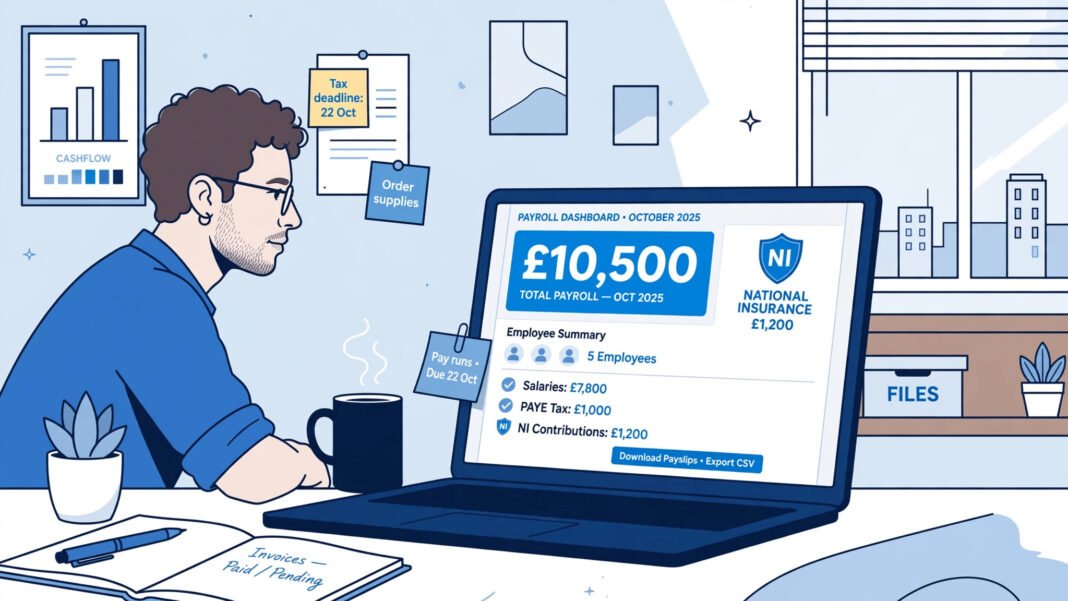

What Is Employment Allowance?
Employment Allowance is a UK government relief that lets eligible employers cut their employer National Insurance bill by up to £10,500 in the 2026/27 tax year. It only reduces secondary Class 1 National Insurance — the National Insurance you pay as an employer — not the National Insurance deducted from your staff’s wages.
You don’t get it automatically. You have to claim it through your payroll, and you have to do it every tax year.
That’s the core idea. Everything below fills in the detail.
How Much Is Employment Allowance in 2026/27?
Direct answer: £10,500. That’s the maximum you can take off your employer National Insurance bill for the tax year running from 6 April 2026 to 5 April 2027.
This figure hasn’t changed since 2025/26. What has moved is the bill it’s offsetting: employer National Insurance is now charged at 15%, and the secondary threshold (the point where employer NI kicks in) sits at £5,000 a year. So the allowance itself is flat, but it’s now covering a bigger underlying NI bill than it used to.
| Feature | 2024/25 | 2025/26 | 2026/27 |
|---|---|---|---|
| Employment Allowance | £5,000 | £10,500 | £10,500 |
| Employer NI rate | 13.8% | 15% | 15% |
| Secondary threshold | £9,100/year | £5,000/year | £5,000/year |
| NI liability cap to claim | £100,000 | Removed | Removed |
The allowance was doubled and the eligibility cap scrapped in 2025/26, specifically to soften the impact of the higher NI rate and lower threshold on smaller employers. Both changes have simply carried through unchanged into 2026/27.
Who Can Claim Employment Allowance?
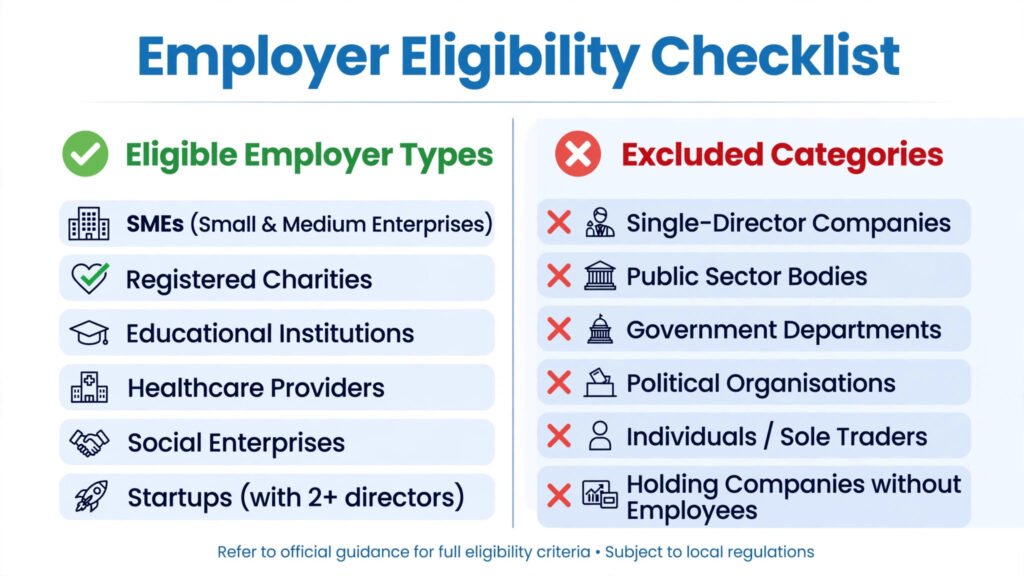
Direct answer: almost any employer paying secondary Class 1 National Insurance, provided they don’t fall into one of the excluded categories below.
That includes:
- Limited companies with employees
- Sole traders with staff on the payroll
- Partnerships with employees
- Charities and Community Amateur Sports Clubs (CASCs)
- People employing a care or support worker in their own home
Business size and turnover don’t matter here. A five-person start-up and a 40-person firm are judged the same way — what matters is the structure of who’s on the payroll, not how big the company is. If you’re a sole trader weighing up the jump to a limited company, the eligibility rules work the same on either side of that decision, as long as you employ staff.
Who Cannot Claim Employment Allowance?
The single-director exclusion
This is the rule that trips people up most often. If your company has only one employee, and that employee is also a director, you cannot claim Employment Allowance. HMRC’s reasoning is straightforward: the allowance is meant to support businesses that employ people, and a one-person company isn’t doing that.
It gets more specific once there’s more than one director. With two or more directors, you can only claim if at least two of them earn above the secondary threshold (£5,000 a year in 2026/27). One director earning above the threshold, with everyone else below it, is still treated as the single-director exclusion. This is worth checking carefully against your own company director responsibilities and payroll setup before you assume you qualify.
Public sector bodies
Businesses carrying out more than 50% of their work for the public sector can’t claim, regardless of how they’re structured.
Connected companies and multiple PAYE schemes
If your business is part of a group of connected companies — one controls the other, or both are controlled by the same person — only one company in the group can claim for the year. You choose which one, but you can’t split the allowance or claim it twice.
The same principle applies if one business runs more than one PAYE scheme. Employment Allowance is granted per employer, not per scheme, so it can only be set against one of them.
A note on IR35
Employment Allowance can’t be used against employer NI on deemed payments made under the off-payroll working rules. If you’re bringing on contractors and you’re not sure how IR35 applies to your setup, it’s worth reading up on how to take on a contractor under IR35 before you build your payroll assumptions around this allowance.
How Does Employment Allowance Work in Practice?
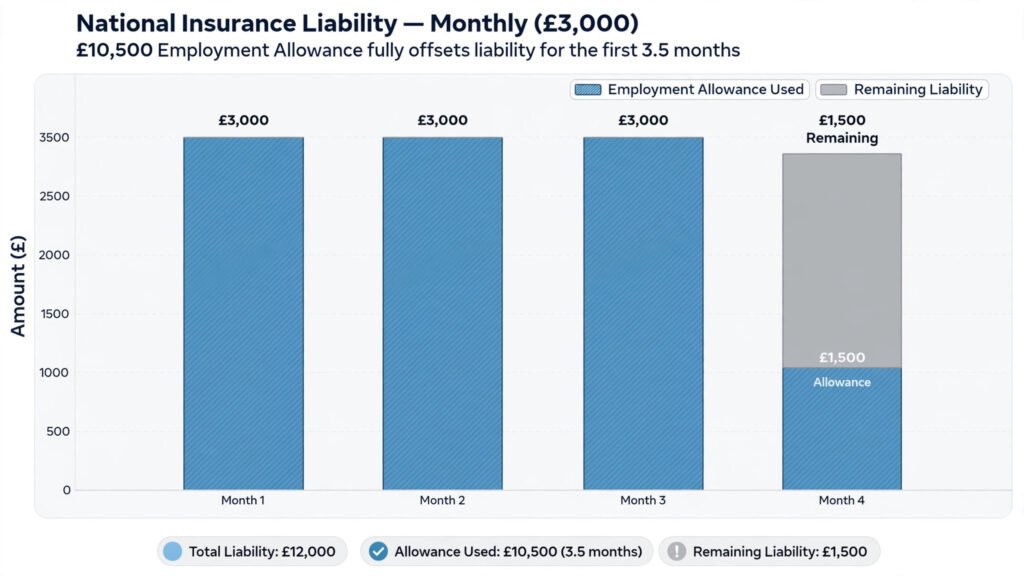
Here’s a worked example. Say a company has an employer NI bill of £3,000 a month and claims Employment Allowance from the start of the tax year.
- Month 1: £3,000 bill, fully covered by the allowance
- Month 2: £3,000 bill, fully covered
- Month 3: £3,000 bill, fully covered
- Month 4: only £1,500 of allowance remains, so £1,500 of that month’s bill is covered and the company pays the remaining £1,500
From month 5 onward, the full £10,500 has been used up, and the company pays its employer NI in full for the rest of the year.
There’s a quick way to work out your own break-even point. At the 15% employer NI rate, £10,500 of allowance covers £70,000 of NICable pay above the secondary threshold (£10,500 ÷ 0.15 = £70,000). If your total payroll above that threshold is under £70,000, the allowance could wipe out your employer NI bill for the entire year.
How Much Could You Save?
| Employees | Avg. salary | Employer NI before EA | After £10,500 EA | Saving |
|---|---|---|---|---|
| 1 | £25,000 | £3,000 | £0 | £3,000 |
| 3 | £25,000 | £9,000 | £0 | £9,000 |
| 5 | £25,000 | £15,000 | £4,500 | £10,500 |
| 5 | £35,000 | £22,500 | £12,000 | £10,500 |
| 10 | £30,000 | £37,500 | £27,000 | £10,500 |
| 20 | £30,000 | £75,000 | £64,500 | £10,500 |
Small teams on modest salaries often see their employer NI bill wiped out completely. Larger payrolls still get the full £10,500 off, but it covers a smaller share of the total bill.
How to Claim Employment Allowance
- Check your eligibility. Run through the exclusions above — single-director status, connected companies, and public sector work are the ones most likely to catch you out.
- Submit your claim through payroll software. You (or your bookkeeper) tick “Yes” against the Employment Allowance indicator on your Employer Payment Summary (EPS). If you’re still choosing a platform, most reviews of payroll-capable accounting software cover how each one handles this setting. Employers without commercial software can claim through HMRC’s Basic PAYE Tools instead.
- Claim early in the tax year. You can claim at any point, but claiming from the start gives you the most months to use the allowance against your NI bill.
- Re-claim every year. The allowance never carries forward automatically — you must submit a fresh claim each tax year, even if nothing else about your business has changed.
Can You Backdate a Claim?
Direct answer: yes, up to four previous tax years.
| Tax year | Claim deadline |
|---|---|
| 2026/27 | 5 April 2031 |
| 2025/26 | 5 April 2030 |
| 2024/25 | 5 April 2029 |
| 2023/24 | 5 April 2028 |
| 2022/23 | 5 April 2027 |
If you were eligible in a previous year but never claimed, it’s worth contacting HMRC or your payroll provider. This can turn into a genuine unexpected refund for the business.
What Happens If You Don’t Use the Full Allowance?
If your total employer NI bill for the year comes to less than £10,500, you simply pay no employer NI. The unused difference isn’t paid out to you, and it doesn’t carry over into next year’s allowance.
A different situation is if you claim partway through the year and end up with allowance you couldn’t apply before the tax year closed. In that case, you can ask HMRC to offset the unused amount against other tax you owe — VAT or Corporation Tax, for example — against other outstanding National Insurance, or refund it if you have no tax due. This only applies to leftover allowance from a late claim, not to allowance you simply never had a big enough NI bill to use up.
Employment Allowance and Other NI Reliefs
Employment Allowance stacks with several other employer NI reliefs. It applies to whatever NI bill is left once those reliefs have already reduced it.
- Under-21 relief: zero employer NI on earnings up to the upper secondary threshold for staff under 21
- Apprentice relief: the same zero-rate treatment for apprentices under 25, up to the equivalent threshold — if you’re planning to bring one on, it’s worth reading about current apprenticeship funding alongside this
- Veterans relief: zero employer NI for the first 12 months of a qualifying veteran’s civilian employment
- Freeport and Investment Zone relief: zero employer NI on new hires working in a designated Freeport or Investment Zone, up to the relevant threshold
Employment Allowance then covers whatever employer NI is left once those specific reliefs have already been applied.
De Minimis State Aid: Does It Affect You?
For most employers in Great Britain, no. Employment Allowance stopped being treated as EU de minimis state aid for the large majority of GB businesses once the UK’s own post-Brexit subsidy control framework took over, and the £100,000 liability cap that used to gate eligibility has also been scrapped.
The exception is Northern Ireland. Because of arrangements that keep parts of Northern Ireland’s economy inside EU state aid rules, some Northern Irish employers still need to treat Employment Allowance as de minimis state aid and check it against the relevant sector ceiling over a rolling three-year period. If that applies to you, confirm your position with HMRC or your accountant rather than assuming the GB rules carry across.
Common Mistakes to Avoid
- Assuming every limited company automatically qualifies — the single-director exclusion catches more businesses than people expect
- Forgetting to re-claim at the start of a new tax year, since the allowance never rolls over automatically
- Claiming from more than one company in a connected group
- Claiming against IR35 deemed payments, which isn’t permitted
- Not checking backdated years when eligibility was missed in the past — this is often unclaimed money sitting on the table
- Wrongly assuming Northern Ireland’s de minimis state aid rules apply UK-wide, or wrongly assuming they don’t apply to you if you are a Northern Ireland employer
If you’re setting up payroll for a new hire around the same time as reviewing this, it’s also worth having a solid employment contract template in place before they start.
FAQs
Can I claim if I only have one employee?
Yes, as long as that employee isn’t also the company’s sole director. One director plus one separate employee earning above the secondary threshold is enough to qualify.
What if my employer NI bill is less than £10,500?
You pay no employer NI for the year. You don’t receive the shortfall as a payment, and it doesn’t carry forward.
Do I need to claim every year?
Yes. Employment Allowance must be claimed fresh each tax year through your payroll software — it’s never applied automatically.
Can sole traders claim Employment Allowance?
Yes, provided they employ staff and pay secondary Class 1 National Insurance on those wages. A sole trader with no employees can’t claim, since they aren’t paying employer NI on their own income.
Is Employment Allowance the same as Employment and Support Allowance?
No. Employment Allowance is a National Insurance relief for employers. Employment and Support Allowance (ESA) is a separate benefit paid to individuals unable to work due to illness or disability.
Key Takeaways
- Employment Allowance is £10,500 for 2026/27, unchanged from 2025/26
- It reduces employer (secondary Class 1) National Insurance, not employee deductions
- Single-director companies with no other qualifying staff can’t claim
- Connected companies and multiple PAYE schemes only get one claim between them
- Claim through your payroll software’s EPS, fresh every tax year
- Missed claims can be backdated up to four tax years
- Northern Ireland employers should separately check the de minimis state aid position
If you’re reviewing how your accounting setup handles this, comparing options like Xero and QuickBooks is a sensible next step before your next payroll run.