


If you’re hiring your first employee, or you’ve realised your existing paperwork is out of date, you need a written statement of employment particulars in place before that person starts work. This isn’t optional. It’s a legal requirement under the Employment Rights Act 1996, and getting it wrong can leave you exposed at an employment tribunal.
Below you’ll find a free, editable UK employment contract template, a section-by-section explanation of what each clause does, and guidance on customising it for your business — whether you’re taking on a full-time employee, a part-time worker, or someone working remotely.
What Is an Employment Contract (and Is It Legally Required?)
An employment contract is the agreement, written or otherwise, that sets out the terms and conditions of employment between an employer and employee. It covers pay, hours, duties, and the statutory rights both sides are entitled to.
Yes, it’s a legal requirement. Under Section 1 of the Employment Rights Act 1996, employers must give employees and workers a written statement of employment particulars — often called the “principal statement” — no later than their first day of work. This is known as a Day 1 right, and it’s applied since April 2020, when the Good Work Plan came into force.
Before that change, employers had up to two months to issue this document. A lot of older templates and blog posts still reference that two-month window. That advice is now out of date, and relying on it could put you in breach of the law from the moment a new hire walks through the door.
A contract technically exists the moment someone accepts a job offer and starts working, even without paperwork. But without a written statement, you have no clear record of agreed terms, and any dispute becomes your word against theirs.
Free UK Employment Contract Template [Copy & Paste]
This template covers the core requirements of Section 1 of the Employment Rights Act 1996, plus the modern clauses most small businesses now need. Copy it into a document editor, delete the bracketed instructions, and fill in your own details.
—
EMPLOYMENT CONTRACT
This agreement is made between:
[Company Name], of [Registered Address] (“the Employer”)
and
[Employee Full Name], of [Employee Address] (“the Employee”)
1. Job Title, Duties, and Place of Work
The Employee is employed as [Job Title] and will report to [Manager Name/Title]. The Employee’s main duties are set out in the attached job description. The Employee’s normal place of work is [Office Address / Remote / Hybrid — specify split].
2. Commencement Date and Probationary Period
Employment begins on [Start Date]. The first [3/6] months constitute a probationary period, during which performance and suitability will be reviewed. Notice during probation is [1 week / as stated in Section 9].
3. Hours of Work
Normal working hours are [X] per week, [days/times]. This may include reasonable overtime as required by the business [paid/unpaid — specify]. The Employee [does/does not] opt out of the 48-hour average weekly limit under the Working Time Regulations 1998. [If opting out, attach a separate signed opt-out agreement.]
4. Remuneration and Payment
The Employee will be paid £[amount] per [annum/hour], paid [monthly/weekly] by bank transfer on or around the [date] of each [month/week].
5. Holiday Entitlement
The Employee is entitled to the statutory minimum of 5.6 weeks’ paid annual leave per year (28 days for a full-time employee, which may include bank holidays), plus [any additional contractual days]. Holiday year runs from [date] to [date].
6. Sickness Absence and Pay
The Employee will be paid Statutory Sick Pay (SSP) in line with current government rates and eligibility rules, for absences properly notified and evidenced in accordance with company policy. [State any enhanced company sick pay here, if offered.]
7. Pension Scheme
The Employer operates a workplace pension scheme in accordance with the Pensions Act 2008. Eligible staff will be automatically enrolled, with contributions as set out separately.
8. Notice Periods and Termination
Either party may terminate this agreement by giving the other party written notice of [X weeks/months], or the applicable statutory minimum notice period, whichever is greater. The Employer reserves the right to terminate without notice in cases of gross misconduct.
9. Confidentiality and Intellectual Property
The Employee agrees to keep confidential all business, client, and trade information encountered during employment, both during and after employment ends. Any intellectual property created by the Employee in the course of their duties belongs to the Employer.
10. Disciplinary and Grievance Procedures
The Employer’s disciplinary and grievance procedures are set out in the Staff Handbook [or attached separately]. These procedures do not form part of this contract and may be amended by the Employer at any time.
11. Governing Law
This contract is governed by the laws of England and Wales [amend for Scotland/Northern Ireland as applicable].
Signed:
Employer: _____________________ Date: __________
Employee: _____________________ Date: __________
—
A note on this template: it gives you a solid, compliant foundation, but it doesn’t constitute formal legal advice. If your hire involves commission structures, restrictive covenants, or anything unusual, it’s worth having a solicitor or HR specialist review the final version.
Written Statement of Particulars vs. Employment Contract: What’s the Difference?
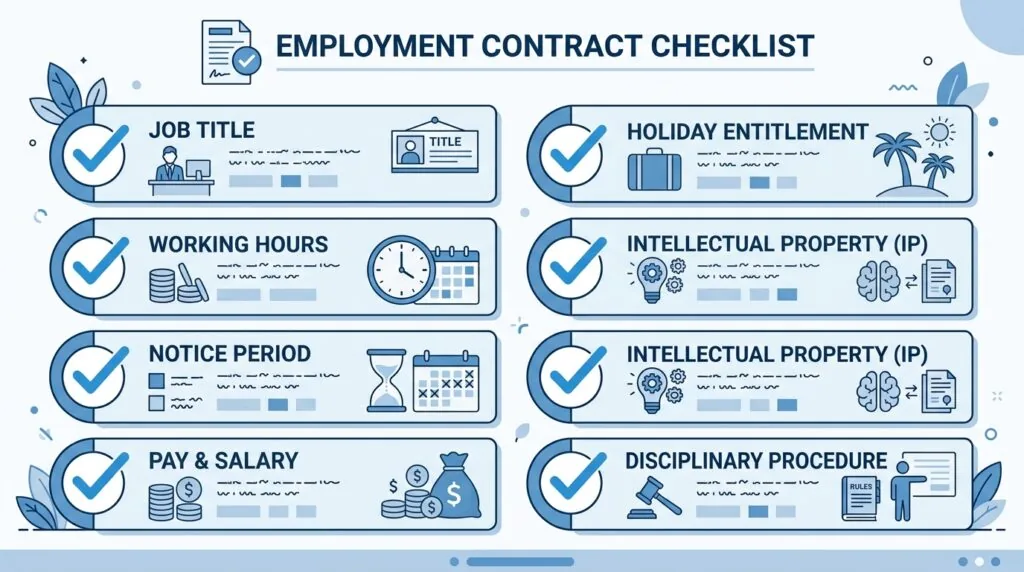
They’re related, but not identical. The written statement of particulars is the legal minimum: a document setting out specific facts about the job, required under Section 1 of the Employment Rights Act 1996. An employment contract is broader — it includes the written statement’s contents plus additional agreed terms, such as confidentiality clauses, IP assignment, and disciplinary procedures.
In practice, most small businesses combine both into a single document, which is exactly what the template above does. That’s the simplest and most defensible approach: one signed contract that satisfies your legal obligation and covers the commercial terms you actually care about.
It’s also worth noting that a contract includes more than what’s written down. Express terms are the ones explicitly agreed and stated in the document. Implied terms are the ones the law reads into every contract regardless — for example, a duty of trust and confidence between employer and employee, or the duty to pay wages for work done. You can’t contract out of statutory rights, even if a clause tries to.
Mandatory Day 1 Clauses Every UK Employer Must Include
Since the Good Work Plan came into force in April 2020, the written statement must be provided on or before the employee’s first day of work, not within two months as previously allowed. At minimum, it must include:
- Names of employer and employee
- Job title and a brief description of duties
- Start date, and whether previous employment counts toward continuous employment
- Rate of pay and how often it’s paid
- Hours of work, including any variability
- Holiday entitlement, including how it’s calculated
- Place of work, or a statement that the employee may be required to work in various locations
- Any collective agreements affecting the terms
- Sick pay entitlement (SSP or enhanced)
- Notice periods
- Duration of employment, if it’s not permanent
- Probationary period details, if applicable
Some of these details can technically be given in a second document within two months of the start date — but the core terms listed above must be in place from Day 1. Treat that as the rule, not the exception.
How to Customise This Template for Your Small Business
Full-Time vs. Part-Time Adjustments
Part-time staff have the same statutory rights as full-time employees, calculated on a pro-rata basis. Adjust the hours, pay, and holiday entitlement clauses accordingly, and make sure the contract doesn’t accidentally imply full-time obligations (like fixed daily hours) if the role is genuinely flexible.
Handling Remote and Hybrid Working
If any part of the role is remote, state it explicitly in the “place of work” clause rather than leaving it implied. Specify whether the employee is expected in the office on set days, who covers home-working equipment costs, and what happens if the arrangement changes. Vague remote-work language is one of the most common sources of later disputes.
Adding Restrictive Covenants
If the role involves access to clients, pricing, or trade secrets, you may want to add non-compete or non-solicitation clauses. These need to be narrowly drafted — covering a reasonable time period, geographic area, and scope — or a tribunal is likely to strike them out as unenforceable. This is one area where it’s genuinely worth paying for a short solicitor review rather than relying on a generic clause.
Worker vs. Employee vs. Contractor: Why It Matters
Not everyone on your payroll is legally an “employee,” and using the wrong template can grant someone rights you never intended to give them.
| Status | Key Rights | Common Mistake |
|---|---|---|
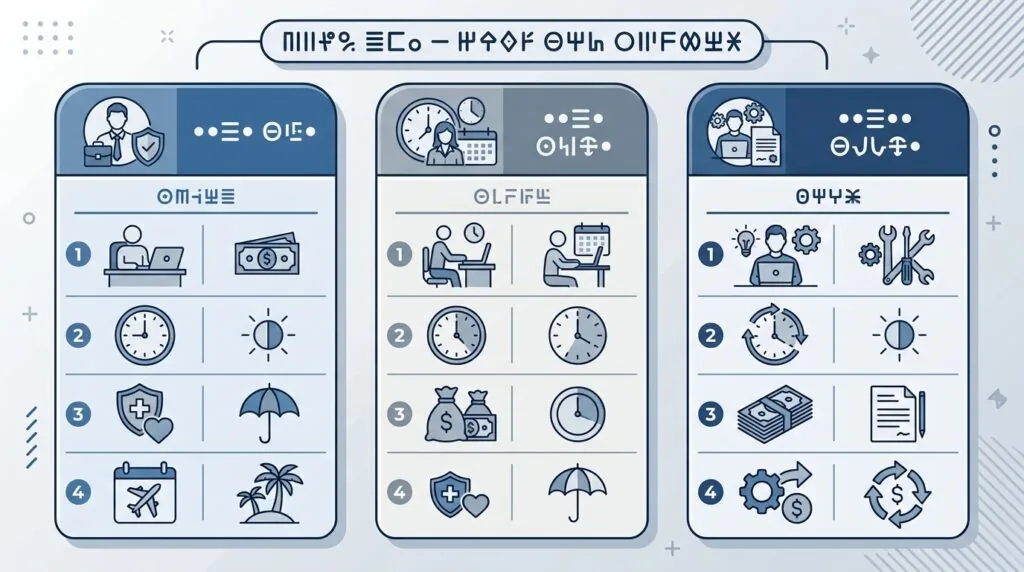
| Employee | Full statutory rights: redundancy pay, unfair dismissal protection, statutory notice, sick pay | Using a casual “worker” agreement when the relationship is actually one of employment |
| Worker | Holiday pay, National Minimum Wage, rest breaks — but not unfair dismissal or redundancy rights | Assuming zero-hours staff have no rights at all |
| Self-employed contractor | No employment rights; operates their own business | Treating a contractor like staff (fixed hours, direct supervision) without realising this can reclassify them as a worker or employee |
The label you put on the document doesn’t decide someone’s status — the actual working relationship does. If you control someone’s hours, direct their day-to-day work, and they can’t reasonably send a substitute, an employment tribunal is likely to treat them as an employee or worker regardless of what the contract says.
Crucial Legal Compliance Mistakes Small Businesses Make
Issuing the statement late. Waiting until week three or “when things calm down” is a breach of Section 1 the moment the employee starts. It’s a quick fix — issue it on Day 1, every time.
Copying a generic template without adapting it. A template written for an office-based retail business won’t fit a remote software contractor or a part-time warehouse worker without changes to hours, location, and pay structure clauses.
Forgetting IP and confidentiality clauses. This is a bigger gap than most business owners realise. Without an explicit IP assignment clause, ownership of work created by an employee can become genuinely disputed, particularly for digital, creative, and product-based businesses.
Ignoring the auto-enrolment pension duty. Every employer has automatic enrolment duties under the Pensions Act 2008 from the point they take on staff, even for a single employee. Missing this is one of the more common — and more expensive — oversights.
Not updating contracts when the law changes. Employment law shifts regularly. A contract written in 2019 is very likely non-compliant today. Build in a habit of reviewing your template annually, and check it against any incoming legislation — several changes are expected under the ongoing Employment Rights Bill reforms, which will affect notice periods and probationary practices once implemented.
Frequently Asked Questions
Is a written employment contract a legal requirement in the UK?
Yes. Employers must provide a written statement of employment particulars on or before an employee’s first day, under Section 1 of the Employment Rights Act 1996.
What must be included in a Day 1 written statement?
Job title, pay, hours, holiday entitlement, place of work, notice periods, and sick pay terms, at minimum. See the full list above.
Can a small business write its own employment contract?
Yes, as long as it meets the statutory minimum requirements. Many small businesses use a template like this one and adapt it, rather than commissioning bespoke drafting for every hire.
What is the difference between a worker and an employee in the UK?
Employees have full statutory rights, including protection from unfair dismissal and redundancy pay. Workers have core rights like holiday pay and minimum wage, but not the full protections employees get. Status depends on the real working relationship, not the job title.
What happens if I don’t give an employee a contract?
You’re in breach of the Employment Rights Act 1996. If it ends up at an employment tribunal, the tribunal can award the employee compensation — typically two to four weeks’ pay — on top of any other claim they’re bringing.
—
Before you take on your first hire, it’s worth checking what insurance a growing business actually needs, and reviewing your obligations around running payroll correctly from day one. If the role involves creative or technical work, pair this contract with a clear approach to protecting your intellectual property, and if you’re bringing in contractors instead of employees, a free NDA template is worth having ready too.