

If you’re comparing FreeAgent and Xero as a UK sole trader, the short version is this: FreeAgent is usually the simpler, cheaper starting point, especially if you bank with NatWest, RBS, Ulster Bank, or Mettle, where it’s free. Xero costs more at the entry level but scales further if your business is likely to grow beyond sole trader status.
Both are HMRC-recognised for Making Tax Digital. Neither is a bad choice. But they’re built for slightly different people, and the details matter more than either vendor’s marketing page suggests.
Quick Verdict
Choose FreeAgent if you want the lowest-hassle route to MTD compliance, you bank with NatWest, RBS, Ulster Bank, or Mettle, and you want to file your own Self Assessment without hiring an accountant.
Choose Xero if your accountant already works in it, you expect to incorporate or hire staff soon, or you need a wider range of app integrations than either platform’s basic feature set covers.
Working out how much it actually costs to run a sole trader business matters here too — accounting software is one line in a much bigger budget, and it’s worth checking how much it costs to start a business in the UK before you commit to either subscription.
FreeAgent vs Xero at a Glance
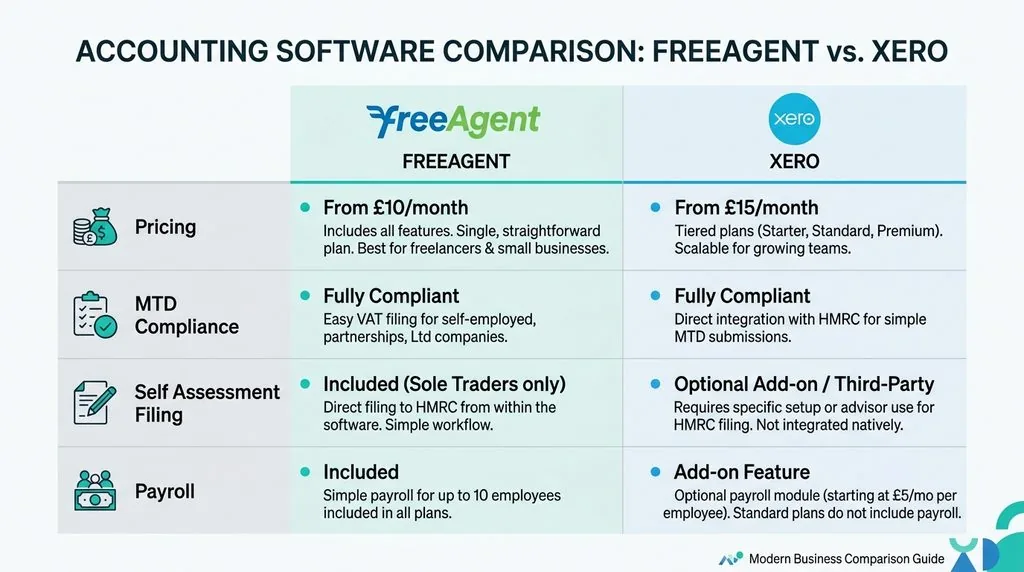
| FreeAgent | Xero | |
|---|---|---|
| Sole trader plan | From £19/month (free via eligible bank account) | From roughly £16/month (Ignite plan, ex VAT) |
| MTD for Income Tax | Yes, end-to-end | Yes, but files via bridging software or an accountant |
| Self Assessment filing | Yes, direct to HMRC | Not for individuals — accountants only |
| Payroll | Included on every plan | Extra cost or included from a higher tier |
| Mobile app | Yes | Yes |
| App ecosystem | Smaller | Much larger (1,000+ integrations) |
| Trustpilot rating | Around 4.6 | Around 4.1 |
| Best for | Solo sole traders, freelancers | Sole traders planning to grow or hire |
Pricing and plan names change fairly often on both platforms, so treat these as a starting point and check the current numbers before you buy.
What Each One Actually Is
FreeAgent: Built for Freelancers and Sole Traders
FreeAgent launched in 2007 in Edinburgh and was built specifically for freelancers, contractors, and small businesses. NatWest Group bought it in 2018, which is why it’s now bundled free with certain NatWest, RBS, Ulster Bank, and Mettle business accounts.
That heritage shows in the product. The dashboard avoids accounting jargon, the Self Assessment feature walks you through filing without needing a separate accountant, and every plan includes payroll as standard rather than as a paid add-on.
Xero: Built to Scale Beyond Sole Trader
Xero started in New Zealand in 2006 and grew into one of the largest cloud accounting platforms globally, partly by investing early in third-party integrations. That’s still its biggest strength: if you use Stripe, GoCardless, or dozens of other business tools, Xero almost certainly connects to them.
The trade-off is that Xero was designed to grow with a business, not just serve a solo trader. Its interface assumes a bit more accounting familiarity, and several features that come free with FreeAgent — like full Self Assessment filing — simply aren’t available to individuals on Xero at all.
Pricing for Sole Traders: FreeAgent vs Xero
FreeAgent Sole Trader Pricing (and How to Get It Free)
FreeAgent’s Sole Trader plan sits at roughly £19 a month, or around £190 a year, excluding VAT, with a common offer of 50% off for the first six months.
If you hold an eligible business current account with NatWest, Royal Bank of Scotland, or Ulster Bank, FreeAgent is free for as long as you keep that account open. Mettle customers get it free too, provided they make at least one transaction a month. That single detail is worth checking carefully — it’s a genuine free route, but the eligibility conditions aren’t always spelled out clearly on comparison pages.
Xero’s Plan Maze — What a Sole Trader Actually Needs
Xero’s cheapest advertised plan looks tempting on price, but it’s built for the simplest possible business and explicitly excludes expense claims and mileage tracking. Most sole traders end up needing the next tier up, which typically starts around £16 a month excluding VAT and includes proper MTD for Income Tax support plus basic payroll for one employee.
This is the detail most comparison articles skip: don’t compare FreeAgent’s Sole Trader price against Xero’s entry-level plan headline figure. Compare it against the Xero tier that actually covers expenses, mileage, and MTD ITSA — otherwise you’re comparing two different feature sets, not two prices for the same job.
Real Cost Comparison Over 12 Months
Take a freelance designer earning £38,000 a year, invoicing monthly, with no VAT registration and no staff.
- FreeAgent Sole Trader: roughly £228 a year at list price (or £0 if banking with NatWest/RBS/Ulster Bank/Mettle)
- Xero’s entry MTD-ready plan: roughly £192 a year at list price, but without built-in Self Assessment filing
On paper, Xero can be cheaper if you don’t qualify for FreeAgent’s free route. But FreeAgent bundles payroll and direct Self Assessment filing at no extra cost — features that either cost more on Xero or aren’t available at all without an accountant.
Making Tax Digital for Income Tax: Which Handles It Better
Direct answer: Both are HMRC-recognised for Making Tax Digital for Income Tax, but FreeAgent lets a sole trader file the whole thing — quarterly updates and the final declaration — without outside help. Xero doesn’t offer direct Self Assessment filing for individuals; you need bridging software or an accountant.
Self Assessment Filing — the Decisive Difference
This is the single biggest practical gap between the two platforms for a solo sole trader. FreeAgent calculates your profit or loss, applies it to a Self Assessment return, and files it directly to HMRC. Xero can track your income and expenses to MTD standard, but actually submitting your personal tax return needs a bridging tool or an accountant’s involvement.
If you don’t use an accountant and want to handle your own tax return end to end, that difference alone may settle the decision. It’s also worth understanding your broader record-keeping requirements as a sole trader, since both platforms only help if your underlying records are accurate and complete.
Deadlines and Thresholds Sole Traders Need to Know
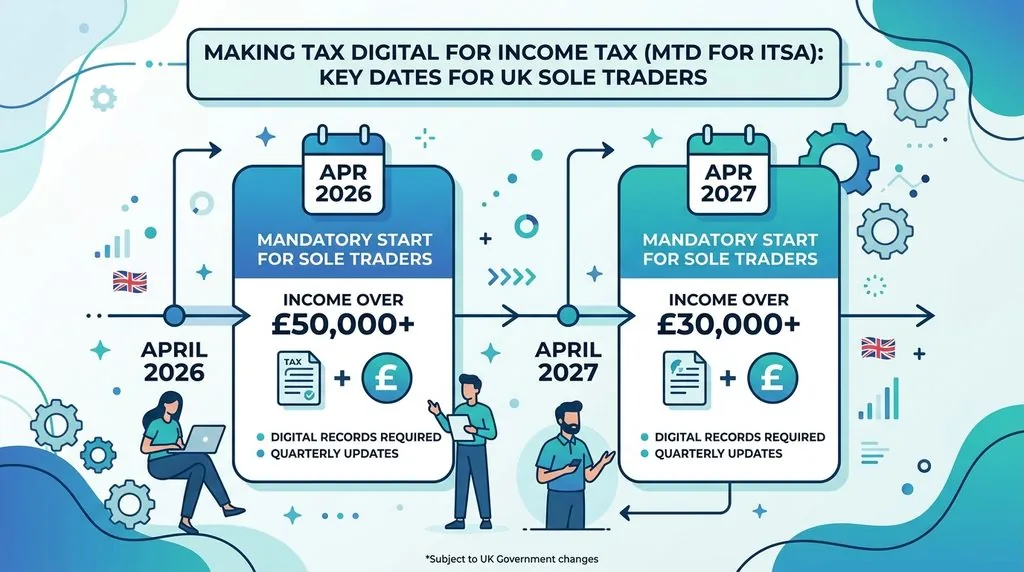
Making Tax Digital for Income Tax became mandatory from 6 April 2026 for sole traders and landlords with qualifying income over £50,000. That threshold drops to £30,000 from April 2027, which brings a much larger group of sole traders into scope.
Under MTD ITSA, you must:
- Keep digital records of income and expenses using compatible software
- Send quarterly updates to HMRC summarising your business activity
- Submit a final declaration instead of a traditional Self Assessment return
HMRC has said there are no penalty points for late quarterly updates during the first year, up to 5 April 2027 — useful breathing room, not a reason to leave your bookkeeping until January.
Features Sole Traders Care About Most
Invoicing, Bank Feeds, and Expenses
Both platforms handle the basics well: automated bank feeds, recurring invoices, payment reminders, and expense tracking. FreeAgent includes Smart Capture for scanning receipts, with 10 free captures a month before a small add-on fee applies. Xero’s equivalent, built around Hubdoc, is generally included at no extra cost on its higher tiers.
Both connect to common payment tools. If you’re deciding how customers actually pay you, it’s worth reading a dedicated Stripe vs PayPal comparison alongside your accounting software choice, since the payment processor you pick affects how cleanly transactions reconcile in either system.
Mileage and Receipt Capture
Mileage tracking is included as standard on FreeAgent. On Xero, it depends heavily on which plan you’re on — it’s missing entirely from the cheapest tier, which catches a lot of new users out. If you drive regularly for client work, check this specifically rather than assuming it’s bundled.
Payroll
FreeAgent includes payroll on every plan, with no per-employee charge for basic use. Xero’s payroll is typically included from its mid-tier plan upward, usually covering a small number of users before per-employee charges kick in. If you’re a sole trader who pays yourself as a CIS subcontractor or takes on the occasional helper, FreeAgent’s flat inclusion is the simpler option.
Both platforms have started adding AI-assisted features — FreeAgent’s Radar flags overdue invoices and cash flow trends, while Xero’s JAX assistant answers questions and helps draft invoices through natural language. Neither is essential, but if you’re curious how AI tools are showing up across small business software generally, our guide to AI for UK small businesses covers the wider trend.
FreeAgent also includes built-in time tracking and project profitability reporting, which suits consultants and contractors who bill by the hour. If project and task tracking matters to how you run your business day to day, it’s worth comparing that against a dedicated task management app rather than assuming your accounting software will cover it fully.
Ease of Use and Support
FreeAgent is generally considered the easier platform to pick up without an accounting background — the language avoids jargon, and UK-based support accountants are reachable by phone, live chat, and email, including a free 20-minute onboarding call.
Xero’s support has shifted from a basic web-form model toward 24/7 case-based support plus an AI assistant, which narrows the gap that used to exist. It’s still generally seen as requiring a slightly steeper learning curve, particularly if you’re setting it up without an accountant guiding you.
Since both platforms hold your financial data in the cloud, it’s also worth having basic protections like two-factor authentication switched on for whichever account you choose, regardless of which software you pick.
What Real Users Say
Community discussion on forums like Reddit’s r/ukaccounting and small business Facebook groups broadly lines up with the vendor comparisons. FreeAgent tends to get recommended by people who want something straightforward, tax-focused, and ideally free through a bank account bundle. Xero gets recommended more by people who expect a bigger setup, already work with an accountant who uses it, or need the wider app ecosystem — though price increases and plan-limit confusion come up regularly as complaints.
Trustpilot scores reflect a similar pattern: FreeAgent generally sits around 4.6, rated “Excellent,” while Xero sits closer to 4.1, rated “Great.” Neither figure tells the whole story, but the direction is consistent across independent review sources, not just each vendor’s own marketing.
FreeAgent vs Xero: Who Should Choose Which
Choose FreeAgent if:
- You’re a straightforward sole trader or freelancer with simple admin
- You bank with NatWest, RBS, Ulster Bank, or Mettle
- You want to file your own Self Assessment without an accountant
- You want payroll included without extra fees
Choose Xero if:
- Your accountant already works in Xero and prefers it
- You expect to incorporate, hire staff, or scale up soon
- You need a wide range of third-party app integrations
- Multi-currency invoicing is a regular part of your work
If growth is genuinely on the horizon, it’s worth reading up on what’s involved in moving from sole trader to a limited company before you pick software — the platform that suits you as a solo trader isn’t always the one you’ll want in eighteen months. More broadly, our guide on how to scale a small business in the UK is worth reading alongside this decision if expansion is part of your plan.
Switching Between Them
Both platforms support importing historical data, though neither switch is instant. Before moving:
- Export your current chart of accounts, contacts, and outstanding invoices
- Check your VAT and MTD filing history transfers cleanly, or confirm with an accountant
- Run both platforms in parallel for one reporting period before fully cutting over
- Cancel the old subscription only once your first live filing period is complete
If you’re not VAT registered and haven’t filed under MTD yet, switching is considerably lower-risk — there’s simply less historical data to reconcile.
FAQs
Is FreeAgent or Xero better for sole traders?
FreeAgent is usually better for a solo sole trader who wants simplicity and self-filed Self Assessment. Xero is usually better if you work with an accountant already using it or expect to grow beyond sole trader status.
Is FreeAgent cheaper than Xero?
At list price, FreeAgent’s Sole Trader plan and Xero’s MTD-ready entry plan are broadly similar in cost. FreeAgent becomes significantly cheaper — free — if you bank with NatWest, RBS, Ulster Bank, or Mettle.
Can I get FreeAgent for free as a sole trader?
Yes, if you hold an eligible NatWest, Royal Bank of Scotland, or Ulster Bank business current account, or a Mettle account with at least one transaction a month.
Does Xero do Self Assessment for sole traders?
No, not directly for individuals. Xero tracks MTD-compliant records, but filing a personal Self Assessment return requires bridging software or an accountant.
Do sole traders need MTD-compliant software in 2026?
Yes, if your qualifying income from self-employment or property exceeds £50,000. That threshold drops to £30,000 from April 2027.
Which is easier to use, Xero or FreeAgent?
FreeAgent is generally considered easier for non-accountants, with a simpler interface and UK-based support built around sole traders specifically.