


Tidio is the better pick for most UK small businesses. It costs less, takes less time to set up and suits teams of one to ten. Intercom is the stronger platform for support-led teams that want deeper automation. It is also much more expensive once you add its AI agent, Fin.
Both tools do live chat, a shared inbox and AI answers. The real difference is how they charge you. That is where small businesses get caught out.
Tidio vs Intercom at a glance
Tidio charges mainly by conversation volume. Intercom charges per agent seat, then adds a fee for each AI resolution.
| Tidio | Intercom | |
|---|---|---|
| Free plan | Yes (50 billable conversations a month) | No standard free plan (trial only) |
| Entry paid price | About $29/month (Starter) | About $29 per seat/month on annual billing (Essential) |
| Pricing model | Per conversation, plus AI and automation add-ons | Per seat, plus $0.99 per Fin resolution |
| AI agent | Lyro (separate add-on from about $39/month) | Fin (available on every plan, billed per resolution) |
| Setup | Quick, no developer needed | Longer, built for support teams |
| Best for | Solo owners and teams of 1-10, ecommerce | Teams of 5+ with complex support |
| Data processing agreement | Available on request | Published DPA covering UK data protection law |
Intercom has also reportedly rebranded around the Fin name in 2026, and Salesforce has agreed to acquire it. Expect product and packaging changes. If you plan to commit to an annual contract, ask about price protection.
Pricing compared: what UK small businesses really pay
Sticker prices mislead here. Tidio looks cheap because the AI is sold separately. Intercom looks cheap because the seat price is only half the bill.
Tidio pricing
Tidio’s paid plans start at about $29 a month for Starter (100 billable conversations) and $59 for Growth (250 conversations). Higher Growth tiers scale up with volume, and a Plus plan starts far higher at around $300 a month. Self-service plans cap at 10 agents.
The free plan covers 50 billable conversations a month, live chat and ticketing. It includes a one-time allowance of 50 Lyro AI conversations. That allowance does not renew.
Watch three things:
- Conversation caps. Go over your tier and you must upgrade.
- Lyro costs extra. The add-on starts at about $39 for 50 AI conversations a month.
- Flows are metered. Automated visitor outreach has its own limit.
One aggregator lists Tidio prices per user, while Tidio’s own model bills by conversation. Check which one your plan uses at checkout.
Intercom pricing
Intercom has three seat plans, all per agent per month:
| Plan | Annual billing | Monthly billing |
|---|---|---|
| Essential | $29 | $39 |
| Advanced | $85 | $99 |
| Expert | $132 | $139 |
Fin AI adds $0.99 for each resolution. Guides report a minimum of 50 billable outcomes a month, and no volume discount. A conversation can count as resolved if the customer simply stops replying for 24 hours. So you may pay for a resolution the customer never confirmed.
Other add-ons include Copilot (an assistant for your agents) at about $29 per seat on annual billing. Channel fees, such as WhatsApp, are extra.
Cheap annual rates also need a year’s commitment. Pay monthly and the same seat costs about 30% more on Essential.
Worked cost examples
These are estimates using annual seat pricing and published list prices. They exclude VAT, card fees and add-ons.
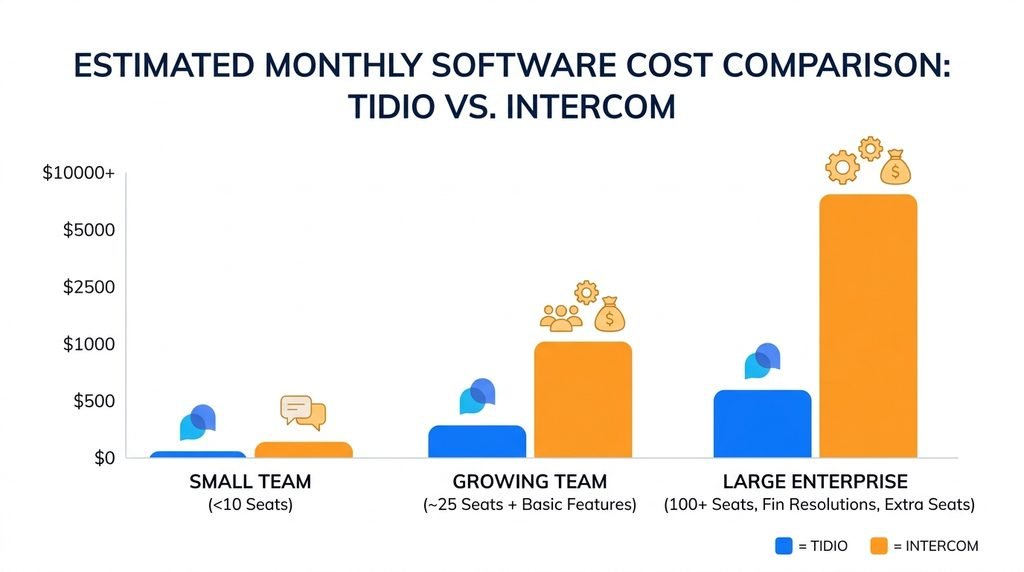
| Scenario | Tidio | Intercom |
|---|---|---|
| Solo owner, about 80 chats a month, light AI | $0 (Free) to $29 (Starter) | $29 (1 Essential seat) + about $50 minimum Fin fee = about $79 |
| 5 agents, 250 chats, 300 AI resolutions | About $59 (Growth) + Lyro add-on = roughly $100-$140 | 5 × $29 = $145 + 300 × $0.99 = $297, total about $442 |
| 10 agents, 400 chats, 300 AI resolutions | About $89 (Growth) + Lyro add-on = roughly $130-$190 | 10 × $85 (Advanced) = $850 + $297, total about $1,147 |
The five- and ten-agent Tidio figures are rough because Lyro’s add-on cost depends on your volume. Ask Tidio for a quote at your expected usage.
At the time of writing, $1 is worth a little under 80p, so Intercom’s five-agent example works out near £330 a month. Exchange rates move, so recheck before budgeting.
Two UK money points. First, US vendors often show prices without VAT. If you are VAT-registered, you can usually reclaim it. If not, add 20% to your budget. Second, you may pay in dollars. Your bank’s foreign transaction fee, if any, is a real cost.
AI chatbots: Tidio Lyro vs Intercom Fin
Fin is generally the more capable AI agent, but Lyro is far cheaper to run for a small shop. Both answer customer questions from your help articles and website content, then pass tricky cases to a human.
Here is how they differ:
- Billing. Lyro is sold as a monthly bundle of AI conversations, with extras at roughly 2-5 cents each. Fin charges $0.99 per resolution, so your bill rises with success.
- Depth. Fin handles multi-step tasks and works across channels, including voice. Lyro is strongest on structured, repeat questions like delivery times and returns.
- Control. Fin’s pricing rewards deflection. If it resolves 300 chats a month, you pay about $297. If it resolves 2,000, you pay nearly $2,000.
Neither AI is perfect. Both can give wrong answers if your help content is thin or outdated. Before you switch an AI agent on, write clear answers for your top 20 customer questions, then test it with real queries. Our guide on how to add an AI chatbot to your website covers that process.
A simple break-even test: if a human reply costs you £2-£5 in staff time, Fin at about 80p per resolution can still pay off. If you receive 100 chats a month, though, that saving is small.
Ease of setup and daily use
Tidio is faster to set up. Most owners can install the widget on Shopify, WooCommerce or WordPress and publish a first chatbot flow in an afternoon. The visual flow builder needs no code.
Intercom takes longer. Its inbox, ticketing, workflows and reporting are more powerful, but you need to configure them. Expect a few days to get Fin trained and tested, and more if you use several channels.
If you do not have a dedicated support person, Tidio’s lighter interface is easier to live with. If you do, Intercom’s structure helps them work faster.
Features small teams actually need
Live chat and inbox
Both give you a shared inbox that brings website chat, email and social messages together. Intercom adds more routing, SLAs and team inboxes on its higher plans. Tidio keeps this simple, which suits small teams.
Automation and flows
Tidio’s flows trigger on visitor behaviour, such as an abandoned cart or a long time on a pricing page. Intercom’s workflows are deeper but sit mainly on Advanced and above.
Ecommerce and integrations
Tidio is built with online shops in mind, with Shopify, WooCommerce and Wix integrations. If you run a store, compare it with your platform choice first. Our Shopify vs WooCommerce guide helps with that decision. Intercom connects widely too, but suits software and service businesses better.
Reporting
Intercom’s reporting is the stronger of the two: response times, resolution rates and team performance. Tidio’s reports cover the basics. Small teams rarely miss the extra depth.
UK-specific considerations
Under UK GDPR, you remain responsible for customer data even when a vendor handles it. Any live chat tool is a data processor, so you need a data processing agreement (DPA) in place.
Use this checklist before you sign up:
- Get a DPA. Intercom publishes a DPA that covers UK data protection law. Tidio provides one on request, by emailing its support team.
- Check data location. Intercom offers EU data hosting, but it is not the default. It is arranged through sales and tied to higher plans, and some features still use processing outside the region. Ask both vendors where chat transcripts and AI processing happen.
- Update your privacy notice. Say that you use live chat and AI to answer queries.
- Handle cookies. Chat widgets often set cookies or similar tech. Get consent where required under PECR.
- Plan for data requests. Know how to export or delete a customer’s chat history.
Our UK GDPR compliance checklist goes through each step. Check too whether you must pay the ICO fee, covered in our ICO registration guide.
Rules around AI are also changing. If your chatbot talks to customers, keep an eye on how UK AI regulation develops. We track it in our piece on the UK AI Act and small business. This is general information, not legal advice.
Pros and cons
| Pros | Cons | |
|---|---|---|
| Tidio | Free plan; cheap entry; quick setup; strong ecommerce fit | AI and flows cost extra; conversation caps; lighter reporting |
| Intercom | Powerful inbox and automation; advanced AI; strong reporting | Costs climb fast; per-resolution AI fees; steeper learning curve |
Which should you choose?
Choose Tidio if:
- You have one to ten people handling chat.
- You run an online shop or a simple service site.
- You want a predictable bill under about £100 a month.
- You need to be live this week, without technical help.
Choose Intercom if:
- You have a dedicated support team of five or more.
- You expect high AI volume and have costed it.
- You need routing, SLAs or detailed reporting.
- Support is central to how you keep customers.
If you are unsure, start on Tidio’s free plan. Moving later to Intercom is easier than the other way round, once you know your real chat volume. For a wider view, see our roundup of the best live chat software for UK small business.
Alternatives worth considering
- Crisp and tawk.to suit very tight budgets.
- Zendesk and Freshdesk suit ticket-heavy support.
- HubSpot suits teams that want chat linked to a CRM.
For other tools that save time, see our list of the best AI tools for UK small business.
FAQs
Is Tidio better than Intercom for a small business?
For most small businesses, yes. Tidio costs less, is simpler to set up, and has a free plan. Intercom is better if you have a larger support team and need advanced automation and reporting.
How much does Intercom cost for a UK small business?
Intercom seats start at about $29 per agent per month on annual billing. Fin AI adds $0.99 per resolution. A five-agent team with 300 AI resolutions pays roughly $440 a month before VAT.
Does Tidio have a free plan?
Yes. Tidio’s free plan includes 50 billable conversations a month, live chat and ticketing. It also gives a one-time allowance of 50 Lyro AI conversations. Beyond that, you need a paid plan or add-on.
Which has the better AI chatbot, Lyro or Fin?
Fin is more capable on complex, multi-step queries and works across more channels. Lyro is cheaper and handles routine questions well. For small shops with modest volume, Lyro usually gives better value.
Are Tidio and Intercom UK GDPR compliant?
Both offer a data processing agreement, and Intercom’s DPA explicitly covers UK data protection law. Compliance still depends on how you use the tool. Update your privacy notice, handle cookie consent, and confirm data location with each vendor.
Final recommendation
Pick Tidio unless you already know you need Intercom’s depth. It gives small UK teams live chat, a usable AI agent and a bill that stays low. Intercom earns its price when support is a core function and your volumes justify it.
Whichever you choose, model your costs with real chat numbers first. Then confirm the DPA and data location, and secure your account with two-factor authentication. If chat volume grows, our guide on how to scale a small business in the UK can help you plan the next step.