

Small UK businesses face real pressure to get GDPR right. One data breach or missed DSAR can trigger an ICO investigation and fines that hit hard. Tools that automate consent, data mapping, and policies make the difference between constant worry and steady operations.
This guide covers what UK GDPR means for SMEs, a clear checklist, the best tools that actually work for small teams, and how to implement them without overspending.
Understanding UK GDPR for Small Businesses
UK GDPR, paired with the Data Protection Act 2018, governs how you handle personal data of UK residents. It largely mirrors EU GDPR but operates under the ICO as the supervisory authority.
Most small businesses qualify as data controllers. You must follow seven key principles: lawfulness, fairness, transparency, purpose limitation, data minimisation, accuracy, storage limitation, integrity, confidentiality, and accountability.
Key differences from EU GDPR post-Brexit: UK-specific rules on international transfers and ICO enforcement. Fines reach up to £17.5 million or 4% of global annual turnover, whichever is higher. Recent cases show the ICO targeting security failures in ransomware incidents, with penalties like £14m for Capita in 2025.
For small businesses, the focus stays practical. You don’t need a full-time DPO unless your core activities involve large-scale monitoring or special category data.
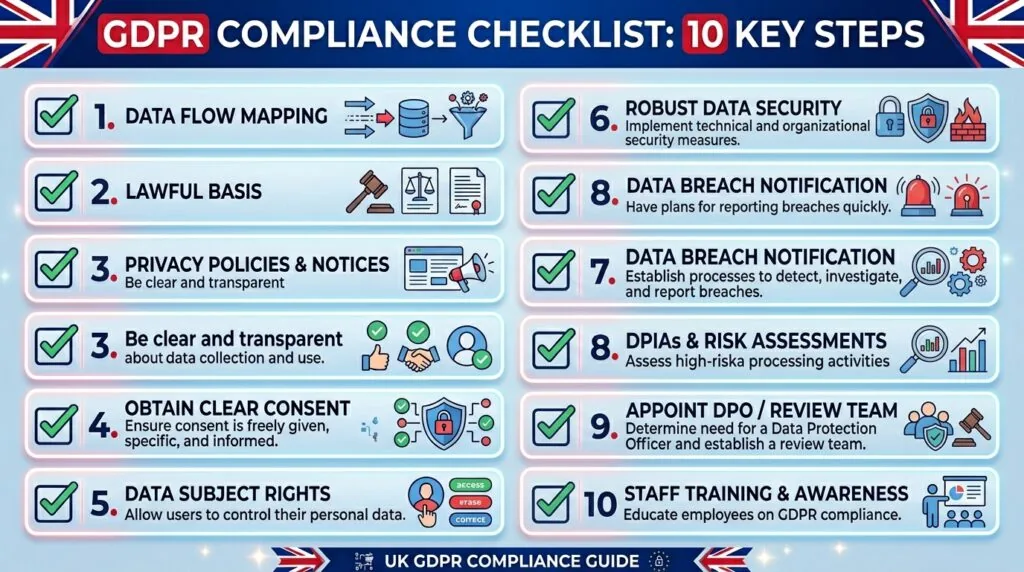
Essential GDPR Checklist for UK SMEs
Follow these steps in rough priority order. Many businesses complete the basics in a few weeks.
- Map your data (RoPA): List what personal data you hold, where it comes from, why you process it, where it’s stored, who accesses it, and retention periods. Article 30 requires this record for most organisations.
- Choose lawful bases: Document consent, contract, legitimate interests, or legal obligation for each activity. Legitimate interest assessments help justify marketing or fraud prevention.
- Create privacy notices: Write clear policies for your website and customers explaining data use, rights, and contact details.
- Handle cookies and consent: Use a compliant banner for non-essential cookies under PECR. Record consent properly.
- Secure data: Apply appropriate technical and organisational measures. Basic steps include encryption, access controls, and regular updates.
- Prepare for DSARs: Have a process to respond to access, erasure, or portability requests within one month.
- Sign processor agreements: Use Data Processing Agreements (DPAs) with suppliers like cloud providers or email tools.
- Breach response plan: Document how you’ll detect, assess, and notify the ICO within 72 hours if there’s risk to individuals.
- Staff training and policies: Ensure employees understand their responsibilities.
- Register with ICO if required and pay the data protection fee.
Tools speed up steps 1, 3, 4, and 6 significantly.
Top GDPR Compliance Tools for Small Businesses in the UK
Here are practical options suited to budgets and needs under £500/month for most SMEs.
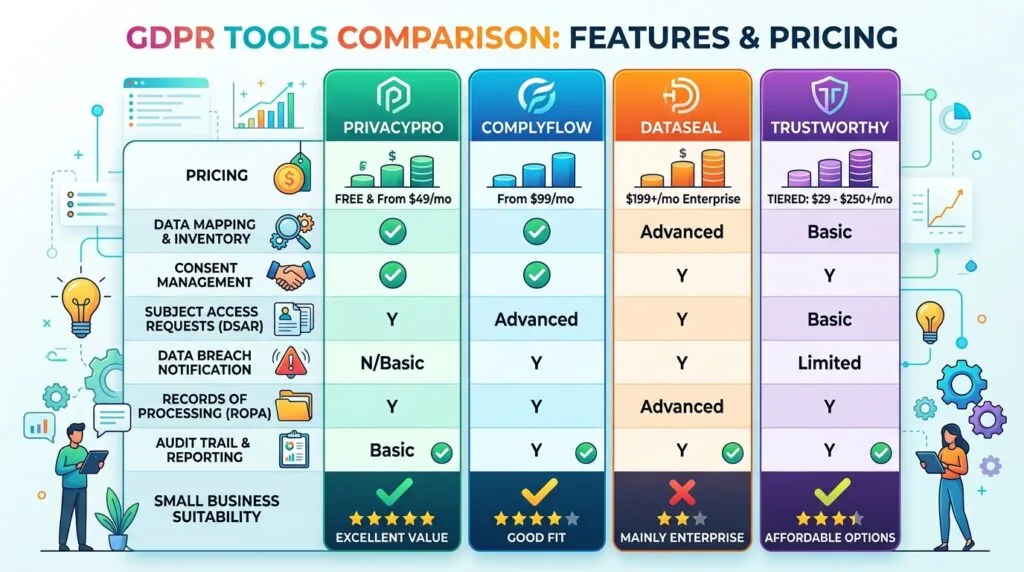
Usercentrics stands out for comprehensive consent management. It offers cookie banners, policy generators, and DSAR tools with strong analytics. Good for websites with traffic. Pricing starts around €9-€99/month depending on scale. Pros: Easy integration with WordPress/Shopify, high consent rates. Cons: Can feel feature-heavy for the smallest teams.
Termly works well for beginners. It auto-generates privacy policies, handles consent, and scans sites. Affordable plans from $10-50/month. Ideal if you want quick setup without legal help.
iubenda provides all-in-one coverage including consent, policies, and international compliance. Popular among e-commerce sites. Starts from €7-€99/month.
Secure Privacy focuses on automated banners and consent. Strong for multi-language or international small businesses.
Sprinto or DataGuard suit teams wanting broader automation around audits, risk assessments, and evidence collection. These lean toward mid-range pricing but deliver time savings on ongoing compliance.
Other mentions: Cookiebot for cookie-focused needs, Osano for privacy management, and UK-friendly options like PrivacyEngine.
Comparison Snapshot (typical for small UK businesses):
- Best overall ease: Termly or iubenda
- Best for consent banners: Usercentrics
- Best automation depth: Sprinto / DataGuard
- Budget pick: Termly free tier + paid upgrade
Choose based on your main pain point — website consent, data mapping, or full audit readiness.
How to Choose and Implement the Right Tool
Start with your biggest gap. Website-heavy businesses prioritise consent platforms. Those with employee or customer databases need strong data mapping.
Must-have features for SMEs:
- Automatic policy updates
- Consent recording and withdrawal
- DSAR workflow
- Integrations with common tools (Google Workspace, Shopify, WordPress)
- Clear audit logs for ICO
- Affordable monthly pricing without long contracts
Implementation steps:
- Run a free trial or demo.
- Import existing data map or policies.
- Connect your website and key apps.
- Test consent flows and DSAR simulation.
- Train your team (usually 1-2 hours).
- Monitor reports for issues.
Most tools claim 50-85% reduction in manual compliance work.
Step-by-Step Guide to Getting Compliant
Begin with the checklist above. Pick one tool to handle the repetitive parts.
Week 1: Complete data mapping and lawful basis review.
Week 2: Deploy consent solution and update privacy policy.
Week 3: Set up DSAR and breach templates.
Ongoing: Review quarterly or when processes change.
Track everything in your RoPA. Document decisions — this proves accountability.
Common Pitfalls and Cost-Saving Tips
Many small businesses underestimate ongoing maintenance. Data flows change with new tools or staff. Tools with automation reduce this risk.
Avoid buying enterprise platforms too early. Start simple and scale.
Costs: Expect £200-£1,500/year for solid tools plus initial setup time. ROI comes from avoided fines, faster customer trust, and smoother operations.
Recent ICO actions show security remains the biggest issue. Tools with built-in risk alerts help here.
Conclusion and Next Steps
GDPR compliance protects your business and builds customer confidence. Start with a basic data map and privacy policy this week. Add one targeted tool to automate the heaviest lifts.
Visit the ICO website for official templates and guidance. Review your setup every six months or after major changes.
Take action today. Map one data flow or test a tool trial. Small consistent steps keep you compliant without overwhelming your team.