Britain’s copper phone network is being switched off for good on 31 January 2027. If your business still runs on a traditional landline or ISDN line, you need a plan — and for most small businesses, that plan is VoIP. This guide compares the providers actually worth considering, breaks down real pricing, and covers the technical details competitors tend to skip: bandwidth needs, number porting rules, and where each provider falls short.
What Is a Small Business VoIP Phone System?
A business VoIP (Voice over Internet Protocol) system is a cloud-based calling service that sends calls over your internet connection instead of a traditional copper PSTN or ISDN line. It turns your voice into digital data packets, so your team can make and receive calls from a physical IP desk phone, a laptop, or a mobile app — all using the same business number.
How Cloud-Based Calling Operates
There’s no phone cabinet in a cupboard anymore. The provider hosts your entire phone system — call routing, voicemail, IVR menus — on their servers, and you manage it through a web portal. When someone dials your business number, the call is routed digitally through the provider’s cloud platform using SIP (Session Initiation Protocol) and connected to whichever device you’ve registered: a desk phone, a softphone app on your laptop, or your mobile.
Most providers now bundle this with wider virtual meeting tools and team chat, which is why the category is often called UCaaS (Unified Communications as a Service) rather than just “VoIP.” Many plans also plug into your CRM system, so incoming calls can pop up with customer history attached.
The UK PSTN Landline Switch-Off (January 2027)
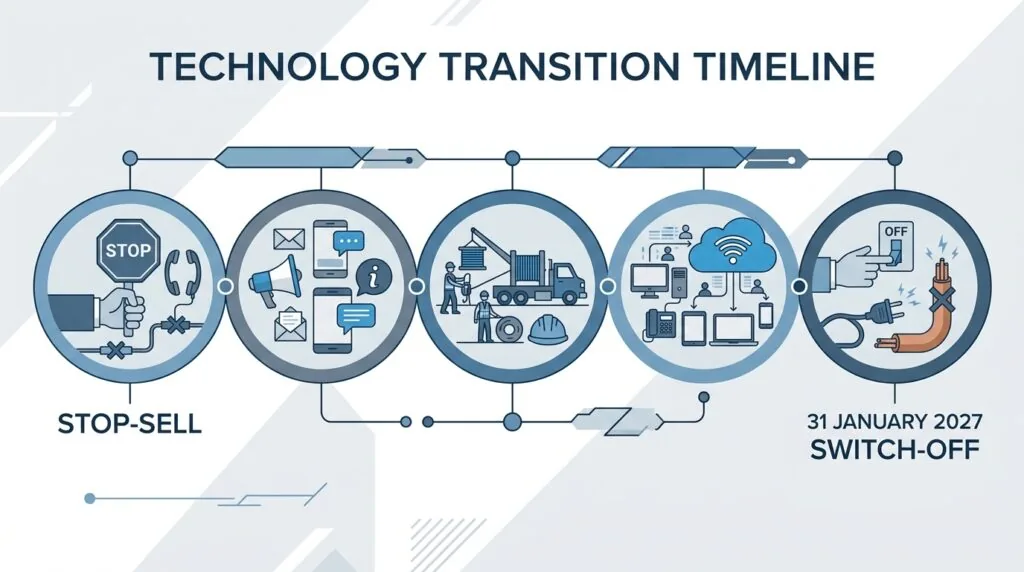
Openreach is permanently retiring the UK’s analogue phone network on 31 January 2027. After that date, traditional copper-based phone lines will stop working entirely, and any business still relying on them — including alarm systems, card machines and lift lines that run over old phone wiring — needs to have migrated to an internet-based system beforehand.
This isn’t a distant deadline anymore. Openreach has confirmed there will be no further delay, and it has already stopped selling new copper-based lines in most exchanges through its “stop-sell” programme. Legacy line rental prices are also being increased in stages through 2026 to encourage the final wave of migrations. If you’re still on a landline, budget for the move now rather than waiting for a forced cutover.
Comparison of the Best UK Business VoIP Providers
Here’s how the five most relevant UK providers compare on price, contract terms and who they actually suit. Prices are indicative starting points per user, per month, excluding VAT.
| Provider | Best For | Starting Price | Contract | Standout Feature |
|---|---|---|---|---|
| bOnline | Startups & micro-businesses | From ~£7/user | 12–24 months typical | Low entry price, desk phone included on higher tiers |
| RingCentral RingEX | Growing teams & unified comms | From ~£16/user | Annual or monthly | Video, team chat and 500+ integrations |
| BT Cloud Voice | Telecom reliability & bundling | Quote-based | Typically 12+ months | Runs on BT’s own network and support footprint |
| Voipfone | Pay-as-you-go & flexibility | From £1.50/user | Rolling monthly | No lock-in, transparent per-feature pricing |
| Air Landline | Sole traders & mobile-only routing | From £9.99/month | No contract | Instant setup, calls divert straight to your mobile |
1. bOnline (Best Overall for Startups & Micro-Businesses)
bOnline’s Starter plan is one of the cheapest genuine VoIP packages on the market, but it only includes around 100 outbound minutes, so outbound-heavy teams will outgrow it quickly. Read the contract carefully: bOnline typically locks customers into 12- or 24-month terms with an early-termination fee, and published plan prices tend to rise by roughly £1.50 per user each April. It’s a strong starting point for a one- or two-person business, but model your real call volume before signing.
2. RingCentral RingEX (Best for Growing Teams & Unified Communications)
RingCentral is priced in dollars, with Core plans starting around £16 per user per month (annual billing) and rising to roughly £28 for the Ultra tier. Its strength is scale: unlimited domestic calling, video meetings, and one of the largest integration libraries in the market, which matters once you’re ready to hire your first employee and need shared call handling. The catch is add-ons — features like the AI receptionist or extra call recording sit outside the base plan and can meaningfully increase your monthly bill if you don’t check what’s included first.
3. BT Cloud Voice (Best for Telecom Reliability & Bundled Broadband)
BT Cloud Voice runs on BT’s own fibre network and support infrastructure, which appeals to businesses that already buy broadband or mobile from BT and want one supplier and one bill. The trade-off is speed: onboarding through BT commonly takes four to eight weeks, compared with one to two weeks for VoIP-native challengers. It’s a sensible choice if reliability and a single relationship matter more than getting live quickly.
4. Voipfone (Best for Pay-As-You-Go & No-Contract Flexibility)
Voipfone is a long-standing independent UK provider built around transparent, itemised pricing rather than bundled tiers — its Flex plan starts at £1.50 per user per month, with call minutes, IVR menus and extra numbers priced separately from £3 each. There’s no minimum term, which suits sole traders and small teams who don’t want to commit to a multi-year contract. The trade-off is that costs can creep up as you add features individually, so total the real monthly cost before comparing it to an all-inclusive competitor.
5. Air Landline (Best for Sole Traders & Mobile-Only Routing)
Air Landline isn’t a full phone system — it’s a professional business number that diverts straight to your existing mobile, with plans starting around £9.99 a month and no contract. There’s no desk phone, no separate app to manage, and setup takes minutes. It’s the right fit for a tradesperson or freelancer who just needs to stop giving out a personal mobile number, but it won’t suit a team that needs shared call queues or multiple extensions.
Crucial Features UK Small Businesses Need
Automated Attendants (IVR) & Call Routing

An IVR (Interactive Voice Response) menu answers incoming calls automatically and routes them based on the caller’s choice — “Press 1 for sales, press 2 for support.” Paired with hunt groups, which ring several team members at once until someone answers, this is usually what stops a small business from missing calls during busy periods. Most providers also offer call monitoring tools and call analytics, which let you see call volume, missed-call patterns and average handling time — useful for spotting where you’re actually losing enquiries.
Mobile Softphone Apps & Desktop Clients
You do not need a physical desk phone to use VoIP. A softphone app turns your existing smartphone or laptop into a full business extension, letting staff make and receive calls on the business number from anywhere — essential for hybrid or fully remote teams. This is also where team communication tools tend to overlap with VoIP platforms, since most bundle chat and presence status alongside calling.
Local Geographic (01/02) and Non-Geographic (03/08) Numbers
VoIP lets you use a local geographic number (01 or 02) even if your team works remotely, which matters for businesses that want to look locally based. National 03 numbers are charged like a standard landline call for the person dialling, while 0800 freephone numbers cost the caller nothing — useful for customer service lines. You can typically run several number types on one account and route each to a different team or IVR menu.
What Do You Need to Set Up VoIP in the UK?
Broadband Quality and Bandwidth Requirements
A single VoIP call uses roughly 90–100 Kbps of upload and download bandwidth — a fraction of what streaming video needs. That means even a basic FTTC (Fibre-to-the-Cabinet) connection comfortably handles a small team’s calls. Raw speed isn’t the real bottleneck, though. Latency under 150ms and jitter under 30ms are what actually determine call quality, so a slow or congested connection can cause choppy audio even with plenty of bandwidth available. If several devices share your office broadband, ask your provider about setting call traffic to a priority queue (QoS), and review your general cybersecurity setup at the same time, since VoIP traffic runs over the same network as everything else you do online.
IP Phones vs. Software-Only Setups
You can run VoIP entirely through software — a softphone app on a laptop or phone — with no extra hardware at all. Physical IP desk phones (from roughly £40–£150 each) are only necessary if your team wants a traditional handset experience, needs a dedicated device for a reception desk, or relies on features like a physical hold button. Most micro-businesses start software-only and add handsets later if they find they need them.
The UK Number Porting Process (Ofcom Rules)
Can I keep my existing business number when I switch to VoIP? Yes. Under Ofcom’s General Conditions, you have the legal right to port your existing landline or mobile number to a new provider, and the losing provider cannot block or unreasonably delay the transfer.
In practice, porting works like this:
- Sign up with your new VoIP provider and request a porting authorisation code (or PAC/STAC, depending on number type) from your current provider.
- Submit the code and your account details to the new provider.
- The new provider schedules the port, typically completed within 1–10 working days depending on number type and provider.
- Your number goes live on the new system, usually with minimal or no downtime if timed correctly.
Budget for a possible porting fee (commonly £20–£30) and avoid cancelling your old service until the port has fully completed — cancelling early can cause you to lose the number altogether.
FAQ: Frequently Asked Questions
Do I need a desk phone for VoIP?
No. VoIP works through a softphone app on a laptop, tablet or mobile, so many small businesses run without any physical desk phones at all.
How much broadband speed does VoIP use?
A single call uses about 90–100 Kbps. Standard business broadband easily supports several simultaneous calls; low latency and jitter matter more than raw download speed.
Is VoIP affected by the BT copper shutdown?
Yes, but positively — VoIP is the replacement for the copper network being switched off, not something affected by the shutdown. Businesses still on a traditional landline must move to VoIP or another IP-based service before 31 January 2027.
Can I keep my existing business number?
Yes. Ofcom’s number porting rules give you the legal right to transfer your existing number to a new VoIP provider, regardless of who you’re currently with.
Is VoIP more expensive than a traditional landline?
Usually cheaper, especially once you factor in line rental and call charges on legacy lines. Entry-level UK VoIP plans start from around £7 per user, per month, and most include UK calls that would otherwise be charged per minute on a traditional line.
What happens to alarms and card machines that use a phone line?
Any equipment wired through a traditional phone line — intruder alarms, telecare pendants, lift emergency phones, older card payment terminals — needs to be checked and, in most cases, upgraded to an IP-compatible version before the PSTN switch-off. Speak to the equipment supplier directly, since this is a separate migration from your office phone system.