


Setting up a limited company in the UK is simpler than most people expect. You can register online with Companies House in under 24 hours for just £12. But the registration itself is only part of the process. Before you apply, you need certain information ready. And after you’re incorporated, there are several legal and tax steps that catch new directors off guard.
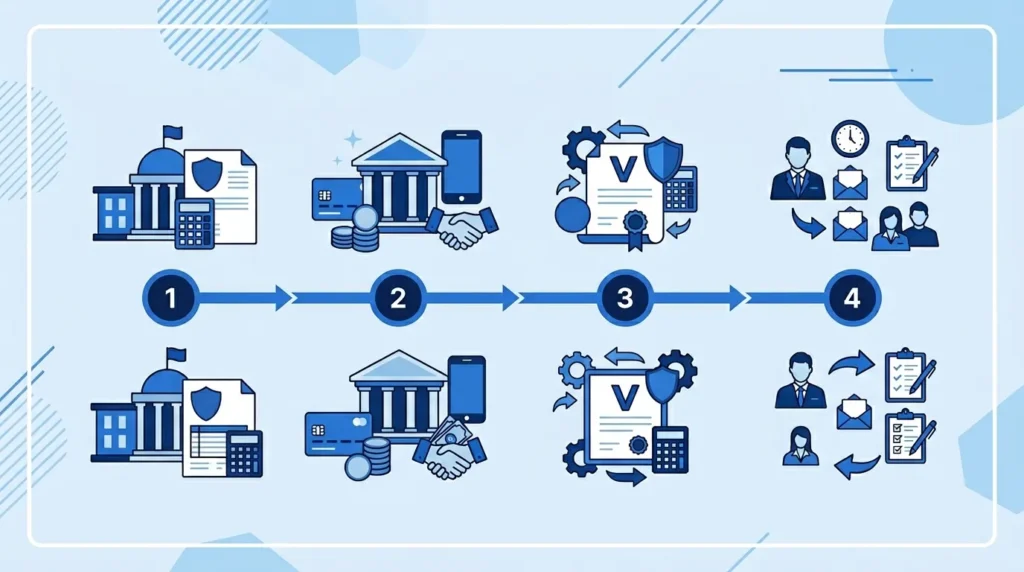
You can set up a UK limited company in 4 stages: prepare your company details, register with Companies House, register for Corporation Tax with HMRC, and set up your business banking and payroll.
What You Need Before You Register
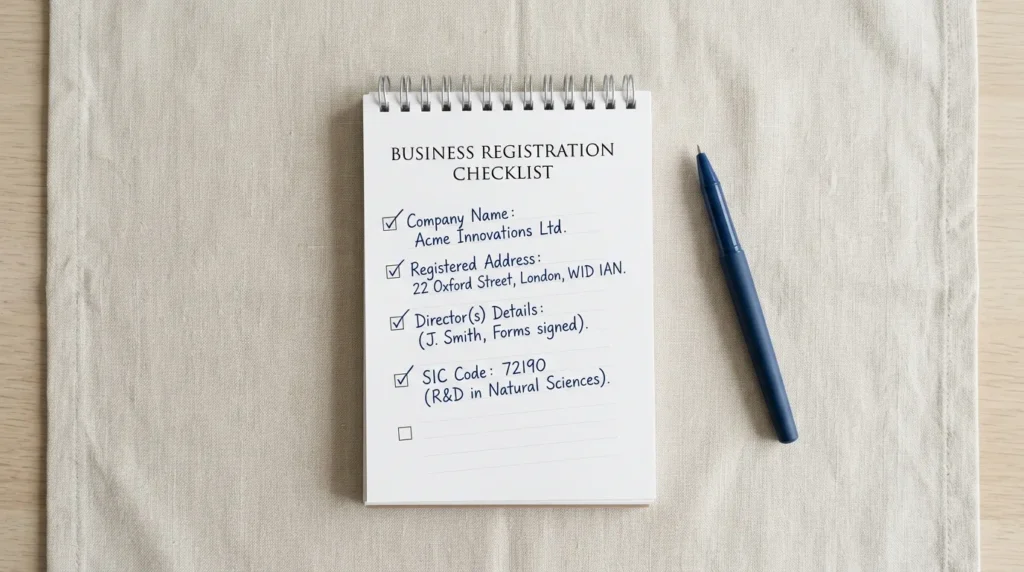
Rushing into the Companies House application without having your details sorted leads to mistakes. Some errors — like a poorly chosen company name or the wrong SIC code — take time and money to fix. Get these six things confirmed first.
A Unique Company Name
Your company name must be unique on the Companies House register. It must end in “Limited” or “Ltd”. You can check availability on the Companies House name availability tool before you apply.
Some words trigger additional scrutiny — words like “Royal”, “Institute”, or “Bank” require special permission. Avoid names that are too similar to existing registered companies, even with different spellings.
If you’re still deciding what to call your business, our guide on choosing a name for your UK small business covers the rules and creative process in detail.
A Registered Office Address
Every limited company needs a registered office address in the UK. This is a public address — it appears on the Companies House register and receives official letters from HMRC and Companies House.
You can use your home address, but it becomes publicly searchable. Many directors use a registered office service (available from £30–£100 per year) to keep their home address private. A formation agent or accountant’s address can also work.
The address must be in the same country as where the company is registered — England and Wales, Scotland, or Northern Ireland.
At Least One Director
A limited company must have at least one director. Directors are legally responsible for running the company, filing annual accounts, and maintaining statutory records.
Directors must be at least 16 years old. There is no upper age limit. They don’t have to be UK residents, but they do need a correspondence address in the UK.
Shareholders and Share Structure
You need at least one shareholder. In small companies, the director and shareholder are often the same person. You’ll need to decide:
- How many shares to issue (most small companies issue 1–100 ordinary shares)
- The value of each share (£1 per share is the standard starting point)
- Who holds which shares and in what percentage
This matters because shareholding determines dividend entitlement and voting rights. If you plan to bring in business partners or investors later, get professional advice on share structure before you register.
A SIC Code
The Standard Industrial Classification (SIC) code tells Companies House what sector your business operates in. There are over 700 codes covering every industry. You’ll pick one during registration.
Choosing the wrong SIC code doesn’t invalidate your company, but it does affect how your business is categorised publicly. Choose the code that most closely matches your main trading activity. You can search the full list on the Companies House website.
Articles of Association
The Articles of Association are the rules that govern how the company is run — voting rights, director powers, dividend policies, and how shares can be transferred.
Most small companies use the Model Articles of Association, which Companies House provides as a standard template. They are automatically applied if you don’t submit your own. Unless you have specific requirements (multiple share classes, complex ownership structures), the Model Articles work fine for most new companies.
Step-by-Step: How to Register With Companies House
You can register a limited company with Companies House online in 4 steps. Most applications are approved within 24 hours.
Step 1 — Choose Your Registration Method
There are three ways to register:
Online via Companies House WebFiling — The fastest and cheapest option. Costs £12. Takes under 24 hours in most cases, often just a few hours. Go to register.companieshouse.gov.uk.
Via a company formation agent — Third-party services like 1st Formations, Rapid Formations, or Companies Made Simple handle the paperwork for you. They typically charge £10–£50 on top of the Companies House fee. Useful if you want extras like a registered office address, bank account referrals, or help setting up company documents. Accounts with most formation agents are usually ready within the hour.
By post using form IN01 — The slowest method. Takes 8–10 working days and costs £71. Very few new companies use this route unless there’s a specific reason.
For most sole directors setting up a straightforward company, the online route is the right choice. For a broader overview of business registration options in the UK, see how to register your business in the UK.
Step 2 — Complete Your Application
The online application asks for:
- Company name
- Registered office address
- Director name, date of birth, correspondence address, and nationality
- Shareholder names, addresses, and share allocation
- SIC code
- Confirmation of the Articles of Association (Model Articles or custom)
- People with Significant Control (PSC) details
The PSC register is a legal requirement under the Companies Act 2006. Anyone who owns more than 25% of shares, controls more than 25% of voting rights, or has the right to appoint or remove the majority of directors must be listed. In most small companies, this is the director-shareholder. If you skip or enter this incorrectly, Companies House will reject the application.
Step 3 — Pay the Fee
The online registration fee is £12, payable by debit or credit card during the application. There is no additional charge if the application is approved first time.
Step 4 — Receive Your Certificate of Incorporation
Once Companies House approves your application, you receive a Certificate of Incorporation by email. This is your proof that the company legally exists as a separate entity. It includes your Company Registration Number (CRN) — a unique 8-digit identifier that you’ll use on invoices, official documents, and correspondence.
Keep the certificate. You’ll need it to open a business bank account and when dealing with HMRC.
What to Do Immediately After Incorporation
Registration is done. Now the clock starts on several legal deadlines. Miss them and you face penalties.
Register for Corporation Tax Within 3 Months of Trading
This is the step most new directors miss. You must notify HMRC that your company is active within 3 months of starting to trade. “Trading” means conducting any business activity — not just making sales.
Register through HMRC’s Business Tax Account online. You’ll receive a Unique Taxpayer Reference (UTR) number by post within 2 weeks. The current Corporation Tax rate is 19% for profits up to £50,000, rising to 25% for profits over £250,000.
For practical advice on managing your company’s tax obligations, these smart tax tips for UK small businesses are worth reading alongside your Corporation Tax setup.
Open a Business Bank Account
You are not legally required to have a separate business bank account, but in practice you must have one. Mixing personal and company finances creates an accounting nightmare and can cause problems if HMRC ever audits your records.
Most high-street banks offer business current accounts. Digital banks like Starling, Tide, and Monzo Business are popular with new companies — many offer free accounts with no monthly fees. You’ll need your Certificate of Incorporation and CRN to apply.
For options that cost nothing to open, see how to open a free UK small business bank account.
Register for VAT if Applicable
VAT registration is compulsory if your taxable turnover exceeds £90,000 in any rolling 12-month period. You must register within 30 days of hitting this threshold.
You can also register voluntarily below this threshold. Voluntary registration makes sense if most of your customers are VAT-registered businesses (you can reclaim input VAT) or if you want to appear more established. It doesn’t always make sense if your clients are consumers — they’ll see the extra 20% on every invoice.
For a full breakdown of when and how to register, and which VAT scheme suits new companies, the VAT guide for UK small businesses covers all current rules including the Flat Rate Scheme.
Register for PAYE if Paying a Salary
If you plan to pay yourself or any employees a salary above the Lower Earnings Limit (£6,396 in 2025/26), you need to register as an employer with HMRC and set up PAYE before the first payroll run.
Many director-shareholders pay themselves a small salary (usually around the National Insurance threshold, currently £12,570) combined with dividends to reduce tax. This is a legitimate and common strategy, but get the figures right. PAYE registration is done through HMRC’s business tax portal.
Your Ongoing Legal Obligations as a Director
Directors of limited companies have legal duties under the Companies Act 2006. These don’t go away once you’re registered. Missing filing deadlines triggers automatic penalties.
Annual Accounts
Every limited company must file annual accounts with Companies House each year. The deadline is 9 months after your company’s accounting reference date (the end of your financial year). Your first accounting reference date is automatically set to the last day of the month in which the company was incorporated, 12 months later.
Small companies (turnover under £10.2 million, fewer than 50 employees) can file abbreviated accounts. Micro-entities (turnover under £632,000, fewer than 10 employees) have even simpler filing requirements.
For ongoing help managing your company’s numbers, these small business accounting tips for UK owners are a practical starting point.
Confirmation Statement (CS01)
Every company must file a confirmation statement at least once a year. It confirms that the information held at Companies House is still accurate — directors, shareholders, registered office, SIC code, and PSC register.
The fee is £34 if filed online. The deadline is 14 days after the anniversary of either incorporation or the last confirmation statement.
Self Assessment Tax Return
As a director, you must file a personal Self Assessment tax return with HMRC every year, even if all your income came through the company payroll. This is separate from the company’s Corporation Tax return.
The deadline is 31 January each year for the previous tax year (which runs 6 April to 5 April). Late filing carries a £100 automatic penalty, with further daily charges after 3 months.
For a full walkthrough of the personal tax return process, see how to do a Self Assessment tax return in the UK.
Key Filing Deadlines at a Glance
| Obligation | Who to File With | Deadline | Penalty for Missing |
|---|---|---|---|
| Corporation Tax registration | HMRC | Within 3 months of trading | Automatic fine |
| Annual accounts | Companies House | 9 months after year end | £150–£1,500 |
| Confirmation statement | Companies House | Within 14 days of anniversary | Fine + potential strike-off |
| Corporation Tax return (CT600) | HMRC | 12 months after year end | £100+ |
| Self Assessment | HMRC | 31 January | £100 minimum |
| VAT return (if registered) | HMRC | Quarterly (usually) | Surcharge |
Common Mistakes New Directors Make
Not registering for Corporation Tax on time. The 3-month window runs from the date you start trading, not from incorporation. If you start doing business the day after registration, the clock starts immediately.
Using the wrong registered office address. If official correspondence goes to an address you don’t monitor, you’ll miss letters from HMRC and Companies House. Missed deadlines follow.
Forgetting the PSC register. Every company must have at least one entry. Leaving it blank causes Companies House to reject or delay the application.
Mixing personal and business finances. This creates serious problems at year-end and can raise questions about whether the company is being run as a separate legal entity.
Not keeping statutory registers. Companies are required to maintain internal records — registers of directors, shareholders, and PSC — separately from Companies House. Most companies keep these in a statutory register book or digital equivalent.
Choosing the wrong SIC code. It won’t collapse your company, but it can affect industry classification and occasionally bank account applications.
Understanding the legal requirements for UK small businesses helps you avoid these compliance gaps from the start.
Frequently Asked Questions
How long does it take to set up a limited company in the UK? Online registration through Companies House WebFiling typically takes 24 hours or less. Same-day approval is common if the application is submitted before midday on a working day. Postal applications take 8–10 working days.
Can I set up a limited company myself without an accountant? Yes. The Companies House online system is designed for non-professionals and walks you through each field. Many directors complete registration without any professional help. That said, getting advice on share structure, tax planning, and payroll before you start trading can save money later. An accountant isn’t required for registration, but is worth considering before your first year-end.
How much does it cost to register a limited company? The Companies House online fee is £12. If you use a formation agent, add £10–£50 for their service fee. Same-day postal registration costs £78. There are no ongoing Companies House fees beyond the £34 annual confirmation statement.
Can I use my home address as a registered office? Yes. It’s legal and free. The trade-off is that your home address becomes publicly visible on the Companies House register. Many directors use a paid registered office address service (from around £30 per year) to keep their home address private.
What is the People with Significant Control (PSC) register? The PSC register records anyone who has significant influence over the company — typically anyone owning more than 25% of shares or voting rights. It’s a legal requirement under the Companies Act 2006. The information is public. Every company must have at least one entry. Failure to maintain it is a criminal offence.
What’s the difference between a limited company and a sole trader? A limited company is a separate legal entity from its owner. Your personal finances are protected if the business fails. A sole trader has no such separation — you’re personally liable for all business debts. Limited companies are also taxed differently and often more tax-efficiently at higher income levels. For a detailed breakdown, see sole trader vs limited company — which is right for you.
Final Thoughts
Setting up a limited company in the UK takes less time than most people expect. The registration itself is straightforward. What matters most is what happens either side of it — getting your company details right before you apply, and hitting the HMRC and Companies House deadlines after incorporation.
Do those two things and the structure takes care of itself. Skip them and the fines and administrative headaches pile up fast.
If you’re still at the planning stage, starting your first business in the UK is a good place to map out the bigger picture before you commit to a structure.