

Closing a UK limited company means either applying to strike it off the Companies House register using form DS01, or putting it into liquidation. Which route you take depends entirely on whether the company is solvent or insolvent, and how much money is left inside it. Get this wrong and you can lose thousands to tax, or watch your company’s bank account get frozen before you’ve withdrawn a penny.
Step 1: Determine If Your Company Is Solvent or Insolvent
This single question decides which of the three closure routes is available to you. Answer it first, before you read anything else.
A company is solvent if it can pay all of its debts, including tax and any final costs, in full within 12 months. If yours can, you have two options: strike-off or a Members’ Voluntary Liquidation. If it can’t, strike-off and MVL are both closed to you, and a creditor-led process is the only legal way forward.
What Does It Mean to Be Solvent?
Solvency isn’t about how much profit you made this year. It’s a simple test: add up everything the company owes — HMRC, suppliers, a lease, a bounce back loan, staff wages — and check whether the company’s cash and assets cover it, with room to spare. If they do, and you can pay it all off within a year, the company is solvent.
What If My Company Is Insolvent?
If the company cannot pay its debts as they fall due, striking it off is not legally available, and doing so anyway can expose you to personal liability. An insolvent company must be closed through a Creditors’ Voluntary Liquidation or, if a creditor forces the issue, a compulsory liquidation. Both require a licensed insolvency practitioner.
Pathway A: Closing a Solvent Company via Voluntary Strike-Off
Voluntary strike-off, also called dissolution, is the cheapest and simplest way to close a solvent UK company with modest assets. You apply using form DS01, and Companies House removes the company from the register once the process completes.
Who Is Eligible for Voluntary Strike-Off?
Under the Companies Act 2006, a company can apply to be struck off if, in the three months before applying, it has not:
- Traded or carried on business
- Changed its name
- Disposed of any property or rights it held for the purpose of its trade
- Engaged in any activity except one necessary to close down properly, settle affairs, or comply with a statutory requirement
The company must also have no ongoing insolvency proceedings and no agreement in place with creditors, such as a scheme under Part 26 of the Companies Act.
How to Apply: The DS01 Form and the New 2026 Fees
Companies House cut the strike-off fee from 1 February 2026. The DS01 application now costs £13 if filed online, or £18 by post, down from the £33 and £44 fees that applied between May 2024 and January 2026. Many guides published before February 2026 still quote the old, higher figures, so double-check any source you’re reading against the date.
To apply:
- Confirm the company meets the three-month eligibility rule above.
- Settle all outstanding taxes, close down PAYE, de-register for VAT if applicable, and distribute or withdraw remaining funds (see the bank account warning below).
- Get the application signed by a majority of the directors.
- File form DS01 online through Companies House WebFiling, or by post with a cheque.
- Within 7 days of filing, send a copy of the application to every shareholder, creditor, employee, non-signing director, and any pension trustee.
- Companies House publishes a notice in The Gazette. If nobody objects, a second notice follows and the company is dissolved, typically two to three months after the first notice.
Tax Rules: The £25,000 Capital Distribution Limit
This is where most directors go wrong, and where most competing guides are dangerously vague.
Under section 1030A of the Corporation Tax Act 2010, if the total value distributed to shareholders when winding the company up through strike-off is £25,000 or less, it can be treated as a capital distribution rather than income. That means it’s taxed under Capital Gains Tax rules — usually 18% or 24% for 2026/27, or as low as 18% if Business Asset Disposal Relief applies — instead of as a dividend.
Here’s the part that trips people up: this is a cliff edge, not a taper. If your distribution comes to £25,001, the concession doesn’t just fail to cover the extra £1 — it fails entirely, and the whole £25,001 is treated as a dividend, taxed at 2026/27 dividend rates of 10.75%, 35.75%, or 39.35% depending on your income band. On a £30,000 distribution, that difference in tax treatment can easily run into several thousand pounds. If your company’s reserves sit anywhere near £25,000, get an accountant to check the number before you file DS01, not after.
Pathway B: Closing a Solvent Company via Members’ Voluntary Liquidation (MVL)
When Is an MVL Better Than a Strike-Off?
If your company holds more than £25,000 in retained profits or assets, a Members’ Voluntary Liquidation is almost always the better route, even though it costs more upfront. An MVL is a formal process run by a licensed insolvency practitioner, who distributes the company’s assets to shareholders and then closes it down.
The trade-off is straightforward: strike-off is free of professional fees but loses the capital treatment above £25,000, while an MVL costs money to run but lets every pound of the distribution qualify as a capital gain, regardless of size.
Tax Advantages and Business Asset Disposal Relief (BADR)
Distributions through an MVL are treated as capital gains rather than income, however large they are. If you’ve owned at least 5% of the shares and the company has traded for at least two years, you may also qualify for Business Asset Disposal Relief.
BADR now charges 18% Capital Gains Tax on qualifying gains, up from 14% in 2025/26, following the rate rise on 6 April 2026. It applies up to a lifetime limit of £1 million in qualifying gains. Above that limit, or where BADR doesn’t apply, the standard CGT rates of 18% or 24% take over.
MVL fees typically run from around £995 for a simple, single-asset case handled by a fixed-fee provider, up to £2,000–£4,000 plus VAT for more complex liquidations with multiple shareholders or assets. Add roughly £350–£1,000 for statutory Gazette advertising and a completion bond. Even after fees, an MVL usually saves money once the distribution clears £25,000, because the alternative is paying dividend tax on the full amount.
| Route | Best for | Tax treatment | Typical cost |
|---|---|---|---|
| Strike-off (DS01) | Solvent, assets £25,000 or less | Capital gains treatment on the full amount | £13 online / £18 paper |
| MVL | Solvent, assets over £25,000 | Capital gains treatment, BADR may apply at 18% | £995–£4,000+ VAT |
| CVL | Insolvent, cannot pay debts | N/A — creditor claims paid from assets | £3,000–£7,000+ VAT |
Pathway C: Closing an Insolvent Company
Creditors’ Voluntary Liquidation (CVL)
A CVL is the standard route when directors accept the company cannot pay its debts and want to close it down in an orderly way, rather than waiting to be forced into it. Under the Insolvency Act 1986, the directors instruct a licensed insolvency practitioner, who takes control of the company’s assets, prepares a Statement of Affairs, and distributes whatever funds are available to creditors according to a fixed legal priority. Directors typically pay nothing personally unless they’ve given a personal guarantee or the liquidator finds evidence of wrongful trading. CVL fees generally run from £3,000 to £7,000 plus VAT and disbursements, usually paid from company funds or asset sales rather than the director’s own pocket.
Compulsory Liquidation
Compulsory liquidation happens when a creditor petitions the court to wind up the company, usually after a statutory demand for an unpaid debt goes unanswered. The court appoints the Official Receiver, who takes over the company’s affairs. This route is more disruptive than a CVL, carries a higher risk of scrutiny into directors’ conduct, and should be avoided by acting early through a CVL wherever possible.
The Essential Pre-Closure Checklist: HMRC and Asset Management
Whichever route applies, there’s a strict order of operations that protects you from frozen funds and unnecessary tax bills.
1. Finalise HMRC Accounts, Corporation Tax, and VAT
File your final statutory accounts and Corporation Tax return (CT600) covering the period up to cessation of trade. Tell HMRC the company has stopped trading. If VAT registered, de-register using form VAT127 and file a final VAT return. Any Corporation Tax owed must be paid before Companies House will let strike-off proceed without objection from HMRC.
2. Closing PAYE and Staff Redundancies
If the company employs staff, run final payroll, issue P45s, and close the PAYE scheme with HMRC through a final Full Payment Submission and Employer Payment Summary. If employees are being made redundant as part of the closure, statutory redundancy rules still apply even though the company is winding down.
3. The Bank Account Trap: Distribute Assets Before Dissolution
This is the single most common and most expensive mistake directors make, and most competing guides barely mention it.
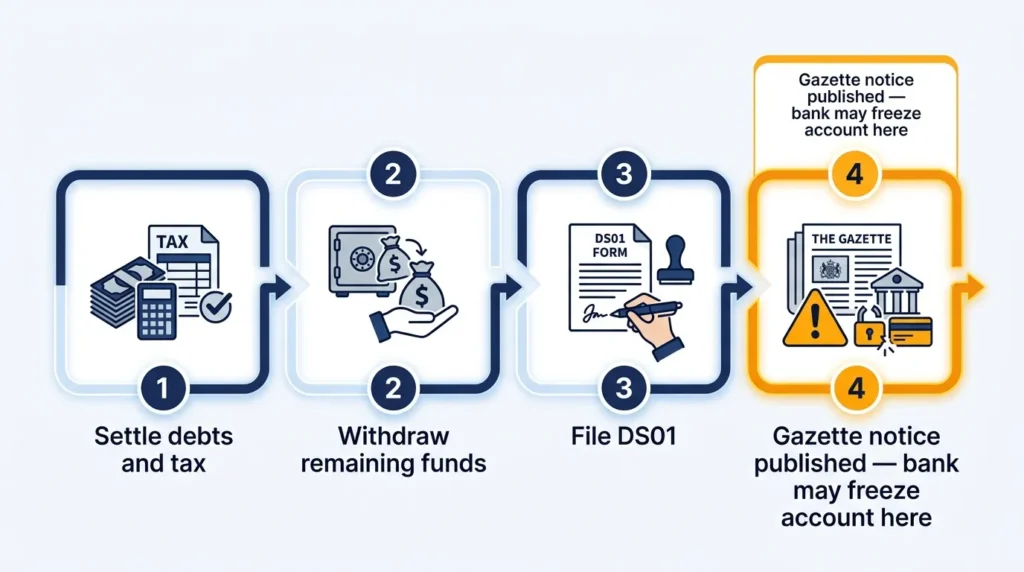
Assets left in a dissolved company legally become bona vacantia — “ownerless goods” — and pass automatically to the Crown. The trap isn’t that the freeze happens the instant you file DS01. It’s that banks routinely see the first Gazette notice, which appears while the application is still being processed, and freeze the account as a precaution well before the company is actually dissolved. Once that happens, recovering the money means applying to the Treasury Solicitor or, worse, restoring the company to the register — both slow and costly.
The safe sequence is: settle every debt and tax bill, distribute or withdraw all remaining cash to shareholders, close the business bank account entirely, and only then file the DS01. Do not leave money sitting in the account “to be safe” — that’s exactly what triggers the freeze.
How Much Does It Cost and How Long Does It Take?
| Route | Companies House / Court fee | Professional fees | Typical timeline |
|---|---|---|---|
| Strike-off (DS01) | £13 online / £18 paper | £0–£500 if using an accountant | 2–3 months after Gazette notice |
| Members’ Voluntary Liquidation | Gazette ads ~£350–£1,000 | £995–£4,000+ VAT (liquidator’s fee) | 1–3 months for a simple case; longer if BADR clearance or complex assets are involved |
| Creditors’ Voluntary Liquidation | Gazette ads and disbursements | £3,000–£7,000+ VAT | Weeks to arrange; full process can run several months |
| Compulsory Liquidation | £343 court fee + £2,600 petition deposit (paid by petitioner) | Official Receiver / liquidator fees from company assets | Several months to over a year |
Common Mistakes That Cause Delays, Penalties, or Personal Liability
- Filing DS01 with money still in the account. Covered above, and worth repeating: this is the single costliest error directors make.
- Applying for strike-off while the company still owes Corporation Tax. HMRC routinely objects to strike-off applications where tax is outstanding, which pauses or blocks the dissolution.
- Treating a distribution over £25,000 as capital anyway. HMRC can and does challenge this. If challenged after the company is dissolved, the funds have already been received as income and the tax bill lands personally.
- Not notifying all required parties within 7 days of filing DS01. This is a legal requirement, and failing to notify creditors or employees is a criminal offence, not just a paperwork slip.
- Assuming strike-off is available for an insolvent company. Directors sometimes try to dissolve a company to escape debts. Creditors can object to the strike-off, and directors risk personal liability or disqualification if the company is later shown to have been insolvent at the time.
- Forgetting the registered office still needs to be valid throughout the process, since Gazette notices and HMRC correspondence are sent there until the company is dissolved.
Frequently Asked Questions
Can I close a limited company myself? Yes, for a solvent company with modest assets. You can complete and file form DS01 yourself through Companies House WebFiling for £13, without hiring an insolvency practitioner or accountant, provided the company meets the eligibility conditions.
How much does it cost to close a limited company in the UK in 2026? A straightforward strike-off costs £13 online or £18 by post. An MVL typically costs £995 to £4,000 plus VAT depending on complexity. A Creditors’ Voluntary Liquidation usually costs £3,000 to £7,000 plus VAT, generally paid from company assets.
What happens to the money in the bank when a company is dissolved? Any money left in the account when the company is dissolved becomes bona vacantia and passes to the Crown. In practice, banks often freeze the account earlier, once they see the Gazette notice, so all funds should be withdrawn or distributed before filing DS01.
What is the difference between strike-off and liquidation? Strike-off is an administrative removal from the Companies House register, suited to solvent companies with £25,000 or less to distribute. Liquidation is a formal legal process run by a licensed insolvency practitioner, used either to distribute larger sums tax-efficiently (MVL) or to wind up an insolvent company for the benefit of creditors (CVL or compulsory liquidation).
How do I close a company with debts and no money? If the company cannot pay its debts, voluntary strike-off is not a legal option. You’ll need a Creditors’ Voluntary Liquidation, arranged with a licensed insolvency practitioner, or the company may face compulsory liquidation if a creditor petitions the court first.
Can HMRC object to a company being struck off? Yes. HMRC routinely objects if Corporation Tax, VAT, or PAYE liabilities remain outstanding, or if the company hasn’t filed its final accounts and returns. Clearing these first avoids a blocked or delayed application.