

A memorandum of association is a short legal document that every new UK company must have. It records the names of the people who agreed to form the company. Once your company is registered, this document never changes.
That’s the whole idea in one paragraph. The rest of this guide covers what it actually contains, how it differs from the articles of association, and what to do if your company was formed before the rules changed in 2009.
At a Glance: Memorandum of Association
| Question | Quick Answer |
|---|---|
| What is it? | A statement that the founding members agree to form the company |
| Who signs it? | The original “subscribers” — the first shareholders or guarantors |
| Can it be changed? | No, not for companies formed after 1 October 2009 |
| Do I need to write it myself? | No — Companies House generates it automatically when you register online |
| Where is it filed? | Submitted with Form IN01 to Companies House |
What Is a Memorandum of Association (MoA)?
A memorandum of association is a legal document stating that the founding members of a company wish to form it and agree to become its first members. For a company limited by shares, it also confirms that each subscriber agrees to take at least one share.
Think of it as a formation snapshot, not a rulebook. It captures a single moment: the point at which the company came into existence. It doesn’t tell anyone how the company should be run day to day — that job belongs to the articles of association.
Definition Under the UK Companies Act 2006
A company is formed under the Companies Act 2006 by one or more people subscribing their names to a memorandum of association and complying with the Act’s registration requirements. Section 8 of the Act defines the memorandum as a statement in which the subscribers agree to become members of the company and, where the company has a share capital, to take at least one share each.
This is a much narrower definition than older company owners might remember. Under the Companies Act 1985, the memorandum was a far longer document — it set out the company’s objects (its purpose), its share capital, and other constitutional details that could later be amended. The 2006 Act stripped almost all of that out.
Who Are the “Subscribers” to a Memorandum?
Subscribers are the people who sign the memorandum to bring the company into being. In practice, they’re the company’s first shareholders (or guarantors, for companies limited by guarantee). A subscriber can be:
- A single individual, if you’re forming a company alone
- Multiple individuals, each taking one or more shares
- Another company or legal entity acting as a corporate subscriber
Once the company is incorporated, the subscribers automatically become its first members and appear on the register of members. Their status as “subscribers” is historical after that point — it’s a record of how the company started, not an ongoing role.
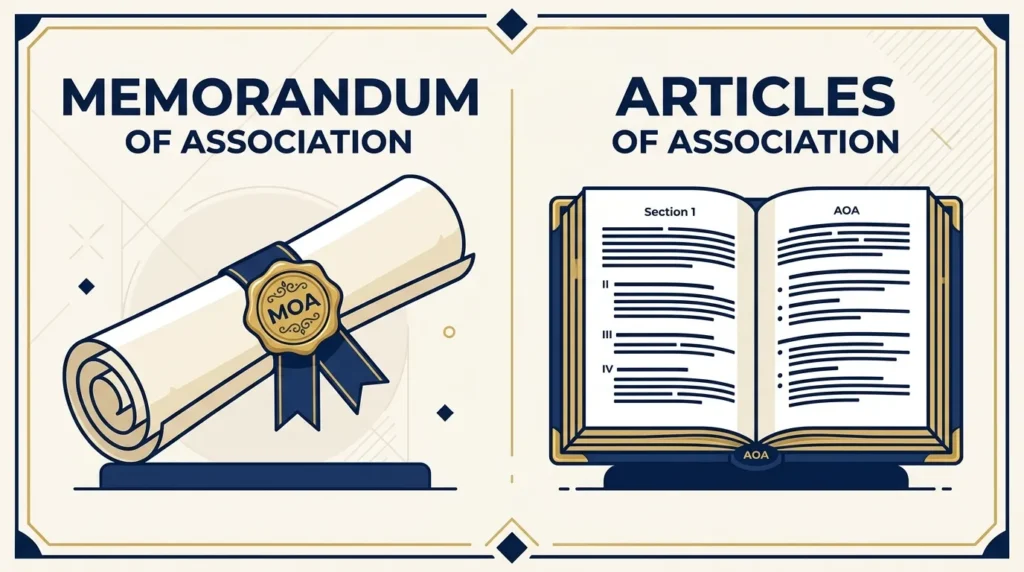
Memorandum vs. Articles of Association: Key Differences Explained
Whenever you form a UK company, you need two documents: a memorandum of association and articles of association. The memorandum sets up the company, while the articles set out how the company is run, governed and owned. That’s the distinction that trips up most first-time founders — so it’s worth spelling out clearly.
The Memorandum of Association (The Historical Snapshot)
The memorandum is fixed the moment your company is incorporated. It exists purely as evidence of formation — who agreed to start the company, and (for a company limited by shares) that they agreed to take at least one share. It’s never filed again, never updated, and never referred to for day-to-day decisions.
The Articles of Association (The Ongoing Rulebook)
The articles are a living document. They cover the responsibilities and powers of directors and the means by which shareholders exert control over the board. Unlike the memorandum, the articles can be changed after incorporation, usually by passing a special resolution requiring 75% shareholder approval.
Most companies use Companies House’s “model articles” as a starting point, then adapt them — for example, by adding entrenched provisions that make certain clauses harder to change in future.
Summary Comparison Table
| Feature | Memorandum of Association | Articles of Association |
|---|---|---|
| Purpose | Records the intention to form the company | Governs how the company is run |
| Can it change? | No, once filed | Yes, by special resolution |
| Content | Subscriber names and agreement statement | Director powers, shareholder rights, decision-making rules |
| Filed with | Form IN01, at incorporation only | Filed at incorporation; updates filed as they happen |
| Public document? | Yes, held permanently by Companies House | Yes, current version always publicly available |
What Does a UK Memorandum of Association Contain?
Since 1 October 2009, a UK memorandum of association contains almost nothing beyond a single statement and the subscribers’ names and signatures. There’s no objects clause, no share capital breakdown, and no company rules. Below is the exact wording Companies House uses.
Standard Wording for Companies Limited by Shares
“Each subscriber to this Memorandum of Association wishes to form a company under the Companies Act 2006 and agrees to become a member of the Company and to take at least one share.”
Below that statement sits a simple table: the name of each subscriber and their authentication (an electronic signature, when registering online).
Standard Wording for Companies Limited by Guarantee
“Each subscriber to this memorandum of association wishes to form a company under the Companies Act 2006 and agrees to become a member of the company.”
Notice the small but important difference: a guarantee company’s memorandum has no “take at least one share” clause, because it has no share capital. This wording is standard for charities, membership bodies, and community interest companies structured without shares.
How to Get and Submit Your Memorandum of Association
You almost never write a memorandum of association yourself. Companies House generates it automatically as part of the incorporation process, using the standard wording above. Your job is simply to complete registration correctly.
Registering Online via Companies House (Form IN01)
Here’s the step-by-step process for anyone registering directly:
- Choose and check your company name against the Companies House register to confirm it’s available.
- Decide your company type — limited by shares or limited by guarantee.
- Appoint at least one director and, if relevant, a company secretary.
- Identify People with Significant Control (PSCs) — anyone who owns more than 25% of shares or voting rights.
- Complete Form IN01 with your registered office address, SIC code, and share or guarantee details.
- Verify your identity. From 18 November 2025, new directors must verify their identity before their appointment can be registered at Companies House, and new PSCs must verify their identity within 14 days before their details can be added to the PSC register.
- Pay the registration fee and submit. The memorandum is generated automatically and filed alongside your application.
- Receive your certificate of incorporation, along with your memorandum and articles of association.
As of the most recent fee update, standard digital incorporation costs £100, with a same-day digital service available for £156, and paper incorporation costing £124. Budgeting for registration is only one part of getting a new company off the ground — most founders also need a compliant registered office address and a plan for their company bank account before trading begins.
Using Formation Agents or Registration Templates
Formation agents and accountants can handle the entire IN01 filing on your behalf, often bundling in a registered office service and compliance reminders. This is worth considering if you’d rather not manage director verification and SIC code selection yourself, though it comes at a cost on top of the statutory Companies House fee. For a full walkthrough of the wider process, see our guide on how to register a company in the UK.

Can You Amend or Change a Memorandum of Association?
No. Once a company is registered, its memorandum of association cannot be altered, updated, or refiled. It will not be possible to amend or update the memorandum of a company formed under the Companies Act 2006. This surprises a lot of business owners who assume it works like the articles.
Why the MoA Cannot Be Altered Post-Incorporation
The memorandum isn’t meant to describe your company today — it’s meant to prove what happened on the day it was formed. Changing it would mean rewriting history, which defeats its purpose as a permanent formation record.
If your company’s ownership, structure, or shareholdings change after incorporation, none of that goes into the memorandum. Instead:
- New shares or share transfers are reported through a confirmation statement (CS01) or a statement of capital.
- Changes to how the company is run go into the articles of association, updated by special resolution.
- Changes to directors or PSCs are reported directly to Companies House, and now require identity verification under current rules.
This is the single most common source of confusion in this area. Founders often ask their accountant to “update the memorandum” when what they actually need is a confirmation statement or an articles amendment. The memorandum itself is never the right document to touch.
How the Law Changed: Pre-October 2009 vs. Post-October 2009 Companies
This is where a lot of guidance online gets vague, and it matters more than most articles admit — especially if you’re running or advising a company that’s been trading for over 15 years.
Before 1 October 2009, under the Companies Act 1985, the memorandum was a substantial document. It included:
- The company’s objects clause — a formal statement of what the company was permitted to do
- Share capital details
- A statement of limited liability
Crucially, these provisions could be changed by special resolution, but doing so required a formal filing.
After 1 October 2009, under the Companies Act 2006, any restrictions that previously sat in the memorandum for companies formed before that date are now treated as being part of the articles instead. In effect, the law reclassified old memorandum content as article content, without requiring companies to do anything.
What this means in practice: if your company was incorporated before October 2009 and still has an objects clause sitting in its original memorandum, that clause is now legally treated as part of your articles — even though it physically appears in the older document. If you want to remove or update it (many companies do, since unrestricted objects are now standard), you’ll need to pass a resolution to amend your articles, not your memorandum.
Common Mistakes and Compliance Risks to Avoid
- Assuming you need to draft one. You don’t — Companies House generates it automatically from your IN01 submission.
- Trying to “update” it after incorporation. This isn’t possible; the change belongs in your articles or your confirmation statement.
- Confusing an old objects clause with an active restriction. For pre-2009 companies, it’s now part of the articles and can be formally removed if it’s causing confusion with banks or investors.
- Missing identity verification deadlines. Since 18 November 2025, unverified directors cannot make or be included in filings at Companies House, and cannot incorporate a new company, with a fine of up to £5,000 possible for non-compliance.
- Not budgeting for the current fee. The incorporation fee doubled in early 2026, so older guides quoting £50 are out of date.
Frequently Asked Questions
What is a memorandum of association in the UK?
It’s a legal document confirming that a company’s founding members agreed to form it and, for companies limited by shares, agreed to take at least one share each.
Do I need a memorandum of association for a limited company?
Yes. It’s a legal requirement for every UK company, but Companies House generates it automatically when you register — you don’t draft it yourself.
What’s the difference between a memorandum and articles of association?
The memorandum is a one-time formation record that never changes. The articles are the company’s ongoing rulebook, which can be amended by shareholder resolution.
Can you change a memorandum of association?
No, not for companies formed after 1 October 2009. Changes to ownership or governance are made through the articles of association or a confirmation statement instead.
Where can I get a template of a memorandum of association?
You don’t need one. Companies House produces the memorandum automatically using standard statutory wording when you file Form IN01, whether online or through a formation agent.
Does a memorandum of association need to be witnessed?
No. Modern subscribers authenticate the memorandum electronically as part of online registration; a physical signature and witness are no longer required for standard incorporations.
—
Getting your memorandum right is a formality — but it sits alongside decisions that matter far more to how your company actually runs, from your articles of association and shareholder agreement to whether a limited company structure suits you in the first place. If you’re still weighing that decision, our comparison of sole trader vs limited company in the UK is a good next stop, and our step-by-step guide to setting up a limited company walks through everything that follows incorporation.