

For most UK small businesses, the best payment gateway depends on where you sell. Stripe suits online stores and subscription businesses. SumUp or Square suit shops, market stalls, and hospitality. GoCardless suits businesses billing recurring invoices. There is no single “best” gateway — only the one that matches your sales channel, turnover, and average transaction size.
What Is a Payment Gateway, and How Is It Different From a Merchant Account?
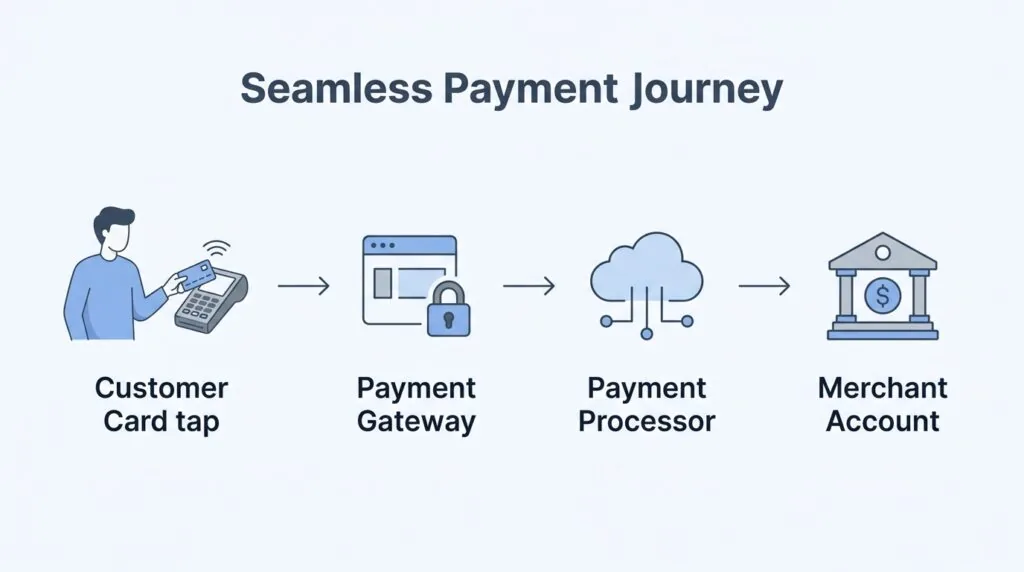
A payment gateway is the technology that captures card details at checkout and passes them securely to the payment network for approval. It is not the same thing as a merchant account or a payment processor, even though most small businesses use the terms interchangeably.
- Payment gateway: encrypts and transmits the transaction data (Stripe, Opayo, PayPal Checkout).
- Payment processor: moves the money between the customer’s bank and yours, and calculates the fees (Worldpay, Elavon, Adyen).
- Merchant account: the account that holds your card takings before they settle into your business bank account.
Providers like Stripe, SumUp, Square, and PayPal bundle all three into one product, which is why they have become the default choice for small businesses that don’t want to manage separate contracts with a gateway, a processor, and an acquiring bank.
How Payment Gateway Fees Actually Work in the UK
Every UK card transaction fee is made up of three layers, even when a provider shows you one flat percentage:
- Interchange fee — paid to the customer’s card-issuing bank. UK and EEA debit cards are capped at 0.2%, and credit cards at 0.3%, under retained EU interchange regulation.
- Scheme fee — paid to Visa or Mastercard for using their network.
- Provider markup — what your gateway or processor adds on top to cover its own costs and profit.
Providers either charge you a blended rate (one flat percentage covering all three layers, like SumUp’s 1.69% or Square’s 1.75%) or interchange-plus pricing (the true interchange cost plus a small fixed markup, common with Worldpay and Dojo at higher turnover). Blended rates are simpler and predictable. Interchange-plus pricing usually works out cheaper once you’re processing more than roughly £5,000–£10,000 a month, because the markup stays flat while the underlying interchange cost doesn’t move.
One post-Brexit detail most guides miss: since January 2021, cards issued in the EU are treated as international, not domestic, by most UK gateways. Stripe charges 2.5% + 20p for EEA cards versus 1.5% + 20p for UK cards — a difference that matters if you sell to European customers.
The Best Payment Gateways for UK Small Businesses in 2026
| Provider | Best for | In-person fee | Online fee | Monthly fee | Contract |
|---|---|---|---|---|---|
| Stripe | Online stores, SaaS, apps | 1.4% + 20p (Terminal) | 1.5% + 20p UK cards; 2.5% + 20p EEA; 3.25% + 20p international | None | None |
| SumUp | Market stalls, mobile trades, occasional sellers | 1.69% (0.99% on Payments Plus, £19/mo) | 2.5% | None (or £19/mo optional) | None |
| Square | Shops, cafés, salons wanting free EPOS | 1.75% | From 1.4% + 25p | None | None |
| PayPal / PayPal POS (Zettle) | Businesses already using PayPal | 1.75% | 2.9% + 30p (payment links); 3.4% + 20p (manual entry) | None | None |
| GoCardless | Subscriptions, memberships, recurring invoices | Not applicable (Direct Debit only) | 1% + 20p, capped at £4 | None | None |
| Tyl by NatWest | Businesses under £50k/year wanting bank-backed support | 1.39%–1.99% + 5p | Via Tap to Pay | From £13.99/mo (hardware) | 12 months |
| Dojo | Growing businesses processing £3,000+/month | From 1% flat (Fix Plan) or custom rate | Custom | From £39.99/mo (Fix Plan) | Varies by plan |
| Worldpay | Established or high-turnover multi-channel businesses | From 1.5% (under £75k/yr) to 0.75% + 4.5p (over £75k/yr) | Custom | Hardware from ~£20/mo + £5 PCI fee | 18 months typical |
Prices are publicly listed provider rates as of mid-2026 and change regularly — always confirm current pricing directly with the provider before signing up.
Stripe — Best for Online Stores and SaaS
Stripe is the default choice for UK businesses selling online, running subscriptions, or building a custom checkout. There’s no monthly fee, setup is entirely self-service, and it plugs into almost every ecommerce platform and accounting tool. The trade-off is that Stripe is built for developers first — a business wanting a simple card reader with no technical setup may find SumUp or Square faster to get running.
SumUp — Best for Mobile and Occasional Sellers
SumUp suits businesses that don’t take card payments every day: market traders, mobile hairdressers, pop-up stalls. Hardware starts from around £25–£39 plus VAT, there’s no monthly commitment, and the 1.69% flat rate is easy to budget for. Once monthly card turnover passes roughly £2,700, the £19/month Payments Plus plan (0.99% rate) usually saves money.
Square — Best for Retail and Hospitality With Free EPOS
Square’s real advantage isn’t the 1.75% rate — SumUp and PayPal match it — it’s the free point-of-sale software bundled in. Inventory tracking, staff logins, and sales reporting come at no extra cost, which makes Square a stronger fit than a basic card reader for shops and cafés that need more than “tap and go.”
PayPal / PayPal POS (Zettle) — Best for Businesses Already Using PayPal
If you already invoice or sell through PayPal, PayPal POS (formerly Zettle) keeps everything in one dashboard and one payout balance. The 1.75% in-person rate is competitive, but manual card entry and payment links cost noticeably more — worth checking if you regularly take payments over the phone.
GoCardless — Best for Subscriptions and Recurring Invoices
GoCardless doesn’t process card payments at all — it collects Direct Debit and Instant Bank Pay transfers directly from a customer’s bank account. For recurring billing, membership fees, or large invoices, this is usually far cheaper than a card fee, because the 1% + 20p charge is capped at £4 no matter how large the payment. It also has a lower payment failure rate than cards. It’s the wrong tool if you need to take one-off card payments in person or at checkout.
Dojo and Tyl by NatWest — Traditional Merchant Accounts for Higher Turnover
Once a business is consistently processing several thousand pounds a month, flat-rate providers like SumUp or Square start to cost more than a negotiated merchant account. Dojo’s Fix Plan charges a flat monthly fee that covers a set amount of turnover, which suits predictable, steady sales. Tyl by NatWest offers tiered rates from 1.39% and the reassurance of being backed by a major UK bank, though it comes with a 12-month contract.
Worldpay — Best for Established or Multi-Channel Businesses
Worldpay remains the largest acquirer in the UK and makes sense for businesses that need to combine in-store, online, and phone payments under one contract, or that process high enough volume to negotiate custom interchange-plus rates. It’s rarely the cheapest option for a business under £30,000 a year in card turnover, and the standard contract runs 18 months.
How to Choose the Right Payment Gateway for Your Business
Work through these questions in order — each one narrows the shortlist:
- Where do you sell? Online-only points toward Stripe or a gateway built into your ecommerce platform. In-person points toward SumUp, Square, or PayPal. Both means checking that one provider covers both channels well, rather than running two separate systems.
- What’s your average transaction value? Low-value, high-frequency sales (coffee, market stalls) suit flat-rate providers. High-value, low-frequency sales (furniture, consultancy invoices) suit interchange-plus pricing or GoCardless for recurring work.
- What’s your monthly card turnover? Under roughly £3,000/month, a no-contract flat-rate provider almost always wins. Above £5,000–£10,000/month, it’s worth requesting a quote from Dojo, Tyl, or Worldpay to compare against your current effective rate.
- Do you sell to customers outside the UK? If EEA or international cards make up a meaningful share of sales, compare the international rate, not just the headline domestic rate.
- What does it need to connect to? Check integration with your accounting software (Xero, QuickBooks, Sage) and ecommerce platform before signing anything — switching providers later is more disruptive than choosing carefully up front.
Common Mistakes UK Small Businesses Make When Choosing a Payment Gateway
- Comparing headline rates, not effective rates. A 1.5% rate can become a 3%+ effective rate once refunds, chargebacks, and international cards are included. Calculate total fees ÷ total revenue processed over a real month before comparing providers.
- Ignoring VAT on fees. Payment processing fees carry 20% UK VAT. If you’re not VAT-registered, you can’t reclaim it, which makes a “1.75%” rate closer to 2.1% in real terms.
- Signing long contracts for low volume. An 18-month Worldpay contract makes sense at high turnover. It’s a poor fit for a business still testing a new sales channel.
- Overlooking the PCI DSS non-compliance fee. Most acquirers charge £15–£30 a month if you haven’t completed your annual Self-Assessment Questionnaire (SAQ). It takes under an hour to submit and stops the fee immediately.
- Choosing on card reader price alone. A £19 reader with a 1.75% rate can cost more over a year than a £39.99/month plan with a 1% rate, depending on turnover. Work out the 12-month total, not just the upfront cost.
- Not checking settlement speed. Payout timing ranges from same-day to two working days depending on provider — this matters more for cash flow than most businesses expect when they sign up.
Compliance and Security Requirements for UK Payment Gateways
Every UK business accepting card payments has to meet three overlapping requirements, regardless of which provider they choose:
PCI DSS. The Payment Card Industry Data Security Standard has been on version 4.0.1 since March 2025, with no grace period remaining. Most small businesses using a hosted checkout (Stripe, PayPal, Square) qualify for the simplest self-assessment tier, SAQ A, because card data never touches their own servers.
Strong Customer Authentication (SCA). Under the UK Payment Services Regulations 2017 — the retained version of the EU’s PSD2 — online card payments generally require two-factor authentication, delivered through 3D Secure 2. This is handled automatically by Stripe, PayPal, and Square, so most small businesses don’t need to build anything themselves. The FCA oversees compliance.
UK GDPR and ICO registration. Card and customer data is personal data. If your business processes it, you likely need to be registered with the Information Commissioner’s Office and have a lawful basis and retention policy for storing transaction records.
What’s Changing in UK Payments Regulation
Two developments are worth watching if you’re choosing a gateway for the next few years, not just the next few months. The Payment Systems Regulator has been acting on cross-border interchange fees charged on EEA card transactions since Brexit, which could bring the EEA surcharge that providers like Stripe currently apply closer to the domestic rate over time. Separately, open banking payments — where a customer pays by authorising a bank transfer instead of using a card — are moving from a niche option to a mainstream checkout choice, driven by lower fees and the rollout of variable recurring payments (VRPs) for subscription-style billing. Neither change requires action today, but a provider that already supports open banking payments alongside cards is a safer long-term choice than one that doesn’t.
Frequently Asked Questions
What is the cheapest payment gateway for a UK small business?
For low, occasional volume, SumUp or Square are typically cheapest because there’s no monthly fee. For recurring invoices and subscriptions, GoCardless is usually cheapest because its fee is capped at £4 regardless of the payment size. For high, steady turnover, a negotiated interchange-plus rate from Dojo, Tyl, or Worldpay usually beats any flat-rate provider.
Do I need both a merchant account and a payment gateway?
Not separately, in most cases. Providers like Stripe, SumUp, Square, and PayPal bundle the gateway, processing, and merchant account into a single product, which is why they’ve become the standard choice for small businesses.
Can I accept card payments without a business bank account?
Some providers, including PayPal and SumUp, allow payouts into a personal account for sole traders, but a dedicated business account makes reconciliation and tax reporting significantly easier as volume grows.
How long does it take to get set up?
Card reader providers like SumUp, Square, and PayPal typically activate an account within a day. Traditional merchant accounts through Worldpay or Tyl can take one to two weeks due to underwriting checks.
Is Stripe better than PayPal for a UK small business?
It depends on the sales channel. Stripe is stronger for custom online checkouts, subscriptions, and developer integrations. PayPal is stronger for businesses that want in-person and online payments under one familiar account, especially if customers already expect to see a PayPal option at checkout.
What happens if my payment gateway account gets frozen?
Providers like PayPal and Stripe can pause payouts for review, particularly on new accounts or after a sudden spike in volume. Keeping a second payment method available, and avoiding sudden unexplained jumps in transaction value, reduces the risk of a hold disrupting cash flow.