
If you’re sharing a business idea, financial figures, or a product design with someone outside your business, you need something in writing before the conversation goes any further. Below are two free, copy-and-paste UK NDA templates — one-way and mutual — along with what makes them legally binding under English law, and why so many free templates online quietly fail to protect anyone.
What Is a Non-Disclosure Agreement (NDA) in the UK?
A non-disclosure agreement (NDA) is a legally binding contract used in the UK to stop one party from sharing or misusing confidential information belonging to another. It sets out what counts as confidential, who can see it, what they’re allowed to do with it, and for how long the obligation lasts.
NDAs are used constantly in UK business — when pitching to investors, briefing a freelancer, negotiating a partnership, or interviewing a senior hire. The agreement doesn’t stop information being shared. It stops it being shared further than intended.
Confidentiality Agreement vs NDA: Is There a Difference?
No. “Confidentiality agreement” and “non-disclosure agreement” describe the same type of document. Some solicitors use “confidentiality agreement” for longer-term or employment-related arrangements and “NDA” for shorter, deal-specific ones, but there’s no legal distinction in England and Wales. The content of the clauses matters far more than the title on the page.
Types of NDAs: Unilateral vs Mutual
Before using either template below, work out which direction the information is flowing.
One-Way (Unilateral) NDAs
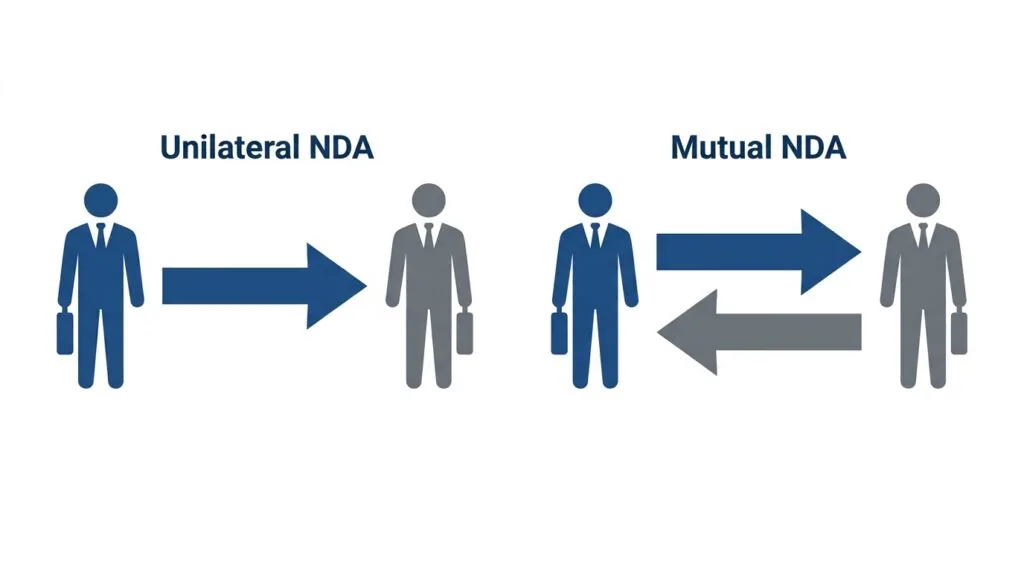
A unilateral NDA protects information flowing from a single disclosing party to a single receiving party. Use this when only one side is sharing anything sensitive — for example, when you brief a contractor, supplier, or potential investor on your business plan, and they aren’t sharing anything confidential back.
Two-Way (Mutual) NDAs
A mutual NDA protects information flowing both ways, because both parties are disclosing and receiving confidential information. This is the right choice for joint ventures, merger discussions, or a founders’ agreement negotiation, where each side is showing the other its numbers, plans, or technology.
| Unilateral NDA | Mutual NDA | |
|---|---|---|
| Who is protected | One party only | Both parties |
| Typical use | Pitching to an investor, briefing a freelancer | Joint ventures, partnerships, mergers |
| Complexity | Simpler, shorter | Slightly more detailed |
| Obligations | One-directional | Reciprocal |
Free UK Non-Disclosure Agreement Templates
Copy the version that matches your situation and fill in the bracketed fields. Both templates are drafted for England and Wales. If your business operates in Scotland or Northern Ireland, see the governing law note further down.
Template 1: Standard One-Way (Unilateral) NDA
“`
NON-DISCLOSURE AGREEMENT
THIS AGREEMENT is made as a Deed on [DATE]
BETWEEN:
(1) [DISCLOSING PARTY NAME], of [registered office / address] (“the Disclosing Party”); and
(2) [RECEIVING PARTY NAME], of [address] (“the Receiving Party”)
BACKGROUND
(A) The Disclosing Party wishes to disclose certain Confidential Information to the Receiving Party for the Permitted Purpose.
(B) The Receiving Party agrees to receive and protect that information on the terms of this Deed.
IT IS AGREED:
- Definitions
“Confidential Information” means any information disclosed by the Disclosing Party to the Receiving Party, in any form, including business plans, financial data, technical specifications, trade secrets, know-how, customer data, and proprietary processes. It excludes information that: (a) is or becomes public through no fault of the Receiving Party; (b) was already lawfully known to the Receiving Party; (c) is independently developed without reference to the Confidential Information; or (d) must be disclosed by law or a regulator.
“Permitted Purpose” means [describe why the information is being shared, e.g. “evaluating a potential investment in the Disclosing Party’s business”].
- Obligations of the Receiving Party
The Receiving Party shall:
(a) keep the Confidential Information strictly confidential;
(b) use it solely for the Permitted Purpose;
(c) not disclose it to any third party without prior written consent, except to employees or advisers who need it for the Permitted Purpose and are bound by equivalent confidentiality terms;
(d) protect it with at least the same care it uses for its own confidential information.
- Duration
This Agreement remains in force for [2] years from the date above. Obligations relating to trade secrets continue indefinitely until the information enters the public domain other than through the Receiving Party’s breach.
- Return or Destruction
On written request, the Receiving Party shall promptly return or destroy all materials containing Confidential Information and confirm this in writing.
- No Licence
Nothing in this Agreement grants any licence or right in the Disclosing Party’s intellectual property, beyond the limited right to use the Confidential Information for the Permitted Purpose.
- No Obligation to Proceed
Nothing in this Agreement obliges either party to enter into any further agreement.
- Third Parties
A person who is not a party to this Agreement has no right under the Contracts (Rights of Third Parties) Act 1999 to enforce any of its terms.
- Governing Law and Jurisdiction
This Agreement is governed by, and shall be construed in accordance with, the laws of England and Wales, and the parties submit to the exclusive jurisdiction of the courts of England and Wales.
EXECUTED AS A DEED
Signed by [DISCLOSING PARTY] …………………………………
In the presence of (Witness) …………………………………
Name: ……………… Address: ………………
Signed by [RECEIVING PARTY] …………………………………
In the presence of (Witness) …………………………………
Name: ……………… Address: ………………
“`
Template 2: Standard Mutual (Two-Way) NDA
Use the same structure as Template 1, with these changes:
“`
BETWEEN:
(1) [PARTY A NAME], of [address]; and
(2) [PARTY B NAME], of [address]
(each a “Party” and together “the Parties”)
BACKGROUND
Each Party may disclose Confidential Information to the other for the Permitted Purpose of [describe, e.g. “exploring a proposed joint venture”], and each wishes to protect its own information accordingly.
- Definitions — as in Template 1, but “Confidential Information” means information disclosed by either Party to the other.
- Obligations — each Party, when acting as the Receiving Party, owes the same obligations set out in clause 2 of Template 1 to the other Party.
3–8. Duration, Return of Materials, No Licence, No Obligation, Third Parties, and Governing Law — identical to Template 1, applied reciprocally to both Parties.
EXECUTED AS A DEED by both Parties, each with their own witness, as shown in Template 1.
“`

Key Elements Every UK NDA Must Include to Be Legally Binding
A UK NDA needs these five elements to hold up if it’s ever challenged.
- Identification of the parties — full legal names, and company numbers where relevant, so there’s no ambiguity about who is bound.
- Definition of confidential information — specific enough to be enforceable, but broad enough to cover documents, verbal disclosures, and demonstrations.
- Permitted purpose — the reason the information is being shared. Courts read this narrowly, so vague purposes weaken your protection.
- Duration and term — how long the obligation lasts. One to five years is typical; trade secrets can be protected indefinitely.
- Governing law and jurisdiction — England and Wales, Scotland, and Northern Ireland are separate legal systems. State the correct one, since Scots contract law differs on several points, including consideration.
How to Execute an NDA in the UK: Contract vs Deed
Why Many Free NDAs Fail (The Problem of Consideration)
Under English contract law, an ordinary contract needs “consideration” — something of value exchanged between the parties. If one party simply shares information and receives nothing measurable in return, a court could find there was no valid contract at all, leaving the “confidential” information unprotected.
Most free templates copied from US websites never mention this, because US contract law does not require the same strict form of consideration. That’s the single biggest reason a free NDA can turn out to be unenforceable in a UK court.
Executing Your NDA as a Deed
The fix is to execute the NDA as a deed rather than a standard contract. A deed does not require consideration to be binding — it takes effect through the formality of its execution instead.
To validly execute a deed in England and Wales:
- The document must state clearly that it is “executed as a deed.”
- An individual must sign in the presence of a witness, who also signs and prints their name and address.
- A company can sign either through one director’s signature witnessed by an independent witness, or through two authorised signatories (two directors, or a director and the company secretary) — in which case no witness is required, under section 44 of the Companies Act 2006.
- The deed must be delivered, which in practice means dating it and handing over a signed copy.
Both templates above are already drafted for execution as a deed. This is why signing them correctly, with a witness present, matters more than the wording of any individual clause.
When Should You Use an NDA? (Common UK Business Scenarios)
- Pitching a business idea to a potential investor — see our guide on how to pitch to investors in the UK for what else they’ll expect alongside the NDA.
- Sharing a business plan with a prospective co-founder before agreeing terms in a founders’ agreement.
- Briefing a freelancer or agency on unreleased product designs.
- Discussing a potential acquisition, alongside a letter of intent.
- Interviewing a senior candidate who needs access to commercially sensitive figures.
- Negotiating a supplier or manufacturing agreement that involves proprietary specifications.
- Bringing on a new shareholder, before finalising a shareholder agreement.
An NDA is not a substitute for registering formal IP protection. If the idea itself is the asset, look at trademarking your business name or filing with the Intellectual Property Office where appropriate — an NDA only controls how information is handled, not who owns it.
What Happens if Someone Breaches an NDA in the UK?
If a party breaches an NDA in England and Wales, the injured party can seek an injunction to stop further disclosure, damages to compensate for losses caused, or both.
Injunctive Relief
An injunction is a court order requiring the breaching party to stop using or disclosing the information immediately. Courts can grant this urgently, sometimes within days, if there’s a real risk that a trade secret or sensitive plan is about to be leaked or exploited. Unlike some US templates suggest, UK courts do not grant injunctions “without the necessity of posting a bond” as standard practice — the applicant may still be required to give a cross-undertaking in damages.
Damages and Compensation
Where the leak has already happened, the injured party can claim damages for the financial loss it caused — lost business, reduced competitive advantage, or the cost of the information becoming public. Proving the exact financial loss is often the hardest part of an NDA claim, which is why clear, specific confidentiality clauses matter more than lengthy generic ones.
NDAs and UK GDPR: What You Need to Know
If the information you’re sharing includes personal data — customer lists, employee records, or contact databases — your NDA sits alongside, not instead of, your obligations under the UK GDPR and the Data Protection Act 2018. An NDA controls confidentiality; it does not authorise you to share personal data without a lawful basis for doing so.
Before disclosing personal data under an NDA, check you have a legitimate reason to share it and that the receiving party will handle it securely. For most small businesses, this also means checking your wider data protection setup — see our guides on the ICO data protection fee and GDPR compliance tools for small businesses.
Frequently Asked Questions
Are free NDA templates legally binding in the UK?
Yes, if they’re drafted for English law, contain the core elements — parties, defined confidential information, purpose, duration, governing law — and are signed correctly. A free template using US legal language or missing a valid signing method may not hold up.
How long does a standard UK NDA last?
Most run for one to five years. There’s no fixed legal limit, but courts are more likely to enforce a duration that’s reasonable for the type of information involved. Trade secret protection can be made indefinite.
What makes an NDA unenforceable under English law?
The most common causes are: no consideration and no valid deed execution, a definition of “confidential information” too vague to interpret, a duration or scope so broad a court considers it an unreasonable restraint, or governing law clauses copied from another jurisdiction.
Do I need a deed of confidentiality or an NDA?
They’re the same document. “Executing an NDA as a deed” simply means signing it in the deed format described above, rather than as an ordinary contract, so it’s binding even without an exchange of value.
Can I use the same NDA for Scotland or Northern Ireland?
Not without changes. Scots law and Northern Irish law differ from England and Wales on points including consideration and how deeds are executed. Update the governing law clause and, for Scotland, check whether the document needs to be a “probative” document rather than a deed.
Do I need a solicitor to review my NDA?
For low-value, short-term arrangements, a correctly executed template is usually sufficient. For high-value deals, sensitive trade secrets, or anything likely to end up in court, have a solicitor review the specific wording before you sign. This article is general information, not legal advice for your situation.