

A UK investor pitch is a short, structured presentation — usually 10 to 12 slides delivered in 15 to 20 minutes — that convinces angels, VCs, or a syndicate to back your business with equity funding. Getting it right means combining a clear commercial story with UK-specific compliance details, particularly around SEIS and EIS tax relief, valuation, and “the ask.” This guide walks through every stage: who you’re pitching to, what to prepare beforehand, exactly what goes on each slide, how to deliver it with confidence, and what happens after the meeting ends.
Understanding the UK Investor Landscape
Before you write a single slide, you need to know who you’re pitching to. UK startup funding comes from three main sources: angel investors, venture capital firms, and equity crowdfunding platforms. Each has different expectations, cheque sizes, and decision-making speed, and pitching the wrong deck to the wrong audience is one of the fastest ways to get rejected.
Angels tend to invest their own money, move quickly, and often make decisions based on the founder as much as the numbers. VCs invest other people’s money (from a fund), follow a formal due diligence process, and expect a larger, more scalable opportunity. Crowdfunding platforms let you raise smaller amounts from many individual backers, which suits consumer-facing brands with an existing following.
Angel Investors vs Venture Capital (VC) in the UK
| Factor | Angel Investors | Venture Capital (VC) |
|---|---|---|
| Typical cheque size | £10,000 – £150,000 | £250,000 – multi-million |
| Investing | Personal funds | Fund (limited partners’ money) |
| Decision speed | Days to weeks | Weeks to months |
| Due diligence | Light to moderate | Formal and extensive |
| SEIS/EIS eligible | Usually yes | Often no (fund structure) |
| What they weigh most | Founder, market instinct | Scalability, market size, returns |
| Involvement post-investment | Mentorship, informal advice | Board seat, formal reporting |
If you’re still working out who to approach, finding the right angel investors is worth reading before you build your target list, and if you’re leaning toward a public raise instead, equity crowdfunding is a genuinely different pitching exercise with its own rules.
Pre-Pitch Preparation: What to Do Before You Open PowerPoint
Before you touch a slide template, three things need to be in place: your SEIS/EIS position, a shortlist of the right investors, and a business plan that backs up every claim you’ll make on stage. Skipping this stage is the single biggest reason founders get a polite “not for us” after weeks of work.
The Ultimate Lever: SEIS and EIS Advance Assurance
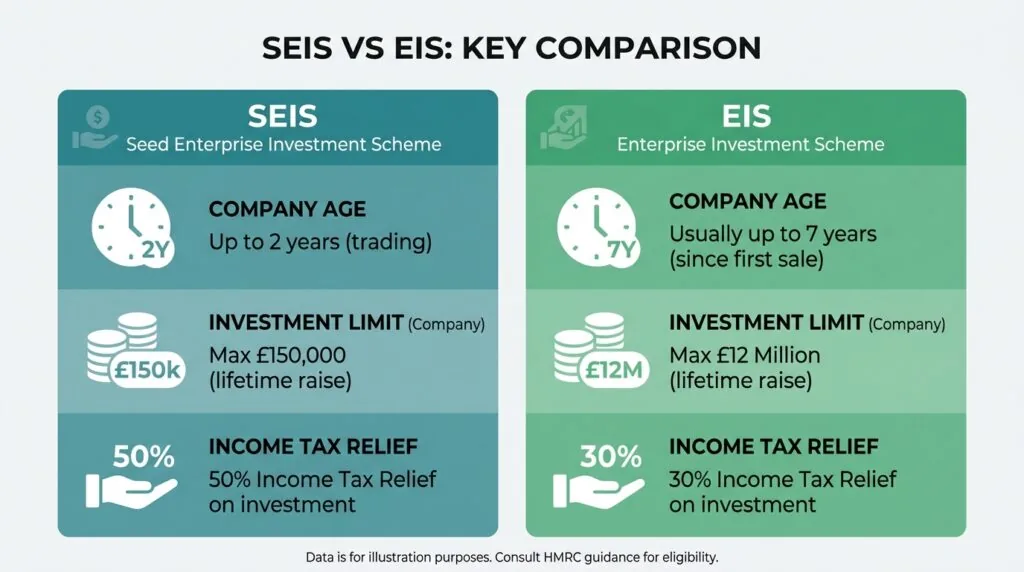
SEIS and EIS are UK government tax relief schemes that reduce an investor’s risk by giving them income tax relief and capital gains exemptions on qualifying startup investments. SEIS is for very early-stage companies — trading for under three years, fewer than 25 employees, and gross assets under £350,000 — and lets a company raise up to £500,000 in total, with investors receiving 50% income tax relief on up to £200,000 invested per year. EIS covers slightly more mature companies (up to seven years old, under 250 employees, gross assets under £30 million) and allows raises of up to £10 million a year, with investors receiving 30% relief on investments up to £1 million (or £2 million where at least £1 million goes into a knowledge-intensive company).
Most guides mention SEIS/EIS in passing. That’s a mistake. Advance Assurance — a letter from HMRC confirming your company is likely to qualify — should be secured before you start pitching, not after. Walking into a meeting with Advance Assurance already in hand does two things: it removes the biggest objection an angel investor has (tax relief uncertainty), and it lets you say something concrete on your Ask slide, such as “this investment qualifies for SEIS Advance Assurance, meaning eligible UK taxpayers can claim 50% income tax relief.” That single sentence de-risks the decision far more than a vague mention of “tax-efficient investment” buried in an appendix.
One important caveat for accuracy: Advance Assurance is not a guarantee. HMRC assesses it based on the information you supply, and final relief depends on the actual share issue and the investor’s own circumstances. Say this plainly in your pitch — investors respect founders who understand the limits of the scheme. If you’re planning to use both schemes, note that SEIS shares must be issued before EIS shares within the same accounting period, so sequencing your raise correctly matters. If you haven’t looked into eligibility yet, it’s worth reading how the SEIS scheme works in full before you apply.
Researching and Targeting the Right Investors
Untargeted pitching wastes everyone’s time. Before you reach out:
- Build a shortlist using Pitchbook or Crunchbase to find investors who’ve backed companies in your sector and stage.
- Check UKBAA’s directory (UK Business Angels Association) for angel networks and syndicates active in your region.
- Get a warm introduction wherever possible — a cold email converts far less often than a referral from a founder or advisor they already trust.
- Confirm SEIS/EIS appetite early. Some funds structurally can’t claim the relief, so it’s not a selling point for every audience.
- Sequence your outreach — pitch to a few less critical investors first to refine your delivery before approaching your top choices.
A solid UK business plan underpins all of this research; it’s the document your pitch deck compresses into 12 slides.
The Anatomy of a Winning UK Pitch Deck (Slide-by-Slide)
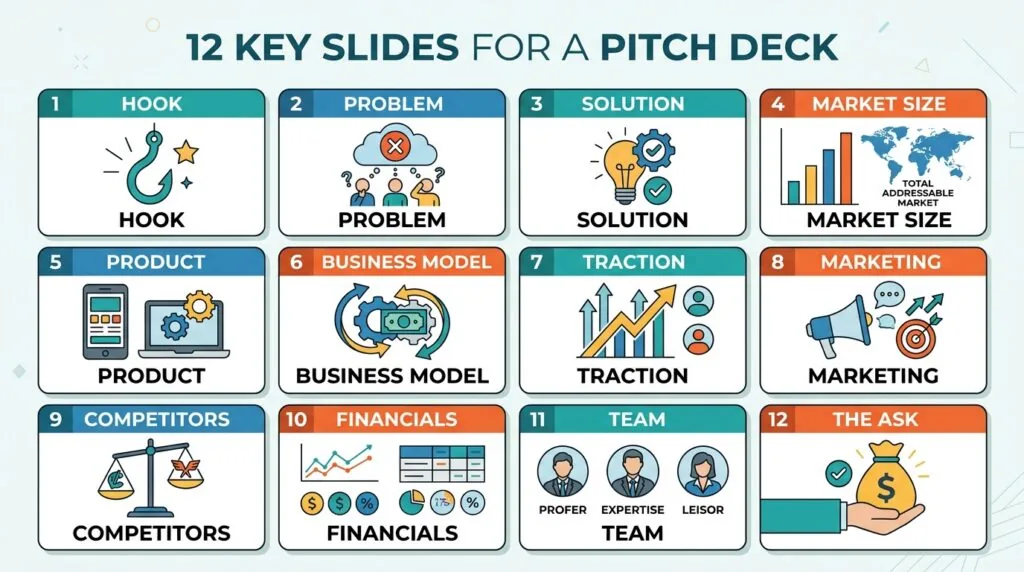
A winning UK investor pitch deck typically runs 10 to 12 slides and takes 15–20 minutes to present, leaving time for questions. Here’s what goes on each one.
- The Hook & Vision — one sentence explaining what you do and why it matters, followed by the size of the change you’re aiming for.
- The Problem — the specific, painful gap in the market, backed by a stat or a short customer story, not a generic industry complaint.
- The Solution — your product’s value proposition in plain terms: what changes for the customer once they use it.
- Market Size & Opportunity — your TAM (Total Addressable Market), SAM (Serviceable Addressable Market), and SOM (Serviceable Obtainable Market), shown as a simple funnel rather than one huge headline number.
- Product or Technology — how it works, what’s defensible (patents, proprietary data, exclusive contracts), and your IP protection status.
- Business Model — exactly how you make money: pricing, unit economics, and revenue streams.
- Traction & Milestones — real proof: revenue, users, pilot results, letters of intent, or waitlist growth. No traction yet? Show validated demand instead — pre-orders, pilot agreements, or committed customers.
- Marketing & Customer Acquisition — your channels, your Customer Acquisition Cost (CAC), and how that compares to customer Lifetime Value (LTV).
- Competitor Analysis — a simple grid showing your unfair advantage, not a dismissive “we have no competitors” claim, which signals poor market research.
- Financial Forecasts & Key Metrics — covered in detail below, since this is where most decks fall short.
- The Team — why you and your co-founders are the right people to execute this, including relevant domain experience or prior exits.
- The Ask — how much you’re raising, what it funds, and your SEIS/EIS position (see above).
The financial slide most decks get wrong
Vague guidance like “include your financials” isn’t useful, and it’s where most competitor guides stop short. UK angels and VCs are checking different things, and knowing which numbers matter to whom changes how you present this slide.
| Metric | What it shows | Why it matters more to |
|---|---|---|
| Burn rate | How much cash you spend per month | Angels — signals discipline with a smaller cheque |
| Runway | Months of cash left at current burn rate | Both — a common opening question in Q&A |
| MRR / run rate | Recurring revenue, annualised | VCs — proof of scalable, repeatable revenue |
| LTV:CAC ratio | Customer lifetime value against acquisition cost | VCs — anything below 3:1 raises concern |
| Gross margin | Revenue left after direct costs | Both — indicates whether the model can scale profitably |
| Pre-money valuation | Company value before this investment | Both — sets the equity percentage on offer |
Present these on one clear slide with a 12–24 month forecast, and be ready to defend every assumption behind them in Q&A. Founders who can’t explain how they arrived at a number lose credibility fast, regardless of how polished the slide looks.
Delivery & Presenting: How to Pitch with Impact
The deck is only half the job. Most guides stop at the slides and barely touch how to actually deliver the pitch in the room, which is exactly where nerves, rambling answers, and weak body language cost founders the deal.
Refining Your Elevator Pitch
Your elevator pitch should run 30–60 seconds and answer three things: what you do, who it’s for, and why now. Practise it until it sounds conversational rather than rehearsed — investors can tell the difference immediately. Cut jargon ruthlessly; if a smart friend outside your industry wouldn’t understand a sentence, rewrite it.
Handling the Q&A Session (The “Make-or-Break” Phase)
Q&A is where most decisions are actually made, not during the slides themselves. A few practical techniques:
- Pause before answering. A two-second pause reads as confidence, not hesitation.
- Answer the question asked, not the question you wish they’d asked. Dodging is obvious and damages trust.
- If you don’t know, say so and commit to a follow-up with the answer — investors respect honesty over a bluffed number.
- Prepare for the hard questions in advance: Why now? What stops a bigger competitor copying this? What happens if your key customer leaves? Rehearse these specifically, since they come up in almost every UK pitch.
- Manage nerves physically — slow your breathing before you start, keep water nearby, and plant your feet rather than pacing, which reads as anxious energy.
One question founders often wonder about beforehand: do you need an NDA before pitching? Generally, no. Most UK angels and VCs won’t sign one before a first meeting — it signals inexperience and slows down deal flow they see dozens of times a week. Protect what genuinely needs protecting (like registered IP) separately, and keep the pitch itself open.
Post-Pitch Protocol: Next Steps and Term Sheets
Most articles stop at the thank-you slide, but what happens next is where deals are actually won or lost. After a positive pitch, expect this general sequence:
- Follow-up email within 24 hours — send your deck, a one-page summary, and answers to any questions you couldn’t fully address live.
- Further meetings or a data room request — investors will want to dig into your numbers, contracts, and cap table in more detail.
- Term sheet — a non-binding document outlining proposed valuation, investment amount, and key terms. Read it carefully; this is where a specialist advisor earns their fee.
- Due diligence — legal, financial, and commercial checks, typically taking two to six weeks depending on deal size.
- Legal completion — shareholder agreements and share issue documents are signed, and funds are transferred.
Set a realistic timeline expectation with yourself: even a fast UK angel round often takes 6–12 weeks from first pitch to funds landing. Don’t let silence after a good meeting spook you into abandoning other conversations — keep multiple investor relationships moving in parallel. Before you get to this stage, it’s worth understanding what a shareholder agreement actually covers, since it will shape how much control you retain.
Common Pitching Mistakes to Avoid
- Overstating market size without a credible SAM/SOM breakdown — investors see through inflated TAM claims immediately.
- Burying the ask at the end without a clear number, use of funds, or valuation.
- No competitor slide, or claiming “we have no competition,” which reads as a lack of research.
- Ignoring burn rate and runway until asked directly in Q&A.
- Ambiguity around SEIS/EIS status — either confirm it clearly or don’t mention it at all.
- Reading slides word-for-word instead of using them as visual support for what you’re saying.
- No follow-up plan after the meeting, leaving investors to chase you instead of the other way round.
Summary Checklist for UK Pitching Success
- SEIS or EIS Advance Assurance secured before outreach begins
- Target investor list built and warm introductions requested
- 10–12 slide deck covering problem through to the ask
- Financial slide with burn rate, runway, MRR, and LTV:CAC ready
- Elevator pitch rehearsed to 30–60 seconds
- Q&A answers prepared for valuation, competition, and “why now”
- Follow-up email and data room ready to send within 24 hours
- Realistic timeline set for term sheet and due diligence stages
Getting the compliance and financial details right early — particularly your SEIS/EIS position and a solid business plan — frees you up to focus on what actually wins the room: a clear, honest, well-rehearsed story about why your business is worth backing now.